Electricity Bill Late Payment Surcharge in Pakistan: 5% or 10%, and How to Dispute It
The electricity late payment surcharge is 5% within 3 days of the due date, then 10%. See how it is worked out, when it is waived and how to dispute it.
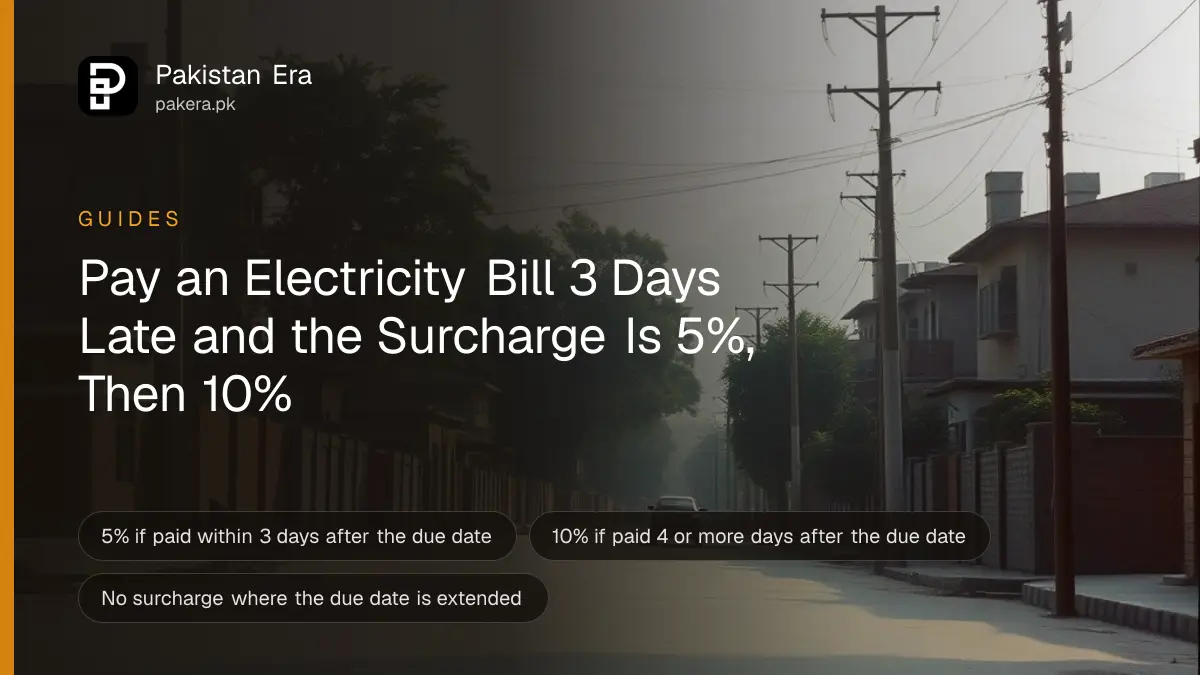
The late payment surcharge (LPS) on an electricity bill in Pakistan is 5% if you pay within 3 days after the due date, and 10% if you pay 4 or more days late. It is worked out on the amount billed, without taxes and duties. Pay by the due date and you pay nothing extra.
That is the rule K-Electric prints on its own FAQ page, where it cites SRO 1035 and says the new structure applies from 1 October 2024. It says NEPRA sets the rates and that they are the same across Pakistan. We read that page, the NEPRA Consumer Service Manual and LESCO's home page on 7 October 2026 for this guide.
A 10% surcharge on a bill of Rs 30,000 is a lot of money for four days of delay. And bills do arrive late. So it helps to know exactly how the surcharge works, when it is not allowed, and how to get a wrong one removed.
The surcharge is 5% for three days, then 10%
K-Electric's FAQ says a 5% surcharge applies if full payment is made within 3 days after the due date, and 10% if it is made 4 days or more after. Both are charged on the amount billed excluding taxes and duties. The new structure is effective from 1 October 2024.
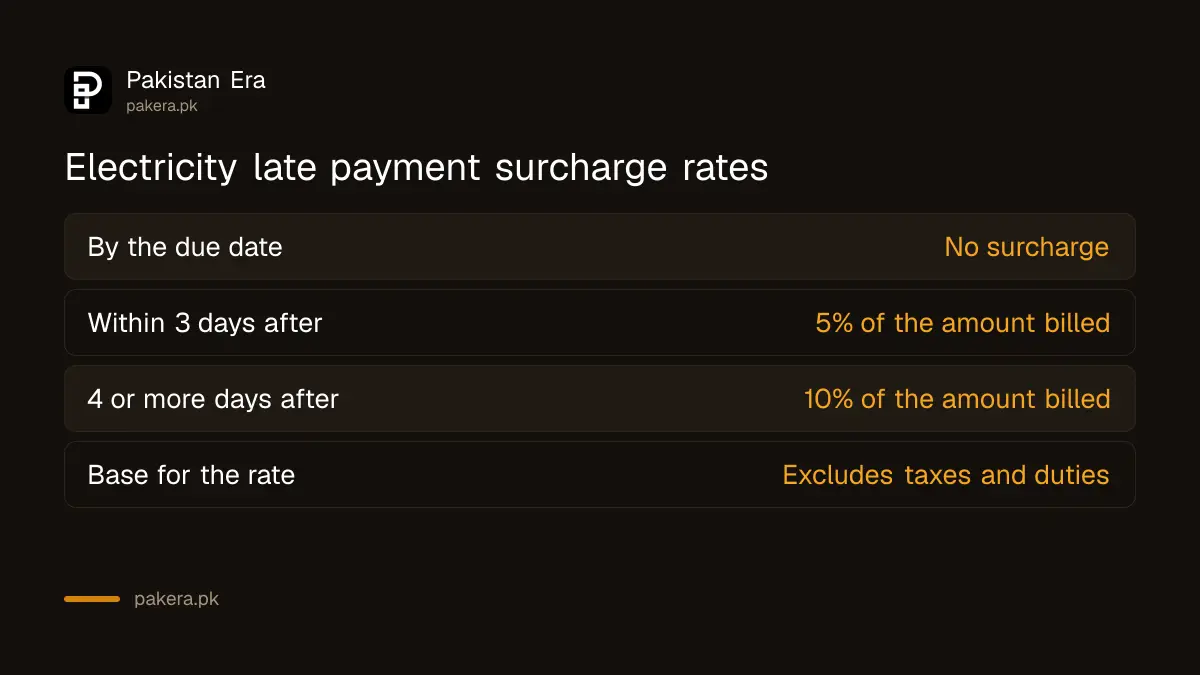
| When you pay | Surcharge |
|---|---|
| On or before the due date | None |
| Within 3 days after the due date | 5% of the amount billed, excluding taxes and duties |
| 4 or more days after the due date | 10% of the amount billed, excluding taxes and duties |
NEPRA's tariff documents for the distribution companies, known as DISCOs, carry the same wording. Those files are scans, and we could not read them in full. So we rely on K-Electric's page for the exact text, and we say that plainly.
The surcharge applies to electricity charges, not the whole bill
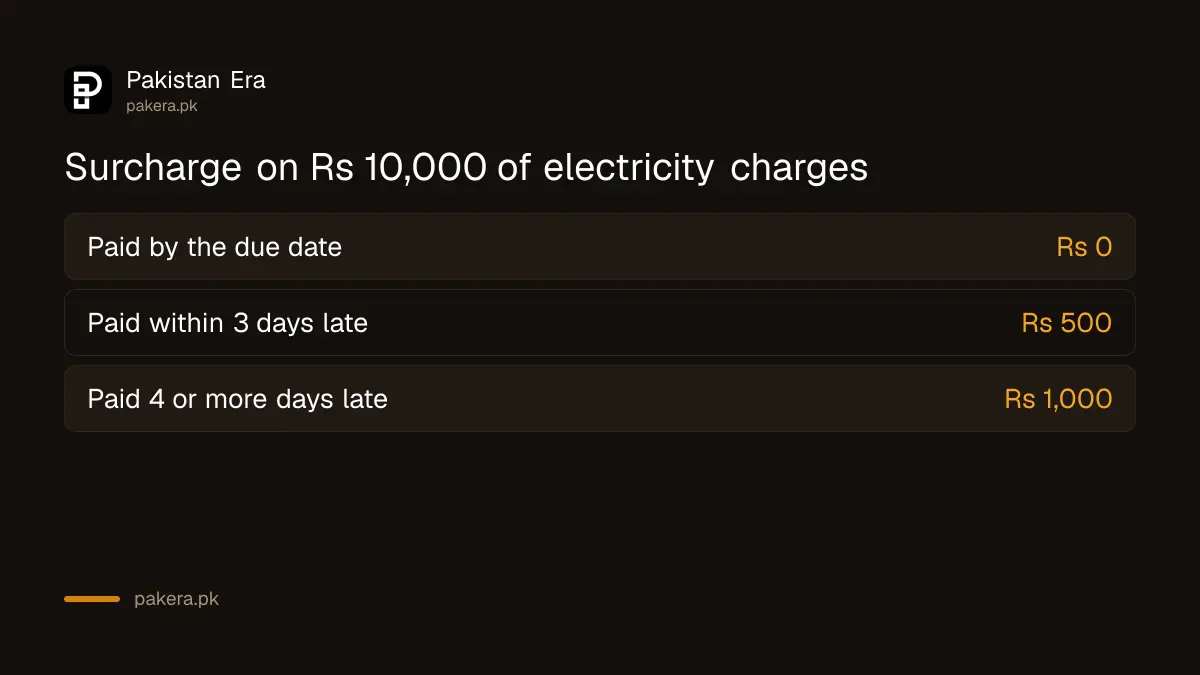
The base for the surcharge is the amount billed excluding taxes and duties. K-Electric gives its own example. On Rs 10,000 of current electricity charges, paying within 3 days late adds Rs 500, and paying after 3 days adds Rs 1,000.
Your bill may show several lines, such as fuel adjustments, general sales tax and duty. Our explainer on electricity bill line items lists what each one is. The bill also prints the "amount payable after due date", which is the total with the surcharge already added. Check that figure against the sum above.
We cannot tell you from the manual exactly which lines count as "taxes and duties" on every DISCO bill. If your surcharge looks higher than 10% of the electricity charges, ask the revenue office to show its working.
Your due date is 15 days from issue, and you get 7 clear days
NEPRA's Consumer Service Manual sets the due date within 15 days from the issue date of the bill. It also says the consumer gets 7 clear days from the date the bill is actually delivered. A bill that reaches you late should not cost you the surcharge for that reason.
The manual also says the bill must be available on the DISCO's website for download and payment. So a missing paper bill is not a reason to skip the due date. Use the online bill check with your reference number.
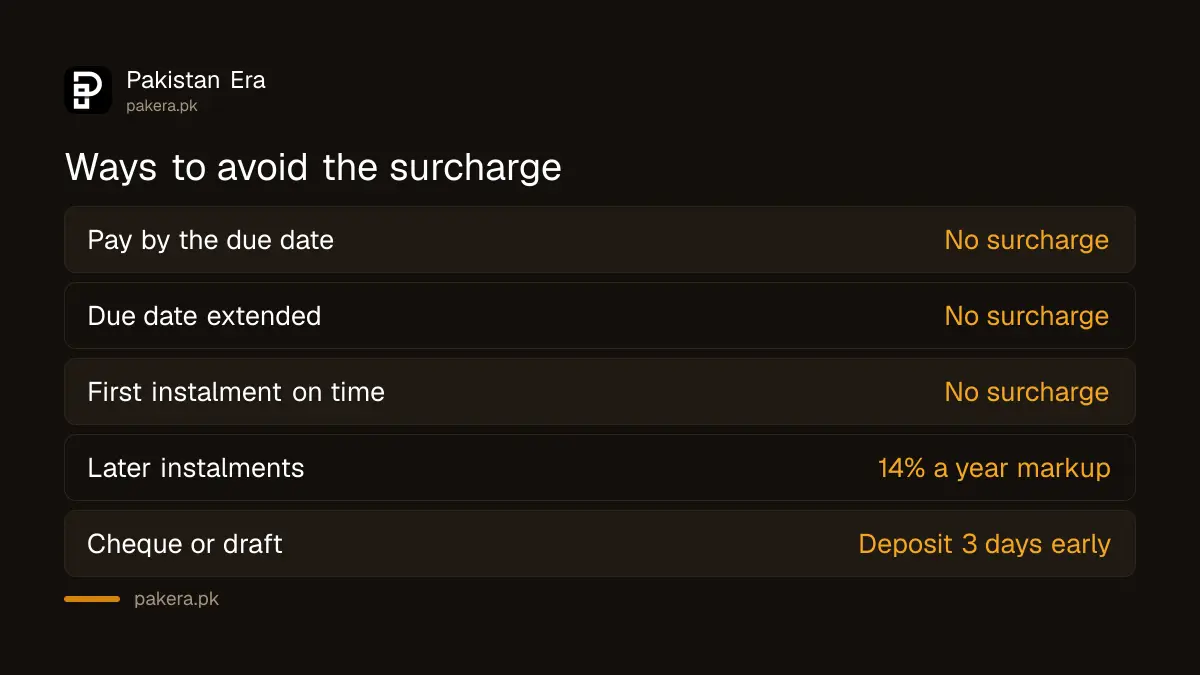
If you pay by cheque, pay order or bank draft at a revenue office, the manual in force since 2021 says to deposit it at least 3 days before the due date. That gives it time to clear within the due date. We read that clause in the January 2021 edition, which has a searchable text layer. NEPRA's 2025 revision is a scan, and we could not search it.
No surcharge applies if the due date is extended or you pay by instalments
The 2025 manual says no surcharge is imposed where the due date is extended. It also says that if you ask to split the current month's bill, the first instalment carries no surcharge when paid by the due date. The later instalments carry markup at 14% a year. All of this is at the DISCO's discretion, not your right.
To ask, go to the sub-division office named on your bill before the due date. The full steps, with the officer limits, are in our walk through of bill instalments for electricity and gas. The point that matters here is timing. Ask before the due date, not after you have been charged.
In our view this is the most underused rule. Many people pay late because the bill is large, then pay a 10% penalty on top. A written request a few days early costs nothing.
How to dispute a wrong surcharge
The manual lists "wrong application of LPS" as a billing complaint. Its examples are a late bank scroll or a lost scroll, which is the bank's record of payments sent to the DISCO. The 2021 manual says the DISCO should deal with it within 3 days of the complaint. It gives the same 3 days for adjustments such as an extension of the due date or a waiver of the surcharge.
- Keep proof of payment: the bank slip, the app receipt or the transaction number, with the date and time.
- Compare the payment date with the due date printed on your bill.
- Take the bill, your CNIC and the proof to the sub-division office or consumer service centre. Complaints about billing are registered there, and you should get a date for the reply.
- Or call the helpline. LESCO's home page lists the hotline 118 and SMS 8118, and a complaints portal called CCMS+.
- If the DISCO does not fix it, take it up with NEPRA. Our NEPRA complaint steps explain the order of escalation.
Argue the dates, not the total. A complaint that says "I paid on 12 October, the due date was 14 October" is checkable. One that says "my bill is too high" invites a long reply about tariffs.
Unpaid bills can lead to disconnection
The manual says one month's unpaid bill alone does not lead to disconnection, if there are no earlier dues. If the previous month is also unpaid, the DISCO issues a notice of seven clear days with the second bill. After the second bill's due date, supply can be cut. It is restored after full payment with the surcharge, or on instalments the DISCO allows.
If you have already been cut, see how to reconnect electricity after disconnection. Paying early is much cheaper than paying a surcharge and a reconnection delay.
Common questions
What is the late payment surcharge on an electricity bill in Pakistan?
It is 5% of the amount billed if you pay within 3 days after the due date, and 10% if you pay later. Taxes and duties are left out of the base. K-Electric states the rates apply from 1 October 2024.
Is the surcharge the same for every DISCO?
K-Electric says NEPRA determines the rates and that they are uniform across Pakistan. We read that on K-Electric's page. We could not find a separate surcharge table on LESCO's home page.
Can I get the late payment surcharge waived?
Only in some cases. The manual says no surcharge applies where the due date is extended, and a wrong surcharge can be corrected. Whether a waiver is granted is the DISCO's decision. Apply in writing at the sub-division office.
What if my bill reached me after the due date?
The manual gives you 7 clear days from the day the bill is actually delivered. Tell the sub-division office the delivery date and ask for the surcharge to be removed.
How long does the DISCO have to fix a wrong surcharge?
The 2021 manual says 3 days from the complaint for wrong application of the surcharge. We could not confirm that the 2025 revision repeats this, because it is a scan we could not search.
Can I pay my bill online after the due date?
Yes at K-Electric. Its FAQ says online payment is available after the due date, with the surcharge added. Other DISCOs differ, so check your own company.
How we verified this
What we checked, where we read it, and what we could not confirm.
Last checked 7 October 2026. We read K-Electric's customer FAQs for the surcharge rates, the SRO reference and the example. We read NEPRA's Consumer Service Manual, the January 2021 edition with a text layer for the payment, complaint and disconnection clauses, and the 2025 revision for the instalment clause. We read LESCO's home page for the helpline. We did not pay a bill late or file a complaint ourselves. Rates and rules can change, so check your latest bill and your DISCO's website.
About the author

Tax, Bills and Technology Writer
Ali Akhtar is a young and curious voice here at Pakistan Era. He is currently pursuing his A-Levels and has a growing interest in Pakistan’s changing industrial landscape and educational trends. Ali likes to write in a way that helps him explain and explore the world around him. His writing reflects the perspective of the new generation navigating the evolving trends of Pakistan where technology, youth innovation, and shifting opportunities are reshaping the country’s future.