Electricity Detection Bill Rules in Pakistan: PITC Portal Only, Manual Bills Banned, New Limits
Detection bills in Pakistan must now come only from the PITC portal, and manual bills are banned. See the proposed 6 and 12 month caps and what to do.
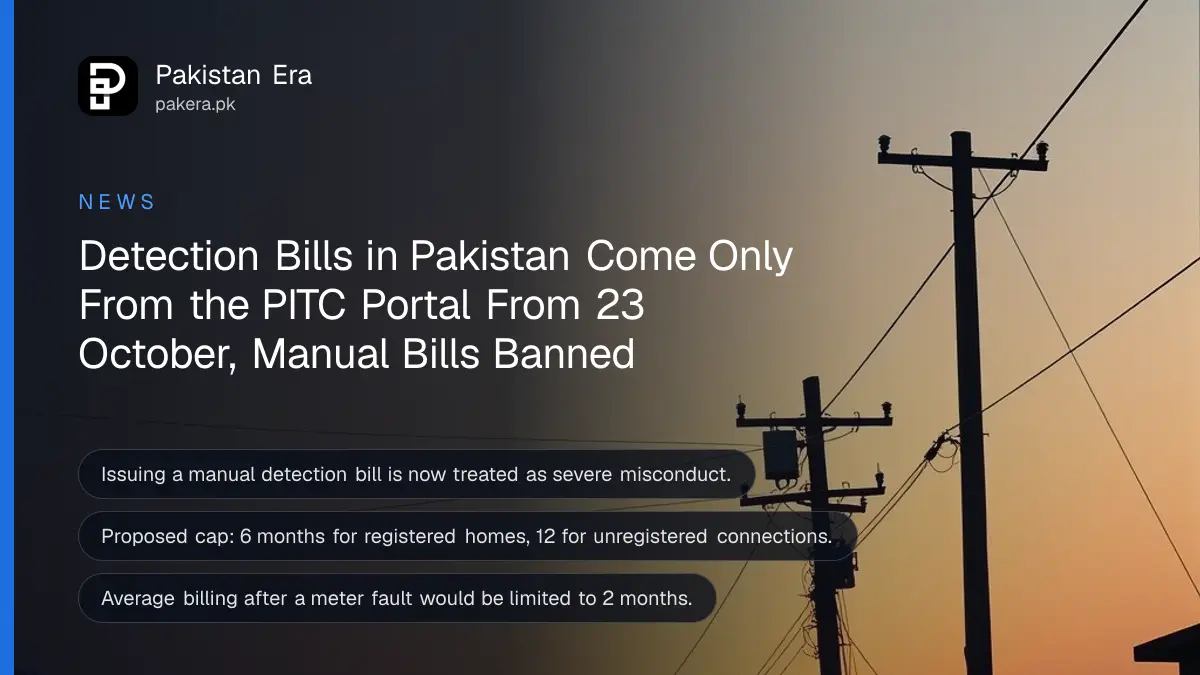
Short answer: From 23 October 2026, every electricity company in Pakistan must issue detection bills only through a central online portal built by PITC, the power sector's IT company. Handwritten or manual detection bills by field staff or SDOs are banned, and issuing one is now treated as serious misconduct.
The Power Division announced this on 23 October after Energy Minister Awais Leghari met the boards of the distribution companies (DISCOs), such as LESCO, IESCO, MEPCO and PESCO. A detection bill is the extra charge a company raises when it says electricity was used without being properly metered. We read the government's press release in full. Below is what is already in force, what is only proposed, and what to do if a detection bill lands on your door this month.
Detection bills now come only from the PITC portal
The Power Division is requiring all DISCOs to issue detection bills only through the centralised online portal developed by the Power Information Technology Company (PITC). A complete ban applies to manual and discretionary detection bills raised by field staff or sub-divisional officers.
The press release says issuing a manual bill will be treated as "severe misconduct", open to disciplinary action and major penalties against the officials responsible. That is the part that has changed now. The press release presents it as a directive to the companies, not as a proposal waiting for approval.
The minister also said fighting electricity theft remains a national priority, and honest officers should not be blocked from doing their work. So detection bills are not going away. What changes is how they are raised and who can see them. Every bill on one central system is easier to audit than a slip written in a sub-division office.
Four new time limits are proposed, not yet in force
The Power Division says it will send amendments to NEPRA's Consumer Service Manual "in the coming days". Until NEPRA approves them, these limits are proposals. They cover meter replacement, average billing, slow or fast meters and how far back a detection bill can reach.
| Problem | Proposed limit | Status on 24 October |
|---|---|---|
| Defective or burnt meter | Replaced at once, or within 2 billing cycles at most | Proposed |
| Average billing while the meter is out | 2 months at most | Proposed |
| Meter found slow or fast | Recovery or credit only for the 2 previous billing cycles | Proposed |
| Detection for theft by a general consumer | 3 billing cycles | Proposed |
| Maximum detection period | 6 months for registered consumers, 12 months for unregistered connections | Proposed |
| Detection bills only through the PITC portal | Manual bills banned | Ordered by the Power Division |
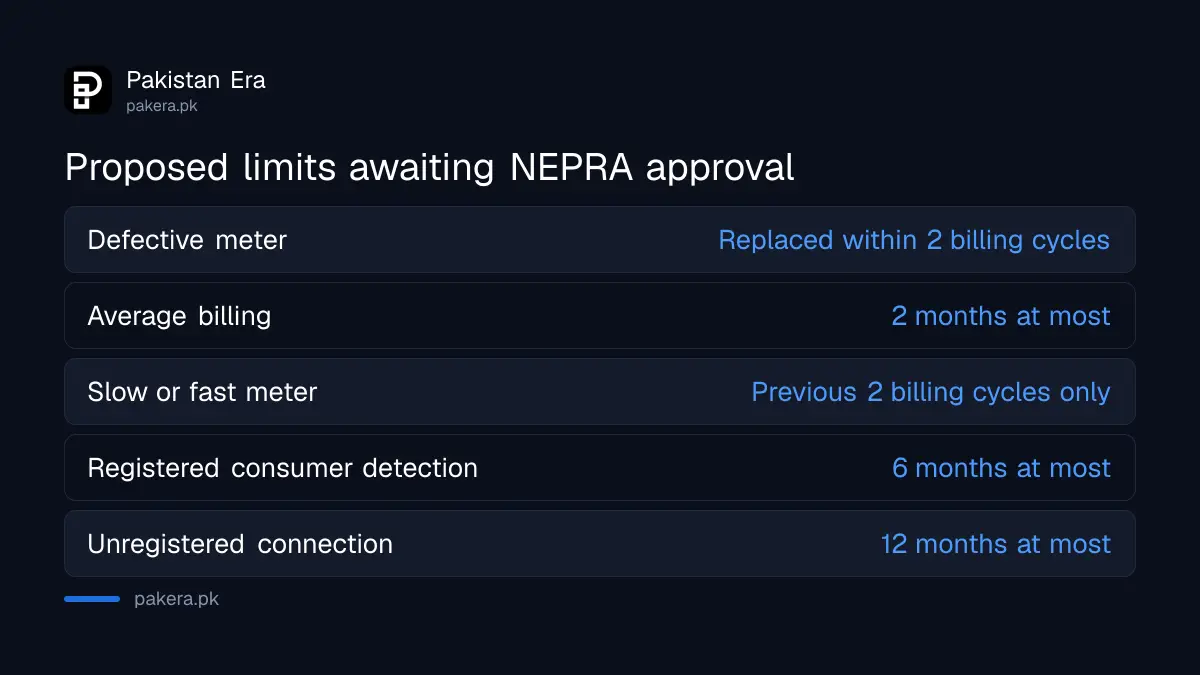
The two billing cycle rule for a defective meter already sits in the current manual as a complaint deadline, as our report on electricity bill complaint deadlines shows. The new part is the cap on average billing and on back charges for a slow or fast meter. Those would stop the large arrears bills many people receive months after a meter fault.
Company boards must now review detection bills every month
The boards of directors of every DISCO and their customer services committees have been told to review detection bills monthly. They are to check that each bill is accurate, transparent and recovered properly. This gives a consumer with a wrong bill one more place where it can be caught.
This matters because, until now, most disputed detection bills were fought one by one at the sub-division or the company's complaint cell. A monthly board review does not replace your own complaint. But a bill that never went through the portal should now stand out in that review, and the officer who issued it faces action.
NEPRA had already proposed its own changes to the detection rules in September, which we covered when it asked for comments on six-month detection bills for tampered home meters. The Power Division's list now sets six months as the ceiling for registered consumers, not the starting point. Which wording NEPRA finally adopts is still open.
What to do if you get a detection bill now
Do not ignore it, and do not pay a large detection charge without asking how it was worked out. Ask the company in writing whether the bill was issued through the PITC portal, which months it covers and which method it used. Then complain within the time the manual allows.
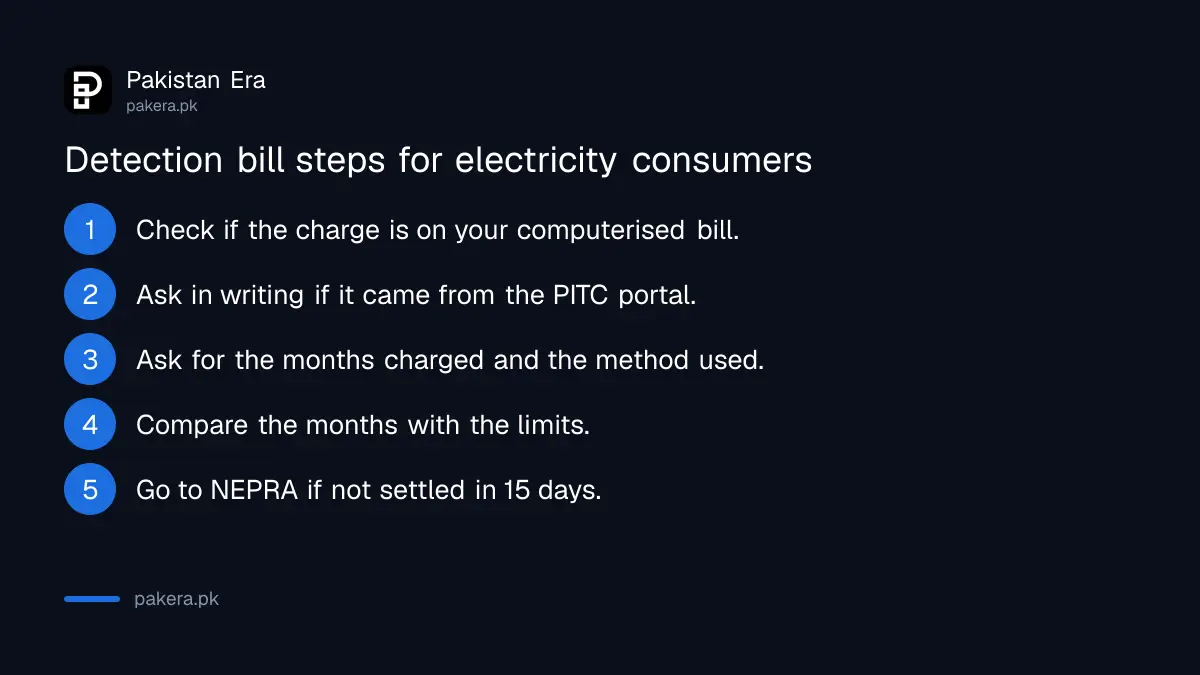
- Check whether the detection charge is printed on your regular computerised bill or given to you as a separate slip.
- Write to your sub-division or the company's customer service centre and ask whether the bill was issued through the PITC portal. Keep a dated copy.
- Ask for the number of months charged and the calculation method used.
- Compare the months with the limits in force and those now proposed. A bill reaching back more than six months for a registered home is worth challenging.
- If the company does not settle your complaint within 15 days, take it to NEPRA.
The full method for challenging the charge is set out in how to dispute an electricity detection bill. If your meter is burnt or not working, ask for a replacement in writing at once and see the steps for a faulty electricity meter replacement. Pay any undisputed part of your normal bill on time, so a late payment surcharge does not add to the problem.
Who this covers, and what it does not change
The order covers the government owned distribution companies that report to the Power Division, such as LESCO, IESCO, FESCO, GEPCO, MEPCO, PESCO, HESCO, SEPCO, QESCO and TESCO. The press release does not mention K-Electric, which is privately owned and supplies Karachi.
It also does not cancel any detection bill already issued. The release says nothing about bills raised before 23 October. If you already have a manual detection bill, use the complaint route above and ask for it to be reviewed under the new rules. We could not find a public link to the PITC detection portal, so consumers cannot check it themselves yet.
Common questions about detection bills
What is a detection bill?
It is an extra charge a power company raises when it believes electricity was used without being properly metered, for example through a tampered meter or a direct hook.
Can an SDO still issue a manual detection bill?
No. From 23 October 2026 the Power Division has banned manual and discretionary detection bills. They must come through the PITC portal.
How many months can a detection bill cover?
The Power Division proposes six months at most for registered consumers and twelve for unregistered connections. These limits need NEPRA's approval before they apply.
How long can average billing last after a meter fault?
The proposal limits it to two months, with the meter replaced within two billing cycles. That too awaits NEPRA's approval.
Does this apply to K-Electric?
The press release names the DISCOs and their boards. It does not mention K-Electric, so we cannot say it applies in Karachi.
Where do I complain if the company does not fix my detection bill?
Complain first to your company. If it does not settle the matter within 15 days, take the complaint to NEPRA.
How we verified this
What we checked, where we read it, and what we could not confirm.
Last checked 24 October 2026. The portal rule, the ban on manual bills, the misconduct wording, the proposed time limits and the monthly board reviews come from the Press Information Department's press release PR No. 357 of 23 October 2026, which we read in full. The 15 day complaint deadline and the two billing cycle meter rule come from NEPRA's Consumer Service Manual as read for our earlier report. We could not find the PITC portal's public address, the text of the amendments sent to NEPRA, or any word on whether bills issued before 23 October will be reviewed.
About the author

Public Services and Education Journalist
Fajr Riaz is a journalist and content writer at Pakistan Era, based in Lahore. She covers the questions people meet in everyday life in Pakistan: how a public service works, what a change in the rules means, and where to find a reliable answer.