How to End Your Liability as a Joint Borrower on a Bank Loan in Pakistan
A joint borrower owes the full loan, but SBP guidelines let you end liability for renewals and new advances by written notice. See the five steps and limits.
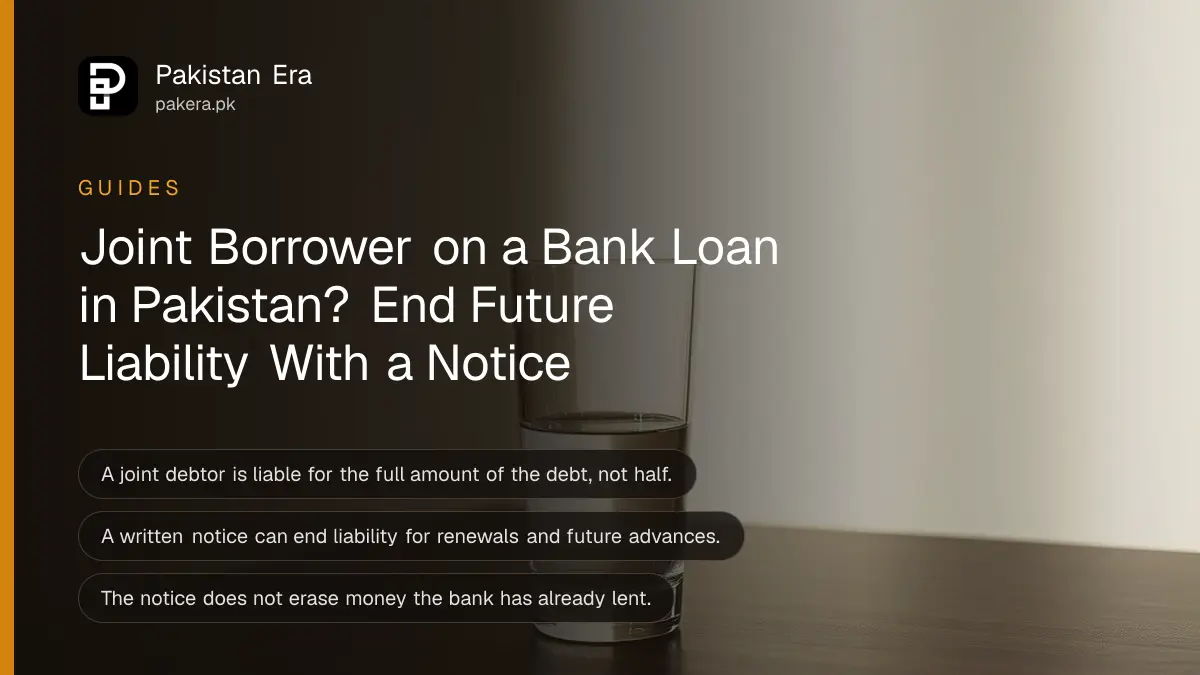
If you signed as a joint borrower on a bank loan in Pakistan, you owe the whole amount, not half. SBP's conduct guidelines let a joint debtor end their liability for renewals and future advances by giving the bank written notice. That does not cancel debt already taken. Send the notice, get a stamped copy, and ask the bank to confirm in writing.
A brother asks you to sign his business loan form. A friend needs a second name on a car finance file. You sign, and the bank treats both names as one borrower. We read the State Bank of Pakistan's (SBP) Guidelines of Business Conduct for Banks on 15 October 2026. The version on SBP's site cites circulars up to 2015, and we found no newer replacement.
A joint debtor is liable for the full amount of the debt
SBP defines joint debtors as two or more people who are given credit based on their combined incomes, assets and credit histories, and who accept joint responsibility for repaying it. Section 4.11.1(b) says the bank must make sure each one understands they are liable for the full amount.
That is different from sharing the debt in half. If the main borrower stops paying, the bank may ask you for everything that is overdue. The guidelines also say the bank must check your identity and your relation to the customer before it accepts you as a co-debtor.
You can end your liability for renewals and future advances with a written notice
Section 4.11.1(c) says a joint debtor who is jointly and severally liable under a credit facility can end liability for renewals and future advances by giving the bank written notice. The right applies where the bank can stop its duty to give more credit to the other debtor.
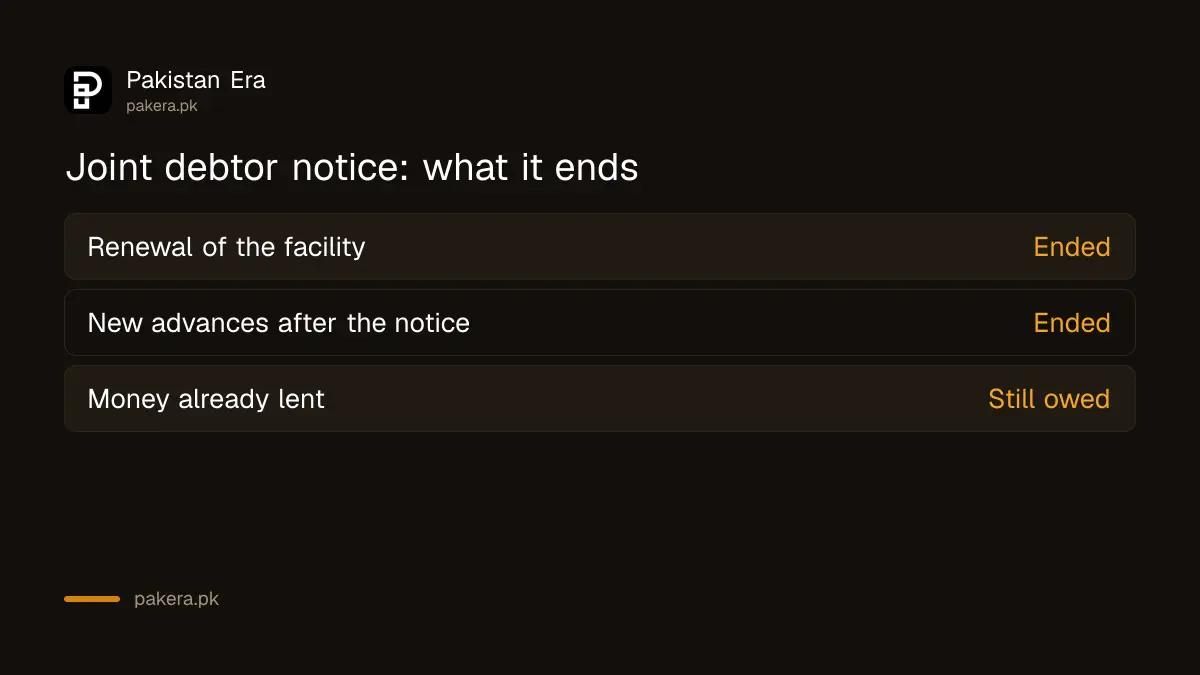
Read the limit carefully. The notice ends what comes after it, such as a renewal of a running finance line or a new draw-down. It does not erase an amount already lent. For that, the loan must be repaid, settled or taken over by someone else.
| Item | Does your notice end it? |
|---|---|
| Renewal of the facility | Yes, for your liability |
| New advances or draw-downs after the notice | Yes, for your liability |
| Amount already lent before the notice | No, you are still liable |
| A facility where the bank cannot stop further credit to the other debtor | The right may not apply |
Send the notice in five steps
The guidelines require written notice, but do not give a form or a deadline. Treat it like any important letter: short, dated, and delivered in a way you can prove. Do it before the next renewal date, not after.
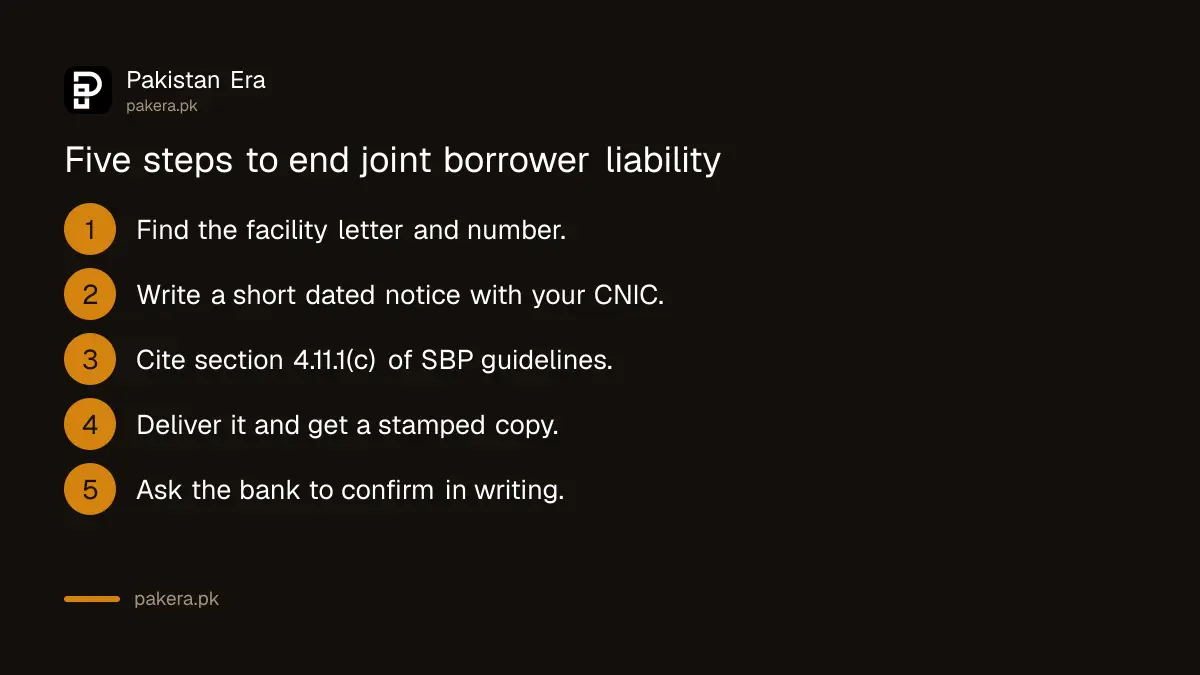
- Find the facility letter and note the account or facility number.
- Write a short notice with your name, CNIC, the facility number and the date.
- State that you end your liability for renewals and future advances under section 4.11.1(c) of SBP's guidelines.
- Deliver it to the branch by hand and ask for a stamped, signed copy.
- Ask the bank to confirm in writing how it will treat the other debtor's facility.
Keep the stamped copy where you keep your CNIC photocopies. If the branch refuses to accept it, send the same letter by courier or registered post and keep the receipt. A refusal to take your letter is itself something you can put in a complaint.
The bank must still follow collection rules if the other borrower stops paying
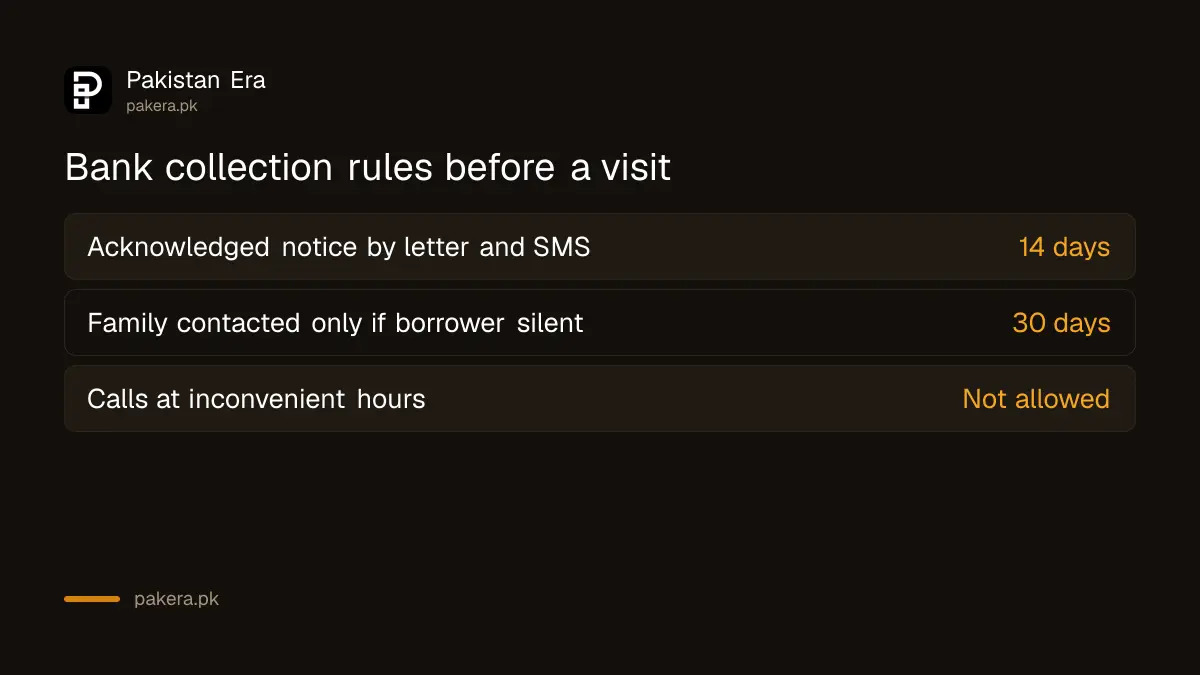
Section 4.14.1 says that before the bank goes to collect, it must send a minimum of 14 days' acknowledged notice to the customer by letter and SMS. It must not contact people at an inconvenient time and must not harass family members.
If the borrower cannot be reached for 30 days after the first missed payment, the bank may ask family, friends or third parties for information. As a joint debtor you may be contacted first. Ask the staff to state their name, the bank and the reason for the call, as the guidelines require.
A guarantor has a different right from a joint debtor
A guarantor, in section 4.12, may withdraw from the guarantee at any time before the credit is provided, by acknowledged written notice or email. A joint debtor's right in section 4.11 is different and covers renewals and future advances.
So check which role you signed. The loan paper may call you a co-borrower, joint debtor, guarantor or surety. If the paper is unclear, ask the branch in writing which of these roles you hold, and send a copy of the question to the bank's complaint unit.
Complain if the bank ignores your notice
SBP's complaints portal sets the order: complain to the bank's own complaint management unit first. If it does not reply within 45 days, or you are unhappy with the outcome, you can go to the Banking Mohtasib Pakistan.
Both routes are explained in the guide to the Banking Mohtasib complaint and the page on SBP's Sunwai portal. For other loan choices, the table of personal loans from Pakistani banks shows the usual terms.
Common questions about joint borrowers in Pakistan
Can I leave a joint loan after I sign?
You can end liability for renewals and future advances by written notice. You cannot walk away from the amount already lent.
Is a joint debtor the same as a guarantor?
No. A joint debtor is a borrower who shares the full liability. A guarantor promises to pay if the borrower does not. SBP gives each a separate right in sections 4.11 and 4.12.
Does my notice stop the other borrower's loan?
Not by itself. Your notice ends your own liability. Whether the bank continues credit to the other debtor is for the bank to decide, so ask in writing.
Do I need a lawyer to write the notice?
The guidelines do not require one. A short dated letter with the facility number is enough to start. For a large facility, a lawyer's check is cheap protection.
What if the bank refuses to accept the notice?
Send it by courier or registered post and keep the receipt. Then complain to the bank's complaint unit and, after 45 days, to the Banking Mohtasib.
Are SBP's guidelines binding on my bank?
They are SBP's conduct standard for banks. We did not check each bank's own policy, and your loan agreement may add terms.
How we verified this
What we checked, where we read it, and what we could not confirm.
Last checked 15 October 2026. Sections 4.11, 4.12 and 4.14 and the definition of joint debtors come from SBP's Guidelines of Business Conduct for Banks. The complaint order comes from the FAQ of SBP's Sunwai portal. We did not send a notice to a bank to test the response. This page explains the guidelines and is not legal advice.
About the author

Senior Writer, Public Services and Technology
Shahid joined us in 2024 as an author. He is a senior contributor to Pakistan's leading technology websites. He writes detailed articles, mostly covering his expertise in the latest tech, mobiles, apps, gadgets, and step-by-step guides. His ideology is to help people understand the latest trends and explain complex methods through very easy-to-understand guides.