How to Evict a Tenant in Islamabad: 6 Grounds Under Section 17 and the Rent Controller Route
Islamabad landlords can evict only through the Rent Controller on six grounds in section 17, from rent 15 days late to own use. See the steps and time limits.
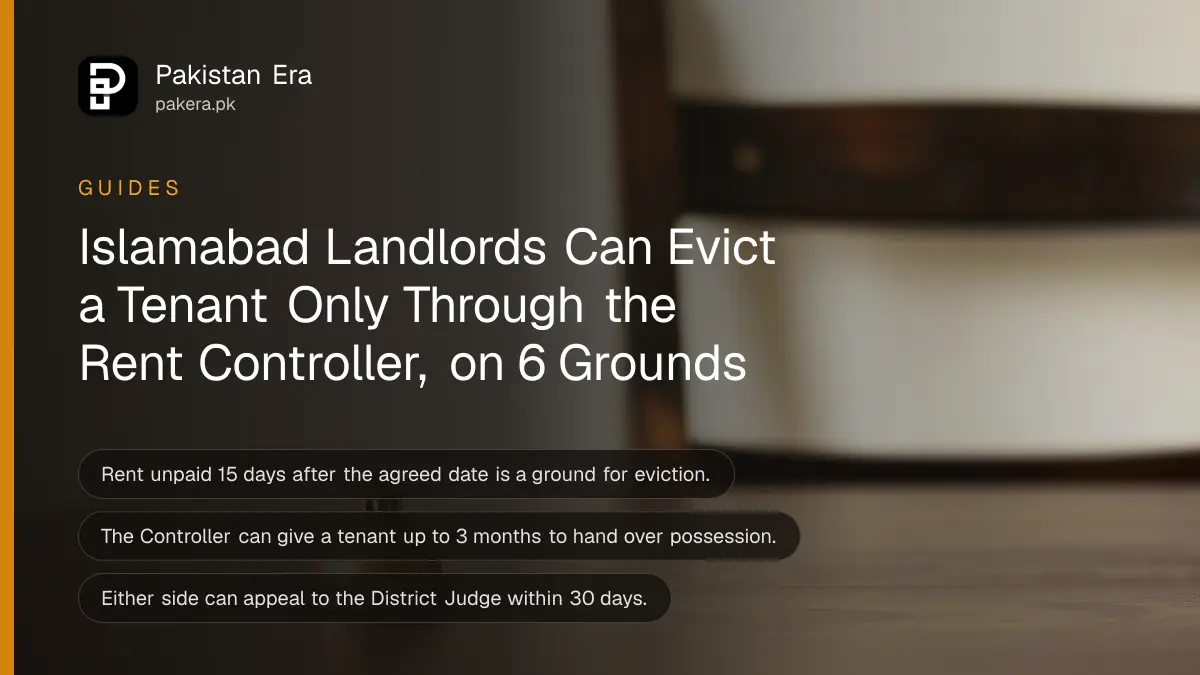
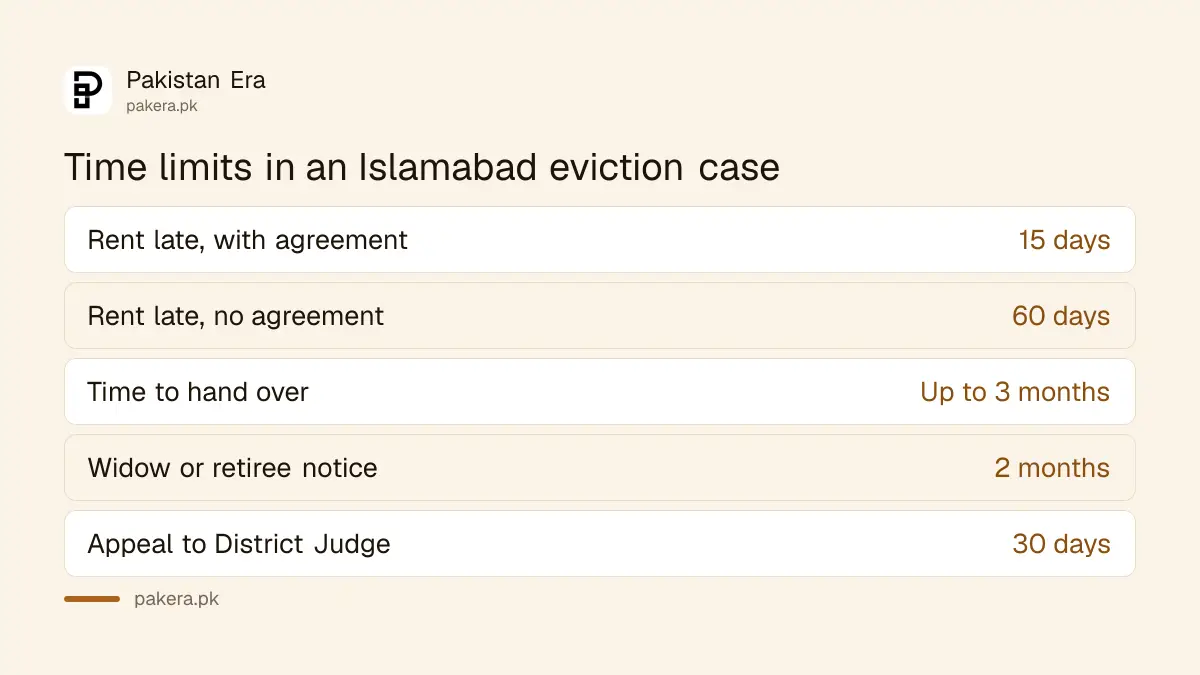
Short answer: A landlord in Islamabad can evict a tenant only through the Rent Controller, under section 17 of the Islamabad Rent Restriction Ordinance, 2001. The main grounds are unpaid rent after 15 days, subletting without written consent, damage, nuisance, rebuilding and the landlord's own need. The Controller can give the tenant up to 3 months to leave.
Changing the locks or cutting the power is not one of those grounds. We read the full Ordinance on the Pakistan Code, the federal government's law portal, on 20 October 2026. Section 17(1) says a tenant in possession "shall not be evicted" except under that section. So the route below is the only legal one for most houses, flats, shops and rented plots in the notified urban areas of Islamabad.
Only the Rent Controller can order an Islamabad tenant out
An Islamabad landlord must apply to the Rent Controller, a judicial officer appointed by the federal government, and the tenant must get a fair chance to answer. The Controller then orders the tenant out or rejects the application. No police station or society office can do this.
The Ordinance covers the urban areas the federal government notifies. The Pakistan Code copy points to SRO 83(KE)/02 of 19 July 2002 for those areas, which we could not open. If your property sits in a rural village of Islamabad Capital Territory, ask the Controller's office whether the Ordinance applies before you file.
The written agreement matters a lot here, because the rent date, the term and the purpose of the letting come from it. An Islamabad tenancy agreement made at the start saves months later.
Section 17 lists six grounds for eviction in Islamabad
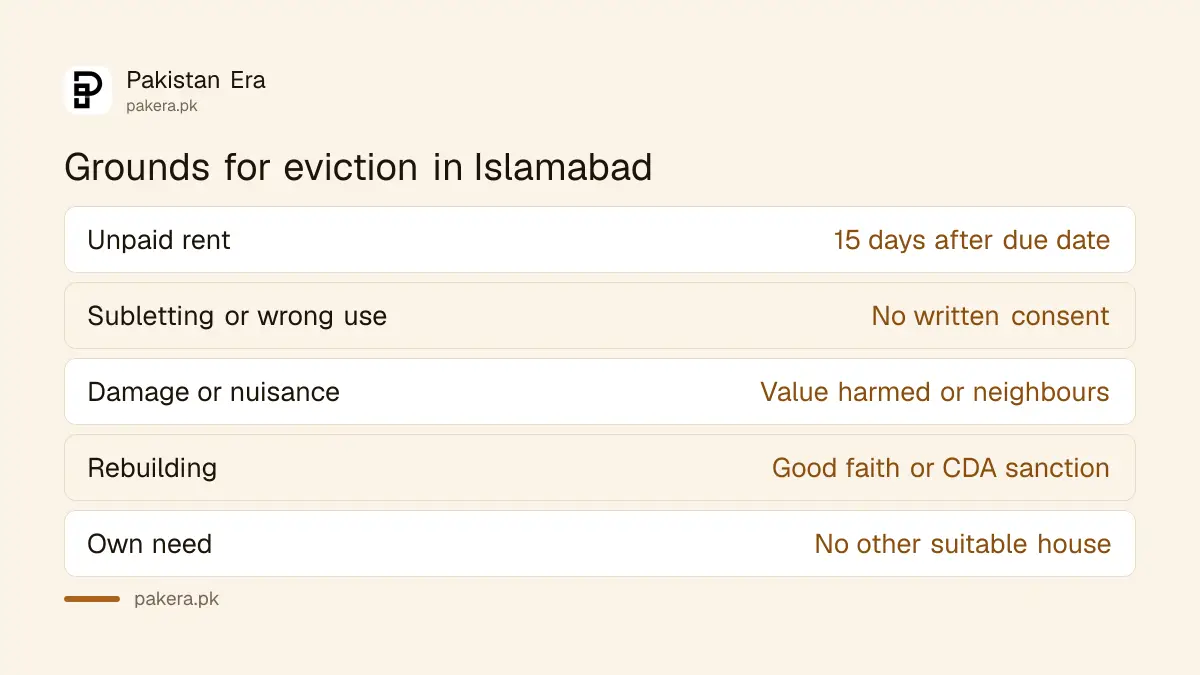
Section 17(2) gives five grounds tied to the tenant's conduct or rebuilding, and section 17(4) adds the landlord's own good faith need. The landlord must prove at least one of them. If none is proved, section 17(3) says the Controller must reject the application.
| Ground | What the landlord must show | Section |
|---|---|---|
| Unpaid rent | Rent not paid or tendered within 15 days after the date in the agreement, or within 60 days if there is no agreement | 17(2)(i) |
| Subletting or wrong use | Tenant sublet or transferred the place, or used it for another purpose, without written consent | 17(2)(ii) |
| Damage | Acts likely to materially impair the value or use of the building | 17(2)(iii) |
| Nuisance | Activities causing nuisance to the neighbours | 17(2)(iv) |
| Rebuilding | Building needed in good faith for reconstruction, or CDA sanction obtained | 17(2)(v) |
| Own need | Landlord or family needs it in good faith and has no other suitable house in the area | 17(4) |
Two details catch people out. Unpaid water, gas or electricity charges count as rent when the tenant pays them to the landlord. And rent sent by money order, or deposited in the Controller's office, counts as paid. A tenant whose landlord refuses rent should deposit it, not stop paying.
The own need ground has a limit. Where the tenancy is for a fixed period, the landlord cannot apply under section 17(4) before that period ends.
An expired tenancy is not yet a written ground in section 17
Section 6 says no tenancy is valid beyond the period the parties agreed, but section 17 does not list expiry as a ground. A Senate-passed bill would add it as a seventh ground, and it was on the National Assembly's agenda on 20 October 2026.
Section 6 also says a tenancy with no fixed period ends 6 months after the tenant receives the landlord's written notice. The bill, the Islamabad Rent Restriction (Amendment) Bill, 2025, adds a new clause (vi): the tenancy period "has expired and has not been extended by the parties". Its statement of objects says the Supreme Court settled this point in 2018, and the bill writes it into the text. Until the bill completes every stage, the current wording stays in force. We follow its progress in the report on the rent bill in the National Assembly.
Filing an eviction case in Islamabad takes five steps
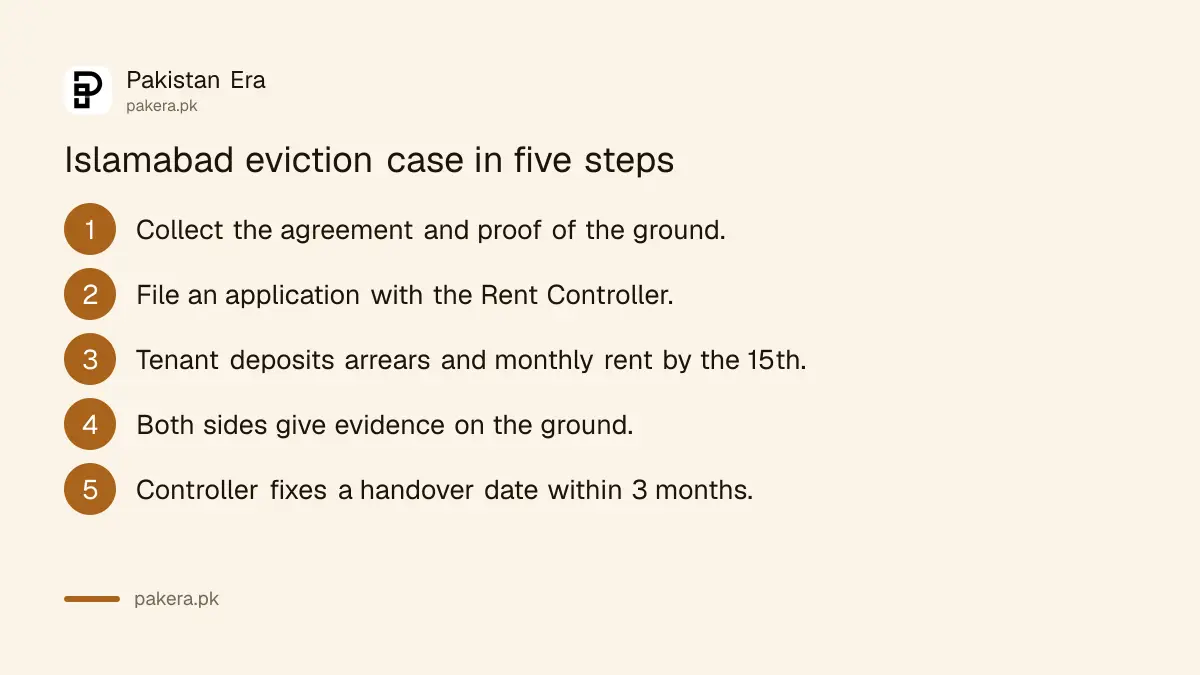
You apply in writing to the Rent Controller, attach the agreement and proof of the ground, and the tenant is summoned. On the first hearing the Controller orders the tenant to deposit all rent due, and then rent by the 15th of each month.
- Collect the tenancy agreement, rent receipts or bank transfers, and proof of the ground, such as photos of damage or a CDA sanction letter.
- File a written eviction application before the Rent Controller for the area. A lawyer usually drafts it.
- Attend the first hearing. The Controller fixes the arrears and orders the tenant to deposit them, then monthly rent before the 15th.
- Give evidence on your ground. The tenant gets a reasonable chance to show cause against the application.
- If you win, the Controller fixes a date to hand over possession, with no more than 3 months in total.
Section 17(9) is the strongest tool in the Ordinance. If the tenant misses the deposit date, the tenant's defence is struck off and the landlord is put in possession "without any further proceedings". Many cases end at that point.
Widows, retiring employees and orphans get a faster notice route
Section 18 lets a widow, a minor child of a dead landlord, or a salaried landlord near retirement give the tenant of a house 2 months' written notice to leave. The landlord must act within one year of the death or retirement.
The same right covers the wife, husband or minor child of such a salaried employee. It applies to one residential building only. A retiring owner who lives in his own house in the same locality must offer that house in exchange before seeking the tenant's house. This route suits a family that suddenly needs its home back.
An eviction order can be appealed within 30 days
Either side can appeal a final order of the Controller to the District Judge within 30 days, under section 21. The appeal court can suspend the order and can also make the tenant keep depositing rent, or strike out the defence.
The law also protects the tenant against a fake need. If a landlord who took the house for own use does not move in within one month, or lets it to someone else within 6 months, the old tenant can ask the Controller to restore possession under section 17(6). A landlord who took a building to rebuild and does not demolish it within 4 months faces up to 6 months in jail, a fine or both.
For landlords outside Islamabad, the rules differ by province. Punjab uses a Rent Tribunal, and you can compare the route to evict a tenant in Punjab before you assume the same deadlines.
Common questions
Can an Islamabad landlord evict a tenant without going to court?
No. Section 17(1) says a tenant in possession cannot be evicted except under that section, which means an order of the Rent Controller.
How late must rent be before it becomes a ground for eviction?
15 days after the date fixed in the agreement. If there is no agreement, 60 days from the period for which the rent is due.
Is the end of the tenancy period a ground for eviction in Islamabad?
It is not written in section 17 today. A Senate-passed amendment bill would add it, and it was listed in the National Assembly on 20 October 2026.
How long can the Controller let a tenant stay after an eviction order?
A reasonable time, extended up to 3 months in total, under the provisos to section 17(2) and 17(5).
What happens if the tenant does not deposit rent during the case?
The tenant's defence is struck off and the landlord is put in possession without further proceedings, under section 17(9).
Where do I appeal an eviction order in Islamabad?
To the District Judge, within 30 days of the Controller's final order, under section 21.
How we verified this
What we checked, where we read it, and what we could not confirm.
Last checked 20 October 2026. We read sections 6, 17, 18 and 21 of the Islamabad Rent Restriction Ordinance, 2001 on the Pakistan Code, and the Islamabad Rent Restriction (Amendment) Bill, 2025 as passed by the Senate, on 20 October 2026. The bill's place on the agenda comes from the National Assembly's orders of the day for 20 October 2026. We could not open SRO 83(KE)/02, which lists the urban areas covered, and we did not check court fees or the Controller's office addresses. This is general information on the law, not advice on your case.
About the author

Senior Writer, Public Services and Technology
Shahid joined us in 2024 as an author. He is a senior contributor to Pakistan's leading technology websites. He writes detailed articles, mostly covering his expertise in the latest tech, mobiles, apps, gadgets, and step-by-step guides. His ideology is to help people understand the latest trends and explain complex methods through very easy-to-understand guides.