National Assembly Lists 13 Senate-Passed Bills on 20 October 2026, From Islamabad Evictions to Arrest Rights
The National Assembly listed 13 Senate-passed bills on 20 October 2026, on Islamabad evictions, arrest rights, FIRs, wages by bank and factory safety. Details.
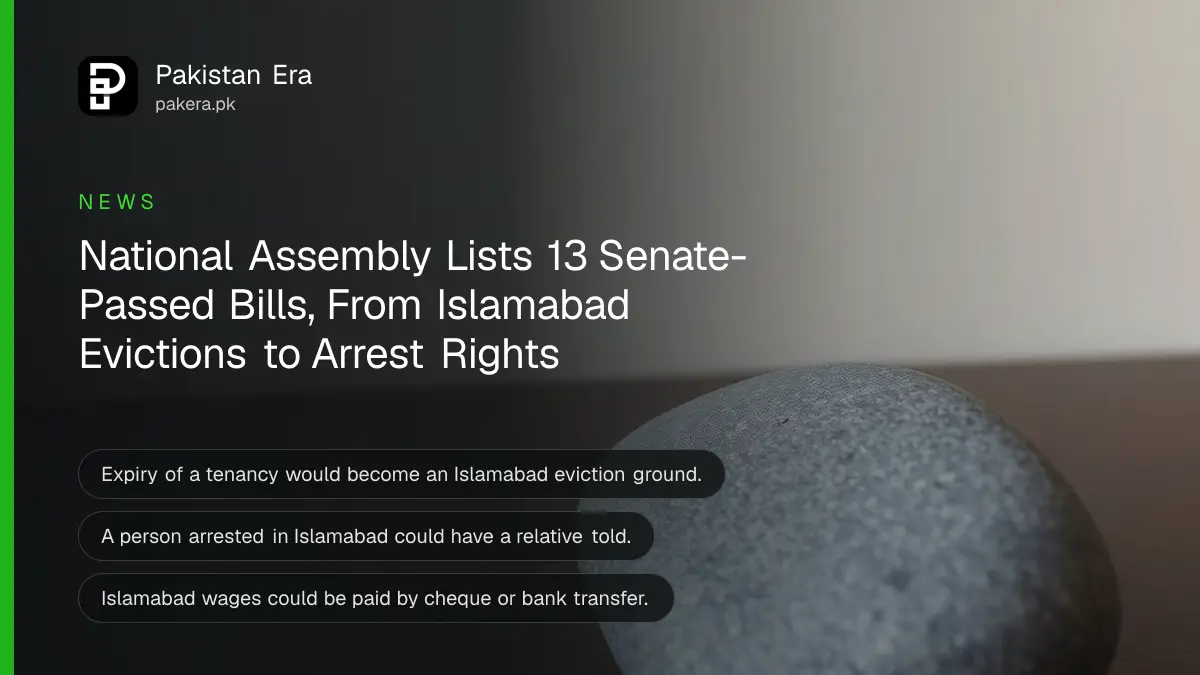
Short answer: The National Assembly's agenda for Tuesday, 20 October 2026 listed 13 bills already passed by the Senate for final passage. Among them: Islamabad landlords could evict when a tenancy expires, people arrested in Islamabad could have a relative told, magistrates could receive an FIR the police refuse, and Islamabad employers could pay wages by bank transfer. None of them is law until both Houses pass the same text and the President assents.
We read the orders of the day, signed on 19 October 2026, and the Senate-passed text of six of the bills on 20 October 2026. All the bills are private members' bills, meaning they were moved by senators rather than the government. Most of them apply only in Islamabad Capital Territory, because rent, policing and labour are provincial subjects everywhere else.
Islamabad landlords could evict once a tenancy expires
The Islamabad Rent Restriction (Amendment) Bill, 2025 adds a new ground to section 17 of the 2001 Ordinance: the tenancy period "has expired and has not been extended by the parties". Today, section 17 lists unpaid rent, subletting, damage, nuisance, rebuilding and own use, but not expiry.
The bill's statement of objects says the Supreme Court decided in 2018 that expiry is a valid ground, and that the text should say so plainly. The Senate passed it on 20 January 2025. The six existing grounds, the 15 day rent rule and the 3 month limit are explained under how to evict a tenant in Islamabad.
People arrested in Islamabad could have a relative told
The Code of Criminal Procedure (Amendment) Bill, 2026 adds section 59A. A person arrested and held in a police station or elsewhere could have a family member, friend or relative told of the arrest by the officer in charge.
Only an officer of Superintendent of Police rank or above could delay that message. The bill allows a delay only if telling the person would harm evidence or other people, alert a suspect not yet arrested, or hinder recovery of property. Its statement of objects says some police keep people in custody "without formally arresting" them.
The same bill makes three more changes for Islamabad:
- A new section 154(2) lets a person give information on a cognizable offence to the magistrate for the area when police have not entered it in their book. The magistrate receives it the same way as an FIR.
- A proviso to section 431 says a criminal appeal does not abate on the appellant's death if an heir asks the court for judgment within 30 days.
- A new section 431A lets an heir file an appeal against conviction when the convict dies before appealing.
Today, a person whose FIR is refused usually applies to a Sessions Judge acting as Justice of the Peace. The bill says those courts are overburdened. The Senate passed it on 23 February 2026. Your current rights on arrest are set out under rights when arrested in Pakistan.
Islamabad wages could be paid by cheque or bank transfer
The Payment of Wages (Amendment) Bill, 2025 rewrites section 6 of the 1936 Act for Islamabad. Wages could be paid in cash, by cheque or into the worker's bank account. The government could order certain workplaces to pay only by cheque or bank.
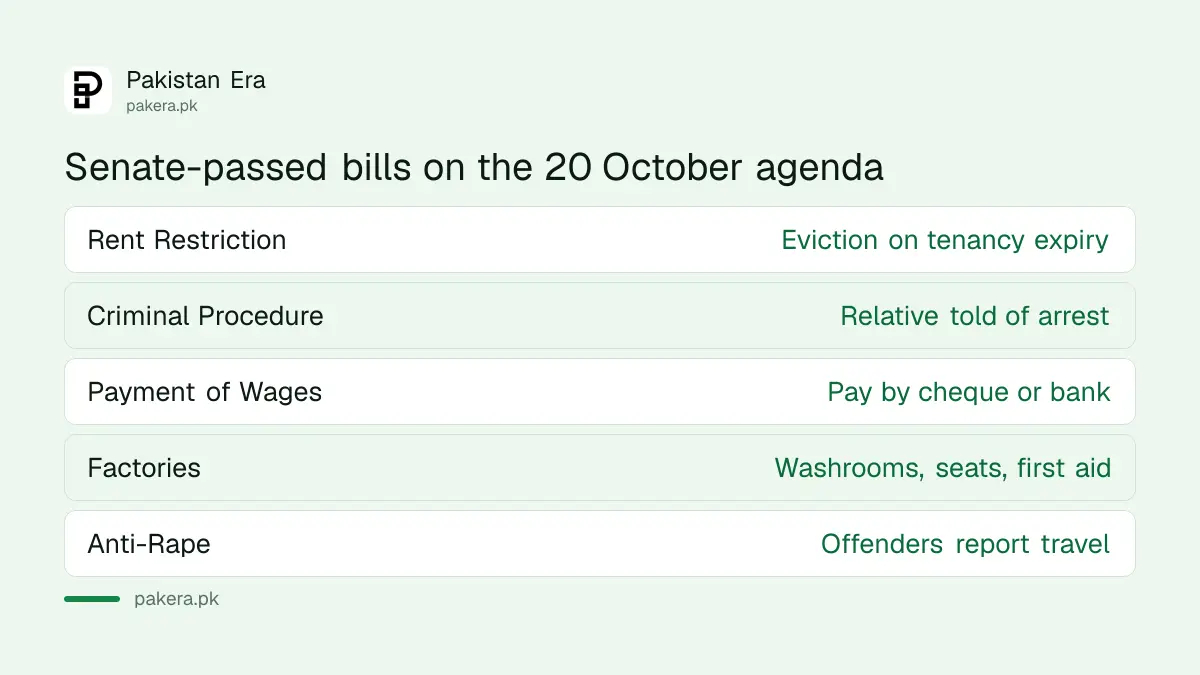
| Bill | Main change | Senate passed |
|---|---|---|
| Islamabad Rent Restriction (Amendment) Bill, 2025 | Expiry of tenancy becomes an eviction ground | 20 January 2025 |
| Code of Criminal Procedure (Amendment) Bill, 2026 | Relative told of arrest, FIR via magistrate, heirs' appeals | 23 February 2026 |
| Payment of Wages (Amendment) Bill, 2025 | Wages by cheque or bank account | 20 January 2025 |
| Factories (Amendment) Bill, 2025 | Washing, seating, first aid, hazard disclosure | 20 January 2025 |
| Anti-Rape (Amendment) Bill, 2024 | Sex offenders must tell police before travel | 4 March 2024 |
Its statement of objects says paying into bank accounts would cut complaints about unpaid or underpaid minimum wages. Section 6 today says coin or currency notes only. How to claim late or cut pay under the existing Act is covered under claiming late wages in Islamabad.
Islamabad factories would owe workers washrooms, seats and first aid
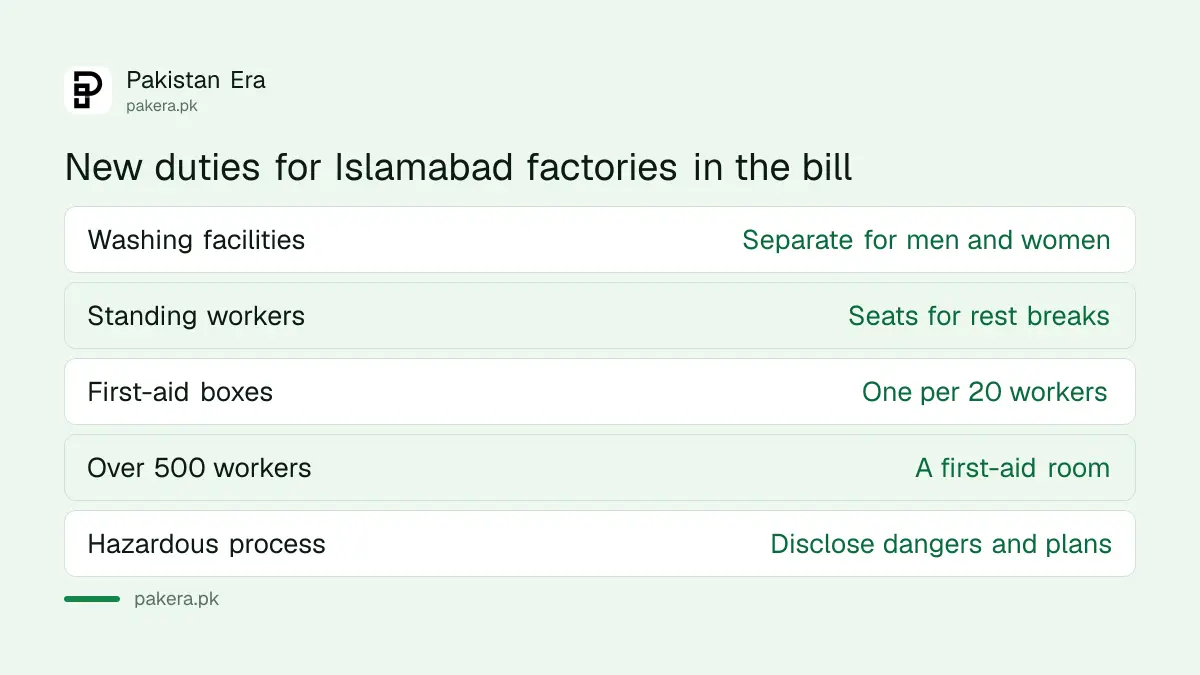
The Factories (Amendment) Bill, 2025 adds separate washing facilities for men and women, seats for workers who stand, and one first-aid box for every 20 workers. A factory with more than 500 workers would need a first-aid room.
Factories with hazardous processes would have to disclose health dangers to workers, the Chief Inspector and nearby residents, keep workers' health records, set up a safety committee and let workers warn of imminent danger. A licence could be cancelled for failing to report a hazardous process.
Eight more bills were listed, including drink driving
The Assembly's list also carried the two drink-driving bills and bills on limited liability partnerships, the National Security Council, emergency treatment cover, breastfeeding in Islamabad, a new section 297A of the Penal Code, and the science council.
The two drink-driving bills would raise motorway fines to Rs 10,000 to Rs 25,000 and Islamabad's to as much as Rs 100,000 for a repeat offence, as reported under drink-driving fines in Pakistan. The Anti-Rape bill would make convicted sex offenders tell police 12 hours before leaving home for more than 3 days. Survivors' current rights are explained under the Anti-Rape Act 2021.
Each bill still needs the President before it becomes law
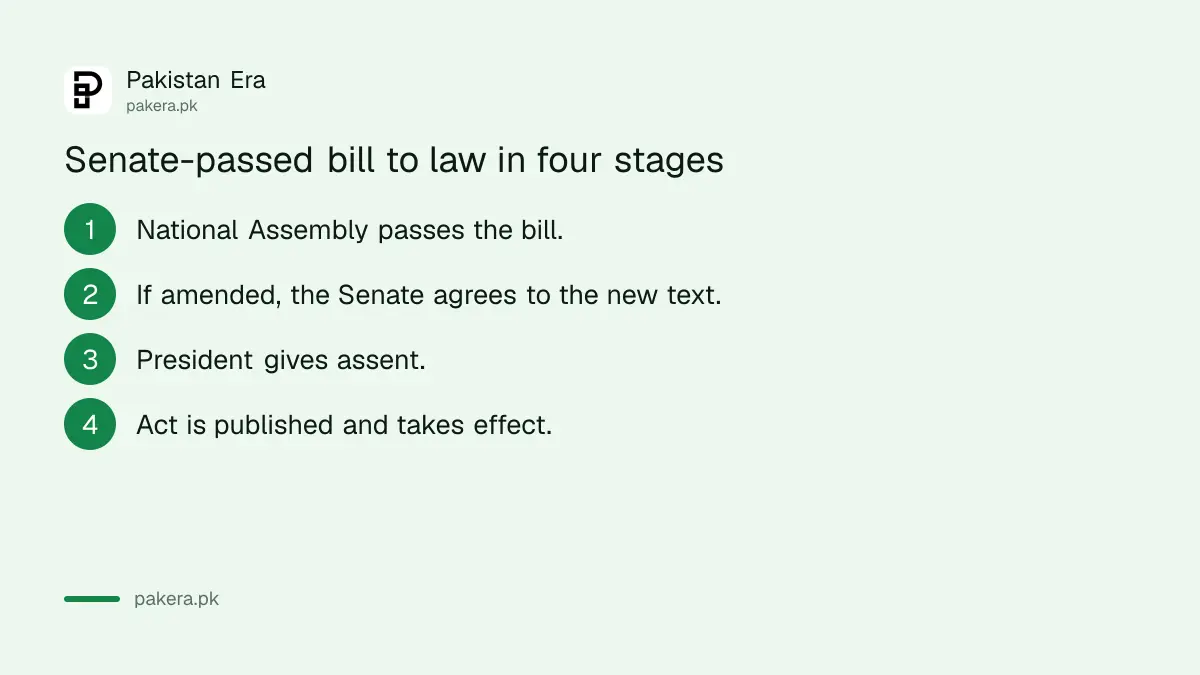
The orders of the day show amendments listed for most of these bills. If the Assembly passes a bill with amendments, it returns to the Senate. Only a text passed by both Houses goes to the President, and each bill comes into force when it is enacted.
The Assembly had not published the outcome of the 20 October sitting on its bills-passed list when we last checked. A listing on the agenda is not a vote, and items can be deferred.
Common questions
Did the National Assembly pass the Islamabad rent bill on 20 October 2026?
It was listed for passage. The Assembly had not published the result on its bills-passed list when we last checked.
What does section 59A in the CrPC bill do?
It would let a person arrested in Islamabad have a family member, friend or relative told of the arrest by the police.
Can a magistrate register an FIR in Islamabad?
Not under the current text. The bill would let a magistrate receive information on a cognizable offence when police have not entered it.
Do these bills apply in Punjab or Sindh?
Most of them apply only in Islamabad Capital Territory. The drink-driving highways bill and the Anti-Rape bill are national.
When would the bills take effect?
Each says it comes into force at once, but only after both Houses pass it and the President assents.
How we verified this
What we checked, where we read it, and what we could not confirm.
Last checked 20 October 2026. We read the National Assembly orders of the day for 20 October 2026 and the Senate-passed text of six bills, including the Code of Criminal Procedure (Amendment) Bill, 2026, on 20 October 2026. Senate passage dates come from the Senate's list of bills passed. We did not read the amendment lists for the Assembly, or the texts of the other seven bills, and we have not seen the result of the sitting.
About the author

Global Affairs & Political Economy Writer
Muhammad Hatim is a book lover who started writing because he enjoys it. At Pakistan Era he writes about international relations, geopolitics and the global economy, with a particular interest in South Asia and the forces behind current events.