Factory and Boiler Chimney Emission Limits in Punjab: All 16 Pollutants, From 40% Smoke to 800 mg CO
Punjab's limits for factory stacks: smoke 40 percent, boiler dust 300 to 500 mg/Nm3, carbon monoxide 800, NOx 400 to 1,200. All 16 limits and how to check.
Short answer: A factory chimney in Punjab must not release smoke darker than 40 per cent, or 2 on the Ringelmann scale. Particulate matter from an oil fired boiler is capped at 300 milligrams per normal cubic metre, from a coal fired boiler at 500, and carbon monoxide at 800.
These limits come from the Punjab Environmental Quality Standards for Industrial Gaseous Emissions, notified in August 2016. They are the numbers an EPA inspector, or a certified lab, tests a stack against. In smog season they decide whether a unit is sealed or allowed to keep running.
Below are all 16 limits, what the units mean, and how a factory owner can check compliance before an inspection.
Smoke from any chimney must stay under 40 per cent
The first limit in the standard applies to every stack, whatever it burns. Smoke opacity must not exceed 40 per cent, or 2 on the Ringelmann scale, or an equivalent smoke number. Anything darker breaks the standard.
The Ringelmann scale is a set of grey shades from 0, clear, to 5, black. Shade 2 is 40 per cent. An inspector matches the plume against the card. Thick grey or black smoke from a boiler or furnace is the most common visible breach in winter.
All 16 limits in Punjab's industrial emission standard
Limits are in milligrams per normal cubic metre (mg/Nm³) of stack gas unless stated. "Normal" means the gas volume is corrected to standard temperature and pressure, so readings from hot and cold stacks can be compared.
| Pollutant | Source | Limit |
|---|---|---|
| Smoke | Any stack | 40%, Ringelmann 2 |
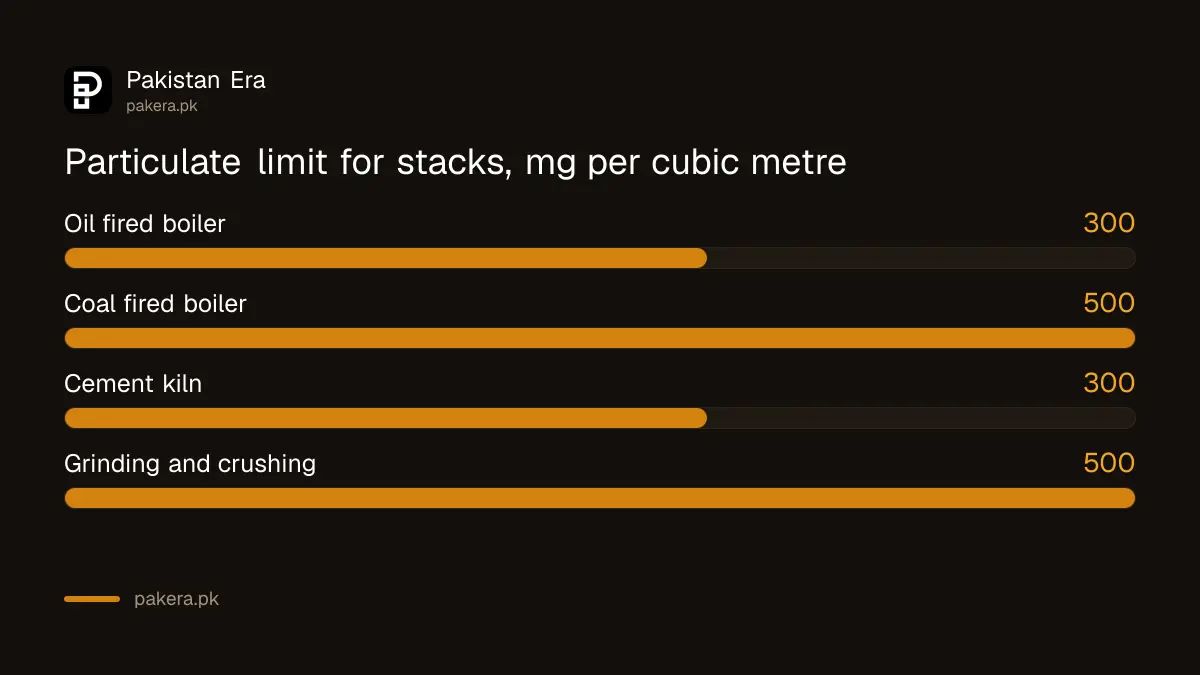
| Particulate matter | Oil fired boilers and furnaces | 300 |
| Particulate matter | Coal fired boilers and furnaces | 500 |
| Particulate matter | Cement kilns | 300 |
| Particulate matter | Grinding, crushing, clinker coolers, metal processes, blast furnaces, cupolas | 500 |
| Hydrogen chloride | Any | 400 |
| Chlorine | Any | 150 |
| Hydrogen fluoride | Any | 150 |
| Hydrogen sulphide | Any | 10 |
| Sulphur oxides | Sulphuric or sulphonic acid plants | 5,000 |
| Sulphur oxides | Other plants, except oil and coal power plants | 1,700 |
| Carbon monoxide | Any | 800 |
| Lead | Any | 50 |
| Mercury | Any | 10 |
| Cadmium, arsenic, antimony | Any | 20 each |
| Copper | Any | 50 |
| Zinc | Any | 200 |
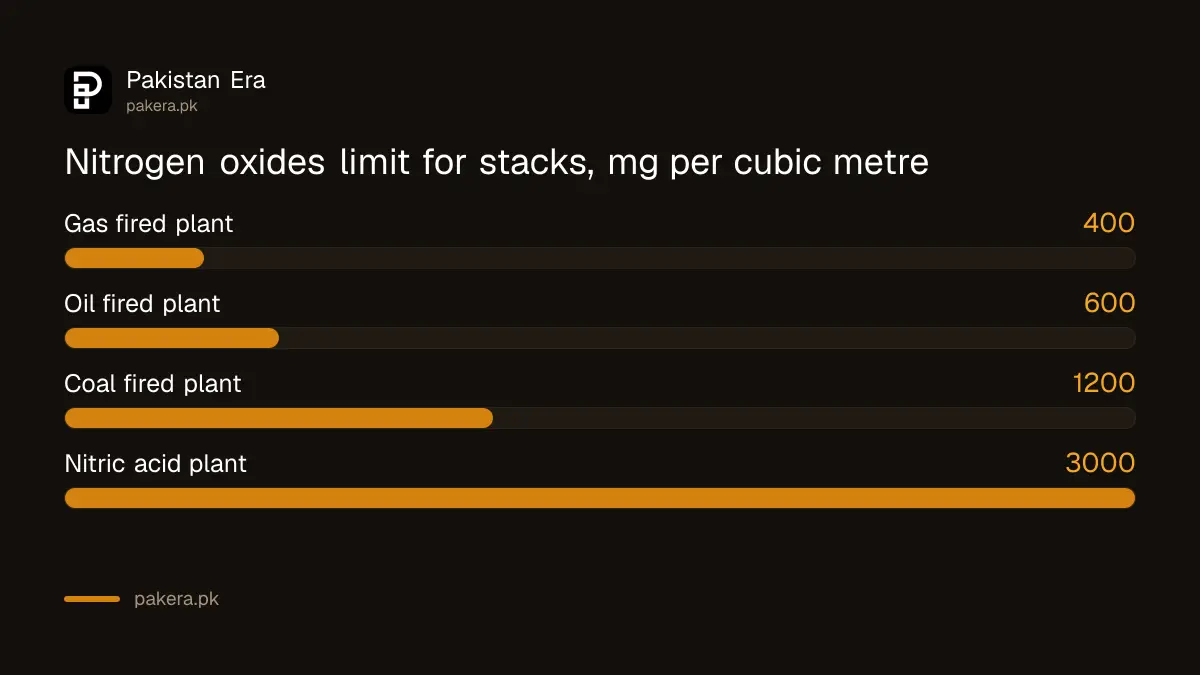
| Nitrogen oxides | Nitric acid plants | 3,000 |
| Nitrogen oxides | Gas, oil or coal fired plants, except power plants | 400, 600 or 1,200 |
The particulate limits assume particles of 10 micrometres or more. The sulphur limits assume fuel oil with 1 per cent sulphur. Fuel with more sulphur gets a pro-rated limit.
Diluting the gas to pass the test is not allowed
The standard says plainly that blowing extra air into a stack to bring readings under the limit is not permitted. The gas must meet the limit before it mixes with the outside air.
This matters because a diluted sample can look clean on paper. A reading lowered by a fan or bypass feeding fresh air into the stack does not meet the standard. The honest route is a working dust collector, scrubber or cleaner fuel.
Oil and coal power plants have extra sulphur and NOx rules
Power plants on oil or coal must meet two more tests for sulphur dioxide, based on how polluted the air around them already is. In "very polluted" areas, where the yearly average is above 100 micrograms per cubic metre, no new project with sulphur dioxide emissions will be recommended.
For nitrogen oxides, the outside air near such plants should not pass a yearly average of 100 micrograms per cubic metre. Fuel fired steam generators have separate limits per unit of heat: 130 nanograms per joule for liquid fuel, 300 for solid fuel and 260 for lignite.
How a factory owner can check compliance before an inspection
Do not wait for a smog season raid. A stack test by a certified lab, and a few visible checks, show whether the unit will pass.
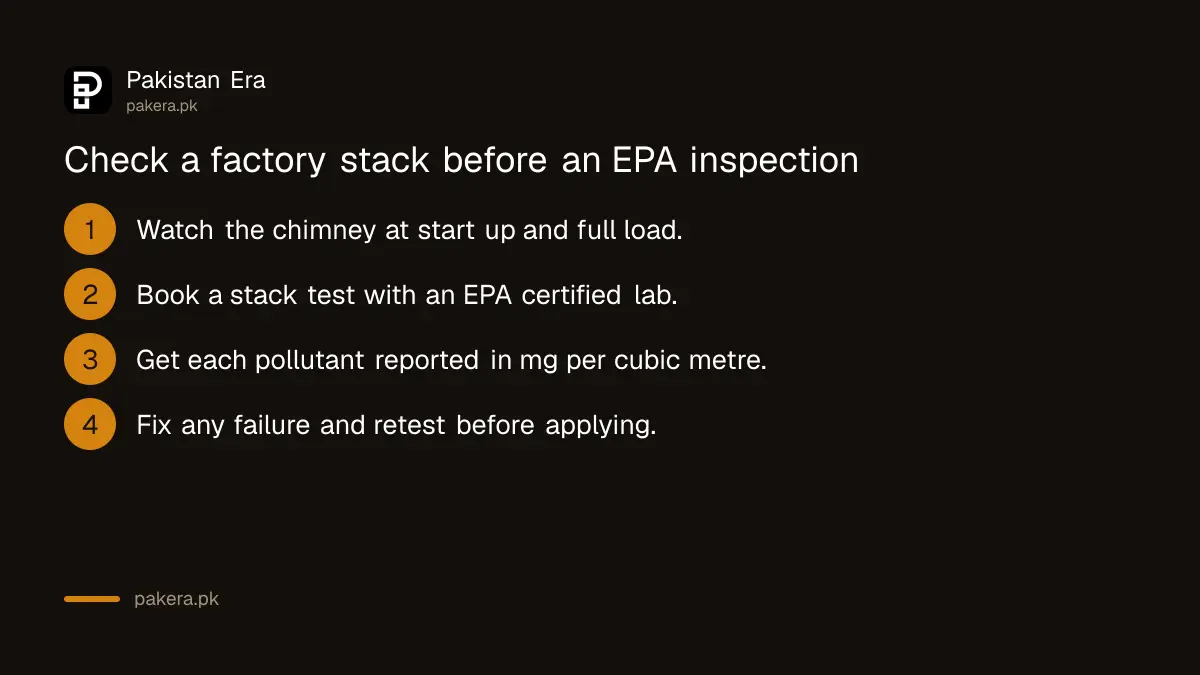
- Watch the chimney during start up and full load. If the smoke is darker than light grey, fix the burner or dust collector first.
- Book a stack test with a Punjab EPA certified lab. The list of approved labs is in the EPA Punjab certified lab list.
- Ask the lab to report each pollutant in mg/Nm³ and to name the limit it used from the 2016 standard.
- Keep fuel records. A switch to higher sulphur fuel changes the sulphur limit.
- If a test fails, fix the cause and retest before applying for any compliance certificate.
Units already ordered to stop can apply to restart through the compliance process in the EPA Punjab compliance of standards application. Brick kilns have their own winter checklist in the brick kiln and factory smog inspection guide.
Common questions
What is the smoke limit for a factory chimney in Punjab?
40 per cent opacity, or 2 on the Ringelmann scale, for any stack.
What is the dust limit for a coal fired boiler?
500 milligrams of particulate matter per normal cubic metre. An oil fired boiler is limited to 300.
What is the carbon monoxide limit for industry?
800 milligrams per normal cubic metre, from any source.
Can a factory add air to the stack to lower readings?
No. The standard says diluting the gas with excess air before release is not permitted.
Which law sets Punjab's industrial emission limits?
The Punjab Environmental Quality Standards for Industrial Gaseous Emissions, notified under the Punjab Environmental Protection Act, 1997, in August 2016.
How we verified this
What we checked and where we read it.
We read the Punjab Environmental Quality Standards for Industrial Gaseous Emissions, Notification No. SO(G)/EPD/7-26/2013 dated 5 August 2016, in the Punjab Gazette (Extraordinary) of 15 August 2016, pages 1182 to 1184, on 15 November 2026. The PDF is linked as "Industrial Gaseous Emission" from the Environment Protection Department's standards page. The meaning of "normal cubic metre" and of the Ringelmann shades are the standard definitions of those terms. The self check steps are general practice, not part of the notification.
About the author

Global Affairs & Political Economy Writer
Muhammad Hatim is a book lover who started writing because he enjoys it. At Pakistan Era he writes about international relations, geopolitics and the global economy, with a particular interest in South Asia and the forces behind current events.