FBISE Computer-Based Test 2027: MCQs in 5 Part I Papers May Move to Computers for 9th and 11th Class
FBISE plans computer-based MCQ tests in Maths, Physics, Chemistry, Biology and Computer Science Part I from 2027. Schools must report labs by 20 November 2026.
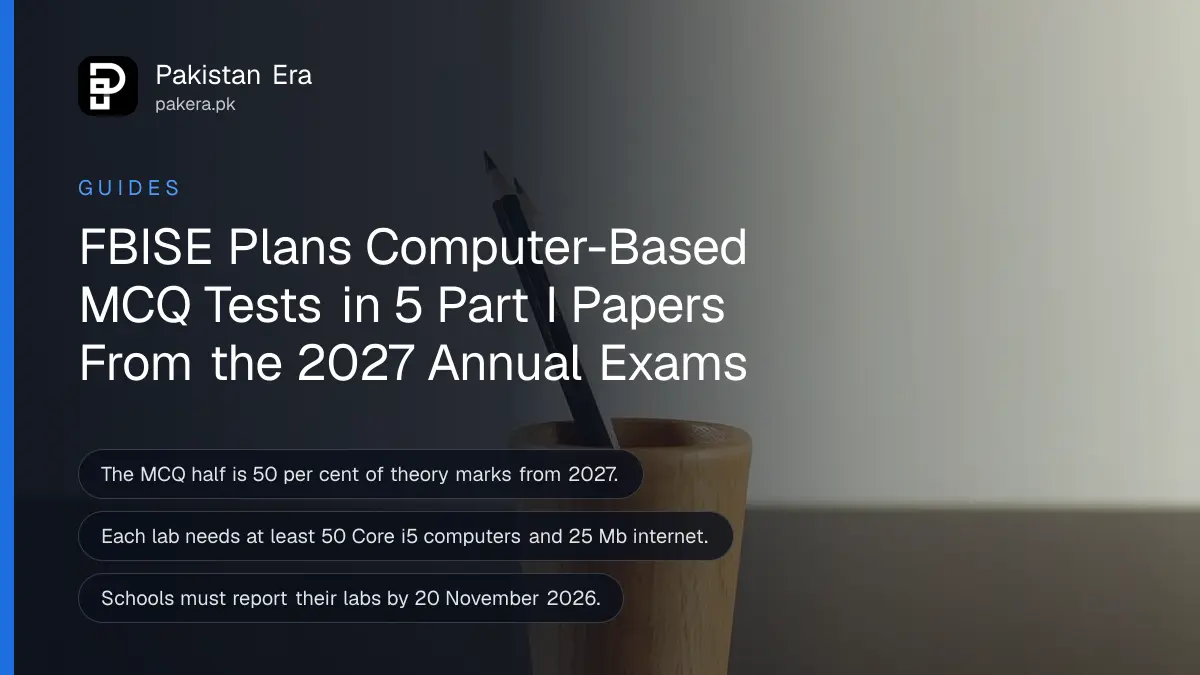
Short answer: FBISE is planning to hold the MCQ part of five Part I papers on computers from the First Annual Examinations 2027. The papers are Mathematics-I, Biology-I, Chemistry-I, Physics-I and Computer Science-I, at SSC-I (9th) and HSSC-I (11th) level. It is a plan, not a final decision.
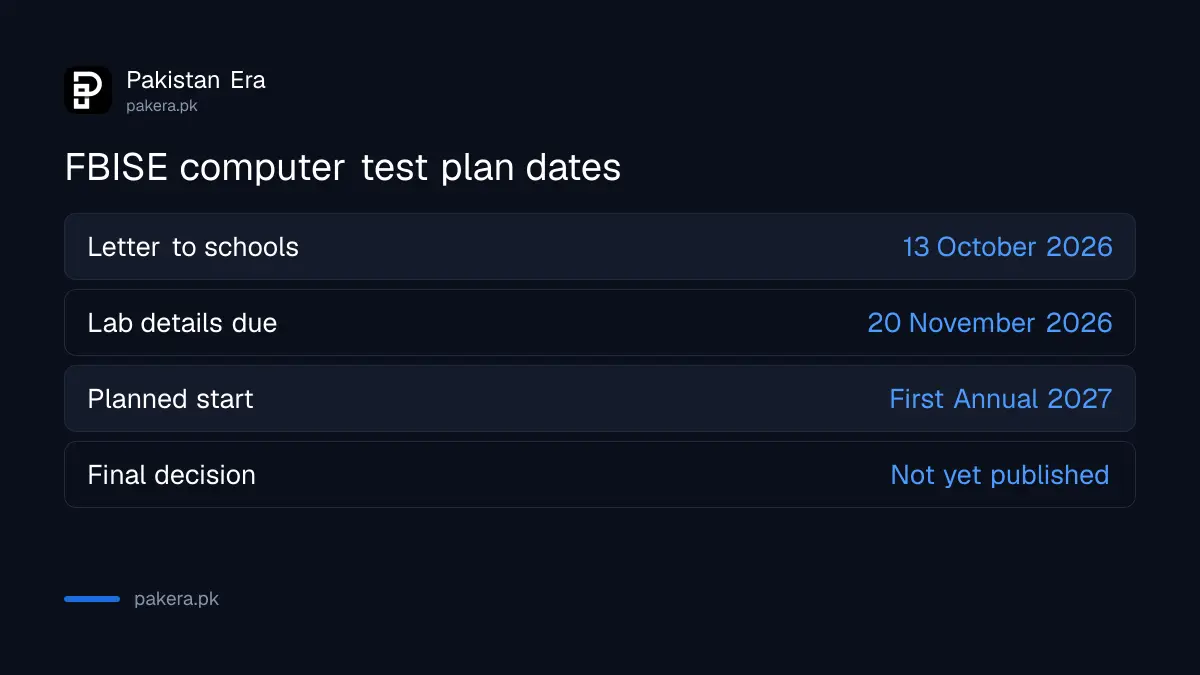
The Federal Board of Intermediate and Secondary Education wrote to every affiliated school and college on 13 October 2026. It asked them to report their computer labs by 20 November 2026. Students now in 9th and 11th class at FBISE schools are the ones this could reach first. We read the letter and explain what it does and does not settle.
FBISE wants MCQs in five Part I papers on computers
FBISE's letter says it is "planning to explore the possibility" of computer-based testing, or CBT, for the MCQ portion instead of printed papers. CBT means you answer the multiple choice questions on a computer screen, not with a pen on an OMR sheet.
The letter names five subjects, all Part I papers. The written, descriptive half of each paper is not mentioned. So on the current plan a student would still write long and short answers on paper.
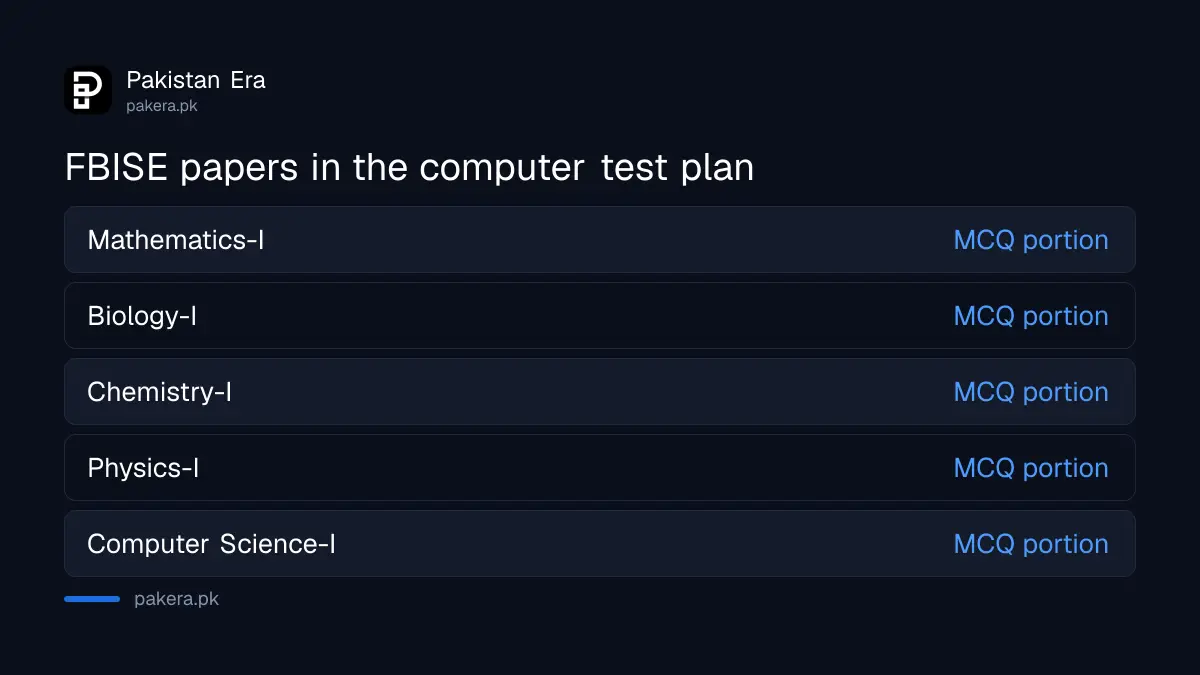
| Paper | Level | Part to go on computer, if approved |
|---|---|---|
| Mathematics-I | SSC-I and HSSC-I | MCQ portion |
| Biology-I | SSC-I and HSSC-I | MCQ portion |
| Chemistry-I | SSC-I and HSSC-I | MCQ portion |
| Physics-I | SSC-I and HSSC-I | MCQ portion |
| Computer Science-I | SSC-I and HSSC-I | MCQ portion |
The MCQ half is now 50 per cent of the theory marks
The letter says FBISE's Board of Governors fixed the MCQ portion at 50 per cent of theory marks at SSC-I and HSSC-I from the First Annual Examination 2027. That makes the MCQ half large enough to test on its own.
FBISE first announced this 50-50 design in August 2026, for the same five core subjects. We covered the phase dates in the note on the FBISE 50 per cent MCQ paper pattern. The CBT letter builds on it. Once half of a paper is multiple choice, a computer can mark it in seconds.
Students should not change how they study yet. The MCQs will test the same syllabus whether they appear on paper or on screen. What changes is the setting: a lab, a mouse and a timer on screen. Practise a few MCQ sets on a computer if you can, so the format is not new on exam day.
Schools must report labs with 50 computers by 20 November
FBISE asked every affiliated institution to tell it what labs it has. The minimum lab is 50 computers with Core i5 processors, a 25 Mb internet connection and power backup from the grid, a generator or solar. Replies are due by 20 November 2026.
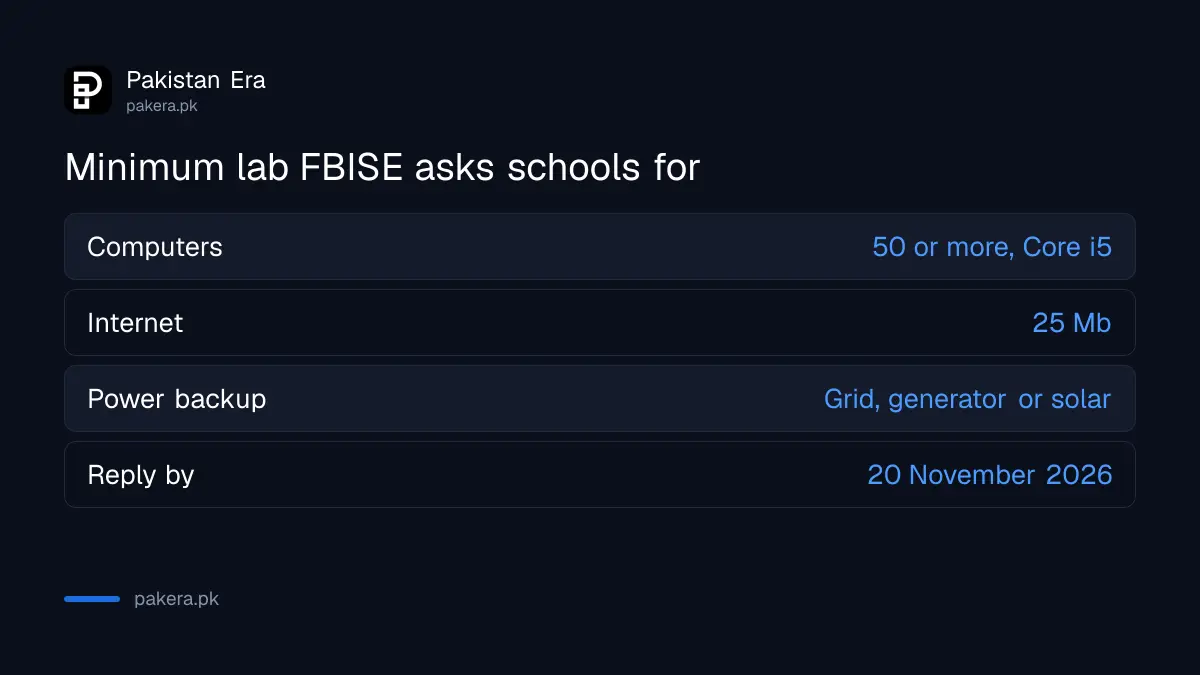
| Item | Minimum FBISE asks for |
|---|---|
| Computers | At least 50 in each lab, Core i5, with intranet if available |
| Internet | 25 Mb connection |
| Power backup | Electricity, generator or solar system |
| Contact details | Focal person, institution code, mobile number and email |
Schools send the details by email to the Controller (Test Administration) at controller.ta@fbise.edu.pk. FBISE says it will use them "for further planning and allocation of candidates". That suggests students may sit the computer test at a lab that is not their own school.
What is still not decided
The letter does not give a start date for any one subject, a fee, or the rules for a power cut or a crashed computer. It does not say whether every candidate or only some will sit on screen. FBISE has not yet published a final CBT notification.
Here is what to watch for over the coming months.
- A final FBISE notification saying CBT is approved, and for which of the five papers.
- A list of CBT centres, which depends on the lab returns due on 20 November 2026.
- A sample or practice CBT, if FBISE publishes one.
- Rules for technical failure, extra time and candidates with a disability.
- Any change to the date sheet for First Annual 2027.
FBISE is changing several things at once for 2027. Composite candidates face a new practical-based assessment, and on the same day as the CBT letter, FBISE told schools that exam centres must print question papers sent online. Students who sit with a writer because of a disability already get extra time under the FBISE amanuensis rules, and those rules will need a CBT version.
Common questions
Will FBISE hold computer-based exams in 2027?
FBISE is planning it for the MCQ portion of five Part I papers from the First Annual Examinations 2027. The 13 October 2026 letter calls it a possibility it is exploring, not a final decision.
Which subjects are in the FBISE CBT plan?
Mathematics-I, Biology-I, Chemistry-I, Physics-I and Computer Science-I, at SSC-I and HSSC-I level.
Will the whole paper be on a computer?
No. The letter covers only the MCQ portion, which is 50 per cent of theory marks. The descriptive part is not mentioned.
Does this apply to Punjab or other provincial boards?
No. The letter is from FBISE to its own affiliated institutions. Provincial boards set their own exam methods.
What do schools have to do?
Email details of any lab with at least 50 Core i5 computers, 25 Mb internet and power backup, plus a focal person, to controller.ta@fbise.edu.pk by 20 November 2026.
Should students prepare differently?
The syllabus is the same. Practising MCQs on a computer helps, so the screen format is familiar if CBT goes ahead.
How we verified this
What we checked, where we read it, and what we could not confirm.
Last checked 20 October 2026. We read FBISE letter No. FBISE/CE(T.A)/2026/335 dated 13 October 2026, on providing computer labs for computer-based testing, on the FBISE website. The five papers, the 50 per cent MCQ share, the lab minimum and the 20 November 2026 reply date all come from that letter. We could not find a final CBT notification, a list of centres or any practice test, and the letter does not say how many candidates would sit on screen.
About the author
Public Services and Education Journalist
Fajr Riaz is a journalist and content writer at Pakistan Era, based in Lahore. She covers the questions people meet in everyday life in Pakistan: how a public service works, what a change in the rules means, and where to find a reliable answer.