FBR Drafts One Electronic Return for Foreign Ships Under Section 143, Filed on IRIS
FBR has reportedly drafted an electronic Section 143 return for non-resident ship owners and charterers on IRIS, linked to PSW. See what is draft and law.
Short answer: FBR has reportedly drafted a rule that would make non-resident ship owners, charterers and their agents file the Section 143 return electronically on IRIS, linked to the Pakistan Single Window (PSW). The draft is not yet notified in what we could read. It would replace a return the ship's master files before the vessel leaves.
A foreign ship unloads at Karachi, takes on cargo and wants to sail. Under the law today, it cannot get port clearance until its Pakistan tax is settled. A reported FBR draft would put the return for that step online, on one electronic form.
We could not open the draft rule text on FBR's website on 12 October 2026. The details of the draft below come from reports and are marked as reported. The current law, Section 143, we read on FBR's own page the same day.
Section 143 already makes a ship's master file a return before departure
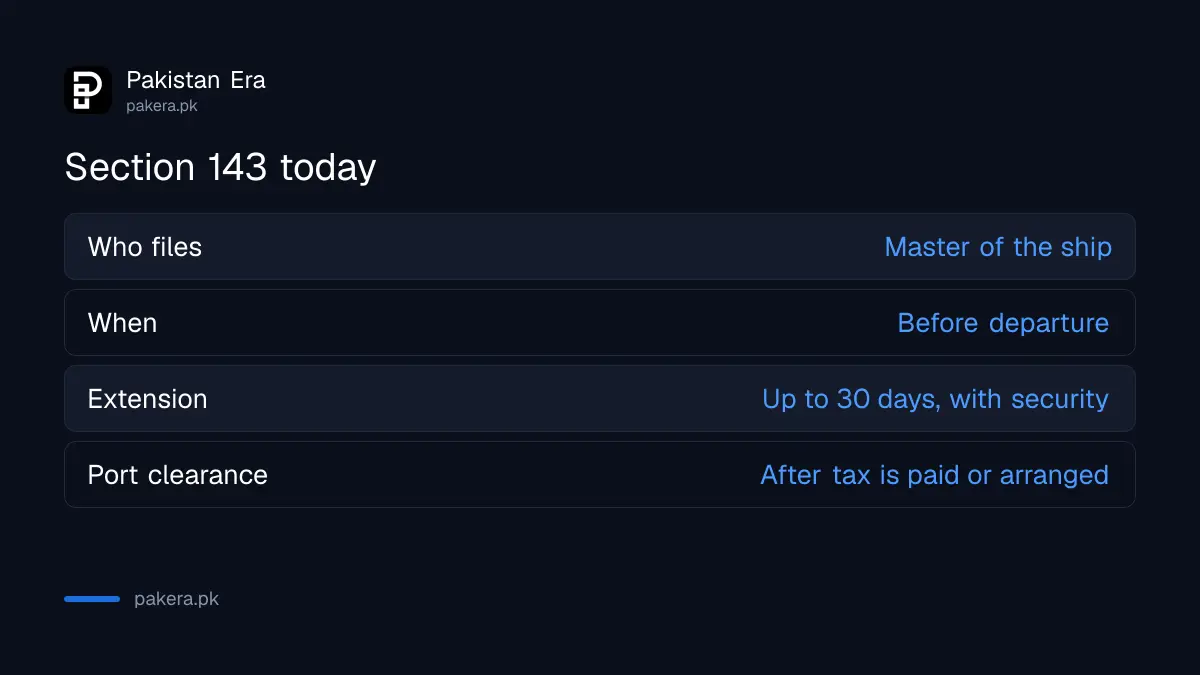
Section 143 of the Income Tax Ordinance, 2001 requires the master of a ship owned or chartered by a non-resident to file a return before the ship leaves a Pakistani port. The return shows the gross amount described in section 7(1) of the Ordinance.
The same page says the Commissioner can allow the return within 30 days of departure if the non-resident owner or charterer arranges satisfactory payment security. Without it, the Collector of Customs or another authorised officer cannot grant port clearance until the tax is paid or arrangements are confirmed.
| Point | What FBR's page says |
|---|---|
| Who files | The master of a ship owned or chartered by a non-resident |
| When | Before departure, or within 30 days if the Commissioner allows it with security |
| What it shows | The gross amount specified in section 7(1) |
| Port clearance | Not granted until tax is paid or arrangements are confirmed |
| Liability | The master is liable, and the non-resident owner or charterer for any unpaid balance |
The draft reportedly moves the return onto IRIS
As reported, the draft would amend the Income Tax Rules, 2002. Non-resident ship owners, charterers and authorised shipping agents would file their Section 143 returns electronically on FBR's IRIS system, with the supporting documents, certificates and statements attached electronically.
IRIS is FBR's online tax system, the same one individuals use for their annual returns. The way that return works is explained in our guide on checking that a return was filed on IRIS.
The report does not say when the draft would take effect. A draft rule has no force until FBR notifies it in the Gazette, usually after it considers comments.
One return would be created for each Vessel Information Report
The draft would link IRIS with PSW. When a Vessel Information Report (VIR) arrives through PSW, key vessel and shipping details would be transferred to IRIS automatically. The system would then generate one electronic return for each unique VIR.
The report names the VIR as the trigger. PSW is the single online window that traders and port users already use for customs and trade documents. Our steps for linking your bank profile on PSW show another part of that system.
That link would replace manual entry. It would also tie each return to one voyage report, so a ship's return could be checked against its port record.
Payment would go through a PSID and a payment receipt
Reportedly, shipping agents and other relevant parties would generate a Payment Slip ID (PSID) against the VIR and pay. After payment, a Computerised Payment Receipt (CPR) would be issued and linked to the return. The return could not be submitted until all payments were made and the receipts attached.
The PSID method is the same one individuals use to pay income tax. Our guide on paying income tax online with a PSID shows how a PSID works at a bank or in an app.
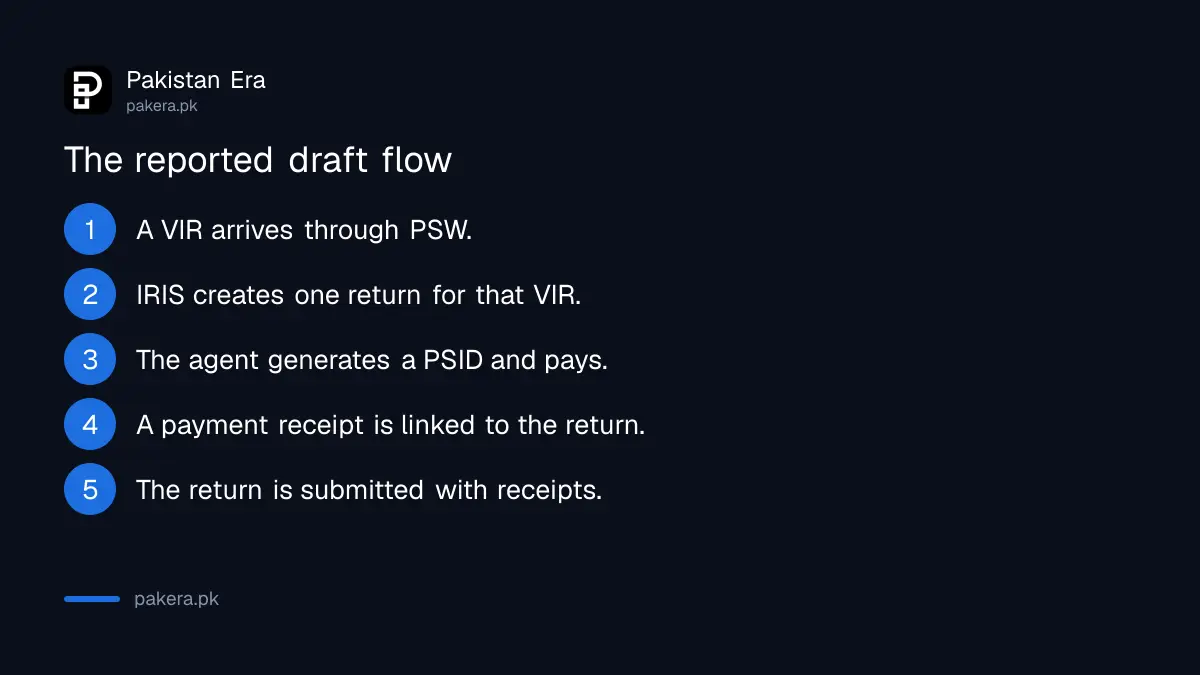
- The vessel's VIR arrives through PSW.
- IRIS creates one electronic return for that VIR.
- The agent generates a PSID and pays the tax.
- A CPR is issued and linked to the return.
- The return is submitted with the receipts attached.
The return would list voyage income and NTN holders
As reported, the electronic return would carry details of the relevant NTN holders, total voyage-related income and the taxes paid. Taxable receipts named include freight, container detention charges, container service charges and terminal handling fees.
The draft would also let FBR use payment information for assessment, audit, verification, enforcement and recovery. That means the electronic record would double as an audit trail.
The report also mentions extension requests. A party that wanted more time would have to apply before the vessel departed, with documents that show expected income and the estimated tax. Section 143 already allows an extension when security is arranged.
Comments close seven days after the Gazette notice
The report says stakeholders may send objections and suggestions within seven days of the draft's publication in the official Gazette. We do not know the Gazette date, so we cannot say whether the window is still open. Interested parties should check FBR's website at once.
Agents and owners who want to comment should look for the draft notice on the FBR website and send their objections in writing.
If you track a vessel or a cargo, our guide on checking a ship's arrival at Karachi Port shows the port side. Our report on FBR's draft Rule 38B shows another recent rule that moves checks onto IRIS.
Common questions
Who would file the electronic return under the draft?
Non-resident ship owners, charterers and authorised shipping agents would file it, as reported. Today the ship's master files the return under Section 143.
Is the draft in force?
No, as far as we could read. A draft rule needs notification in the Gazette before it applies.
What would the return be filed on?
It would be filed on IRIS, FBR's online system, linked to the Pakistan Single Window.
Does a ship need a tax clearance to leave port?
Under Section 143, port clearance is not granted to a non-resident's ship until tax is paid or arrangements are confirmed with the Commissioner.
Does this affect ordinary taxpayers?
No. It concerns non-resident shipping parties and their agents. Individuals and local businesses are not covered by this section.
Where can I read the draft?
It should appear on FBR's website as a notice of draft amendments to the Income Tax Rules, 2002. We could not locate the text there on 12 October 2026.
How we verified this
What we checked, where we read it, and what we could not confirm.
We read Section 143 on the FBR website on 12 October 2026. We could not read the draft rule on FBR's site, so every detail of the draft is reported and unconfirmed. The seven day window and the effective date are not known to us.
About the author

Senior Writer, Public Services and Technology
Shahid joined us in 2024 as an author. He is a senior contributor to Pakistan's leading technology websites. He writes detailed articles, mostly covering his expertise in the latest tech, mobiles, apps, gadgets, and step-by-step guides. His ideology is to help people understand the latest trends and explain complex methods through very easy-to-understand guides.