FBR Refund Status Check: Track Your Income Tax Refund on IRIS, the 60 Day Rule and Every Fix
Track an FBR income tax refund: where the status shows, the 60 day order rule, the IBAN check and what to do when it is late. Law says 3 years to claim, not 2.
To check your FBR income tax refund status, open the refund application you submitted in IRIS under Completed Tasks, count 60 days from its date, and ask your Regional Tax Office (RTO) if no order has come, because FBR itself says the RTO gives the status. The law gives the Commissioner 60 days to decide. After that, you can appeal or complain, and a refund paid more than three months late earns compensation.
Refunds are where many salaried people give up. Tax was taken from salary, bank profit, a car registration or a phone bill, the return shows an excess, and then nothing happens. Here is how to follow the application through each stage, which dates the law sets, and what to do at each one.
FBR gives refund status through your Regional Tax Office
FBR's income tax refund page says the refund is claimed through a separate application in IRIS, and that to check its status you should visit your relevant Regional Tax Office. There is no public refund tracker by CNIC. IRIS and the RTO are the two places to look.
In IRIS, a submitted form moves from Draft to Completed Tasks. FBR uses the same rule for the return and the wealth statement. So the first check is simple: if your refund application is still in Draft, it was never filed, and no clock has started. The steps to check that a return was filed on IRIS work the same way for the refund application.
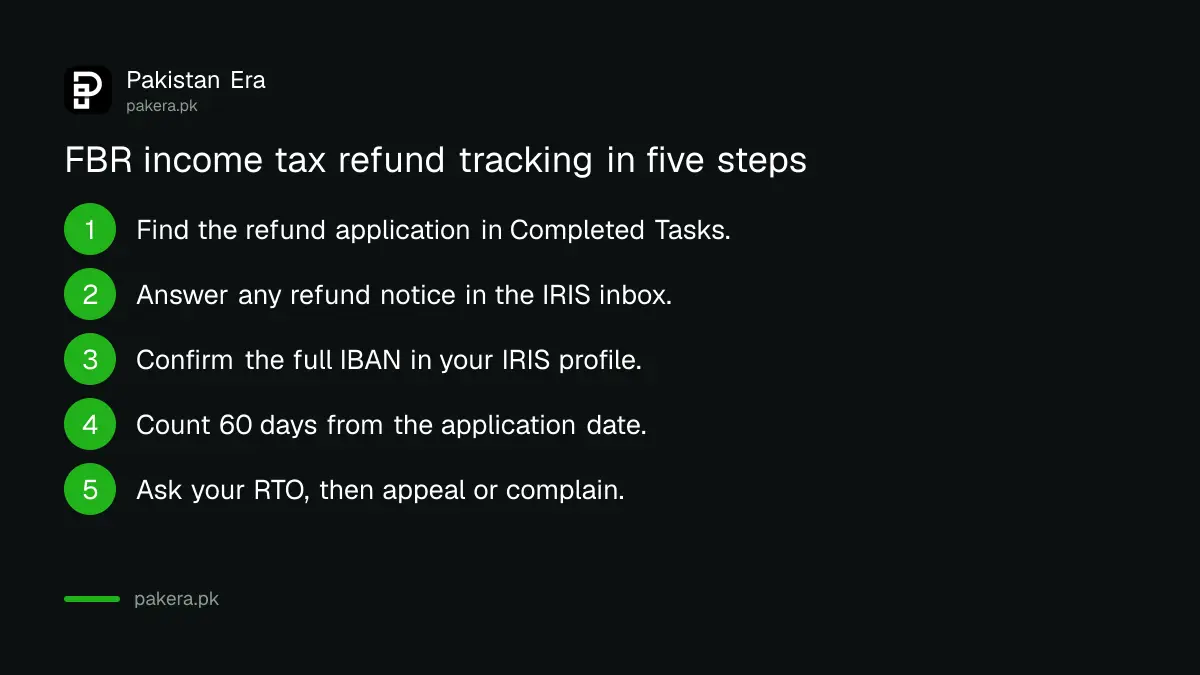
Track the refund in six steps
Start in IRIS, confirm the application date and your bank details, then count the legal deadlines from that date. Most delays come from a missing IBAN or an unanswered notice, and both are visible in IRIS before you visit anyone.
- Log in to IRIS and open Completed Tasks. Find your refund application and note the date it was submitted.
- Check the IRIS inbox for any notice about the refund, such as a call for documents or a hearing. Reply before the date it gives.
- Open your profile and confirm your bank account shows the full IBAN. FBR pays refunds by electronic transfer to it.
- Count 60 days from the application date. That is when the Commissioner's written order is due.
- If the 60 days have passed with no order, take the application details to your RTO and ask for the status in writing.
- If there is still no order, use an appeal or a complaint, as set out further down.
If you have not applied yet, how to claim an income tax refund covers the application itself. This page starts where that one ends.
The law sets the dates: 60 days for an order, then 3 months to pay
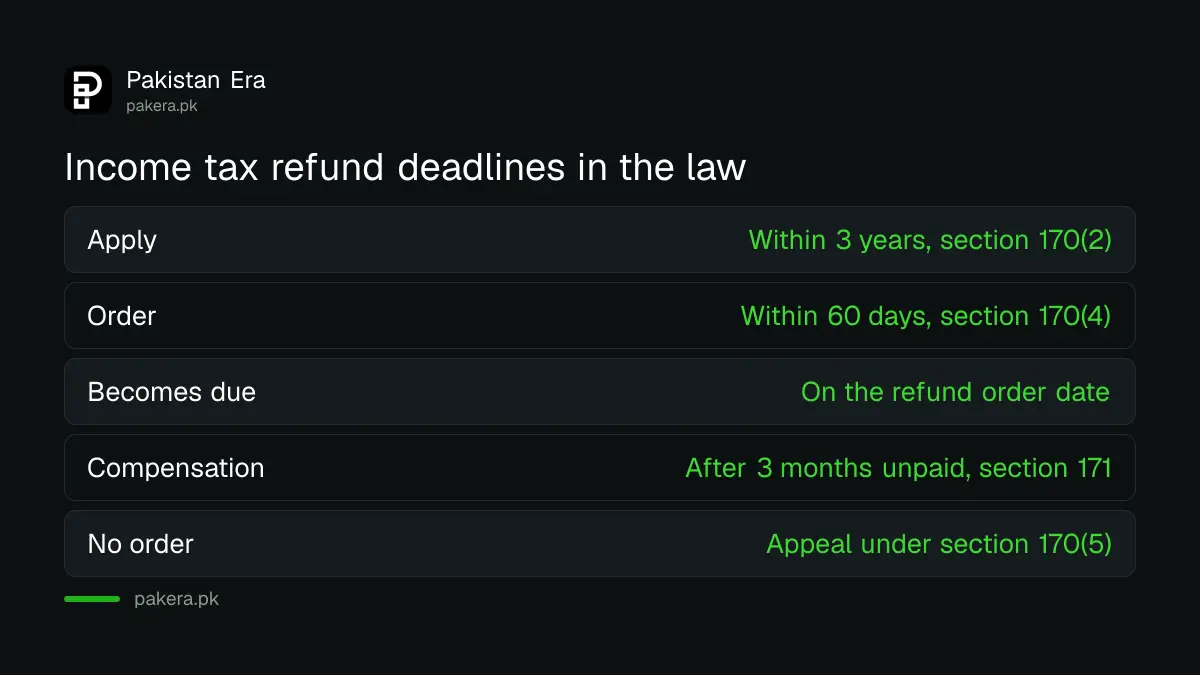
Section 170(4) of the Income Tax Ordinance gives the Commissioner 60 days from receiving your application to serve a written order, after giving you a chance to be heard. Section 171 then adds compensation if the refund is not paid within three months of falling due.
| Stage | Deadline in the law | Section |
|---|---|---|
| Apply for the refund | Within 3 years of the assessment order or the tax payment, whichever is later | 170(2)(c) |
| Commissioner decides | Written order within 60 days of the application | 170(4) |
| Refund becomes due | On the date the refund order is made | 171(2)(c) |
| Compensation starts | If unpaid 3 months after it became due | 171(1) |
| Appeal | Against the order, or against no order in 60 days | 170(5) |
Before paying, the Commissioner first sets the excess against any other income tax you owe, then against other tax liabilities, and refunds only what remains. That is section 170(3). So a refund smaller than you expected is not always an error. Ask for the order, which should show the adjustment.
FBR's web page says two years, but the law says three
FBR's refund page says a refund can be claimed within two years. The Income Tax Ordinance, as amended up to 30 June 2026, says three years. The Finance Act 2016 changed "two" to "three" in section 170(2)(c), so the law gives you the longer window.
The three years run from the later of two dates: the date of the assessment order for that tax year, or the date the tax was paid. For a return you filed yourself, the assessment is treated as made on the filing date. We point out the gap because a reader who trusts the web page may think a claim has expired when it has not.
Refunds go only to the IBAN in your IRIS profile
FBR runs a centralised system that pays income tax refunds by electronic transfer. It asks every taxpayer to add the complete IBAN of the same bank account already in the IRIS profile. A wrong or missing IBAN is a common reason a sanctioned refund never arrives.
FBR publishes a short guide, Steps to Manage Bank Account, for adding the account. Changing a bank account in the profile goes through a modification form, and changing your bank account in IRIS walks through it.
Section 170A also lets FBR pay some refunds without any application, from tax year 2021 onwards, up to the tax credit its computer system can verify. If you see a transfer from FBR you did not apply for, that is the likely reason. We found no published list of who gets these automatic refunds.
Late filers get no refund while they are off the ATL
Section 182A blocks refunds for anyone who filed after the due date, for as long as the person is not on the Active Taxpayers List. That period also does not count towards compensation for delay. For tax year 2026, the due date was 31 October 2026.
So a late filer has to get back on the list first, by paying the ATL surcharge of Rs 25,000 for an individual or by giving the six-month property undertaking. The late return penalty after 31 October works through both routes.
When the refund is late, appeal or complain
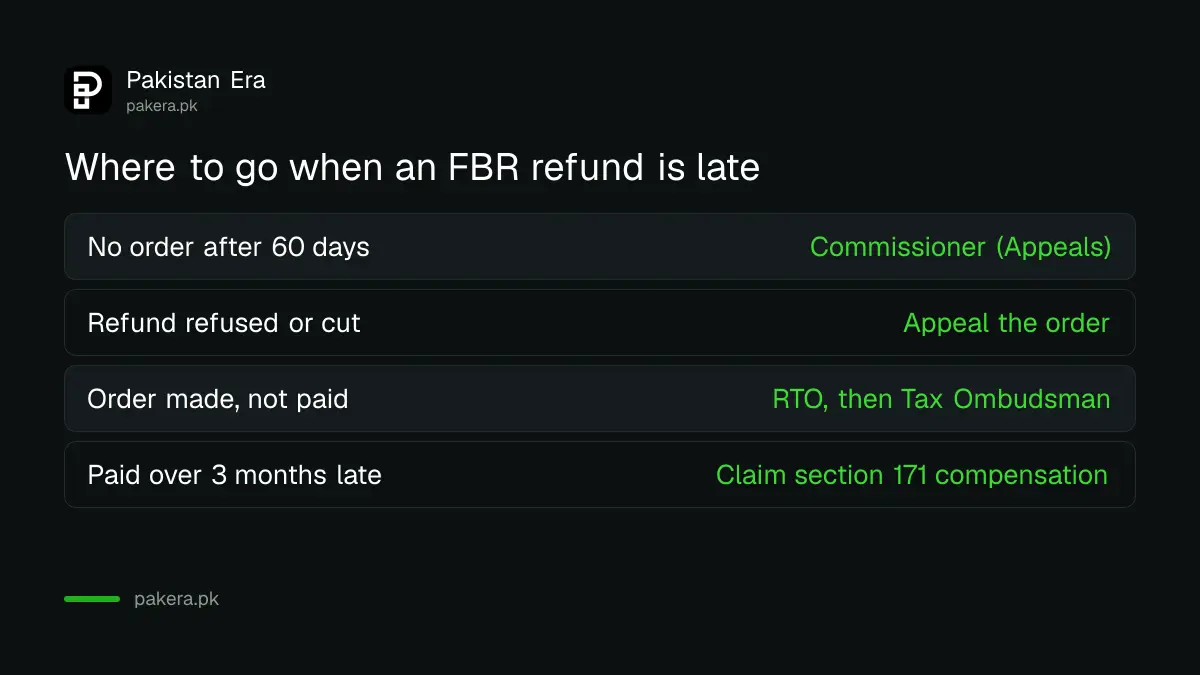
If the Commissioner passes no order within 60 days, section 170(5) lets you appeal to the Commissioner (Appeals), just as you could against a refusal. For delay without a decision, the Federal Tax Ombudsman takes complaints against FBR free of charge.
| Problem | Where to go |
|---|---|
| No order after 60 days | Appeal to the Commissioner (Appeals) under section 170(5) |
| Refund refused or cut | Appeal against the order under section 170(5) |
| Order made, money not paid | RTO first, then the Federal Tax Ombudsman |
| Paid more than 3 months late | Ask for compensation under section 171 |
The appeal route, fees and time limits are in appealing an FBR income tax order. For maladministration and delay, a complaint to the Federal Tax Ombudsman is free and filed online.
Compensation runs at KIBOR plus 0.5 per cent a year on the unpaid refund, from the end of the three months until the day it is paid. The law suspends it where FBR has reason to believe the claim is not admissible, until that check is finished.
Common questions
Can I check my FBR refund status by CNIC?
We found no public refund tracker by CNIC. FBR says to ask your Regional Tax Office, and your application and any notices are in IRIS.
How long does FBR take to decide a refund?
Section 170(4) gives the Commissioner 60 days from the application to serve a written order.
How long do I have to apply for a refund?
Three years under section 170(2)(c), from the later of the assessment order date and the date the tax was paid. FBR's web page still says two years.
Does FBR pay interest on a late refund?
Yes. Section 171 adds compensation at KIBOR plus 0.5 per cent a year if the refund is unpaid three months after it became due.
Why was my refund smaller than the return showed?
The Commissioner first adjusts it against other tax you owe, under section 170(3). The refund order should show the adjustment.
I filed late. Will I get my refund?
Not while you are off the ATL. Section 182A blocks refunds for late filers until they rejoin the list.
How we verified this
What we checked, where we read it, and what we could not confirm.
Last checked 31 October 2026. We read FBR's income tax refund page and its page on the centralised online payment of refunds at fbr.gov.pk, and sections 170, 170A, 171 and 182A of the Income Tax Ordinance amended up to 30 June 2026. FBR's web page says two years for a claim; the Ordinance says three, and we follow the Ordinance. We did not file a refund application or open a live IRIS account, so menu names may differ slightly on your screen.
About the author

Global Affairs & Political Economy Writer
Muhammad Hatim is a book lover who started writing because he enjoys it. At Pakistan Era he writes about international relations, geopolitics and the global economy, with a particular interest in South Asia and the forces behind current events.