FBR Extends August Sales Tax Return to 2 October for DISCOs and STGO 10 Taxpayers
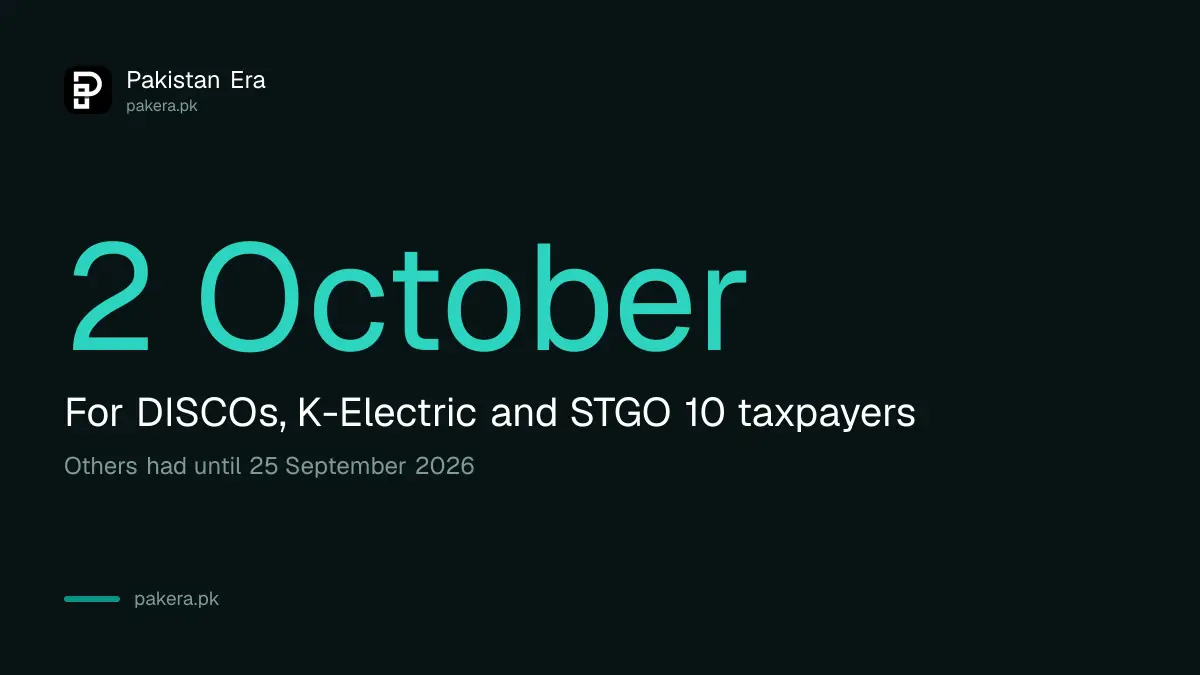
FBR extended the August 2026 sales tax return to 2 October, but only for DISCOs, K-Electric and STGO 10 taxpayers. Others had until 25 September. Check yours.

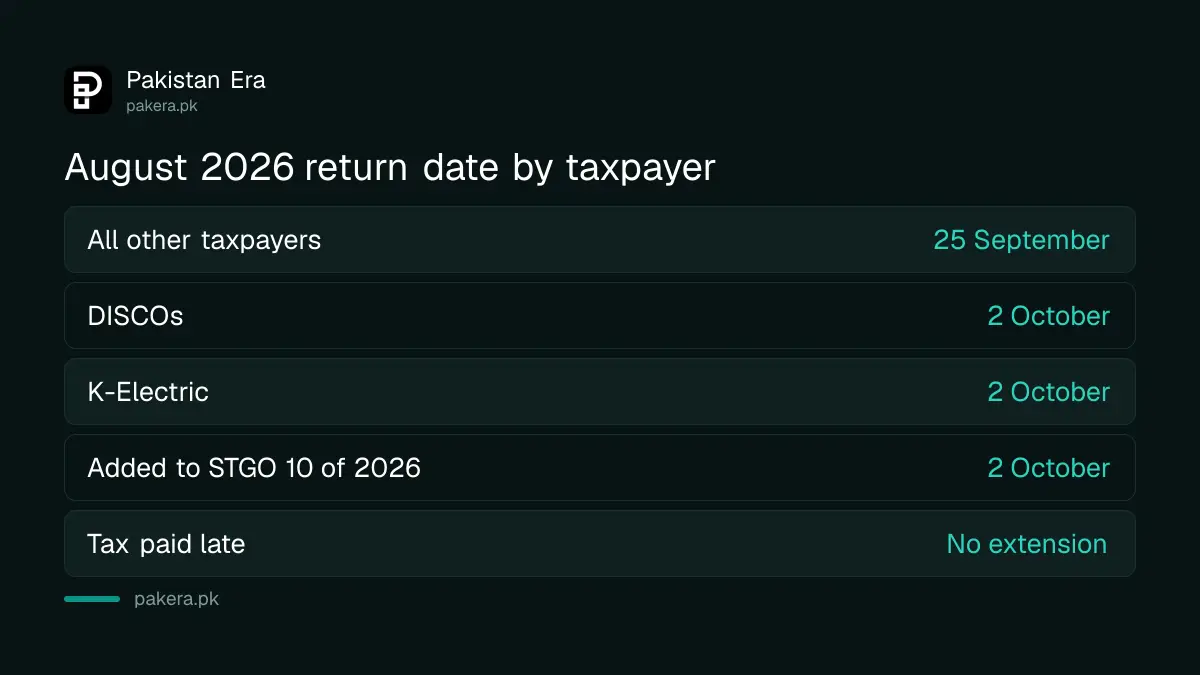
FBR has extended the August 2026 sales tax and federal excise return date to 2 October 2026, but only for electricity distribution companies (DISCOs), K-Electric and the taxpayers added to Sales Tax General Order 10 of 2026. For every other registered person, the extended date was 25 September 2026, and it has passed.
FBR issued three letters on the August return in under two weeks. We read all three on fbr.gov.pk on 1 October 2026. Each one is signed by the Second Secretary (ST-L&P) at the Federal Board of Revenue (FBR) and sent to the Chief Commissioners of the Large Taxpayers Offices, Corporate Tax Offices and Regional Tax Offices.
The headline on FBR's homepage reads like a general extension. It is not. The latest letter, dated 30 September 2026, names a narrow group. A shopkeeper or small manufacturer who missed 25 September is not covered by it.
FBR extended the August sales tax return to 2 October for DISCOs only
The 30 September letter extends the August 2026 sales tax and federal excise return to 2 October 2026 for DISCOs, K-Electric and taxpayers added to STGO 10 of 2026, dated 14 July 2026. It applies only if the sales tax due was already deposited by its normal due date.
The letter is reference C.No. 9(11) ST-LP&E/Misc/2016/109486-R. It has one paragraph. It uses section 74 of the Sales Tax Act, 1990 and section 43 of the Federal Excise Act, 2005, which are the provisions FBR cites when it extends a time limit.
Two words in it matter. "Return" means the filing. The payment is a separate obligation, and none of the three letters moves it. The condition at the end of each letter says the extension holds only where the "due sales tax liability has been deposited within due date".
Three FBR letters moved the August return date in two weeks
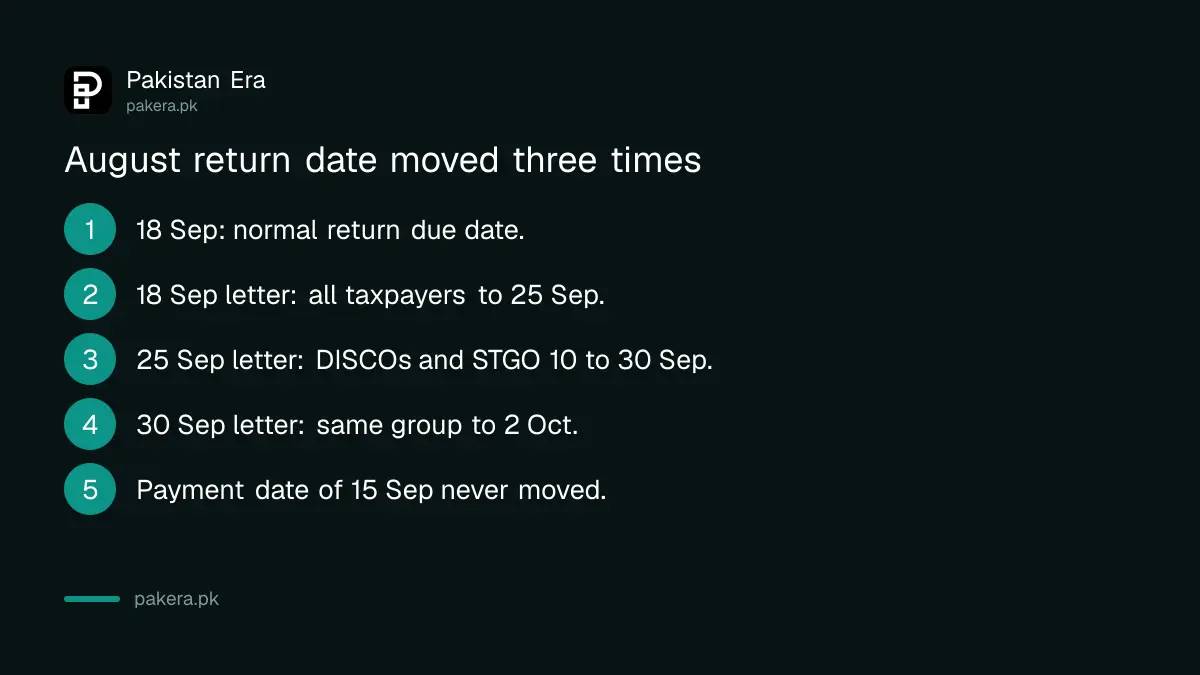
FBR first gave all taxpayers until 25 September. It then gave DISCOs, K-Electric and STGO 10 taxpayers until 30 September, and finally until 2 October. Each letter carries the same subject line, which is why the homepage now shows the same title twice.
| FBR letter date | Who it covers | New return date | Reason given |
|---|---|---|---|
| 18 September 2026 | All taxpayers | 25 September 2026 | None stated |
| 25 September 2026 | DISCOs, K-Electric, taxpayers added to STGO 10 of 2026 | 30 September 2026 | Technical system issues |
| 30 September 2026 | DISCOs, K-Electric, taxpayers added to STGO 10 of 2026 | 2 October 2026 | None stated |
The 25 September letter is the only one that gives a reason. It says "technical system issues" were reported in applying SRO 1245(I)/2026 of 31 July 2026 to DISCOs and K-Electric, and in the "system linkages of corporate entities" under STGO 10 of 2026.
The DISCO extension is linked to sales tax collected through electricity bills
SRO 1245(I)/2026 sets sales tax on steel melters, composite units and re-rollers per unit of electricity they use. That tax is collected through their electricity bills, so the DISCOs and K-Electric must report it. Their August returns are the ones FBR says ran into trouble.
FBR amended that SRO again on 29 September 2026, through SRO 1664(I)/2026. We read the amendment on fbr.gov.pk. It sets sales tax for steel re-rollers at Rs 30 per electricity unit consumed. Steel melters and composite units in the former FATA and PATA areas that use local scrap pay Rs 20 a unit, or Rs 5 a unit if more than 70 per cent of their raw material over the past 12 months was imported or bought directly from EFS registered persons.
The amendment also says the tax collected this way is advance tax. The steel units can adjust it against their output sales tax. That is a lot of new arithmetic for a power company's billing system to carry, and it may help explain why the return needed more time.
We could not find STGO 10 of 2026 on FBR's site, so we cannot say which corporate taxpayers it added. If you are not sure whether you are one of them, ask your Regional Tax Office before 2 October rather than assume you are.
The normal sales tax return dates are the 10th, 15th and 18th
FBR's own due dates page says a registered person files Annexure C by the 10th, pays by the 15th and e-files the return by the 18th of the month after the tax period. For August 2026, the return was due on 18 September 2026.
Annexure C is the list of your sales for the month. It feeds your buyers' input tax claims, which is why it comes first. The monthly sales tax return follows the same order every month.
So the August payment was due on 15 September. That date did not move. A return filed on 2 October with tax paid late is outside the extension, even for a DISCO.
What to do if you missed the 25 September date
If you are not a DISCO, K-Electric or an STGO 10 taxpayer, your August return was due by 25 September 2026. File it now on IRIS. FBR's page says a return more than six months late needs the Commissioner's approval, so do not let it drift.
- Log in to IRIS and open the Sales Tax return for the August 2026 tax period.
- Check that Annexure C, your sales list, is complete and submitted.
- Check that the August tax was paid. Keep the payment slip number.
- Submit the return and download the acknowledgement.
- If IRIS shows a default surcharge or penalty, note the amount and speak to your tax adviser or Regional Tax Office before paying anything extra.
We have not quoted a penalty figure here because we did not read one for this case on an FBR page. The amount depends on the section applied and on how late you are. The sales tax return is separate from the income tax return, which FBR has extended to 15 October 2026 under its own circular.
New businesses often miss this split. A sales tax registration brings a monthly return every month, even a month with no sales.
Common questions
Has FBR extended the sales tax return date for August 2026?
Yes. All taxpayers had until 25 September 2026. DISCOs, K-Electric and taxpayers added to STGO 10 of 2026 now have until 2 October 2026.
Is the 2 October date for all sales tax payers?
No. The 30 September letter covers only DISCOs, K-Electric and taxpayers added to STGO 10 of 2026, dated 14 July 2026.
Did FBR extend the date to pay sales tax?
No. Each letter extends only the return. It holds only if the tax was deposited by the normal due date, which is the 15th.
Under which law did FBR extend the date?
Section 74 of the Sales Tax Act, 1990 and section 43 of the Federal Excise Act, 2005, as each letter states.
Why did FBR give DISCOs more time?
The 25 September letter cites technical system issues in applying SRO 1245(I)/2026 to DISCOs and K-Electric, and in system links of corporate entities under STGO 10.
What is the normal sales tax return due date?
The 18th of the following month, per FBR's due dates page. Annexure C is due by the 10th and payment by the 15th.
How we verified this
What we checked, where we read it, and what we could not confirm.
Last checked on 1 October 2026. We read the three FBR letters titled "Extension in Date of Submission of Sales Tax & Federal Excise Return for the Tax Period of August, 2026", dated 18, 25 and 30 September 2026, as scanned PDFs linked from the FBR homepage. We read SRO 1664(I)/2026 of 29 September 2026 on the same site. The 10th, 15th and 18th dates are from FBR's Sales Tax Due Dates page, and the six month rule is from its File Sales Tax Return page. We could not find STGO 10 of 2026 or the original SRO 1245(I)/2026 text, so we do not describe which corporate taxpayers STGO 10 covers. This is general information, not tax advice.
About the author

Tax, Bills and Technology Writer
Ali Akhtar is a young and curious voice here at Pakistan Era. He is currently pursuing his A-Levels and has a growing interest in Pakistan’s changing industrial landscape and educational trends. Ali likes to write in a way that helps him explain and explore the world around him. His writing reflects the perspective of the new generation navigating the evolving trends of Pakistan where technology, youth innovation, and shifting opportunities are reshaping the country’s future.