FBR S.R.O. 2063: Advance Payments Now Need an Advance Receipt Invoice, Tax Due in the Month Received
FBR's S.R.O. 2063 of 5 November 2026 rewrites rule 160: issue an advance receipt invoice on each advance and declare its sales tax in that month's return.
FBR has told sales tax registered businesses how to handle advance payments. Under S.R.O. 2063(I)/2026, dated 5 November 2026, you must issue an advance receipt invoice each time a customer pays in advance, and declare the output tax on that payment in the return for the month you receive it, not the month you deliver. The final invoice then charges tax only on the value not already covered.
We read the signed notification on FBR's website on 6 November 2026. It replaces rule 160 of the Sales Tax Rules, 2006 with a new rule titled "Accounting for advance payments against supplies". FBR, the Federal Board of Revenue, issued it under section 50 of the Sales Tax Act, 1990, read with sections 9 and 23.
This fills a gap we flagged last month. Our guide to the unique FBR invoice number and advance receipt invoices explained that the Finance Act 2026 named the advance receipt invoice but left the working rules to FBR. These are those rules.
An advance receipt invoice is now due on every advance payment
The new rule 160(1) applies to any registered person, or class of persons, covered by section 23 of the Act. When that person receives an advance payment against a supply, in full, in part or in instalments, it must issue an advance receipt invoice at the time it receives each payment.
The invoice must carry the particulars set out in section 23, as far as they apply. The rule says the advance receipt invoice "shall be treated as a tax invoice" for sections 7 and 8 of the Act. Section 7 covers input tax claims and section 8 covers input tax that cannot be claimed. So your buyer's input tax position follows the advance invoice too.
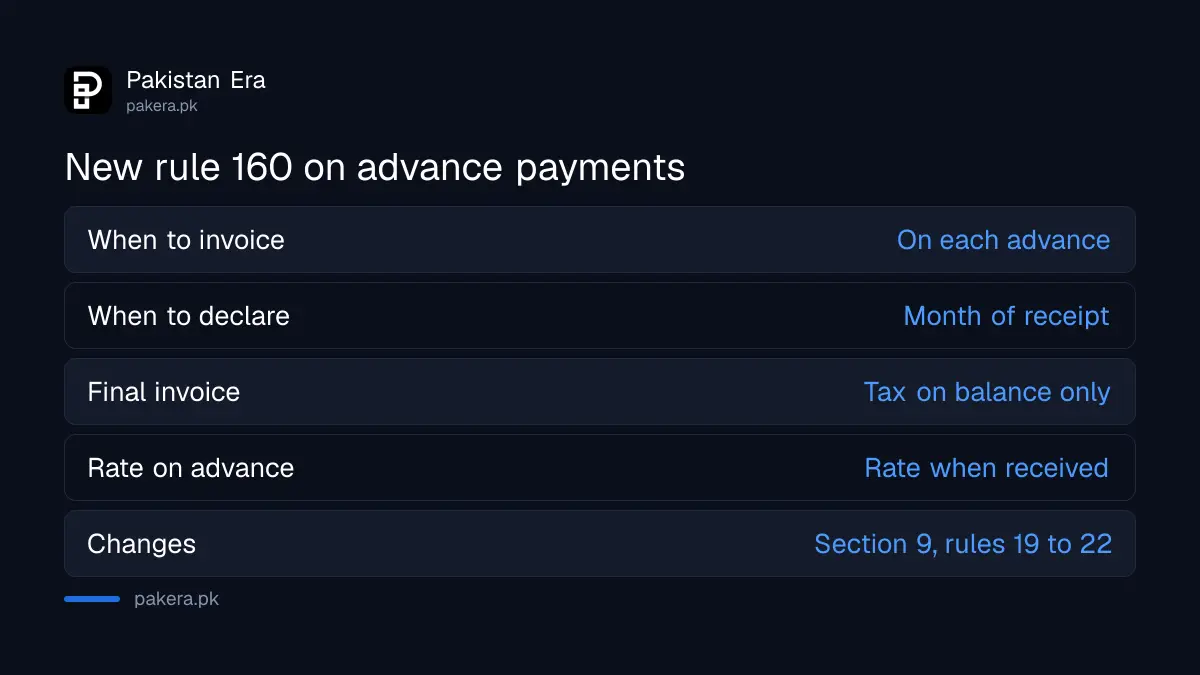
| Point | What the new rule 160 says |
|---|---|
| When to invoice | At the time each advance payment is received |
| When to declare tax | In the return for the tax period of receipt |
| Several advances | A separate invoice for each, linked to the earlier ones |
| Final supply | Final invoice referring to every advance invoice |
| Rate on the advance | The rate in force when the advance was received |
| Rate on the rest | The rate in force at the time of supply |
| Changes or refunds | Adjust under section 9 and rules 19 to 22 |
Output tax moves to the month you receive the money
This is the change most businesses will feel first. The rule says you "shall account for and declare the output tax payable" on the advance in the return for the tax period in which the advance is received. A builder, supplier or manufacturer who takes a deposit in November now reports tax on that deposit in the November return.
That can mean paying tax before the goods leave. Plan your cash for it. If you file monthly returns, our guide to filing the monthly sales tax return covers the steps, and our page on late return penalties shows what a missed month costs.
A worked example with two advances
Here is how the rule plays out for a supply worth Rs 1,000,000 in total. We show values only. The rule does not say how to split tax out of an advance that already includes tax, so check that with your adviser.
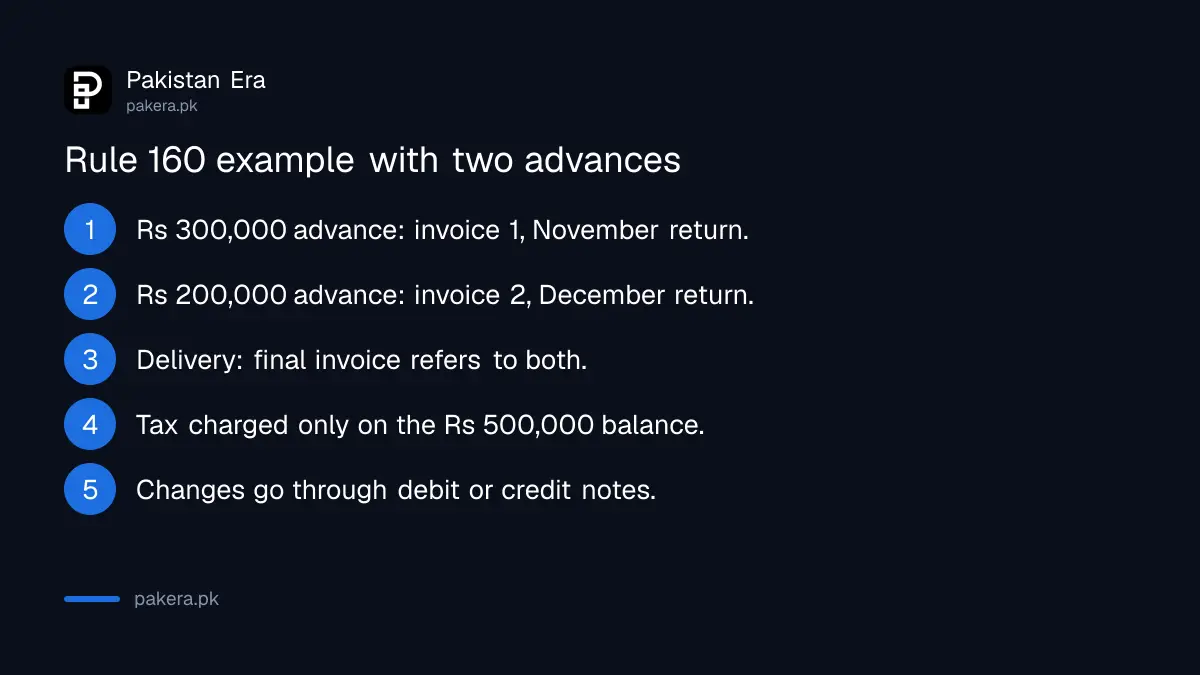
- On 10 November the customer pays Rs 300,000. You issue advance receipt invoice 1 and declare tax on it in the November return.
- On 5 December the customer pays Rs 200,000. You issue advance receipt invoice 2, linked to invoice 1, and declare tax on it in the December return.
- On 15 January you deliver. You issue a final sales tax invoice that refers to invoices 1 and 2.
- The final invoice charges tax only on the remaining Rs 500,000, at the rate in force on 15 January.
- If the order is later reduced or cancelled, you issue a debit or credit note under section 9 and rules 19 to 22.
Rule 160(4) matters if a rate changes in between. The two advances keep the rate in force when you received them. Only the Rs 500,000 balance uses the rate on the day of supply.
Every invoice must link electronically
Rules 160(2) and 160(6) require the chain to be traceable. Each later advance receipt invoice must be linked "in the prescribed electronic manner" to the earlier ones. The advance invoices, any debit or credit notes, and the final invoice must all be electronically linked and kept as the rules or the Board specify.
In practice that points to FBR's electronic invoicing system. If you are not yet integrated, our guide to FBR digital invoicing and licensed integrators lists the routes. The notification itself does not name a software, a format or a start date for the linking.
What to do now
The notification gives no separate start date, so read it as applying from its issue on 5 November 2026 unless FBR says otherwise. A short checklist for a registered business:
- List every open order where you have taken money in advance.
- Issue an advance receipt invoice for each advance received from now on.
- Declare the output tax on advances in the return for the month you received them.
- Number and link each advance invoice to the earlier ones for the same order.
- On delivery, refer to all advance invoices and charge tax only on the balance.
Before acting on any FBR notification you receive by email or WhatsApp, check it on FBR's own site. Our guide to checking an FBR SRO shows how.
Common questions
What is S.R.O. 2063(I)/2026?
It is an FBR notification dated 5 November 2026 that replaces rule 160 of the Sales Tax Rules, 2006 with new rules for accounting for advance payments against supplies.
When must I issue an advance receipt invoice?
At the time you receive each advance payment, whether it is the full amount, a part or one of several instalments.
In which month do I pay sales tax on an advance?
In the return for the tax period in which you received the advance, under the new rule 160(1).
Do I pay tax again when I deliver the goods?
Only on the value not already covered by advance receipt invoices. The rule says value and tax already accounted for shall not be accounted for again.
Which tax rate applies if the rate changes before delivery?
Each advance keeps the rate in force when it was received. The remaining value uses the rate in force at the time of supply.
What if the customer cancels after paying an advance?
You adjust it under section 9 of the Sales Tax Act and the debit and credit note procedure in rules 19 to 22.
What we checked and sources
We read the signed text of S.R.O. 2063(I)/2026, dated 5 November 2026, linked from the updates list on fbr.gov.pk, on 6 November 2026. The worked example is ours and uses values only. We did not find FBR guidance on splitting tax out of a tax-inclusive advance, on the electronic linking format, or on a separate start date.
About the author

Tax, Bills and Technology Writer
Ali Akhtar is a young and curious voice here at Pakistan Era. He is currently pursuing his A-Levels and has a growing interest in Pakistan’s changing industrial landscape and educational trends. Ali likes to write in a way that helps him explain and explore the world around him. His writing reflects the perspective of the new generation navigating the evolving trends of Pakistan where technology, youth innovation, and shifting opportunities are reshaping the country’s future.