FBR Cuts the Steel Melters' Scrap Test From 12 Months to 6 Months
FBR's S.R.O. 1788 of 13 October 2026 changes the steel melters' Rs 5 per unit scrap test to six months. See what moved, what stayed and what to check this week.
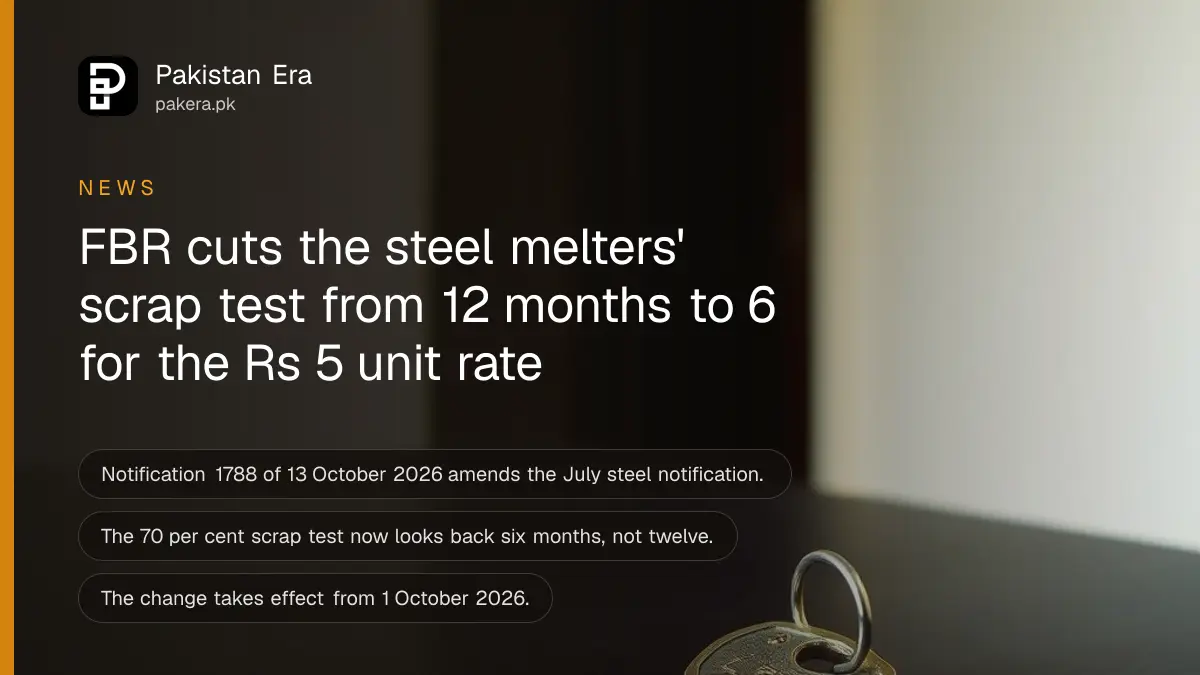
Short answer: FBR issued S.R.O. 1788(I)/2026 on 13 October 2026. It changes the July notification on sales tax per unit of electricity for steel melters. The Rs 5 rate now depends on the last six months of scrap use, not twelve. The change takes effect from 1 October 2026.
A steel melter pays sales tax on every unit of electricity its furnace uses. The rate it pays depends on the scrap it melts. So the window FBR uses to count that scrap decides whether the bill is Rs 5 a unit or Rs 30.
We read the new notification and the July one on FBR's own site on 14 October 2026. This is a short, technical change. We explain what the text says and mark what we could not match.
The scrap test now looks back six months, not twelve
S.R.O. 1788(I)/2026 amends S.R.O. 1245(I)/2026 of 31 July. In clause (a) of the July notice, wherever the word "twelve" appears, the word "six" now stands. The test of how much scrap a melter used therefore covers six months.
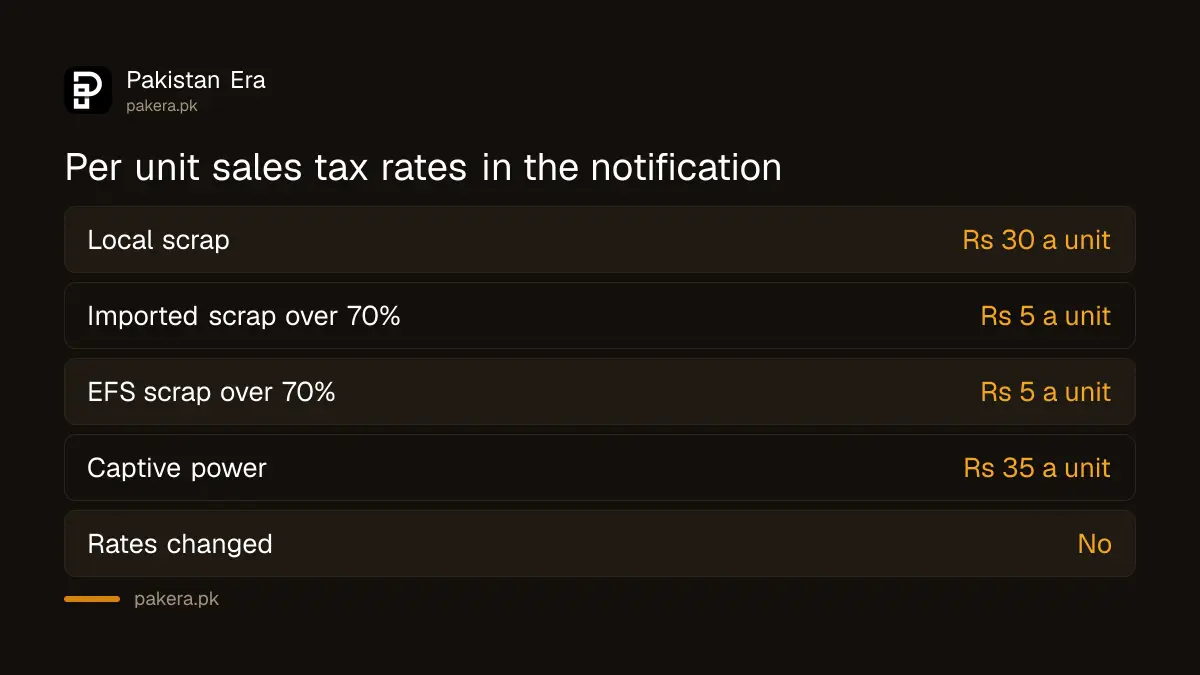
The July notice set three rates. A melter using local scrap pays Rs 30 a unit. A melter whose imported scrap exceeded 70 per cent over the last twelve months pays Rs 5. A melter using scrap supplied by an EFS licensee over 70 per cent in the same twelve months, counted from 1 June 2026, also pays Rs 5. Captive power or self-generation pays Rs 35.
| Item | July notice (1245) | After 13 October (1788) |
|---|---|---|
| Window for the 70 per cent scrap test | Last twelve months | Last six months |
| Rate for local scrap | Rs 30 a unit | No change |
| Rate if the test is met | Rs 5 a unit | No change |
| Captive power | Rs 35 a unit | No change |
| Start date | 1 July 2026 | Change applies from 1 October 2026 |
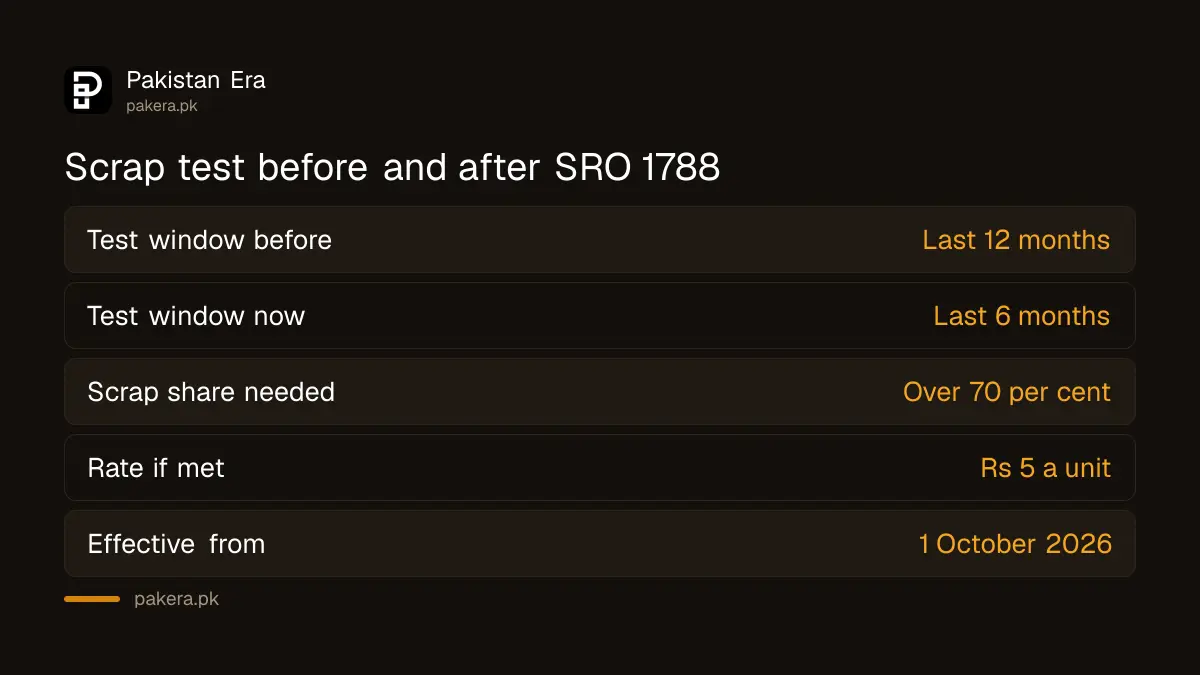
The new text does not change any rate. It only changes how far back FBR looks.
FBR put off the real-time reporting condition
The July proviso tied the Rs 5 rate to being connected to FBR's computer system for real-time reporting. The new notice adds that this connection will apply from a date FBR will set later through a Sales Tax General Order. Until then, the connection appears not to be a condition for the lower rate.
That is our reading of the sentence added to the proviso, not an FBR explanation. FBR has not yet published the date in anything we found. A melter should watch for the general order, because the rate may depend on it once it arrives.
One more edit: in a sub-clause (viii), the words "or registered persons" are deleted. The July text we read does not carry a sub-clause with that number in the form we could read, so we cannot tell you what it changes. We will not guess.
The change reaches back to 1 October
The notification is dated 13 October, but it says it takes effect from 1 October 2026. For a melter that means the six-month test can apply to the October electricity bill even though the notice came after the month began. Ask your accountant how the bill was assessed.
The bill itself is raised by the power distribution company. The July notice says the companies must apply the per-unit rate from 1 July 2026 to all melters, re-rollers and composite units, and may disconnect a melter that does not pay by the due date on the bill.
What a melter should check this week
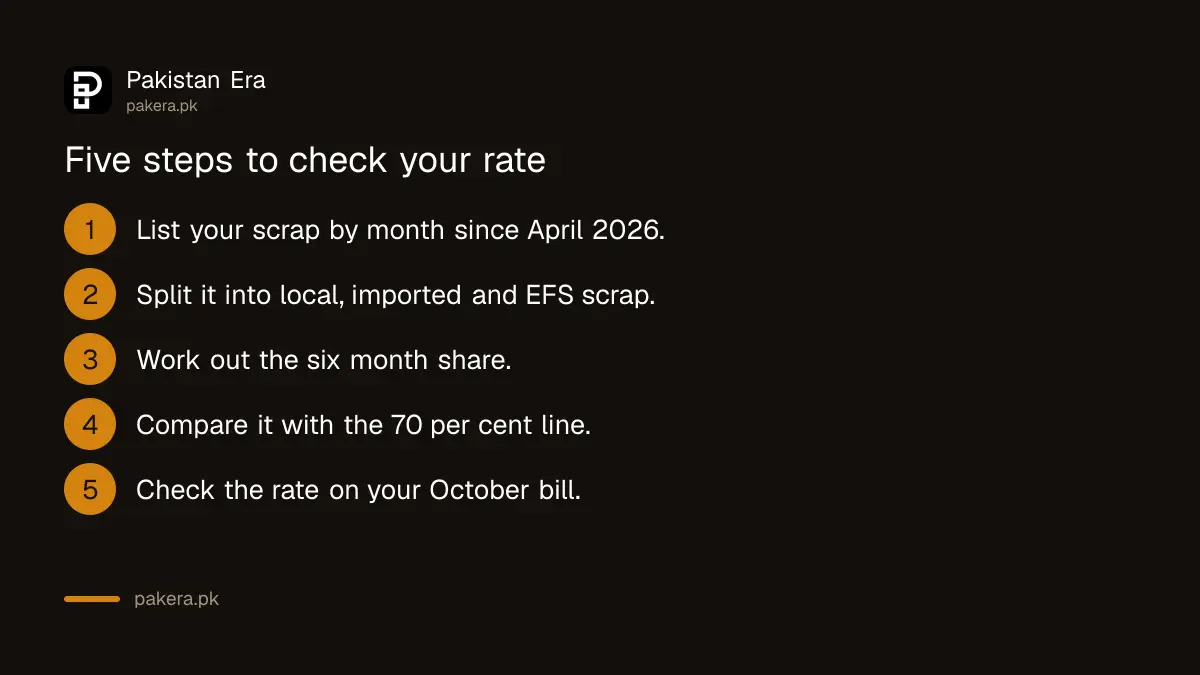
Pull out your scrap purchase and consumption records, and count how much of your last six months of raw material was imported scrap or EFS scrap. If the share is above 70 per cent, you may qualify for Rs 5. Compare that with your latest bill.
- List the scrap you melted each month since April 2026, split into local, imported and EFS-supplied.
- Work out the imported plus EFS share over the last six months.
- Compare it with the 70 per cent line in the notice.
- Check which rate is printed on your October electricity bill.
- If the two do not match, ask FBR through your sales tax office and keep the bill and your records.
The electricity units are also reported in a return. The steps are in how to declare electricity units in Annex K on IRIS. For the July rules in full, see the earlier steel sales tax notification.
A second sales tax notification came out the same day
S.R.O. 1789(I)/2026 is also dated 13 October. It changes a date in Table-1 of an older notification, S.R.O. 1190(I)/2019, issued under section 8B of the Sales Tax Act. At serial number 15 the date "30th September" becomes "31st December".
We read the new notice but could not identify which category of taxpayer sits at serial 15, so we do not say who gains. We also did not find a plain explanation on FBR's site. If you think you are covered, ask your tax adviser to open the consolidated Table-1 and check serial 15.
FBR is also adding factory video monitoring in several sectors. See the video surveillance order for factories and how long to keep sales tax records.
Common questions
What does S.R.O. 1788(I)/2026 change?
It shortens the look-back for the 70 per cent scrap test from twelve months to six, and delays the real-time reporting condition until a date FBR sets later.
Did the Rs 5, Rs 30 and Rs 35 rates change?
No. The notification changes the test window and the reporting condition, not the three rates.
From when does it apply?
The notification says it takes effect from 1 October 2026, which is before its own date of 13 October.
Who collects the tax?
The electricity distribution company collects it through the bill, according to the July notice. The melter pays it as part of the electricity charge.
Where can I read the notification?
On FBR's SROs page. The notification number is S.R.O. 1788(I)/2026, dated 13 October 2026.
How we verified this
What we checked, where we read it, and what we could not confirm.
Last checked on 14 October 2026, Pakistan time. We read S.R.O. 1788(I)/2026 and S.R.O. 1245(I)/2026 on FBR's site. The scanned text is rough, so some words are reported from an imperfect copy. We could not match sub-clause (viii) or serial 15 of Table-1 to a taxpayer group, and we saw no Sales Tax General Order with the reporting date.
About the author

Public Services and Education Journalist
Fajr Riaz is a journalist and content writer at Pakistan Era, based in Lahore. She covers the questions people meet in everyday life in Pakistan: how a public service works, what a change in the rules means, and where to find a reliable answer.