Keep Your Sales Tax Records for Six Years: FBR Rules, the Rs 50,000 Bank Rule and Penalty
Keep sales tax records for six years: what FBR says each register must show, the Rs 50,000 bank payment rule and the Rs 5,000 monthly penalty. Check yours now.
Short answer: A person registered for sales tax with FBR must keep a record of everything supplied, bought and imported, in English or Urdu, for six years after the end of the tax period. Payments above Rs 50,000 should go through a bank instrument. If you are slow to produce records beyond 15 days, FBR's page says Rs 5,000 a month applies.
An auditor does not ask whether you paid your sales tax. He asks you to show it. A drawer of unsorted invoices and a handwritten ledger will not answer that question. Four years after a tax period is a long time to remember a supplier's name.
We read FBR's sales tax records pages and its audit page on 12 October 2026. This guide turns them into a plain filing system you can build in an afternoon.
FBR requires a record of what you supply, buy and import
FBR says a registered person must keep a record, in English or Urdu, of all goods and services supplied, purchased or imported in the course of business. The records have set details for sales, for purchases and imports, for payments and receipts, and for other papers.
"Registered person" means a business registered for sales tax. If you are not yet registered, read about the documents for sales tax registration first.
The record is not only for audit. It is what you use to work out the tax in your monthly return, which is why our guide to filing the monthly sales tax return is the natural next read.
What each record must show
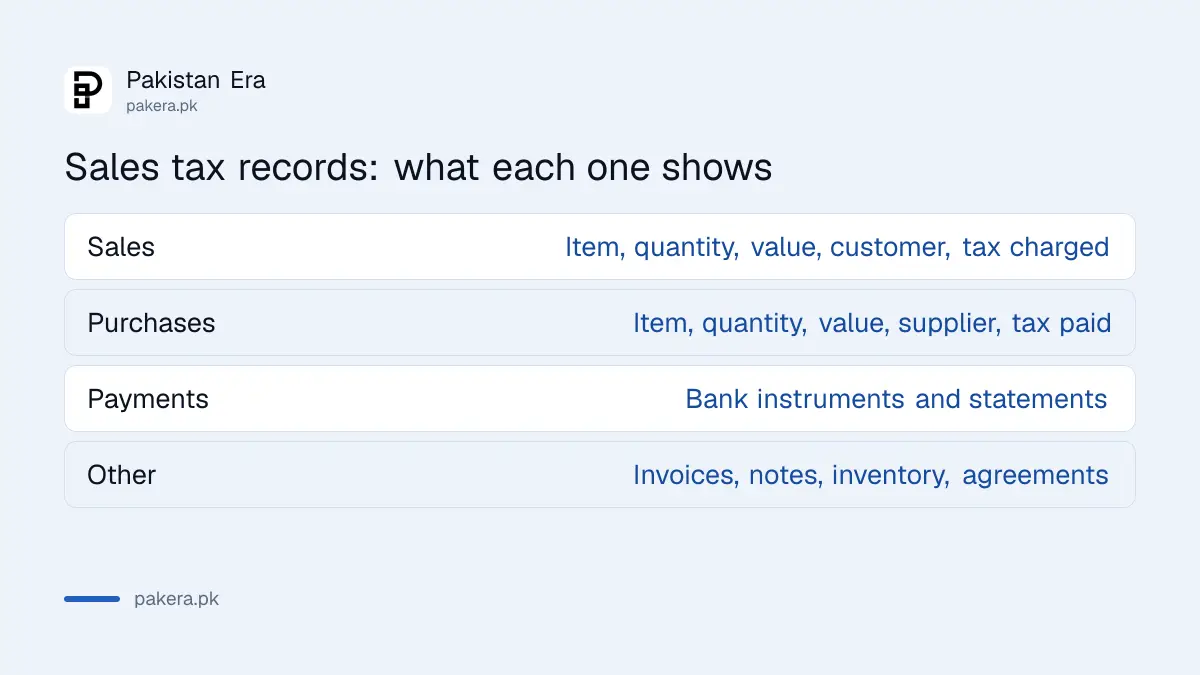
For sales, FBR lists description, quantity, value, customer name and address, and the tax charged. For purchases and imports, it lists description, quantity, value, the supplier's name, address and registration number, and the tax paid. Keep both in separate registers.
| Record | What FBR says it should show |
|---|---|
| Sales | Description, quantity, value, customer name and address, amount of tax charged |
| Purchases and imports | Description, quantity, value, supplier name, address and registration number, tax paid |
| Payments and receipts | Bank instruments showing both parties' bank accounts, with statements |
| Other records | Zero rated and exempt supplies, invoices, credit and debit notes, bank statements, inventory |
| Supporting papers | Utility bills, salary and labour bills, rent, sale, purchase and lease agreements |
At the end of each month, FBR says you must add up the sales tax shown in the sales records and transfer the total to the sales tax account as output tax. That is the figure that goes into your return.
Use a bank for any payment above Rs 50,000
FBR says that payments or receipts of sales tax on purchases or supplies above Rs 50,000, except utility bills, should be made through bank instruments that show the bank accounts of both seller and buyer. It recommends you keep photocopies of the instruments with the bank statements.
The page links this to section 73 of the Sales Tax Act and says the aim is to avoid audit complications. The practical meaning is simple. A cash payment of Rs 80,000 to a supplier leaves you with a weak record. A cheque or bank transfer leaves you with a strong one.
Digital payments are easier to document. A shop that takes payments through a bank app can match each one to a sale. Our note on accepting Raast QR payments in your shop shows one way to get a clean trail.
Keep everything for six years and keep the return too
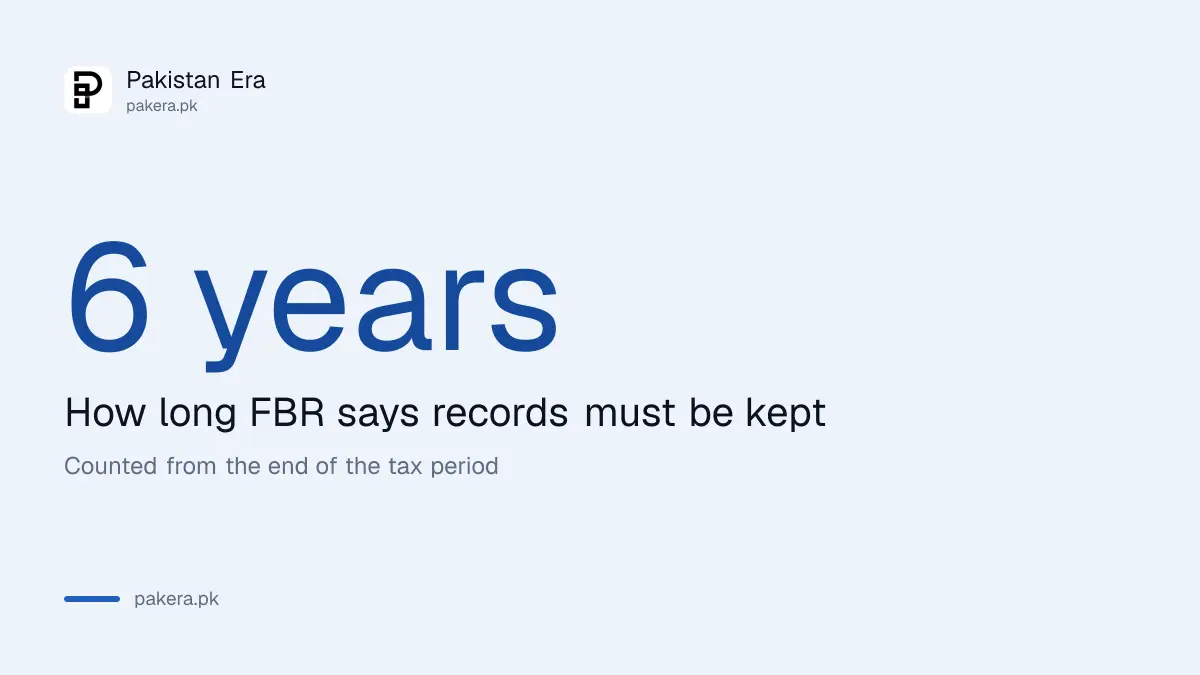
FBR says a registered person must maintain records and documents for six years after the end of the tax period they relate to. The electronic return and its attachments must be kept in electronic form and produced to the officer in charge on demand, with the supporting documents.
The page adds that if production is delayed beyond 15 days, a penalty of Rs 5,000 a month is payable. This is a figure from FBR's page, and we did not check it against the current Sales Tax Act text.
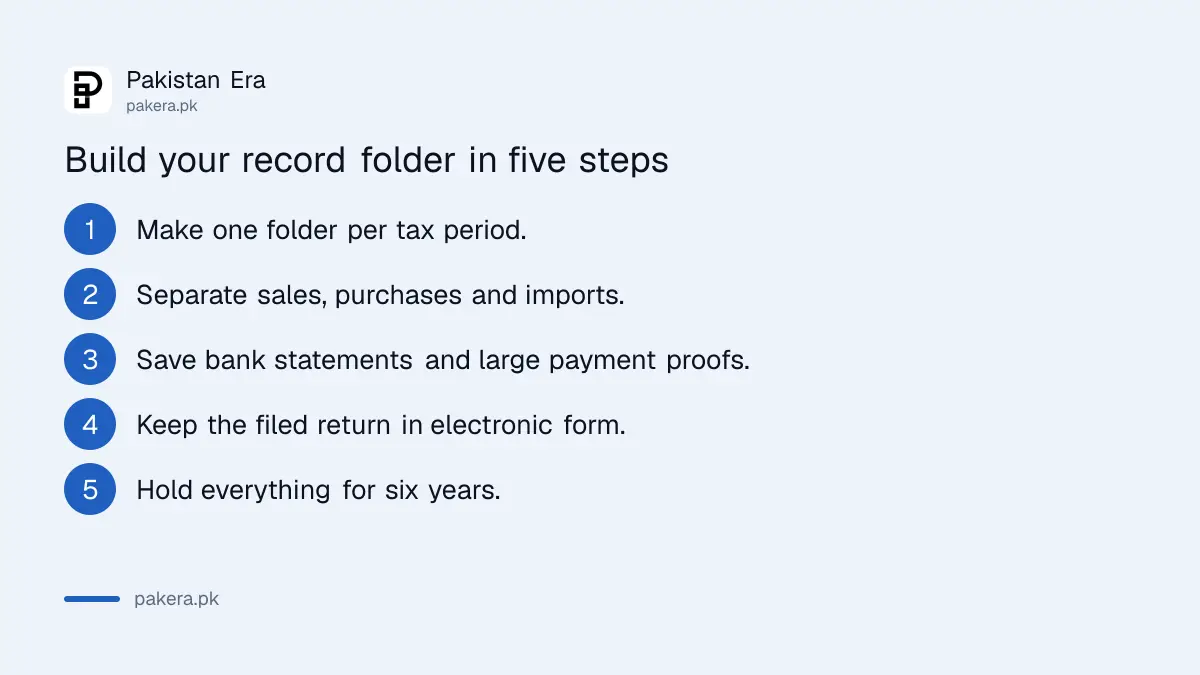
- Create one folder per tax period, named by month and year.
- File sales invoices, purchase invoices and import declarations in separate sections.
- Save each month's bank statement and every bank instrument above Rs 50,000.
- Keep a copy of the filed return and its attachments in electronic form.
- Keep the folder for six years after the period ends, then review before you discard.
How audit works and why your records matter
FBR's audit page says that, through the Finance Act 2018, a sales tax audit under section 25 of the Sales Tax Act is to be conducted only once in every three years. The page is short and does not set out exceptions. We cannot say whether other powers apply in a particular case.
Audit is only one route to your papers. Enforcement officers can ask for your records in other ways. Our report on FBR's powers to seal a factory and seize goods shows how serious missing records can become for a manufacturer.
The simplest defence is the dullest one: every sale has an invoice, every purchase has a supplier with a registration number, and every large payment went through a bank.
Common questions
How long must I keep sales tax records in Pakistan?
FBR says six years after the end of the tax period to which the records relate.
Can I keep sales tax records in Urdu?
Yes. FBR says the record must be kept in English or Urdu.
Do I need to pay by bank for purchases?
FBR says payments or receipts above Rs 50,000, except utility bills, should be made through bank instruments that show both parties' accounts.
What is the penalty for not producing records?
FBR's page says that if production is delayed beyond 15 days, Rs 5,000 a month is payable. Check the current Act before relying on it.
How often can FBR audit my sales tax?
FBR's audit page says an audit under section 25 is to be conducted once in every three years, through the Finance Act 2018.
Do I need to keep my electronic return?
Yes. FBR says the electronic return and its attachments must be kept in electronic form and produced on demand with the supporting documents.
How we verified this
What we checked, where we read it, and what we could not confirm.
We read FBR's Sales Tax Records pages and its Sales Tax Audit page on 12 October 2026. We did not read the Sales Tax Act itself, so the penalty and the audit rule are as the pages state them. Check FBR again before you rely on either.
About the author

Public Services and Education Journalist
Fajr Riaz is a journalist and content writer at Pakistan Era, based in Lahore. She covers the questions people meet in everyday life in Pakistan: how a public service works, what a change in the rules means, and where to find a reliable answer.