Federal Constitutional Court: Doctors in Khyber Pakhtunkhwa Need a Drug Sale Licence to Run a Medical Store at Their Clinic
The FCC held a KP doctor may dispense to his own patients but needs a drug sale licence to run a store, and should reply to a show-cause notice first.
Short answer: In a judgment dated 23 September 2026, the Federal Constitutional Court (FCC) held that a registered doctor in Khyber Pakhtunkhwa may dispense medicine to his own patients, but cannot run a medical store from a clinic without the drug sale licence the Drugs Act, 1976 requires. It also said doctors should answer a show-cause notice first.
Many clinics have a small shelf or room where the doctor's own prescription is filled. The question in this case was where that stops being treatment and becomes selling. The court drew a line, and it matters to patients as much as to doctors.
We read the full judgment (C.P.L.A. No. 538-P of 2023) on the court's website on 13 October 2026. It decides an appeal by the Khyber Pakhtunkhwa government against a Peshawar High Court judgment. It is a final judgment on that appeal, not a new law, and the court did not decide whether any named doctor broke the law.
A doctor may dispense to his own patients, but not run a retail store
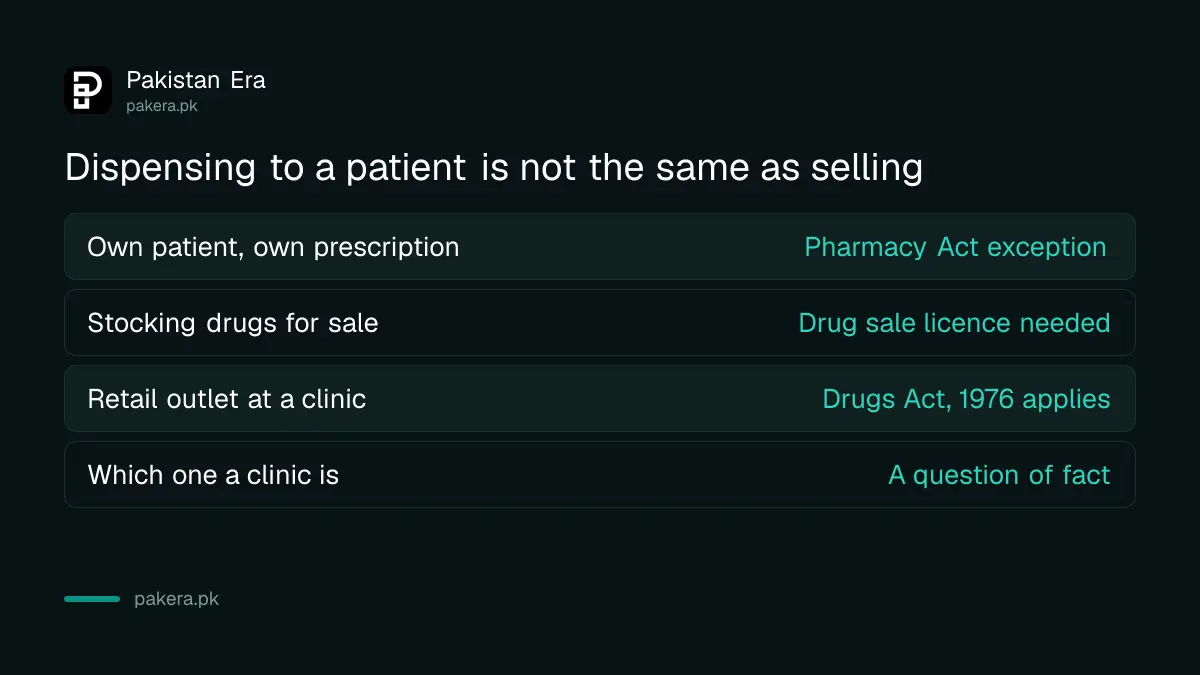
The court said section 31(4)(a) of the Pharmacy Act, 1967 protects a registered medical practitioner who dispenses medicine to his own patients or serves his own prescriptions. It does not allow him to stock and sell drugs as an independent outlet without a licence.
The judgment calls these two different activities. Dispensing as part of treatment can fall inside the Pharmacy Act exception. Stocking and selling drugs commercially is covered by the Drugs Act, 1976, which says no person shall sell a drug except under the conditions of a licence (section 23(1)(c)).
Whether a particular clinic crossed the line is a question of fact. The court said it depends on the quantity of stock, how it was bought, sales records, who received it, payment, invoices and prescriptions.
The facts: an inspection in January 2020 and show-cause notices
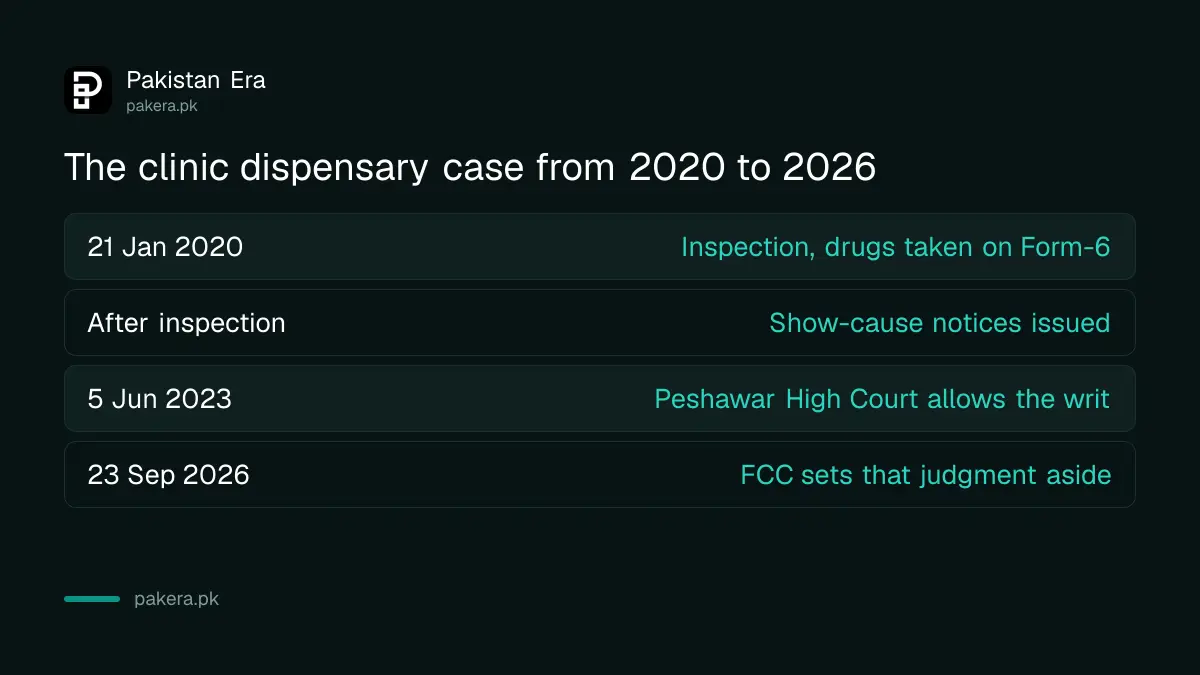
The respondents were registered medical practitioners who later went to the D.I. Khan Bench of the Peshawar High Court. An inspection on 21 January 2020 found dispensaries or medical stores inside their clinics, stocking and selling medicines without drug sale licences. Drugs were taken into custody on Form-6 and show-cause notices followed.
The doctors did not reply to the notices. They went to the Peshawar High Court under Article 199, which allowed their petition on 5 June 2023. The FCC set that judgment aside.
| Date | What happened |
|---|---|
| 21 January 2020 | Drug Inspector inspects the clinics, drugs taken on Form-6 |
| After the inspection | Show-cause notices issued |
| 5 June 2023 | Peshawar High Court allows the doctors' writ petition |
| 23 September 2026 | FCC sets the High Court judgment aside |
Reply to a show-cause notice before going to a High Court
The court said a show-cause notice is a chance to give your side before any decision is made. A person who declines it cannot ordinarily ask a High Court to decide what the authority has not yet decided. Intervention at that stage needs an exceptional defect.
The court gave examples of an exceptional defect: an authority with no jurisdiction at all, or an admitted and incurable violation of law on the face of the record. None was shown here.
It also pointed to the Drugs Act's own route. A Provincial Inspector refers a contravention to the Provincial Quality Control Board, and prosecution goes to a Drug Court. The court said the High Court should not stop that process before it runs.
What the judgment does not do
The FCC did not find the doctors guilty. It restored the statutory proceedings and said the respondents remain free to reply to the show-cause notices and prove, with prescriptions, invoices and stock registers, that they only dispensed to their own patients.
It also did not change the law for other provinces by itself. The case turned on the Drugs Act, 1976, the Pharmacy Act, 1967 and the Khyber Pakhtunkhwa Drugs Rules, 1982. In Islamabad the same licence question is explained in the guide to getting a drug sale licence to run a medical store.
What doctors and patients can do
This is a plain reading of the judgment, not legal advice. A doctor with a clinic dispensary should ask a lawyer to review the set-up against the licence rules. A patient has simpler options.
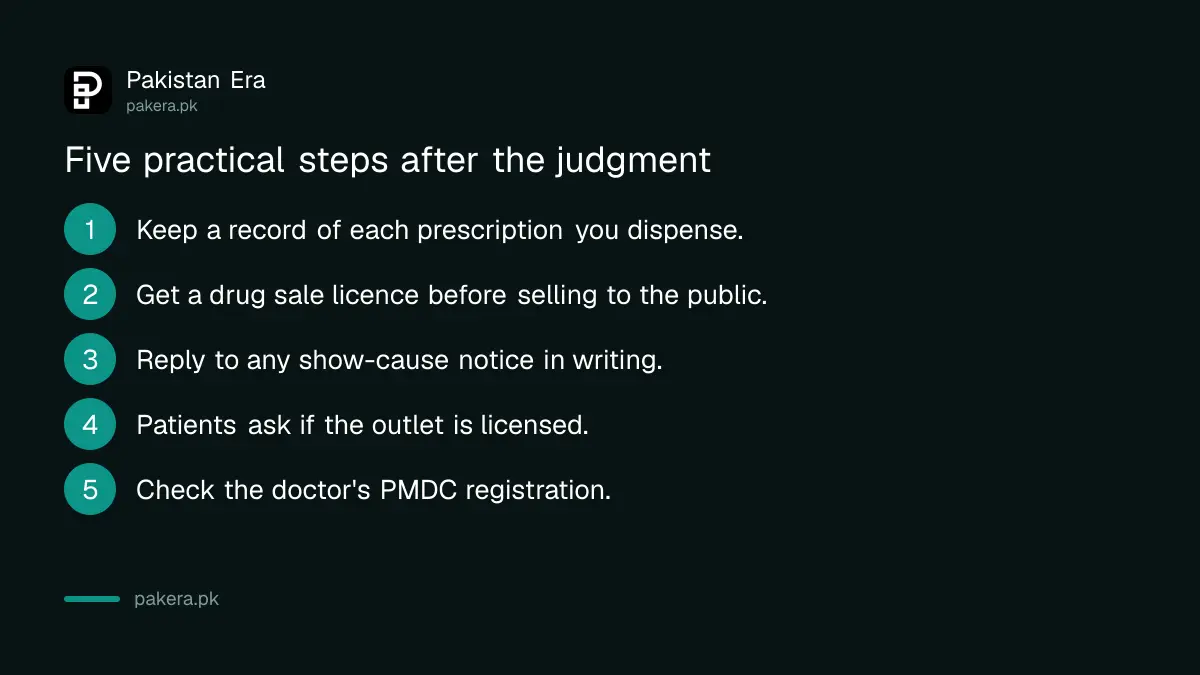
- A doctor keeps a dispensary only for his own patients' prescriptions, with a record of each one.
- A doctor who sells drugs to the public gets a drug sale licence first.
- Anyone who receives a show-cause notice replies in writing before the date given.
- A patient asks whether the outlet is licensed, and checks that the doctor is registered through the guide to checking a doctor's PMDC registration.
- A patient with a complaint about a clinic uses the route in the steps to complain against a hospital or doctor in Khyber Pakhtunkhwa.
Common questions
Can a doctor in Khyber Pakhtunkhwa give medicine from his clinic?
Yes, to his own patients as part of treatment, according to the Pharmacy Act exception the court described. Selling drugs as a store needs a drug sale licence.
Which law requires the drug sale licence?
The Drugs Act, 1976. The judgment quotes section 23(1)(c), which says no person shall sell a drug except under a licence issued under the Act.
Did the court find the doctors guilty?
No. It restored the show-cause proceedings and said it was not treating its remarks as a finding of guilt.
What should I do if I get a show-cause notice?
Reply in writing within the time given and attach your evidence. The court said a person who skips this step cannot ordinarily ask a High Court to step in early.
Does the judgment apply outside Khyber Pakhtunkhwa?
The case arose under the provincial drug rules of Khyber Pakhtunkhwa. The reasoning on the federal Drugs Act and Pharmacy Act is likely to matter elsewhere too, but we could not confirm how other courts will apply it.
How we verified this
What we checked, where we read it, and what we could not confirm.
Last checked on 13 October 2026, Pakistan time. We read the judgment in C.P.L.A. No. 538-P of 2023 on the Federal Constitutional Court judgments page, where it is listed with the date 2 October 2026. The judgment itself is dated 23 September 2026. We did not read the Drugs Act, 1976 or the Pharmacy Act, 1967 text directly for this page, so section numbers are as the court quotes them. We could not find what has happened to the show-cause proceedings since.
About the author

Tax, Bills and Technology Writer
Ali Akhtar is a young and curious voice here at Pakistan Era. He is currently pursuing his A-Levels and has a growing interest in Pakistan’s changing industrial landscape and educational trends. Ali likes to write in a way that helps him explain and explore the world around him. His writing reflects the perspective of the new generation navigating the evolving trends of Pakistan where technology, youth innovation, and shifting opportunities are reshaping the country’s future.