FCC Rules Outsourced Workers in Pakistan Have No Right to Regularisation, Even After Years
The FCC ruled 2 to 1 that workers supplied through a third-party contractor are not permanent staff and the NIRC cannot regularise them. What workers can do.
The Federal Constitutional Court of Pakistan has ruled, by two judges to one, that a worker supplied to an organisation through a third-party contractor does not become its permanent employee and has no right to be regularised, however long the worker serves there. The judgment, released on 23 November 2026, also says the National Industrial Relations Commission (NIRC) cannot order regularisation.
This matters to the many guards, cleaners, drivers, data entry staff and dispensers who work inside banks, government offices and companies but are paid by a manpower firm. The ruling is marked approved for reporting, so employers can rely on it in similar cases.
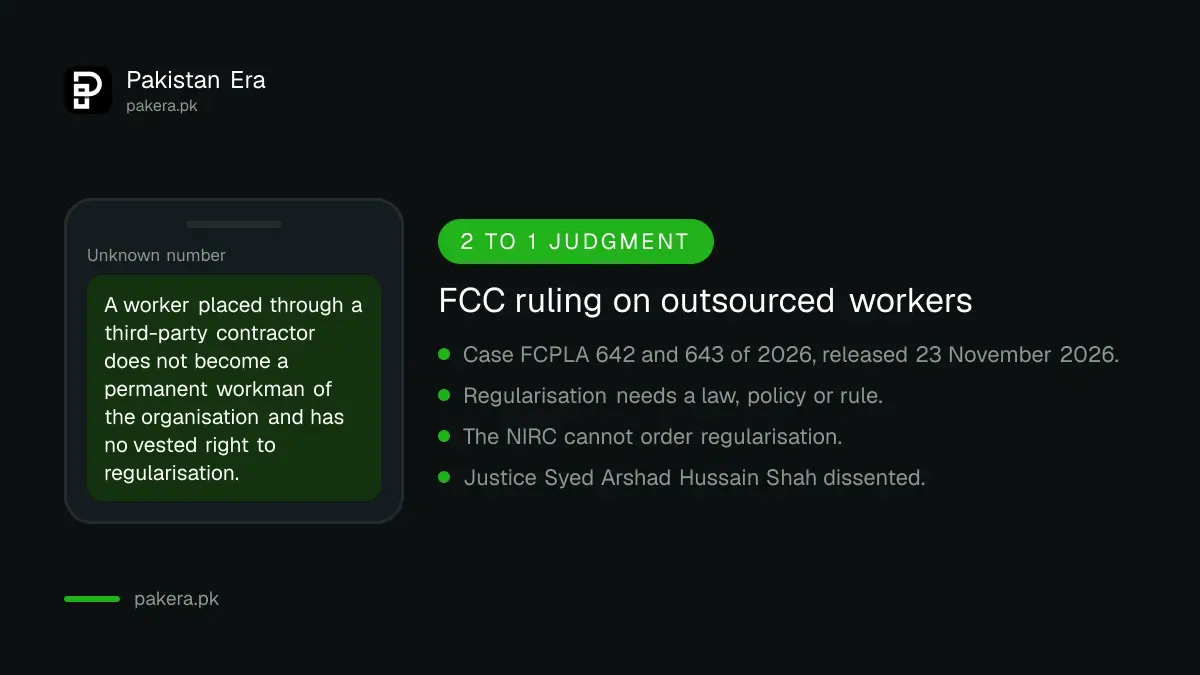
The FCC ruled outsourced workers cannot claim regularisation
The majority held that a worker placed through a third-party contractor does not acquire the status of a permanent workman of the principal organisation. No employee has a vested right to regularisation unless a law, policy or rule gives it.
The case is F.C.P.L.A. Nos. 642 and 643 of 2026, the State Bank of Pakistan and the State Bank of Pakistan Banking Services Corporation (SBP BSC) against the Full Bench of the NIRC and others. Justice Aamer Farooq wrote the majority judgment with Justice Rozi Khan Barrech. Justice Syed Arshad Hussain Shah dissented. The court heard the case on 30 September 2026.
The court allowed the State Bank's appeals, set aside the orders of the NIRC and the Sindh High Court, and dismissed the worker's grievance petition.
A dispenser supplied by a manpower firm brought the case
SBP BSC signed a contract with Prime Human Resource Services (Private) Limited on 19 December 2014 to supply staff. A dispenser worked at the bank's dispensary through that firm until the firm relieved him on 13 November 2017. He then went to the NIRC.
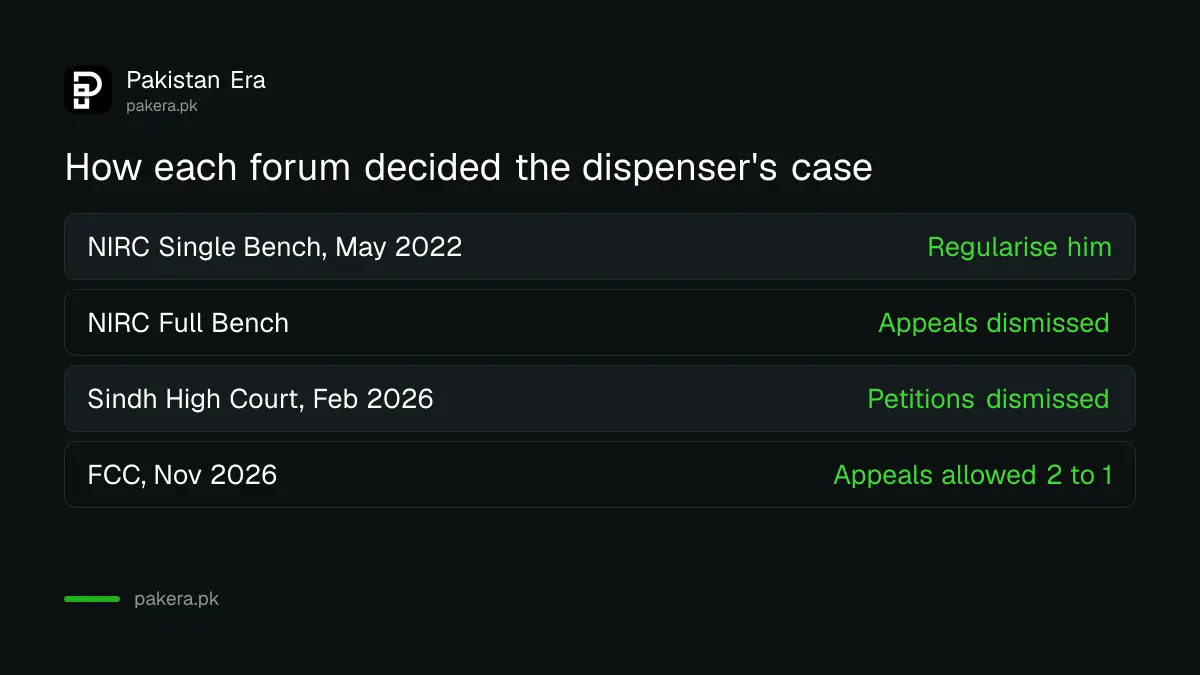
| Forum | Date | Decision |
|---|---|---|
| NIRC Single Bench | 10 May 2022 | Termination set aside, State Bank directed to regularise him |
| NIRC Full Bench | Later | Appeals of SBP BSC and the contractor dismissed |
| Sindh High Court | 16 February 2026 | State Bank's petitions dismissed |
| Federal Constitutional Court | Heard 30 September 2026, released 23 November 2026 | Appeals allowed 2 to 1, grievance petition dismissed |
The majority noted that the contractor hired him, paid his salary and issued the letter ending his service. The contractor's own HR manager said in evidence that he was the firm's employee, posted to the bank's premises.
Nine months of service does not make a worker permanent
The Standing Orders define a permanent workman as one doing permanent work likely to last over nine months after a three-month probation. The majority said that is only a definition. It gives no automatic right to be regularised after nine months.
The court set out its reasoning in four points:
- Third-party arrangements are lawful. The majority called them a modern, practical arrangement, not a sham to dodge labour law.
- Length of service is not enough. It disagreed with an earlier view that regularisation depends on how long someone has served. The whole arrangement has to be looked at.
- Regularisation needs a legal basis. A law, policy, rule or regulation must give the right. Neither the 1968 Standing Orders Ordinance nor the Sindh Terms of Employment (Standing Orders) Act 2015 does so.
- The NIRC cannot regularise anyone. The court endorsed an earlier Supreme Court view that the NIRC has no authority to order regularisation.
The court also said the NIRC had directed the State Bank itself, though the contract was only between SBP BSC and the contractor.
The dissent said real control should decide
Justice Syed Arshad Hussain Shah disagreed. He said a worker hired through a contractor can still be a permanent workman of the principal organisation if the facts show a real employer and employee relationship and the labour law conditions are met.
He pointed to evidence that the bank provided the premises, medicines and equipment, that its doctors supervised the dispensary, and that it served the bank's own staff. In his view the label of outsourcing should not let an organisation and its contractor shift responsibility between them at the worker's expense. A dissent is not the law, but it shows where future cases may push.
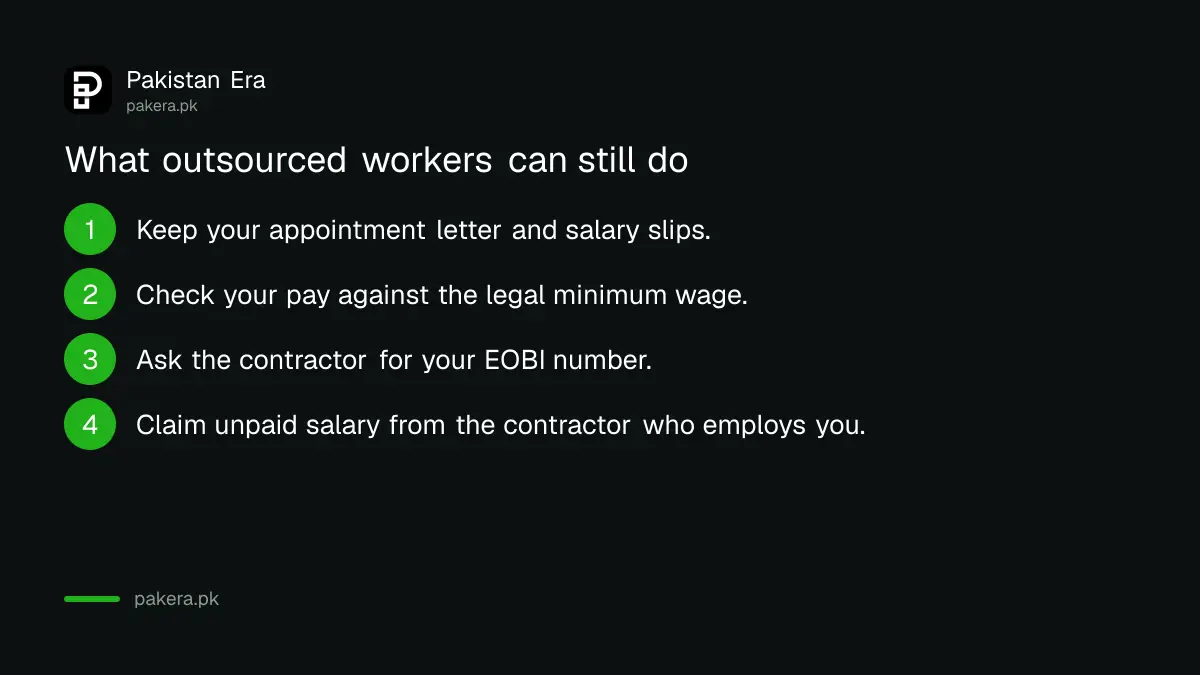
What outsourced workers can still do
The ruling closes the regularisation route for most outsourced staff. It does not take away pay and legal protections you are owed by the contractor who employs you, such as minimum wage, timely salary and social security.
- Keep your appointment letter, salary slips and any card or pass issued by the contractor or the organisation.
- Check your pay against the legal minimum. The federal rate is explained in the Islamabad minimum wage and shortfall claim guide.
- Ask the contractor for your EOBI registration number. The EOBI registration check shows whether contributions are being paid in your name.
- For unpaid salary, a complaint lies against the contractor, your direct employer. Punjab workers can follow the unpaid wages claim steps.
- If you were dismissed without notice or inquiry, a grievance against the employer is still possible. The NIRC grievance petition guide covers when that forum applies.
Common questions
Can a contract worker be made permanent after nine months?
Not automatically. The FCC majority said the nine-month rule in the Standing Orders only defines a permanent workman. Regularisation needs a law, policy or rule, and does not follow from length of service alone.
Does this ruling apply to government departments?
It was decided for a worker at a State Bank subsidiary, but the reasoning covers any organisation that takes staff through a third-party contractor. Workers hired directly on contract were also said to fall outside the Standing Order definition.
Can the NIRC order an organisation to regularise me?
No. The court endorsed an earlier Supreme Court view that the NIRC has no authority to regularise any employee or workman.
Who is my employer if a manpower firm pays me?
In this case the court treated the manpower firm as the employer, because it hired, paid and released the worker. The organisation where you work was not held responsible for regularisation.
Was the decision unanimous?
No. It was two to one. Justice Syed Arshad Hussain Shah dissented and said the real working relationship, not the contract label, should decide a worker's status.
How we verified this
What we checked and where we read it.
We read the full judgment and the dissenting note in F.C.P.L.A. Nos. 642 and 643 of 2026, downloaded from the judgments page of the Federal Constitutional Court of Pakistan on 25 November 2026, where it is listed with an upload date of 23 November 2026. The majority judgment is dated 30 September 2026 and marked approved for reporting. The forum dates come from the judgment; the date of the NIRC Full Bench decision is not given in it. Labour law references are to the Industrial and Commercial Employment (Standing Orders) Ordinance 1968 and the Sindh Terms of Employment (Standing Orders) Act 2015, as quoted by the court. The State Bank of Pakistan was the petitioner. Last checked 25 November 2026.
About the author

Global Affairs & Political Economy Writer
Muhammad Hatim is a book lover who started writing because he enjoys it. At Pakistan Era he writes about international relations, geopolitics and the global economy, with a particular interest in South Asia and the forces behind current events.