Environmental Approval for a Factory in Punjab: EPA Punjab Questions and Papers
Applying for factory environmental approval in Punjab? EPA Punjab asks 18 questions on flow diagram, chemicals, air controls and wastewater. See what to attach.
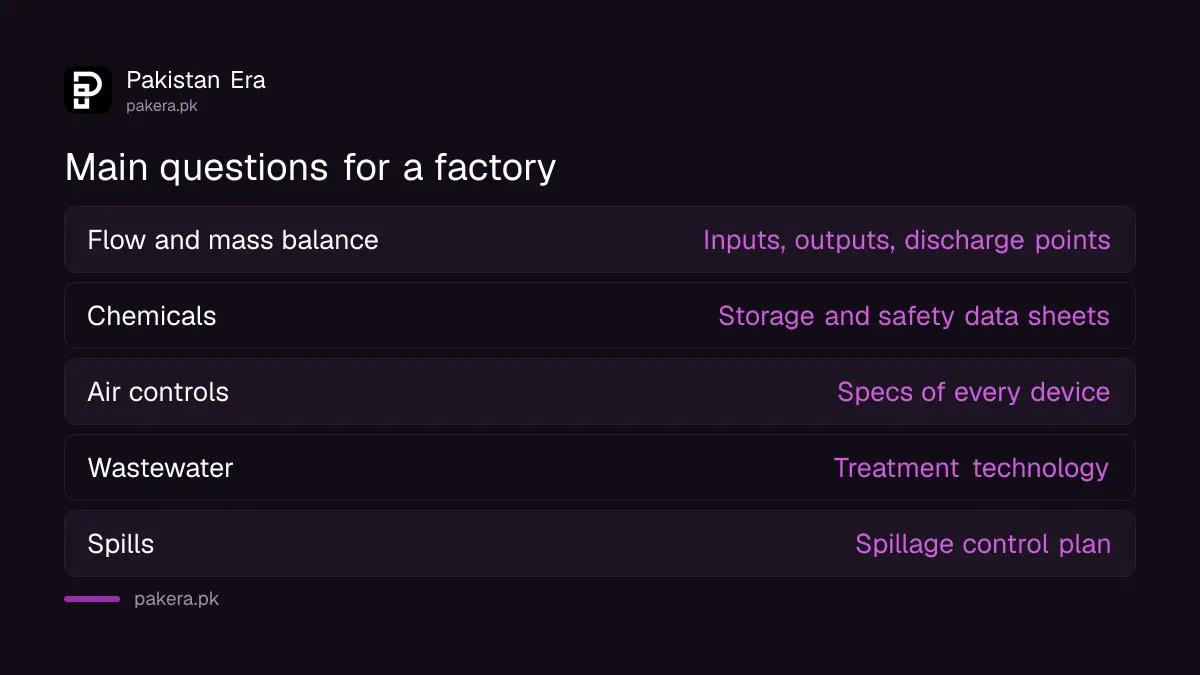
A factory seeking environmental approval from EPA Punjab must show a process flow diagram with every input, output and discharge point, a list of air pollution control devices, its wastewater treatment technology, a spillage control plan and the safety data sheets of its chemicals. These come from the agency's "Specific points" sheet, category C, manufacturing and processing, which lists 18 questions. Some units add one more paper from another office.
Category C covers food processing, textiles, chemicals, cement, tanneries and plastics. We read the EPA Punjab sheet on 22 October 2026. Reviewers use it to find gaps in an IEE or EIA report, so answering it before you submit saves a round of replies. The steps and review times are in the guide to Punjab environmental approval.
The process flow diagram must show where every material goes
EPA wants a diagram of inflows and outflows, a mass balance, and each discharge point with its destination: sewer, storm water, atmosphere, recycling, landfill or storage. It also wants capacity, raw material sources and quantities, products and wastes for both the construction and operating phases.
Draw it before you write the text. Every other answer, from air controls to wastewater, hangs off this one page. A factory that cannot say where a waste stream ends has no complete answer.
Chemicals, air controls and wastewater each need their own answer
The sheet asks for details of storage and the safety data sheets for any chemicals, dyes and additives used or made. It asks for specifications of all air pollution control devices, the wastewater treatment technology, a spillage control plan, the heating source and the machinery list.
| Question on the sheet | What you should attach |
|---|---|
| Green or eco-friendly technology | A short note on the technology chosen |
| Raw material, product and waste quantities | A table for construction and operation |
| Inflows, outflows and discharge points | The process flow diagram with mass balance |
| Chemicals, dyes, additives, hazardous items | Storage details and safety data sheets |
| Air pollution control devices | Specifications of every device installed |
| Wastewater treatment | The technology and design |
| Spills | A spillage control plan |
| Water source and quantity | Permission of the local council to extract groundwater |
Some trades get a question of their own
Tanneries must explain treatment and disposal of chromium-contaminated sludge. Apparel units must give an undertaking that no dyeing or printing will take place in the unit. Cosmetic projects need a no-objection certificate from PSQCA that creams contain no hazardous ingredients.
Pesticide makers need an NOC or registration certificate from the agriculture or plant protection department. Beverage and cement units get a special line on water source and quantity, with the local council's permission to take groundwater.
Recycling units must explain the risk of what they handle
One question covers hazards and risks in recycling plastic, lead-acid batteries and compressors, and in chemical, fertiliser and pesticide plants. The sheet does not say what level of detail is needed, so write a short risk statement for each material you handle.
Industrial estates, including export processing zones, face a further requirement: a cumulative impact assessment. That is the combined effect of all units on the estate, not just one factory. A single owner inside an estate should ask the estate manager for it.
Prepare the file in this order
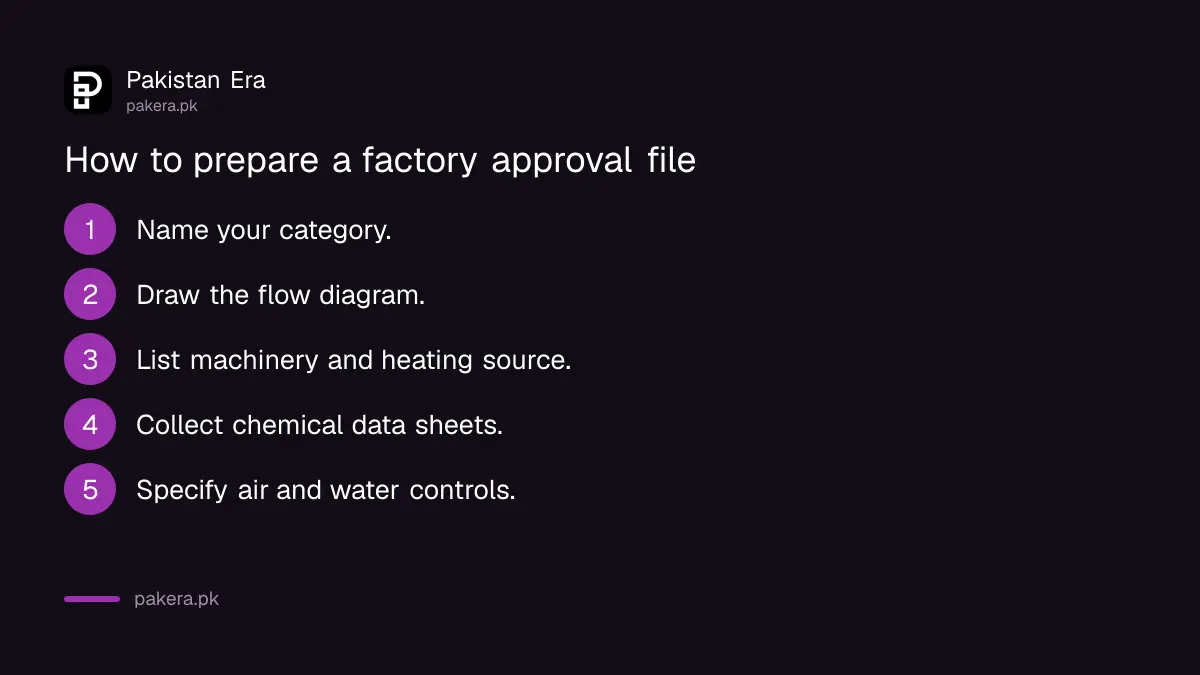
- Name your category from the schedule of the IEE and EIA regulations.
- Draw the process flow diagram and mass balance.
- List machinery, heating source and any heat recovery system.
- Collect safety data sheets and storage details for every chemical.
- Specify each air pollution control device and the wastewater plant.
- Write the spillage plan and the water source note.
- Add the trade-specific NOCs and undertakings.
A unit already running should also know the enforcement side. The inspection points in the guide to a brick kiln and factory smog inspection match several of these questions, and neighbours can use the steps to report a smoking kiln or factory.
Common questions about factory environmental approval in Punjab
Does a small workshop need all 18 answers?
The sheet does not set size limits. Whether you need an IEE, an EIA or neither depends on the regulations' schedule, which we did not read. Ask EPA Punjab on 1373.
What is a mass balance?
It is a count of everything that goes into a process and everything that comes out, so the two sides match. The sheet asks for it alongside the flow diagram.
What is an MSDS?
It is a material safety data sheet, a supplier document that lists a chemical's hazards and safe handling. The sheet asks for it for chemicals, dyes and additives.
Do I need a PSQCA certificate for every product?
No. The sheet names PSQCA only for cosmetic creams, where it asks for a no-objection certificate on hazardous content.
Is the sheet current?
The file on the EPA site shows a 2022 date. It was the version on the checklists page when we read it on 22 October 2026.
Where do I send questions?
Call 1373, or write to ddisepa@punjab.gov.pk. The office is at Green Building, 27 College Road, Gulberg 2, Lahore.
How we verified this
What we checked, where we read it, and what we could not confirm.
Last checked 22 October 2026. We read the EPA Punjab "Specific points" sheet, general points and category C, through the checklists page on epd.punjab.gov.pk. We did not read the IEE and EIA regulations or schedules, so which factories need which report is not covered. The table is our own summary of the sheet's items.
About the author

Tax, Bills and Technology Writer
Ali Akhtar is a young and curious voice here at Pakistan Era. He is currently pursuing his A-Levels and has a growing interest in Pakistan’s changing industrial landscape and educational trends. Ali likes to write in a way that helps him explain and explore the world around him. His writing reflects the perspective of the new generation navigating the evolving trends of Pakistan where technology, youth innovation, and shifting opportunities are reshaping the country’s future.