Get a Thal Farm Subsidy in Punjab: Solar Drip on 10,000 Acres, Citrus Plants and 1,500 Threshers
Punjab's Thal project runs 2026-29 in six districts with 70:30 sharing on solar drip, sprinklers and ponds, 50:50 on citrus and machines. See what it gives.
Short answer: Punjab's Transformation of Agriculture in Thal project covers Bhakkar, Layyah, Mianwali, Jhang, Muzaffargarh and Kot Addu from 2026-27 to 2028-29. It pays 70:30 cost sharing on solar drip systems, sprinklers, water ponds and irrigation schemes, and 50:50 on citrus plants, threshers and pulses seed drills. The department pages show no application link yet, so ask your district agriculture office.
Thal is the sandy desert belt between the Indus and the Jhelum, where farming depends on scarce water. The project is built for a farmer who irrigates by flooding a field in sandy soil and wants to use less water.
We read the Agriculture Department's own project page for Transformation of Agriculture in Thal, and its list of Chief Minister's schemes, on agripunjab.gov.pk on 12 October 2026. This article sets out what the project gives, which districts it covers and what the pages leave unsaid.
The Thal project covers six districts and costs Rs 7,986 million
The project runs for three years, from 2026-27 to 2028-29, at a total cost of Rs 7,986.385 million, about Rs 8 billion. Rs 900 million is set for 2026-27. It will be carried out in Bhakkar, Layyah, Mianwali, Jhang, Muzaffargarh and Kot Addu districts.
The department states the aim as bringing uncultivated land under irrigated agriculture and promoting high value crops suited to dry land. One stated aim is to raise gram yields in Thal by providing subsidised machinery and better farming practice.
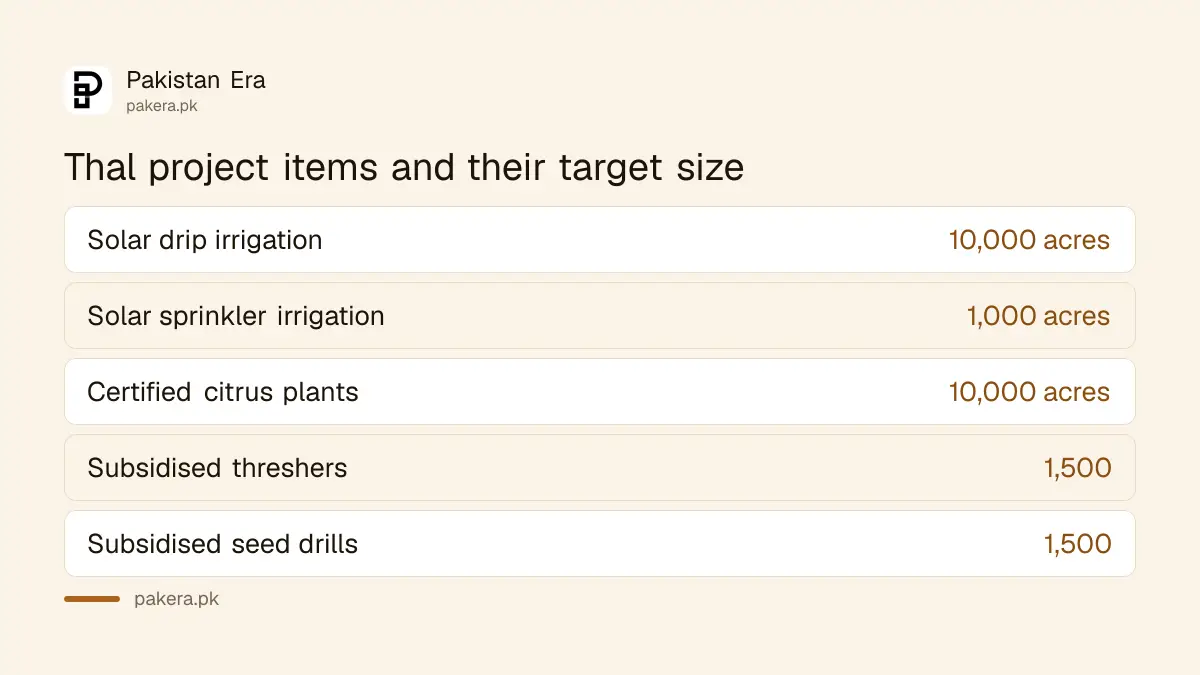
| Item | Target | Cost sharing |
|---|---|---|
| Irrigation schemes | 500 | 70:30 |
| Solar-coupled drip irrigation | 10,000 acres | 70:30 |
| Solar-powered sprinkler irrigation | 1,000 acres | 70:30 |
| Water storage ponds | 500 | 70:30 |
| Certified citrus plants | 10,000 acres | 50:50 |
| Subsidised threshers | 1,500 | 50:50 |
| Subsidised seed drills | 1,500 | 50:50 |
Cost sharing of 70:30 most likely means 70% government
The page prints "Cost Sharing: 70:30" and "50:50" without saying which side is which. In the department's own Pothohar scheme, the government pays 70% of a solar drip system, so we read 70:30 here as 70% government and 30% farmer. Confirm this in writing before you commit money.
On a 50:50 item, such as a thresher, the government and the farmer each pay half. The pages do not give the price of a thresher or a seed drill, so we cannot work out your share in rupees.
As an example only, and not a department figure: if a solar drip system quoted at Rs 1,000,000 is shared 70:30, the farmer's part would be Rs 300,000. If a thresher quoted at Rs 600,000 is shared 50:50, the farmer's part would be Rs 300,000. Ask for the real quote, because prices vary by supplier and by acreage.
Also ask what is counted in the cost. A farmer should know whether the shared amount includes installation, solar panels, pipes and a warranty, or only the equipment. The department pages do not say.
Drip, sprinkler and ponds are the water side of the project
The water management wing handles irrigation schemes, drip on 10,000 acres, sprinklers on 1,000 acres and 500 water ponds. For comparison, the drip rates in the rest of Punjab are set out in the drip and sprinkler irrigation subsidy, where 75% applies up to 7.5 acres.
A water storage pond lets a farmer collect canal or tube well water when it is available and use it at sowing or flowering time. A farmer whose canal water does not reach the end of the watercourse can use the steps for reporting canal water theft or a dry tail.
Citrus, threshers and seed drills are the extension side
Certified citrus plants are planned for 10,000 acres at 50:50. The Agriculture Extension wing will supply 1,500 subsidised threshers and 1,500 seed drills, also at 50:50.
The 2026-27 wheat and gram season is already starting. See the sowing window in wheat sowing in Punjab in 2026 if you plan to sow before any machinery arrives.
How to prepare while no application link is public
The project is in its start-up stage. The department's job page shows an advertisement for contract staff for the Thal project that closed on 1 October 2026. The project office is therefore still being formed, and an application window is likely to follow.
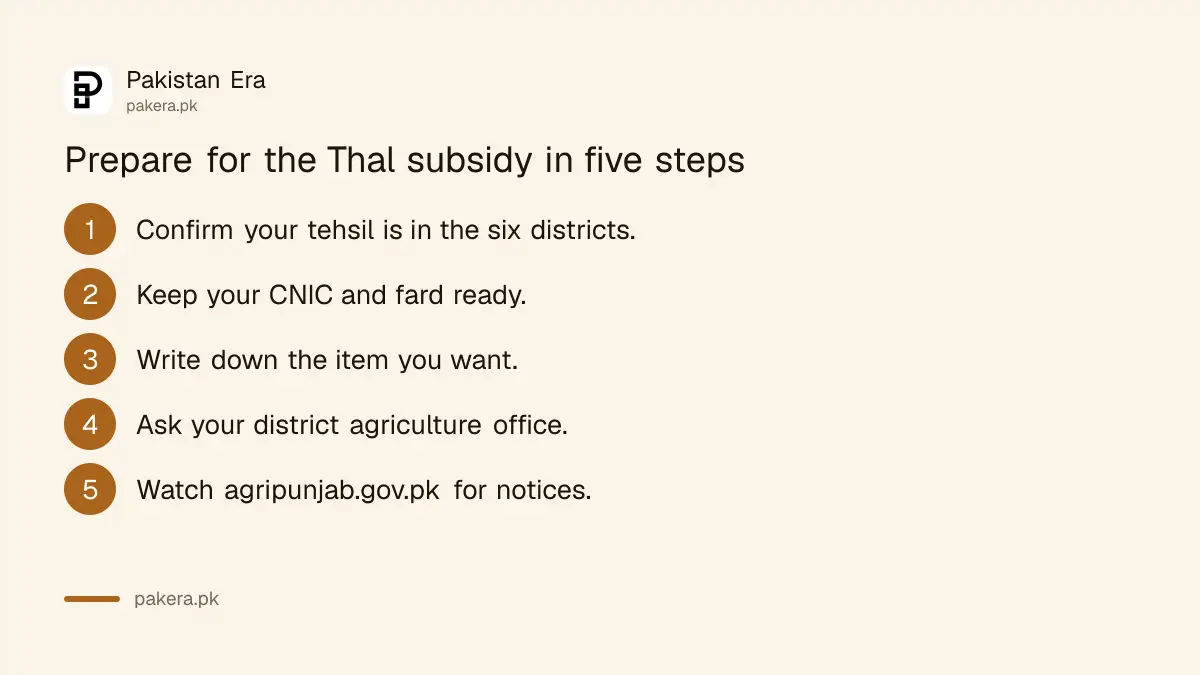
- Confirm your tehsil is inside one of the six districts.
- Keep your CNIC and your fard, the land record, ready.
- Write down what you want: drip, sprinkler, pond, citrus, thresher or seed drill.
- Ask your district agriculture office how the project will take applications.
- Check agripunjab.gov.pk under Projects and Jobs for notices.
Do not pay anyone to "reserve" a place. The pages describe a government project and do not mention agents.
Common questions
Which districts does the Thal project cover?
Bhakkar, Layyah, Mianwali, Jhang, Muzaffargarh and Kot Addu.
How long does the project run?
Three years, from 2026-27 to 2028-29.
How much of the cost does the farmer pay?
The pages print 70:30 for water items and 50:50 for citrus, threshers and drills. We read 70:30 as 70% government, but the page does not label the sides.
Can I apply today?
We found no application link or form. Ask your district agriculture office and watch the department's pages.
Does it include solar power?
Yes. The drip systems are solar-coupled and the sprinklers are solar-powered.
Is gram part of the project?
Yes. Raising gram yields through subsidised machinery is one of the stated aims, and 1,500 pulses seed drills are listed.
How we verified this
What we checked, where we read it, and what we could not confirm.
Last checked on 12 October 2026. We read the Agriculture Department's Transformation of Agriculture in Thal page for the districts, cost, years and cost sharing, and its list of Chief Minister's initiatives for the 2026-27 allocation. We did not find an application link, an eligibility rule or a unit price.
About the author

Tax, Bills and Technology Writer
Ali Akhtar is a young and curious voice here at Pakistan Era. He is currently pursuing his A-Levels and has a growing interest in Pakistan’s changing industrial landscape and educational trends. Ali likes to write in a way that helps him explain and explore the world around him. His writing reflects the perspective of the new generation navigating the evolving trends of Pakistan where technology, youth innovation, and shifting opportunities are reshaping the country’s future.