How to Give First Aid for a Child's Febrile Seizure (Fever Fit) in Pakistan
A fever fit usually stops in 2 to 3 minutes. Note the time, protect the head, never hold the child or put anything in the mouth. Call 1122 after 5 minutes.
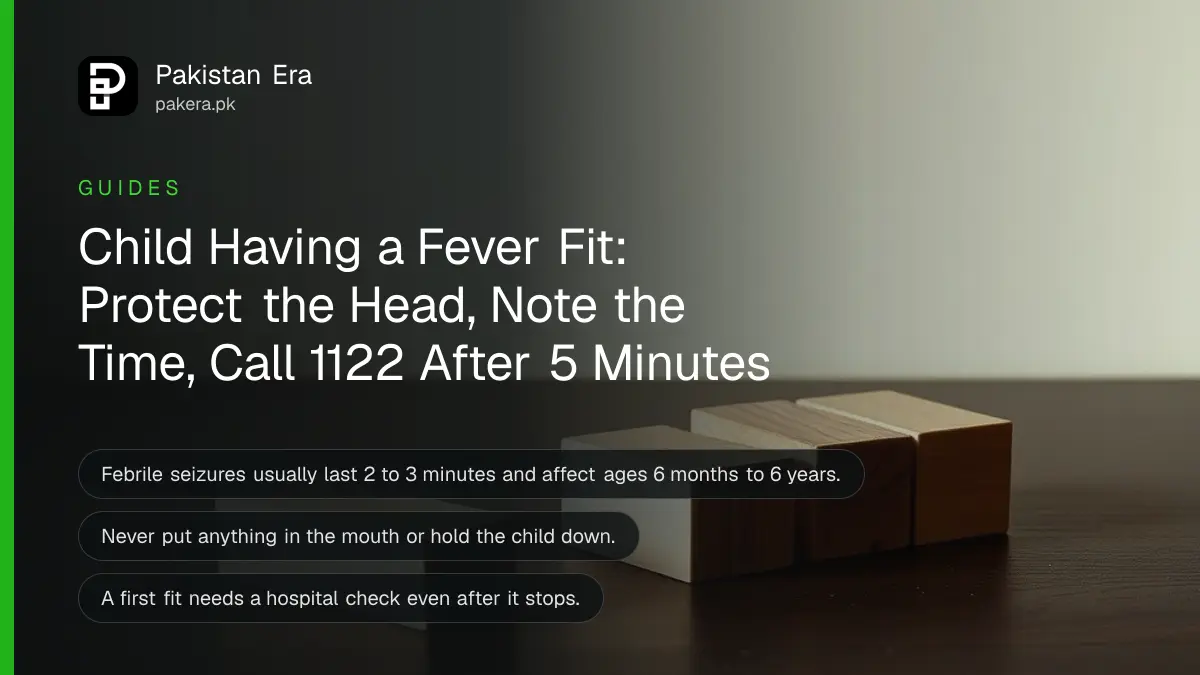
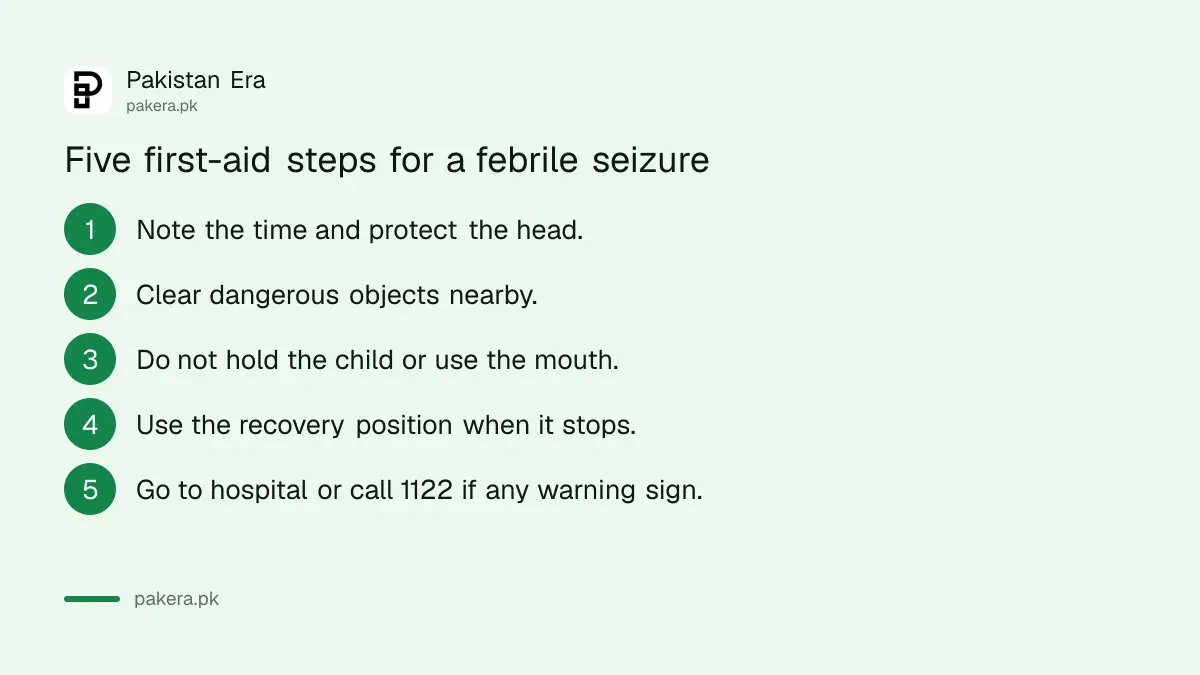
If your child has a fit with a high fever, note the time it starts, protect the head with your hands or something soft, clear dangerous objects, and do not hold the child down or put anything in the mouth. When it stops, lay the child on their side and take them to hospital if it is the first fit, or call 1122 if it lasts more than 5 minutes.
A fever fit, called a febrile seizure, is frightening to watch. Most stop by themselves in 2 to 3 minutes. We read the National Health Service (NHS) of England's febrile seizures page on 21 October 2026 and built the steps below from it, with Pakistan's emergency numbers in place of the NHS's 999.
A febrile seizure is a fit that happens during a high temperature
It can happen when a child has a fever from an infection. Your child may go stiff, twitch, shake or jerk, lose consciousness, not respond to you, be sick or wet themselves. It usually affects children between 6 months and 6 years old.
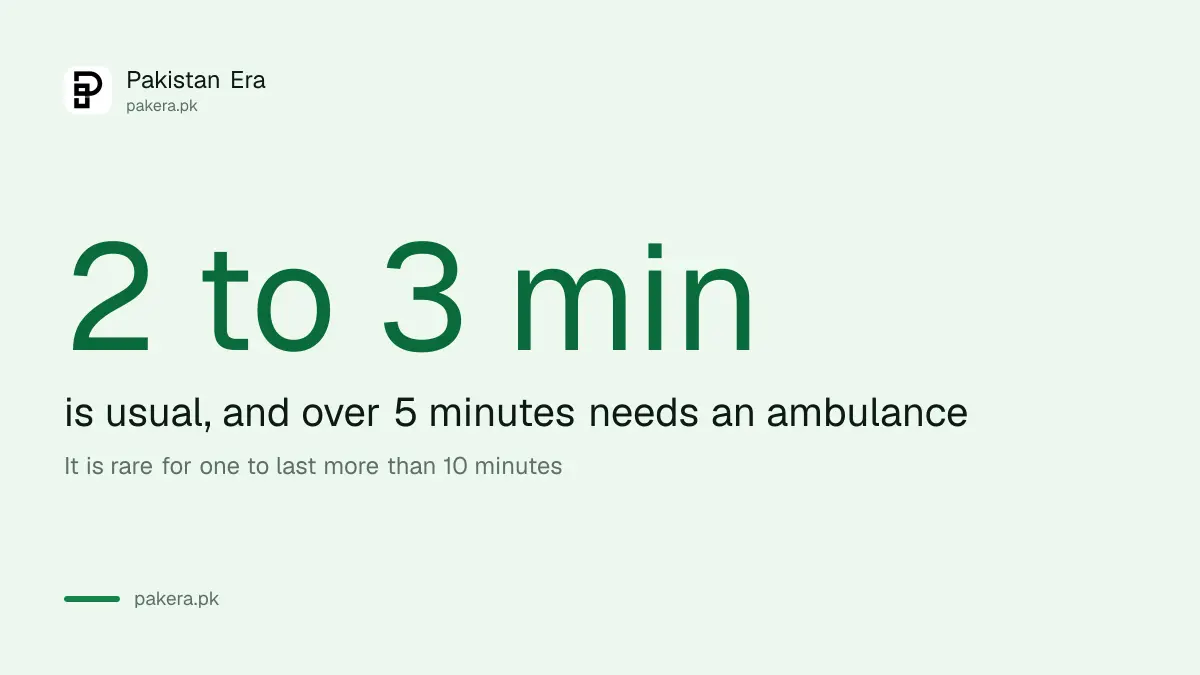
The NHS says febrile seizures usually last 2 to 3 minutes, and it is rare for one to pass 10 minutes. Afterwards a child may be sleepy, irritable or confused for up to 1 hour. In Pakistan, fevers rise in the dengue and malaria season, so a fever fit can arrive on top of an illness you are already watching. Our guides on dengue warning signs and on testing a fever for malaria cover that side.
Protect the head, note the time and leave the child where they are
Keep your child safe while you wait for the fit to end. Check the time it starts and stops, protect the head with your hands or something soft, and move dangerous objects away. Do not move the child unless they are in danger.
| Do | Do not |
|---|---|
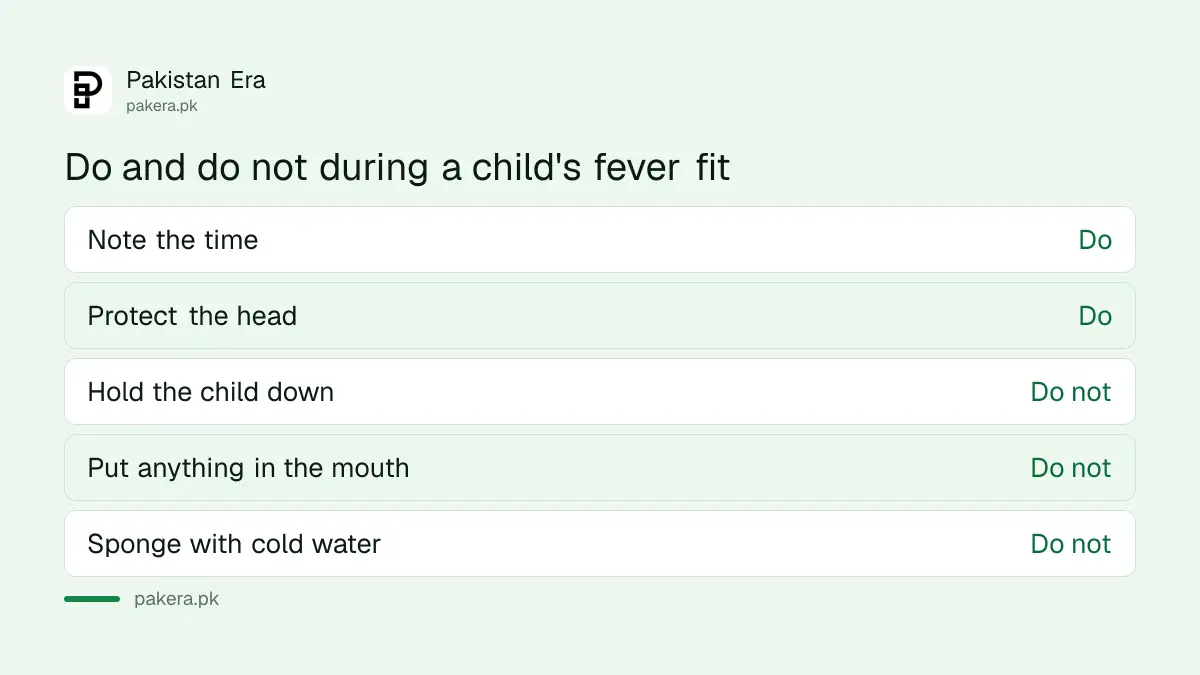
| Check the time the seizure starts and ends | Do not move your child or try to hold them in place |
| Protect the head with your hands or something soft | Do not put anything in your child's mouth |
| Remove dangerous objects nearby | Do not undress the child or sponge with cold water to lower the temperature |
| After it ends, use the recovery position and check nothing is in the mouth or throat | Do not take the child to hospital while still fitting, call for help instead |
Cooling the child with cold water during the fit is not advised
The NHS says not to try to lower the temperature by undressing the child or sponging with cold water during a seizure. Leave the child as they are and wait for the fit to end.
Keep the child on their side with the head protected. If the child is still fitting or unconscious, do not drive to the hospital. Call for an ambulance instead.
Call an ambulance if the fit is the first one or lasts more than 5 minutes
The NHS lists six reasons for emergency care: the first ever seizure, one lasting more than 5 minutes, difficulty breathing, stiffness and twitching on only one side, being more sleepy than usual for more than an hour afterwards, or more than one seizure within 24 hours.
In Pakistan, 1122 is the rescue and ambulance number where Rescue 1122 operates, mainly in Punjab and Khyber Pakhtunkhwa, and 115 is Edhi's. Our list of emergency numbers in Pakistan explains which to save. If you are in a district without 1122, find out the local ambulance number in advance.
- Note the time and protect the child's head.
- Remove dangerous objects from around the child.
- Do not hold the child or put anything in the mouth.
- When it stops, put the child in the recovery position.
- Go to hospital after a first fit, or call 1122 or 115 if any emergency sign above appears.
Hospital checks after the first fit may include blood tests
The NHS says a child must be checked in hospital after a first febrile seizure and may stay a short time. Tests can include blood tests, a urine test and a lumbar puncture, which takes a sample of spinal fluid to look for bacteria or viruses. Infection is treated with medicine.
Most febrile seizures need no treatment. In rare cases of repeated fits, a doctor may prescribe a medicine to give during a seizure and will explain how. The NHS says febrile seizures cannot be prevented. Since they cannot be prevented, do not blame yourself if one happens. Ask your doctor before giving any medicine to a baby or small child. For the signs that a fever needs a doctor, see when a cold or flu needs a doctor.
Common questions about fever fits in children in Pakistan
What age do febrile seizures happen?
Usually between 6 months and 6 years old, says the NHS.
How long does a febrile seizure last?
Usually 2 to 3 minutes. It is rare for one to last more than 10 minutes.
Should I put something in my child's mouth?
No. The NHS says not to put anything in a child's mouth during a seizure.
Can I prevent febrile seizures with fever medicine?
The NHS says febrile seizures cannot be prevented. They can happen when a child has an infection and a high temperature.
Does my child need hospital after one?
Yes, after a first febrile seizure the NHS says to have the child checked at hospital.
What if a second fit comes the same day?
More than 1 seizure within 24 hours is an emergency sign on the NHS list. Call for an ambulance.
How we verified this
What we checked, where we read it, and what we could not confirm.
Last checked 21 October 2026. We read the NHS febrile seizures page on that date for the symptoms, timings, emergency signs, do and do not list and hospital tests. The 1122 and 115 numbers come from our own emergency list, not from the NHS. We did not test any step ourselves. This is general first-aid information, not medical advice, and we could not verify how each Pakistani hospital runs its checks after a first fit.
About the author

Tax, Bills and Technology Writer
Ali Akhtar is a young and curious voice here at Pakistan Era. He is currently pursuing his A-Levels and has a growing interest in Pakistan’s changing industrial landscape and educational trends. Ali likes to write in a way that helps him explain and explore the world around him. His writing reflects the perspective of the new generation navigating the evolving trends of Pakistan where technology, youth innovation, and shifting opportunities are reshaping the country’s future.