Transport Talks Fail, Strike Goes Into a Fourth Day
Alliance president Malik Shehzad Awan says the deadlock holds after talks with federal and Sindh officials. Trucks and tankers stay parked.
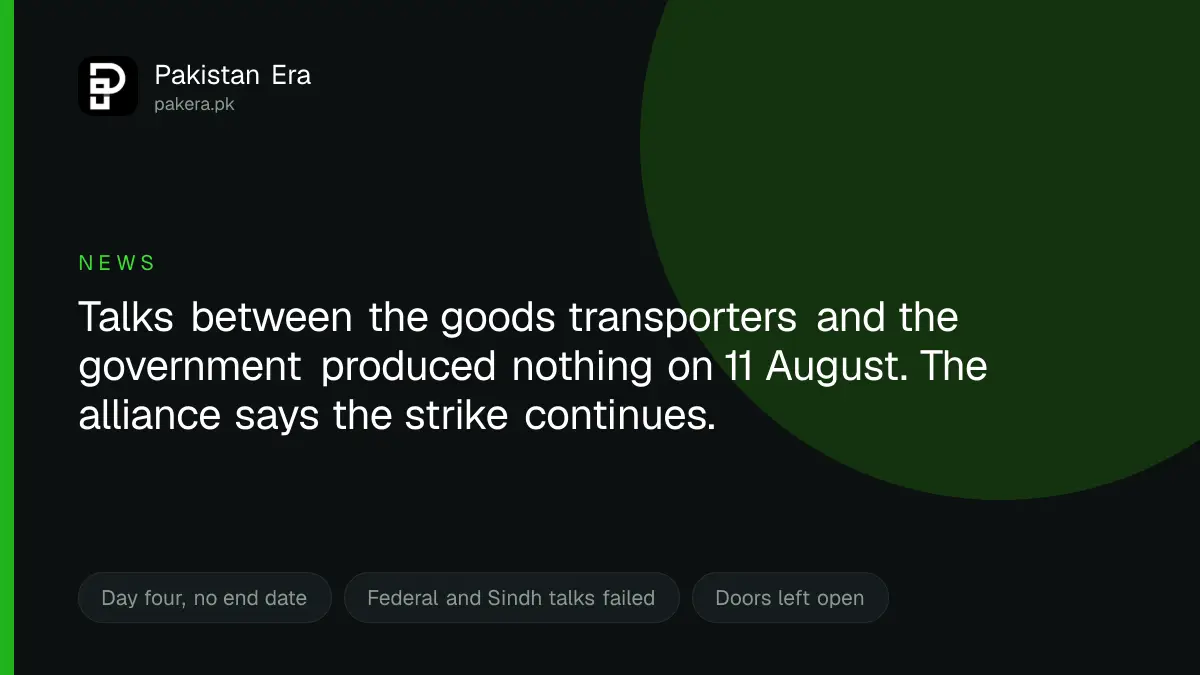
The goods transport strike is continuing into a fourth day. Talks in Islamabad on Monday produced nothing, and the transporters say they are staying out.
Malik Shehzad Awan, president of the All Pakistan Goods Transport Alliance, told a press conference on 11 August that the deadlock persists despite detailed talks with representatives of the federal and Sindh governments.
His words were direct. "Negotiations have not been successful, and we have decided to continue the strike."
What the alliance said
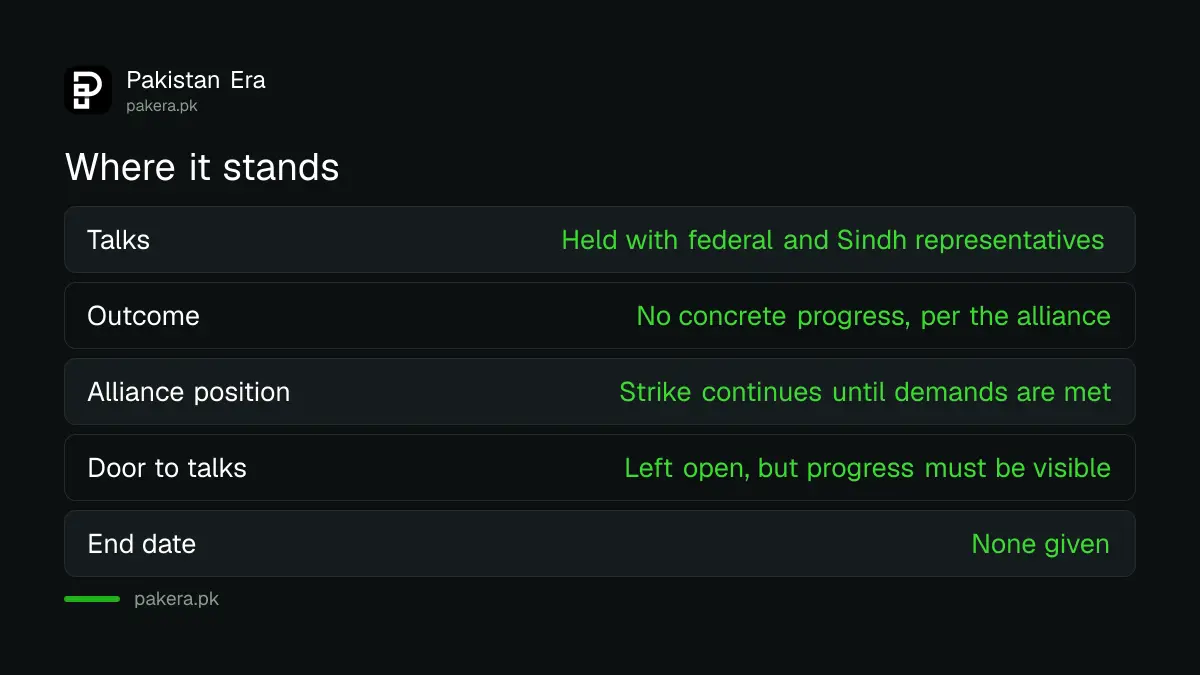
Three things came out of that press conference.
No concrete progress. Awan said nothing substantive moved on the demands the transporters raised, even though the talks were detailed and involved both federal and provincial representatives.
The door is still open. He said the alliance remains willing to talk, but that meaningful and visible progress is required, and that verbal assurances are not enough.
No end date. The protest continues until the government agrees to the demands.
| Question | Position on 11 August |
|---|---|
| Were talks held? | Yes, with federal and Sindh representatives |
| Did they produce anything? | No concrete progress, per the alliance |
| Is the strike continuing? | Yes |
| Are talks over? | No, the alliance says doors remain open |
| Is there an end date? | None given |
How it got to a fourth day
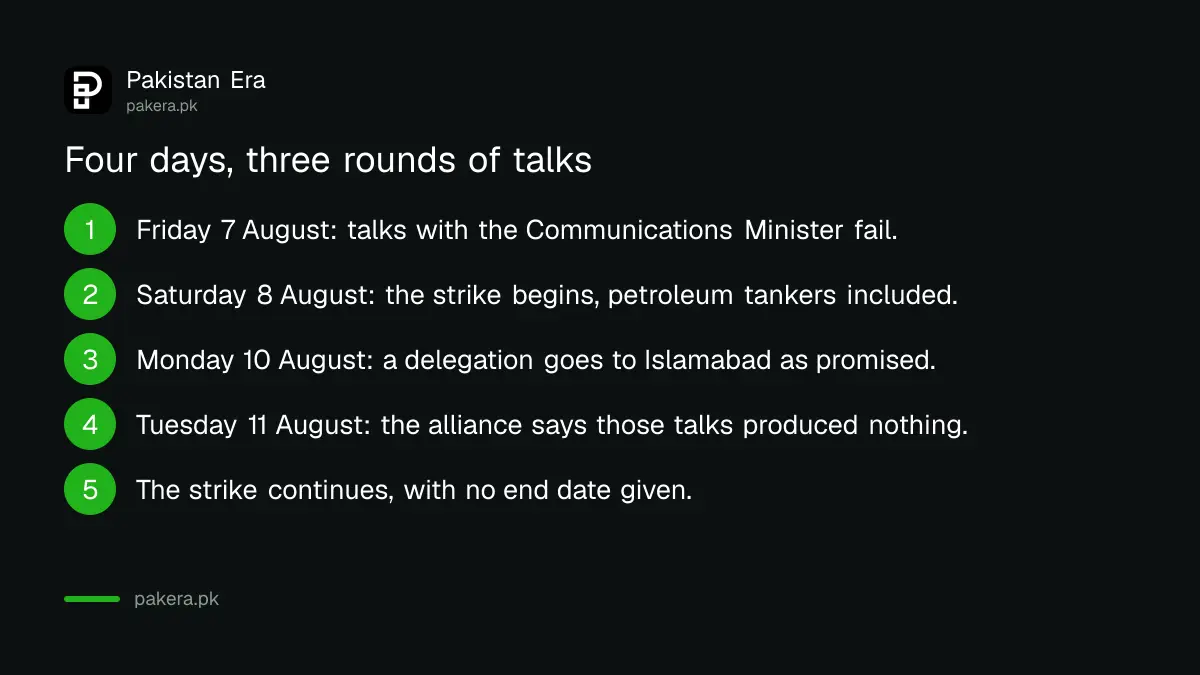
- Friday 7 August: talks with the Federal Minister for Communications, Abdul Aleem Khan, fail to produce a breakthrough.
- Saturday 8 August: the strike begins. Trucks, trailers, intercity loading vehicles, edible oil tankers and petroleum tankers all stop.
- Sunday 9 August: the government invites the alliance to Islamabad and the transporters form a committee to represent them.
- Monday 10 August: that delegation goes to Islamabad.
- Tuesday 11 August: the alliance says the talks produced nothing and the strike continues.
The full list of what the transporters are asking for, which runs to ten items covering diesel pricing, toll tax, withholding tax and a Finance Act provision on vehicle confiscation, is in our original piece on the goods transport strike. We are not repeating it here.
The demand underneath all the others
If you read only one of the demands, read the one about daily fuel pricing.
Pakistan moved to revising petroleum prices every day. For a haulier, that means the cost of a job can change between quoting it and doing it, and a rate card built on a monthly price stops working. The transporters want monthly pricing back.
That is not an isolated complaint. The operator of the Lahore Metro Bus said almost exactly the same thing this week, that its fuel reimbursement formula no longer covers what it actually pays, and it threatened to stop the service before talks put that shutdown on hold. Two very different operators, the same week, giving the same reason.
How the daily mechanism works, and why the cuts are smaller than the oil price moves behind them, is in why petrol prices do not fall with oil.
What we are still not going to tell you
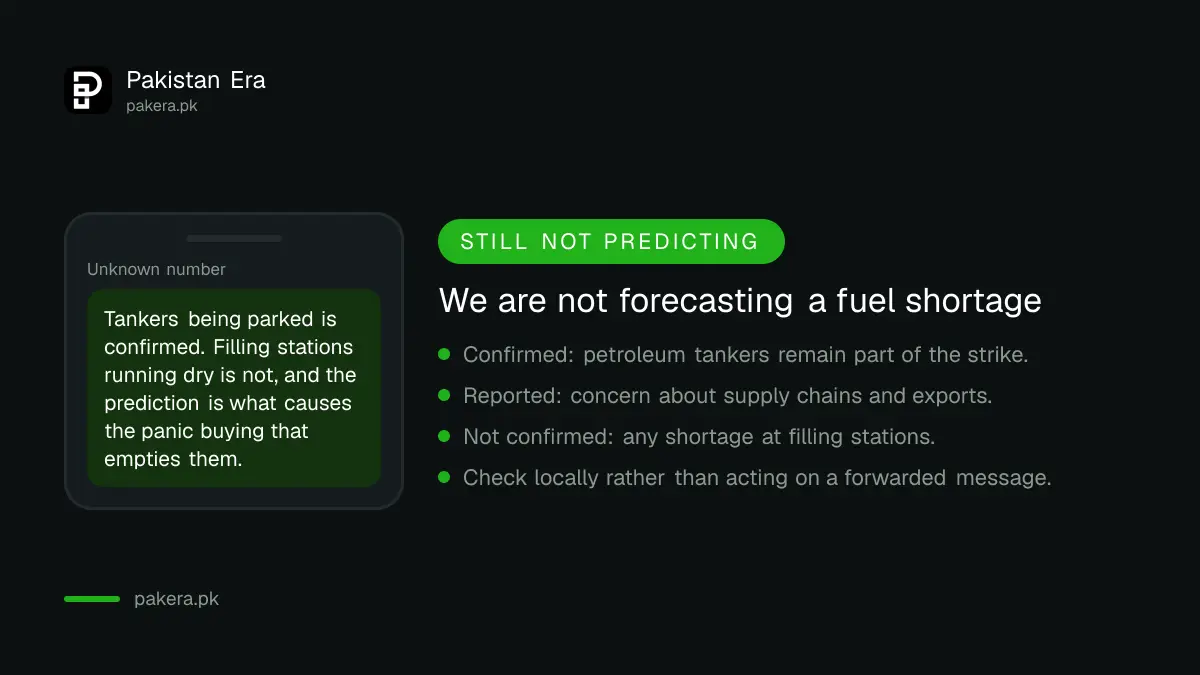
We said this on day one and it holds on day four.
Confirmed: petroleum tankers are part of the strike and remain parked.
Reported: concern about disruption to domestic supply chains and to exports, since Pakistan moves most goods between ports, factories and markets by road.
Not confirmed: any shortage at filling stations. No impact figures have been published.
The reason we keep drawing that line is practical rather than principled. Predicting a fuel shortage is the thing that causes one. People top up tanks they did not need to fill, queues form, and stations with normal stock run out because of the forecast rather than the strike.
If you need fuel, buy fuel. If you do not, check locally rather than acting on a forwarded voice note. The current pump price is on our daily petrol price page.
What would actually end this
The honest answer is that nobody has said, and we are not going to guess at a settlement date.
What can be said is which demands are cheapest for the government to move on. The tax items are specific and quantifiable: withholding tax on cargo operators cut from 7 per cent to 2, and the toll increase rolled back to 2024 levels. Those are the kind of thing a negotiation produces first, because they are concrete.
The daily pricing demand is harder, because it runs against a mechanism the government adopted deliberately and which is tied to wider commitments.
Awan's own framing is the thing to watch. He said the doors remain open but progress must be visible. That is a position that can move quickly if something concrete is offered, and it is not the language of a permanent breakdown.
Questions readers are asking
Is the transport strike still going on?
Yes. As of 11 August 2026 the All Pakistan Goods Transport Alliance says the strike continues after talks with federal and Sindh representatives failed to produce progress.
Why did the talks fail?
The alliance says no concrete progress was made on its demands and that verbal assurances are not enough. Neither side has published a detailed account of where the talks broke down.
When will the strike end?
No end date has been given. The alliance says the protest continues until the government agrees to its demands, while leaving the door open to further talks.
Are petrol pumps going to run out?
That has not been confirmed and we are not predicting it. Petroleum tankers being parked is confirmed. A shortage at filling stations is not. Check locally.
What do the transporters actually want?
Chiefly an end to daily fuel pricing, a cut in withholding tax on cargo operators from 7 to 2 per cent, a rollback of the toll increase to 2024 levels, and changes to a Finance Act provision allowing a whole vehicle to be confiscated over non-duty-paid goods.
Who is leading the strike?
The All Pakistan Goods Transport Alliance, whose president is Malik Shehzad Awan. Other bodies including the All Pakistan Goods Transport Owners Association are also involved.
About the author

Tax, Bills and Technology Writer
Ali Akhtar is a young and curious voice here at Pakistan Era. He is currently pursuing his A-Levels and has a growing interest in Pakistan’s changing industrial landscape and educational trends. Ali likes to write in a way that helps him explain and explore the world around him. His writing reflects the perspective of the new generation navigating the evolving trends of Pakistan where technology, youth innovation, and shifting opportunities are reshaping the country’s future.