Goods Transport Strike: Trucks and Oil Tankers Stop Nationwide
Transporters and oil tanker operators began an indefinite strike on 8 August after talks failed. What they want, and what we are not predicting.
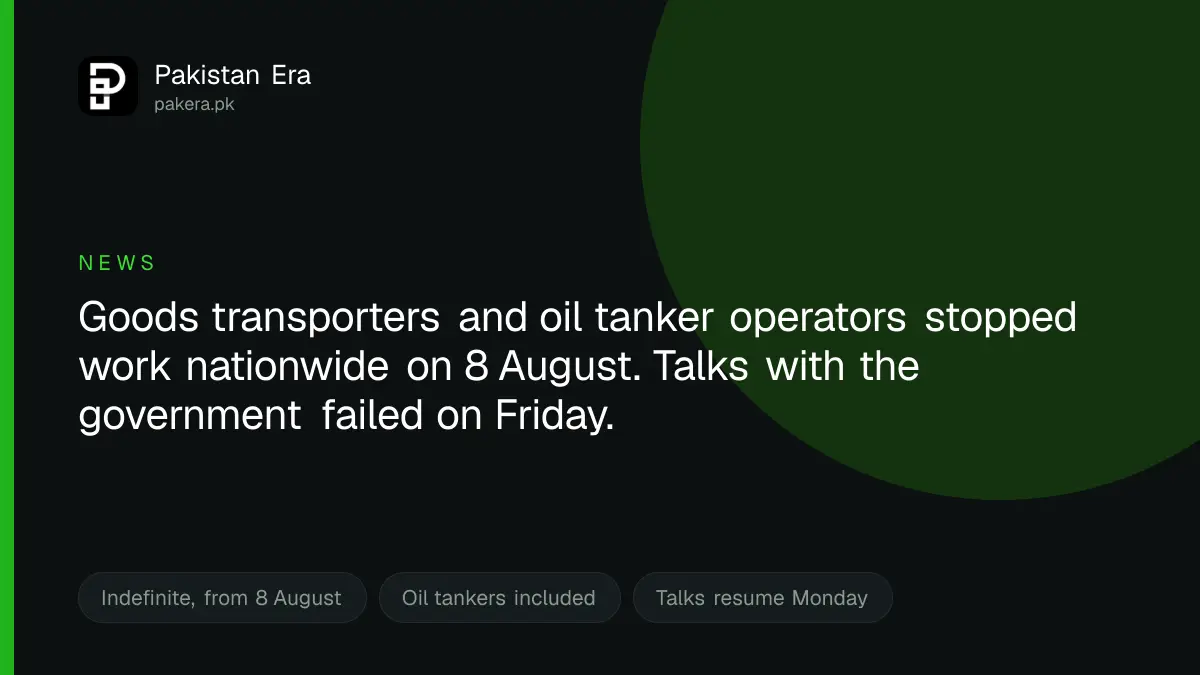
Goods transporters across Pakistan stopped work on Saturday 8 August. The strike is indefinite, and it includes petroleum tankers.
Vehicles began parking on Friday night after talks with the Federal Minister for Communications, Abdul Aleem Khan, ended without agreement. A fresh round of negotiations is due on Monday morning.
The transporters say the strike is peaceful and that vehicles are being parked rather than used to block highways.
Updated 9 August: talks set for Monday, exporters warn first
The strike ran into a second day. Two things changed.
The government has invited the alliance to negotiate on Monday, and the transporters have formed a committee to represent them in that meeting. That is more structure than Friday's failed round had, and it is the first real signal that a settlement is being worked on rather than waited out.
Exporters have started warning about consequences. Karachi's industrial base, including SITE exporters and small and medium manufacturers, say the shutdown threatens to choke supply lines, with immediate production cuts, missed export orders and job losses. Alliance leaders say a prolonged freight shutdown would hit imports, exports and the supply of daily essential goods.
Note what that is and is not. It is industry stating what it expects if this continues. It is not a report of shortages that have already happened, and we are still not going to write one until there is something to report.
Who has stopped
This is broader than trucks. According to reporting from the first day, the stoppage covers:
- Petroleum tankers
- Edible oil tankers
- Trucks and trailers
- Intercity loading vehicles
The bodies involved include the All Pakistan Goods Transport Itehad and the All Pakistan Goods Transport Owners Association. Some outlets refer to an All Pakistan Goods Transport Alliance. We are describing the groups rather than settling on one name, because the reporting does not agree.
What we are not going to tell you
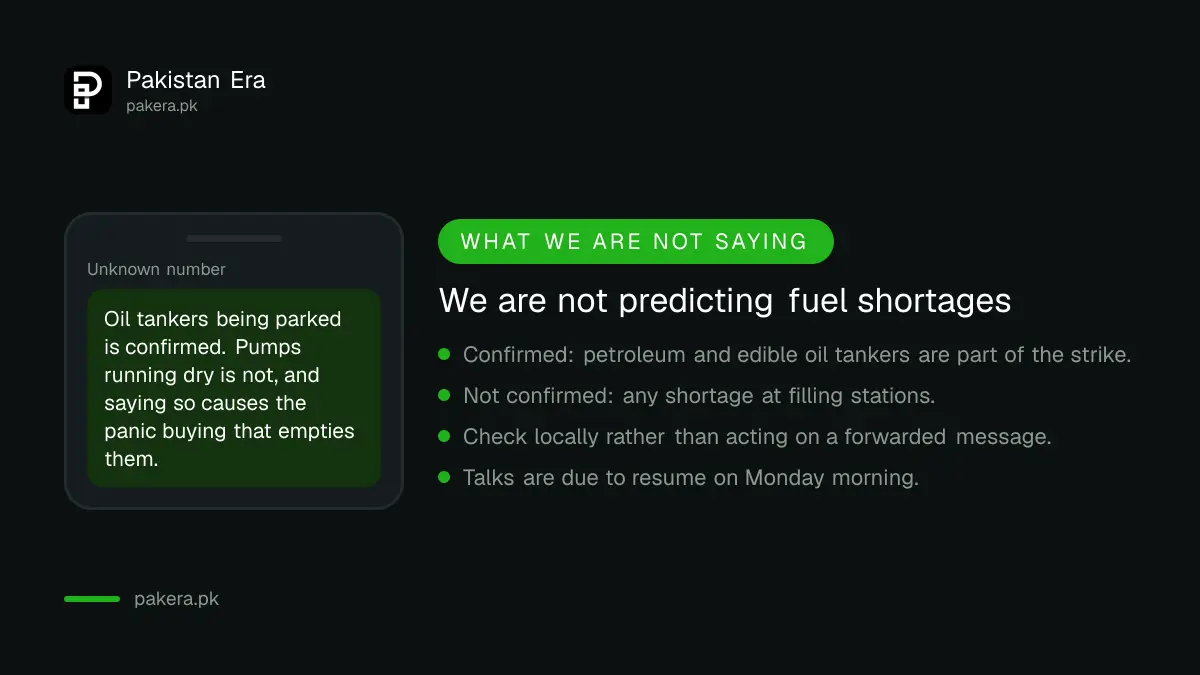
You will see messages today predicting that petrol pumps will run dry. We are not going to join in, and it is worth being clear why.
Confirmed: petroleum tankers are part of the strike.
Not confirmed: any shortage at filling stations. No impact figures had been published at the time of writing.
Predicting a fuel shortage is the thing that causes one. People top up tanks they did not need to top up, queues form, and stations that had normal stock run out because of the prediction rather than the strike. If you need fuel, buy fuel. If you do not, the responsible thing is to wait and check locally.
How it got here
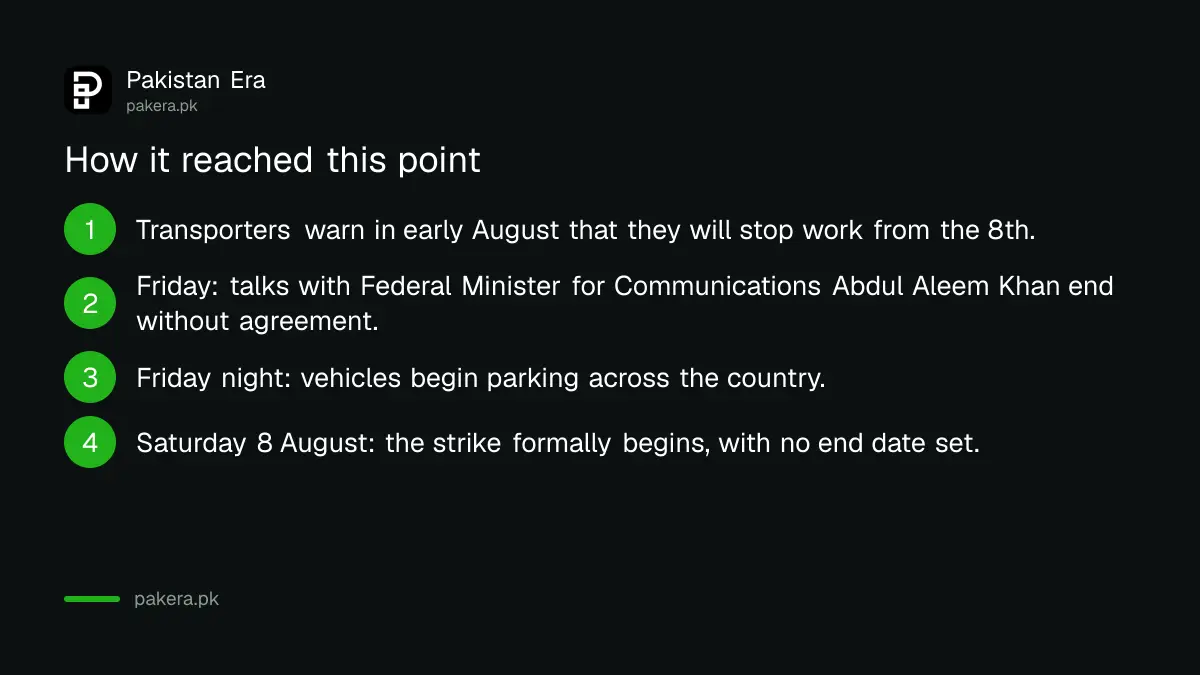
- Early August: transporters warn they will stop work from the 8th unless talks resolve their demands.
- Friday: negotiations with Aleem Khan and other officials fail to produce a breakthrough.
- Friday night: vehicles begin parking nationwide.
- Saturday 8 August: the strike formally begins, with no end date.
- Monday: a fresh round of talks is promised.
What they want
The demands are unusually specific, which matters because it makes them negotiable.
| Demand | Detail |
|---|---|
| End daily fuel pricing | Return to monthly petroleum price revisions |
| Reverse recent fuel increases | Back to earlier levels |
| Cut withholding tax | From 7 per cent to 2 per cent on cargo operators |
| Reverse the toll tax rise | To the 2024 level |
| Finance Act 2026 | Stop confiscation of a whole vehicle over non-duty-paid goods |
| Customs SRO 1619/2024 | Withdraw it |
| Axle load | Uniform enforcement nationwide |
| Load limits | Allow 10-wheel vehicles to carry 35 tonnes |
| HTV licences | Proper testing before they are issued |
| Ports | Parking facilities near Karachi Port and Port Qasim |
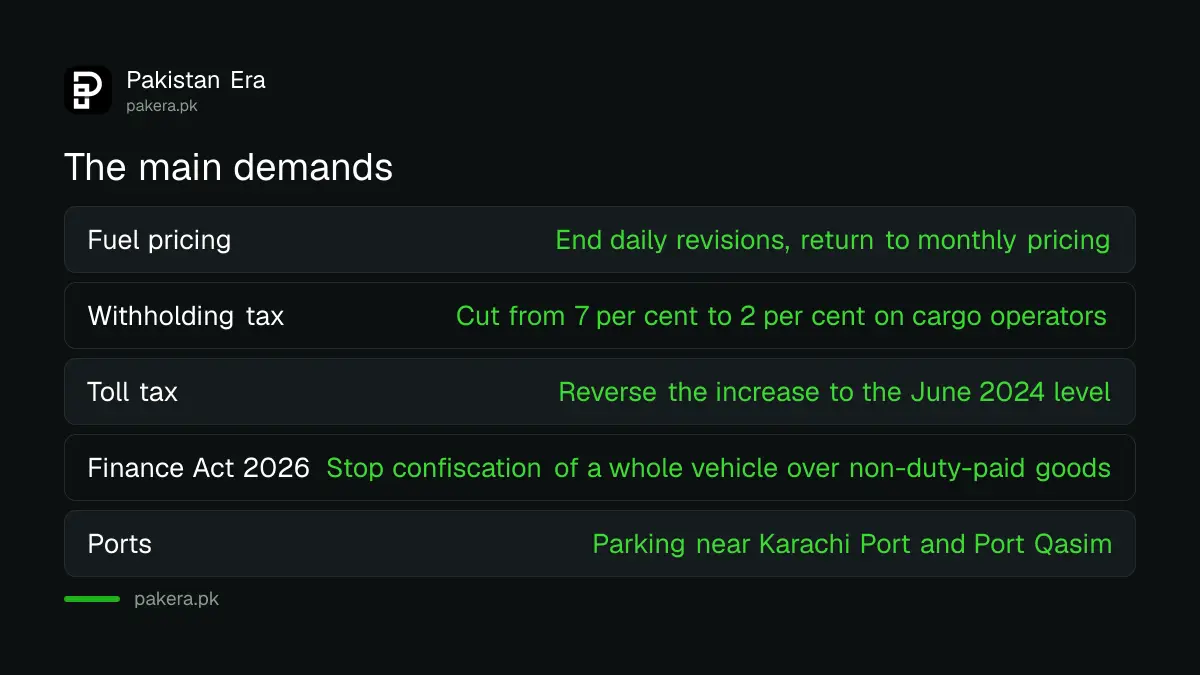
On the toll tax, sources differ on the exact date being demanded, giving either 30 June 2024 or 1 July 2024. The substance is the same: a return to 2024 levels.
Two demands worth understanding
The daily pricing one is not a small technical point. Pakistan moved to revising petroleum prices daily, and for a haulier that means the cost of a job can change between quoting it and doing it. A monthly price is easier to build a rate card against. We explained how the daily mechanism works, and why the cuts are smaller than the oil price moves behind them, in the piece on why petrol prices do not fall with oil.
The confiscation provision is the one generating the most anger. Under the Finance Act 2026, a whole vehicle can be confiscated if non-duty-paid goods are found on board. Transporters argue a driver cannot verify the duty status of every consignment handed to him, and want the earlier system restored, where a fine was imposed and the vehicle released.
What to expect over the next few days
The honest answer is that it depends on Monday.
Goods transport moves industrial, agricultural and retail supply. A short stoppage over a weekend is absorbed. A prolonged one raises transport costs, and those costs reach shelf prices with a lag rather than immediately.
What would change the picture quickly is the talks producing something on the tax demands, which are the cheapest for the government to move on and the most concrete. Both sides have said negotiations continue.
What you can do
- Do not panic buy fuel. The shortage most often follows the rumour rather than the strike.
- Check locally rather than acting on a forwarded voice note.
- If you have goods in transit, contact your carrier for a status rather than assuming.
- Expect perishables to move first if the strike ends, since those are the loads prioritised.
- Watch Monday's talks rather than the daily rhetoric.
If you are budgeting fuel for a long drive this week, the current pump price and how it moves is tracked in our daily petrol price page.
Questions readers are asking
When did the transport strike start?
Saturday 8 August 2026, with vehicles beginning to park from Friday night. It is indefinite and no end date has been given.
Are oil tankers part of the strike?
Yes. Petroleum tankers and edible oil tankers are included, alongside trucks, trailers and intercity loading vehicles.
Will petrol pumps run out of fuel?
That has not been confirmed and we are not predicting it. Tankers being parked is confirmed; a shortage at filling stations is not. Check locally.
Why are transporters striking?
Chiefly over diesel and toll taxes, a withholding tax they want cut from 7 per cent to 2, the shift to daily fuel pricing, and a Finance Act 2026 provision allowing a whole vehicle to be confiscated over non-duty-paid goods.
Is the government talking to them?
Yes. Talks with Federal Minister for Communications Abdul Aleem Khan failed on Friday, and a fresh round was promised for Monday morning.
Will prices go up because of this?
A prolonged stoppage raises transport costs and those reach retail prices with a lag. A short one is usually absorbed. It depends on how quickly the talks resolve.
About the author

Tax, Bills and Technology Writer
Ali Akhtar is a young and curious voice here at Pakistan Era. He is currently pursuing his A-Levels and has a growing interest in Pakistan’s changing industrial landscape and educational trends. Ali likes to write in a way that helps him explain and explore the world around him. His writing reflects the perspective of the new generation navigating the evolving trends of Pakistan where technology, youth innovation, and shifting opportunities are reshaping the country’s future.