Diphtheria Cluster in Hangu, KP: NIH Report Finds 1 Death and 4 Unvaccinated Children
NIH's field report on the August 2026 diphtheria cluster in Hangu, KP, found 3 cases, 1 death and 4 zero-dose children. See the timeline and check your child.
A cluster of three laboratory-positive diphtheria cases in Shadi Khal, Hangu district, Khyber Pakhtunkhwa, in August 2026 included the death of an unvaccinated 13-year-old boy, according to a field report from the National Institutes of Health (NIH). The NIH team found four more children in the area who had never had a diphtheria vaccine dose. If your child's vaccine card has gaps, a health centre can close them.
The report appears in NIH's Week 39 public health bulletin, which NIH posted on 16 October 2026. We read the full field report, titled "Diphtheria Cluster in Shadi Khal, Hangu District", on NIH's website on 20 October 2026. NIH is the federal body that runs disease surveillance in Pakistan.
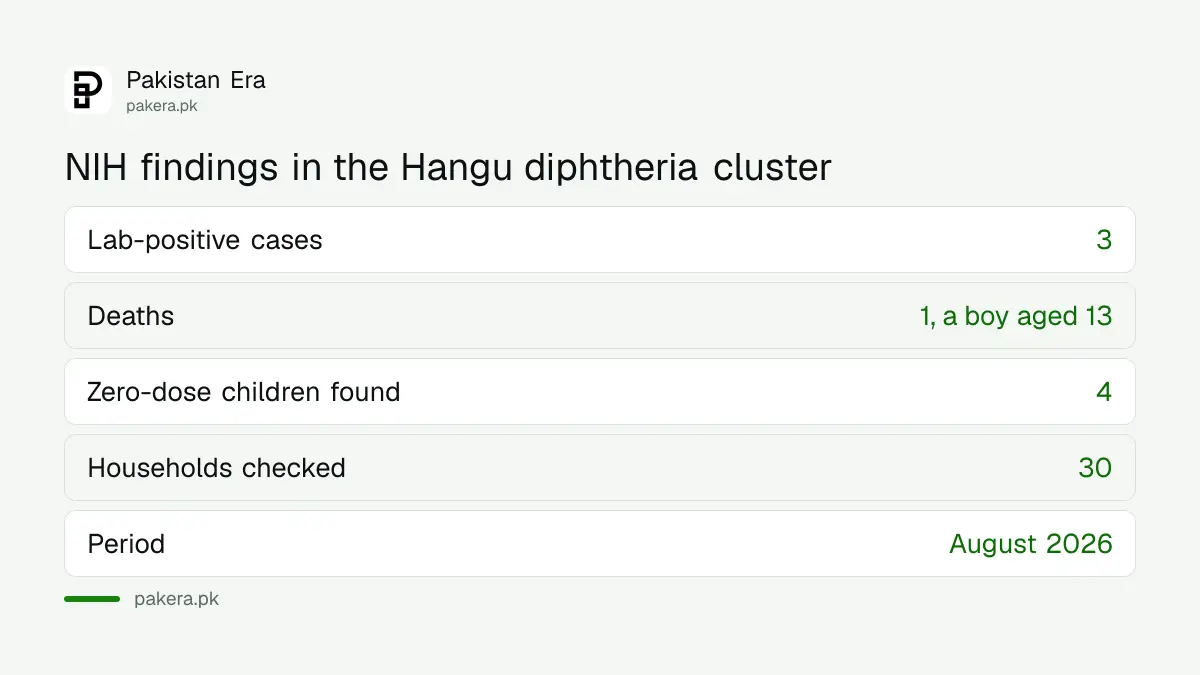
NIH found three lab-positive cases and one death in Shadi Khal
The NIH field report documents three laboratory-positive diphtheria cases in Shadi Khal, Union Council Togh Sarai, Tehsil Hangu, during August 2026. One patient, a 13-year-old boy with no recorded doses of a diphtheria, tetanus and pertussis (DTP) vaccine, died.
Diphtheria is a bacterial infection of the throat and nose. It spreads through droplets and close contact. A toxin made by the bacteria can block the airway and damage the heart and nerves. A grey layer stuck to the throat, which doctors call a pseudomembrane, is its classic sign.
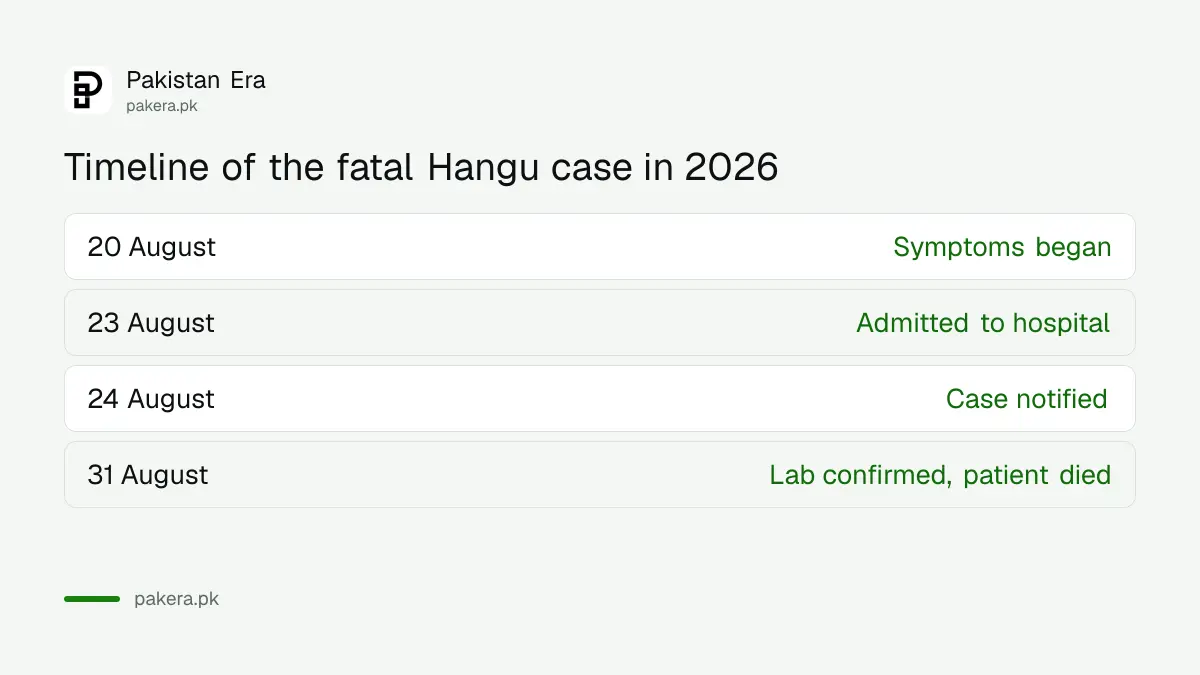
| Date in 2026 | What happened to the fatal case |
|---|---|
| 20 August | Symptoms began |
| 23 August | Admitted to hospital |
| 24 August | Case notified to health officials |
| 31 August | Laboratory confirmation received |
| 31 August | Died at North West General Hospital, Peshawar |
Eleven days passed from the first symptom to the laboratory result. The boy died on the day the confirmation came. That gap is why NIH's first treatment recommendation matters so much, as the section on what NIH recommends shows.
Four more children had never had a diphtheria vaccine
The team checked 30 households around the case, his school and his family. Active case finding identified four more zero-dose children, meaning children who had received no dose of a DTP-containing vaccine. Record reviews also showed gaps in later doses among other children.
NIH's discussion says the gaps in later doses suggest the problem "may extend beyond children who have never been vaccinated". In other words, children who had a first dose but missed the rest may also be unprotected. The report notes that WHO says several doses plus boosters are needed for lasting protection.
Globally, the report cites WHO's estimate that 85 per cent of infants received three doses of a diphtheria vaccine in 2025. That left about 20 million infants unvaccinated or only partly vaccinated. Pakistan's own gaps, NIH says, come from missed routine doses and incomplete schedules.
NIH's team traced contacts and vaccinated children in the area
The response, according to the report, included tracing close contacts, giving them preventive treatment and watching them for symptoms. The team ran catch-up and outbreak-response vaccination. It also worked with community elders and religious leaders to explain the risk.
Throat swabs from people with symptoms went to NIH in Islamabad for testing. The report credits going house to house, and checking the school, with finding the extra zero-dose children. A response limited to the first patient would have missed them.
NIH recommends treating suspected diphtheria without waiting for the lab
NIH's recommendations are for health officials, but two of them help families too. Doctors should start treatment for suspected diphtheria without waiting for a lab result when suspicion is high. Every zero-dose, under-vaccinated and defaulter child should be found and vaccinated.
The other recommendations call for continued case finding in Shadi Khal and nearby localities, in homes, schools and health facilities, and for prompt isolation of suspected cases. For parents anywhere in Pakistan, the practical message is to check the vaccine card.
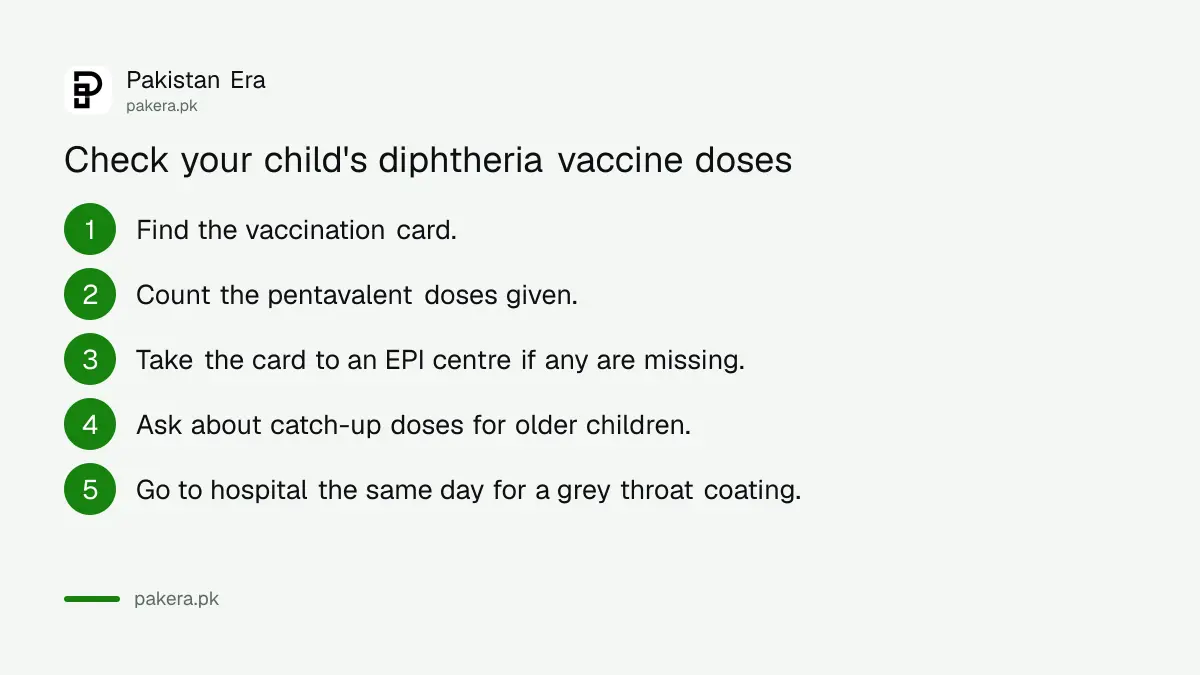
- Find your child's vaccination card and look for the DTP-containing doses, given as part of the pentavalent vaccine in infancy.
- Count the doses. If any are missing, take the card to your nearest government health centre or EPI vaccinator.
- Ask about catch-up doses for older children who missed the infant schedule.
- If a child has a sore throat with a grey coating, fever and a swollen neck, go to a hospital the same day.
- Tell the doctor if anyone close to the child has had diphtheria.
The ages for each dose are set in the EPI baby vaccination schedule. NIH explains the warning signs in its diphtheria advisory on sore throat and membrane, and NIH's weekly counts of measles, mumps and diphtheria cases show the national trend.
Common questions
How many diphtheria cases were found in Hangu?
Three laboratory-positive cases in Shadi Khal, Union Council Togh Sarai, Tehsil Hangu, in August 2026, according to NIH's Week 39 bulletin.
Who died in the Hangu diphtheria cluster?
A 13-year-old boy with no recorded doses of a DTP-containing vaccine. He died at North West General Hospital, Peshawar, on 31 August 2026.
What is a zero-dose child?
In this report, a child who has received no dose of a diphtheria, tetanus and pertussis vaccine. NIH found four such children near the cases.
Is diphtheria still spreading in Hangu?
The report does not say. It describes the August cluster and recommends continued case finding in Shadi Khal and nearby localities.
What are the signs of diphtheria?
A sore throat or nose infection with a grey layer stuck to the throat, tonsils or nose. Severe cases can block breathing and affect the heart.
Where can my child get a missed diphtheria dose?
At a government health centre or from an EPI vaccinator, under the routine immunisation programme. Take the vaccination card with you.
How we verified this
What we checked, where we read it, and what we could not confirm.
Last checked 20 October 2026. We read the field report in the NIH Public Health Bulletin, Week 39, 2026, listed on NIH's weekly bulletin page. The file on NIH's server is dated 16 October 2026. The report does not give the ages of the other two cases, the contacts' results or whether any new case appeared after August. We could not check those with the KP Health Department. The steps for parents are our practical reading, not NIH's words. This page is not medical advice.
About the author

Public Services and Education Journalist
Fajr Riaz is a journalist and content writer at Pakistan Era, based in Lahore. She covers the questions people meet in everyday life in Pakistan: how a public service works, what a change in the rules means, and where to find a reliable answer.