Check a Sore Throat for Diphtheria in Pakistan: NIH's Signs, Contacts and Vaccine Doses
NIH's diphtheria advisory: a grey-white throat coating needs a hospital at once, contacts need antibiotics, and vaccine doses fall at 6, 10 and 14 weeks.

Short answer: A sore throat with a thick grey-white coating on the tonsils or throat, swollen neck glands and trouble swallowing or breathing may be diphtheria. NIH says treatment must start without waiting for tests. The free vaccine is given at 6, 10 and 14 weeks, with a booster later.
A parent does not think twice about a child's sore throat in October. Most sore throats are harmless. A throat with a grey coating that will not wipe away is the one that cannot wait for tomorrow.
We read the National Institutes of Health (NIH) advisory "Urgent Actions required to prevent and control Diphtheria Transmission", dated 28 October 2024, and the week 38 of 2026 bulletin on 12 October 2026. The bulletin lists diphtheria among the diseases that increased that week.
The sign to look for is a grey-white coating in the throat
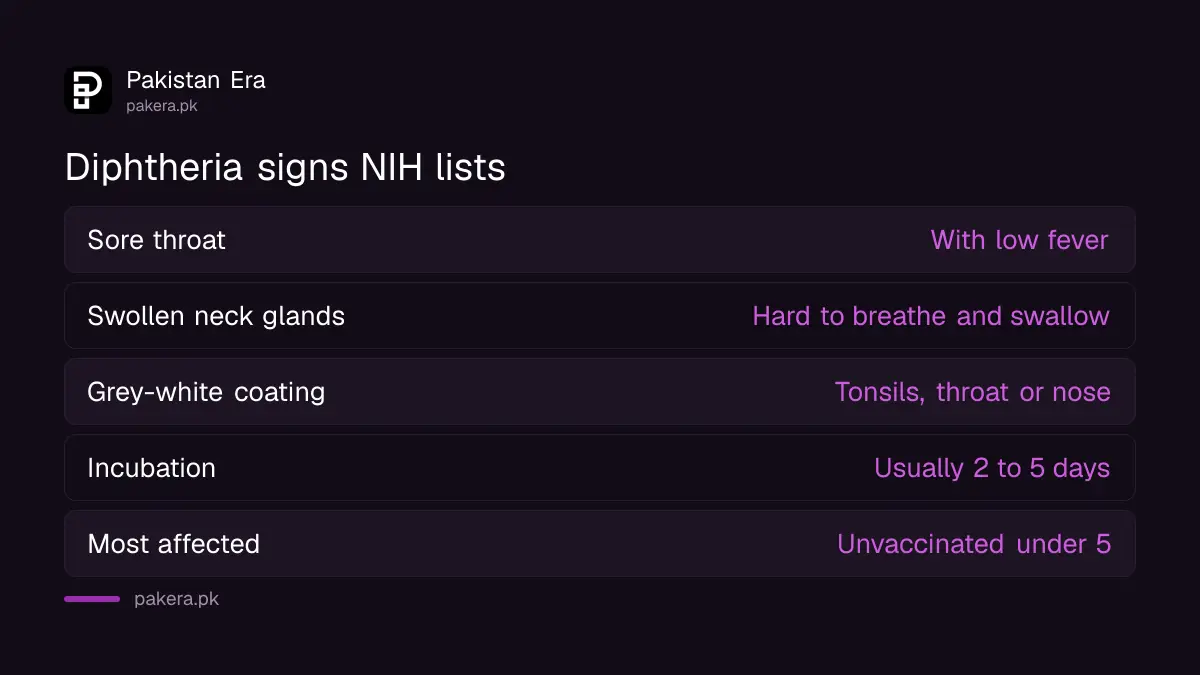
NIH says diphtheria begins with a sore throat and low fever, then swollen glands that make breathing and swallowing hard. The toxin forms a thick, grey-white coating, called a pseudomembrane, on the tonsils, throat or nose. That coating can block the airway.
The advisory says the incubation period, the time from catching it to showing signs, is usually 2 to 5 days. It spreads through coughs and sneezes, and by touching open sores or things such as toys and clothes used by a sick person.
Diphtheria affects all ages, but NIH says unvaccinated children under 5 are the most commonly affected. The advisory lists crowded places such as schools, public transport and hospital outpatient departments as higher-risk settings, and people who are unvaccinated or only partly vaccinated.
| Sign | What NIH says |
|---|---|
| Sore throat, low fever | Common first signs |
| Swollen neck glands | Can make breathing and swallowing hard |
| Grey-white coating | Pseudomembrane on tonsils, throat or nose |
| Trouble breathing, double vision, slurred speech | Later signs of toxin spread; emergency |
Go to a hospital at once, because the toxin spreads
NIH says treatment should start even before the lab confirms, because diphtheria can kill. Doctors use an antitoxin and antibiotics, and the patient is isolated. If a throat coating and breathing trouble appear together, go to a hospital emergency department, not a clinic queue.
The advisory says the antitoxin neutralises the toxin before it enters cells, and that the patient must be tested for sensitivity to it first. It names erythromycin and penicillin as the antibiotics. A throat swab is taken for culture. These are hospital steps, not home treatment.
On deaths, the advisory is not consistent. It gives a case fatality rate of 5 to 17 per cent among the unvaccinated in one place, and says death can occur in up to 10 per cent of clinical cases in another. The honest reading is that it is a serious disease with a real risk of death. The advisory also says having diphtheria does not give immunity, so a recovered patient still needs vaccination.
Close contacts need antibiotics, whatever their vaccine status
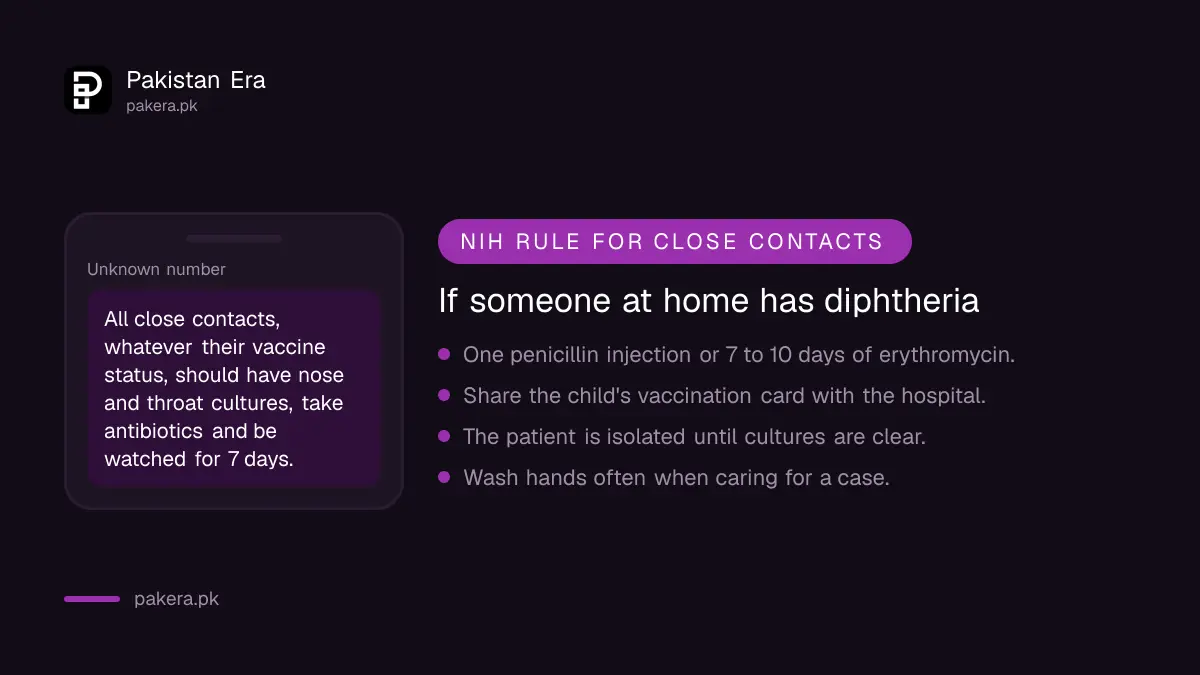
NIH says everyone in close contact with a case should be checked with nose and throat cultures, get a single penicillin injection or a 7 to 10 day course of erythromycin, and stay under watch for 7 days. This applies even to people who are fully vaccinated.
That means family members, classmates who share a bench, and anyone who shares spit, food or toys. Tell the hospital who lives with the patient. The advisory says vaccination history must be shared at the time of testing, so keep the child's card handy.
The bulletin figures are in our report on the week 38 measles, mumps and diphtheria numbers.
The vaccine schedule is 6, 10 and 14 weeks, then a booster
NIH lists three doses of the pentavalent vaccine, which protects against diphtheria, tetanus, whooping cough, hepatitis B and Hib, at 6, 10 and 14 weeks. A DTP booster follows between 18 months and 4 years. The EPI offers these doses at government centres.
For anyone who missed the series, the advisory says children under 5 should get the DT vaccine and those aged 5 and over and adults should get the Td vaccine, to complete three doses. During an alert it says teenagers and adults should get a booster. Our list of adult vaccines and where to get them includes tetanus. For the baby doses, see the free EPI schedule.
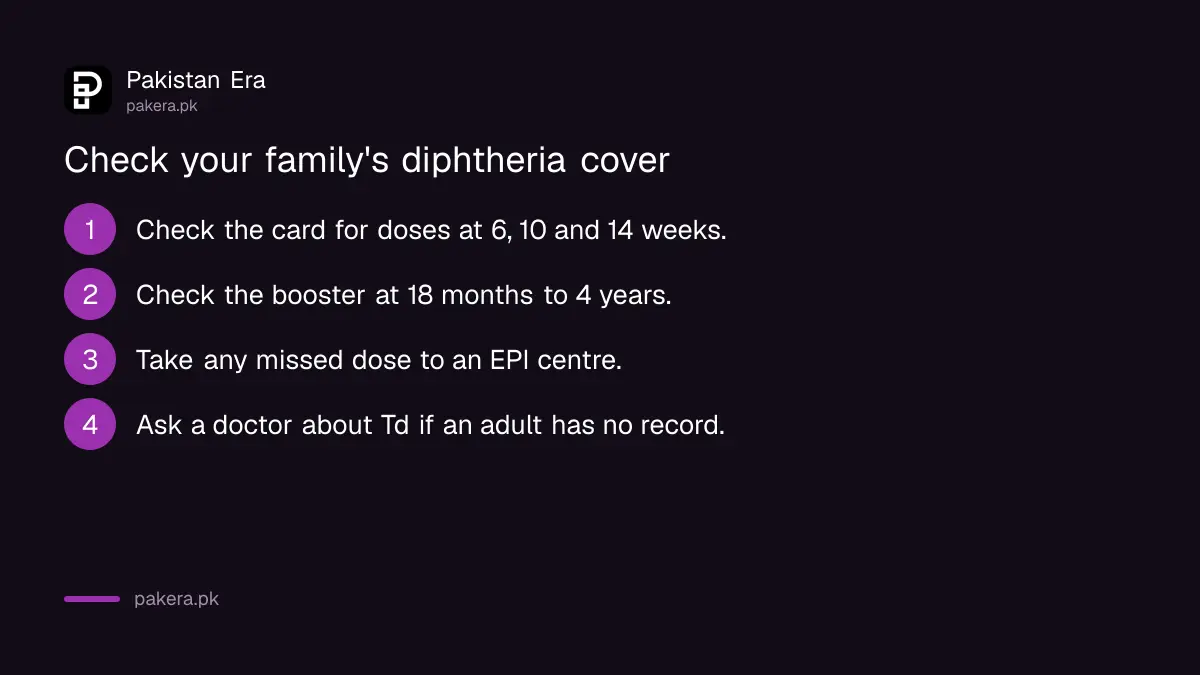
- Check your child's card for the 6, 10 and 14 week pentavalent doses.
- Check that the booster between 18 months and 4 years was given.
- Take a missed dose to your nearest EPI centre.
- If you are a teenager or adult with no record, ask a doctor about a Td dose.
The latest bulletin shows diphtheria rising
NIH's week 38 bulletin lists diphtheria among diseases that increased in the week, with mumps, pertussis and meningitis. The case counts are suspected cases. Punjab is marked "not reported", so the national table does not show Punjab at all.
The advisory is two years old, and we did not find a newer NIH document on diphtheria. Use it for the clinical and vaccine details, and look to the weekly bulletin for current counts.
Common questions
What does diphtheria look like in the throat?
A thick, grey-white coating on the tonsils, throat or nose, with a sore throat, low fever and swollen neck glands, says NIH.
How long before diphtheria signs appear?
NIH gives the incubation period as usually 2 to 5 days.
Can a vaccinated person catch diphtheria?
NIH says close contacts of a case should get tests and antibiotics regardless of vaccination status, so check with a doctor if you were exposed.
Is the diphtheria vaccine free in Pakistan?
The pentavalent doses are part of routine immunisation at EPI centres at 6, 10 and 14 weeks. Check your centre for stock.
Do adults need a diphtheria booster?
NIH says teenagers and adults should get a booster during alerts, and adults who never completed the series should have Td doses to make three.
How we verified this
What we checked, where we read it, and what we could not confirm.
We read NIH's diphtheria advisory of 28 October 2024 and the week 38 of 2026 bulletin on 12 October 2026. This is general information and not medical advice. A child with a throat coating or breathing trouble needs a hospital.
About the author

Public Services and Education Journalist
Fajr Riaz is a journalist and content writer at Pakistan Era, based in Lahore. She covers the questions people meet in everyday life in Pakistan: how a public service works, what a change in the rules means, and where to find a reliable answer.