HEC Amendment Bill 2026 Passed by National Assembly With 3 Other Bills to Put Women on Boards
The National Assembly passed the HEC Amendment Bill 2026 and three more education bills on 30 October to add women to boards. What changes and what comes next.
The National Assembly of Pakistan passed the Higher Education Commission (Amendment) Bill, 2026 on Friday 30 October 2026, along with three other bills from the Ministry of Federal Education and Professional Training. All four add women to the boards and governing bodies of federal education institutions. None of them is law yet: the Senate still has to pass them and the President has to sign them.
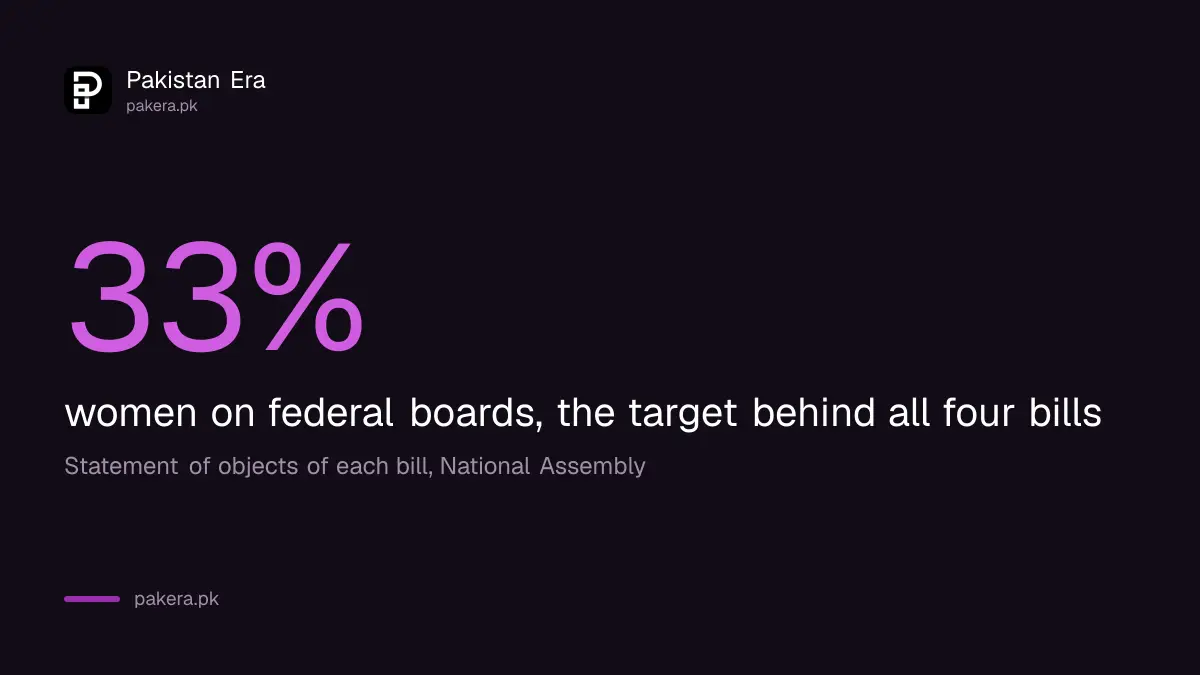
We read the National Assembly's "Bills Passed" page and opened the four bill texts it links for 30 October. Each carries the same reason. The Cabinet Division passed on the Prime Minister's direction to ensure "33% women representation" in all federal boards, statutory bodies, public sector organisations and allied committees. The education ministry is now changing the laws of the bodies under it to match.
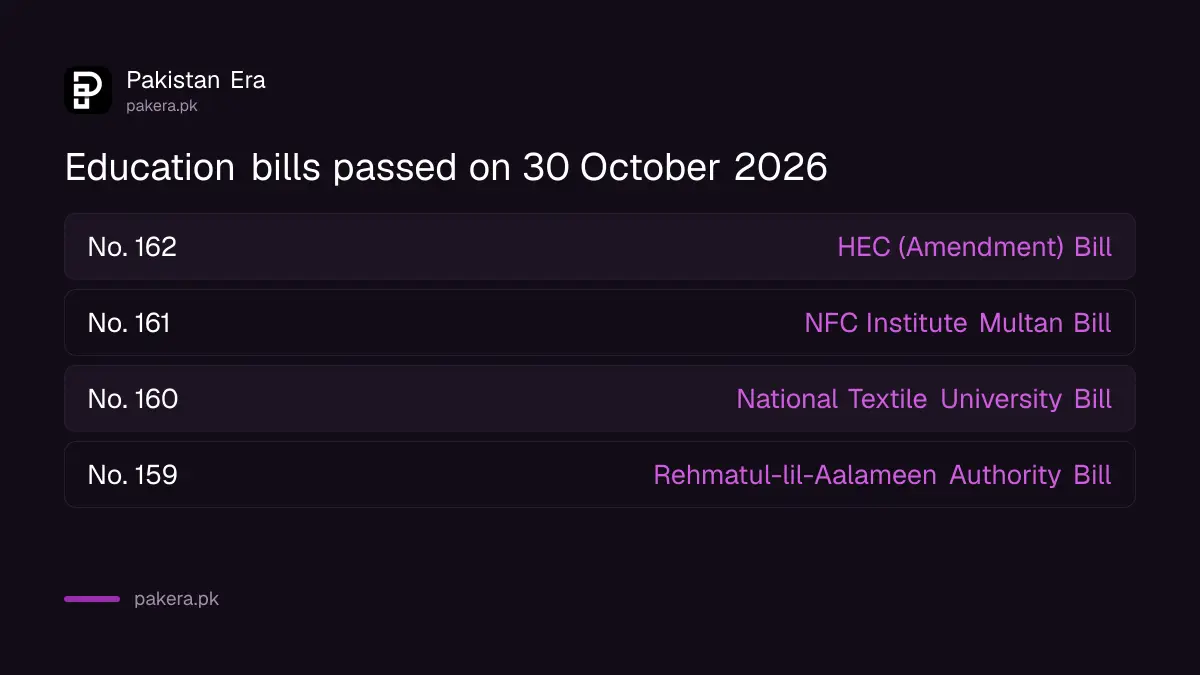
Four bills passed the National Assembly on 30 October 2026
The National Assembly list records bills 159 to 162 as passed on Friday 30 October 2026. They amend the laws behind the Higher Education Commission, two engineering and textile institutions, and the national authority on the Prophet's life and teachings.
| No. | Bill | Passed by National Assembly |
|---|---|---|
| 162 | The Higher Education Commission (Amendment) Bill, 2026 | 30 October 2026 |
| 161 | The NFC Institute of Engineering and Technology Multan (Amendment) Bill, 2026 | 30 October 2026 |
| 160 | The National Textile University (Amendment) Bill, 2026 | 30 October 2026 |
| 159 | The National Rehmatul-lil-Aalameen Wa Khatamun Nabiyyin Authority (Amendment) Bill, 2026 | 30 October 2026 |
The texts are scanned copies marked "As passed by the National Assembly". Each states that it comes into force at once, but that only starts to count after the full law-making process is complete.
The HEC bill changes who sits on the Commission
The HEC bill amends section 6 of the Higher Education Commission Ordinance, 2002, the section that sets out the Commission's members. It inserts words in two clauses so that part of each group of members must be women. It also follows the instruction to replace "Federal Government" with "appropriate authority" where relevant.
The scan of the HEC bill is hard to read in places, and we could not make out the exact number of women each clause now requires. We will not guess it. The statement of objects, which is clear, ties the change to the 33 per cent target. It is signed by Khalid Maqbool Siddiqui, the Federal Minister for Federal Education and Professional Training.
For students, nothing changes on admissions, degrees or fees. This is about who sits on the body that oversees universities. Anyone tracking HEC decisions on degree attestation or scholarships will see the same rules as before.
The NFC Institute bill names one woman in each listed group
The NFC Institute of Engineering and Technology, Multan, bill is the clearest of the four. It adds the words "out of which one shall be female" to several groups named in the institute's law, including teachers, professors and other members. It also replaces one clause with "two eminent persons, one male and one female" from other engineering universities or institutes.
The same bill changes a reference from "Industries and Production" to the education ministry's name, which suggests the institute's line ministry is being updated in the law. The National Textile University bill makes similar changes to its own governing body. The authority bill adds a set number of women to its members, but the number is again hard to read in the scan.
Three more education bills passed on 28 October
The same National Assembly list shows the National College of Arts Institute (Amendment) Bill, the Centre for Clinical Psychology (Amendment) Bill and the Area Study Centres (Amendment) Bill passed on Wednesday 28 October 2026. We did not open those three texts, so we cannot say what they change.
On 27 October the Assembly passed 11 bills, including amendments to the Criminal Law, the Code of Criminal Procedure, the Qanun-e-Shahadat and the Islamabad Capital Territory Senior Citizens Act. You can follow each day's business through the National Assembly agenda and live session.
The Senate and the President still have to approve the bills
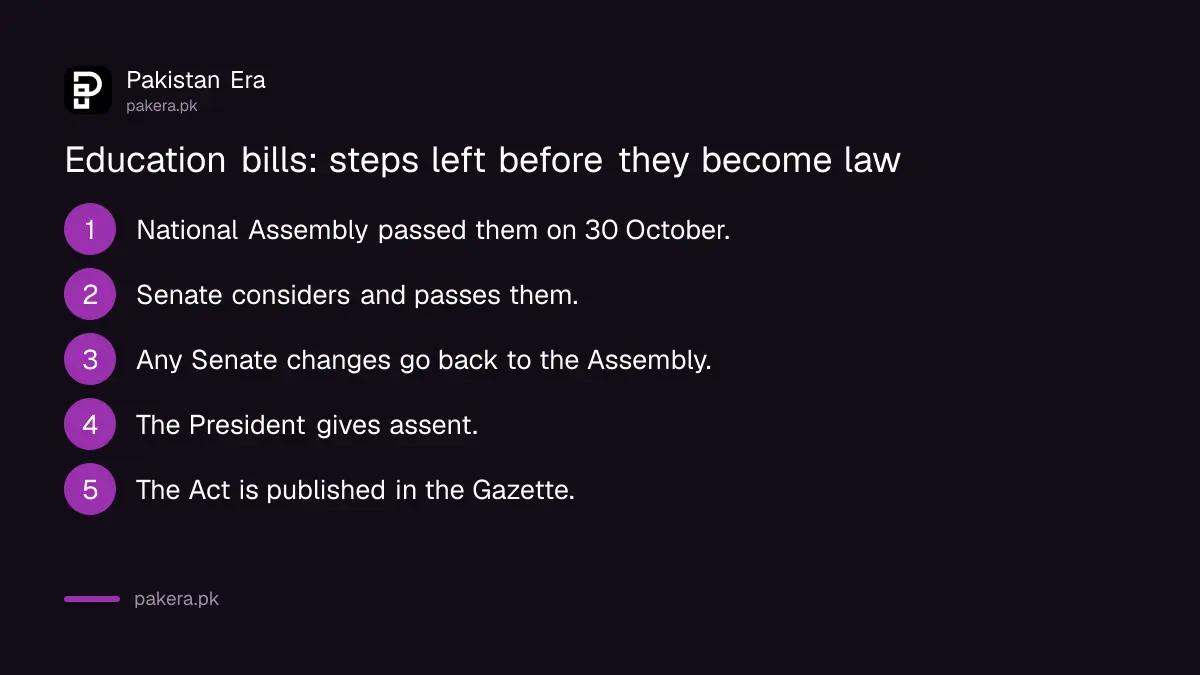
A bill passed by the National Assembly goes to the Senate. If the Senate passes it without change, it goes to the President for assent, and it becomes an Act once assented and published in the Gazette. The Senate website says its session was prorogued on Friday 30 October 2026, so the Senate cannot take these bills up until it meets again.
- National Assembly passes the bill. Done on 30 October 2026.
- Senate considers and passes it, with or without amendments.
- If the Senate changes it, the National Assembly must agree, or a joint sitting decides.
- The President gives assent.
- The Act is published in the Gazette of Pakistan and the change takes effect.
The full route, with time limits for the President's assent, is in how a bill becomes law in Pakistan. Once an Act is published, its final text appears on the federal law portal, which is how to check the latest text of a federal law.
Common questions
Has the HEC Amendment Bill 2026 become law?
No. The National Assembly passed it on 30 October 2026. It still needs the Senate's approval, the President's assent and publication in the Gazette.
What does the HEC Amendment Bill 2026 change?
It amends section 6 of the HEC Ordinance, 2002, so that part of the Commission's membership must be women, in line with a federal target of 33 per cent women on boards.
Does the bill change HEC fees, degrees or admissions?
No. The bill deals with the Commission's membership. We found nothing in it about fees, degrees, attestation or admissions.
Which other bills passed on 30 October 2026?
The NFC Institute of Engineering and Technology Multan, National Textile University and National Rehmatul-lil-Aalameen Wa Khatamun Nabiyyin Authority amendment bills.
Who moved these bills?
The statements of objects are signed by Khalid Maqbool Siddiqui, the Federal Minister for Federal Education and Professional Training.
When will the Senate vote on them?
No date is set. The Senate session was prorogued on 30 October 2026, so the bills wait for its next session.
How we verified this
What we checked, where we read it, and what we could not confirm.
Last checked 31 October 2026. We read the National Assembly's list of bills passed and downloaded the four bill texts it links for 30 October, including the HEC (Amendment) Bill, 2026. We read the Senate website's notice that its session was prorogued on 30 October 2026. The scans are partly unreadable, so we could not confirm the exact number of women required on the HEC and the authority, or what the 28 October bills change. We found no Senate date for these bills.
About the author

Global Affairs & Political Economy Writer
Muhammad Hatim is a book lover who started writing because he enjoys it. At Pakistan Era he writes about international relations, geopolitics and the global economy, with a particular interest in South Asia and the forces behind current events.