Honhaar Scholarship University List 2026 for Punjab Students: All 497 Institutes and 70 Disciplines
The Honhaar 2026 list has 91 universities, 390 colleges and 16 medical colleges, plus 70 disciplines. See if yours qualifies and apply by 9 November 2026.
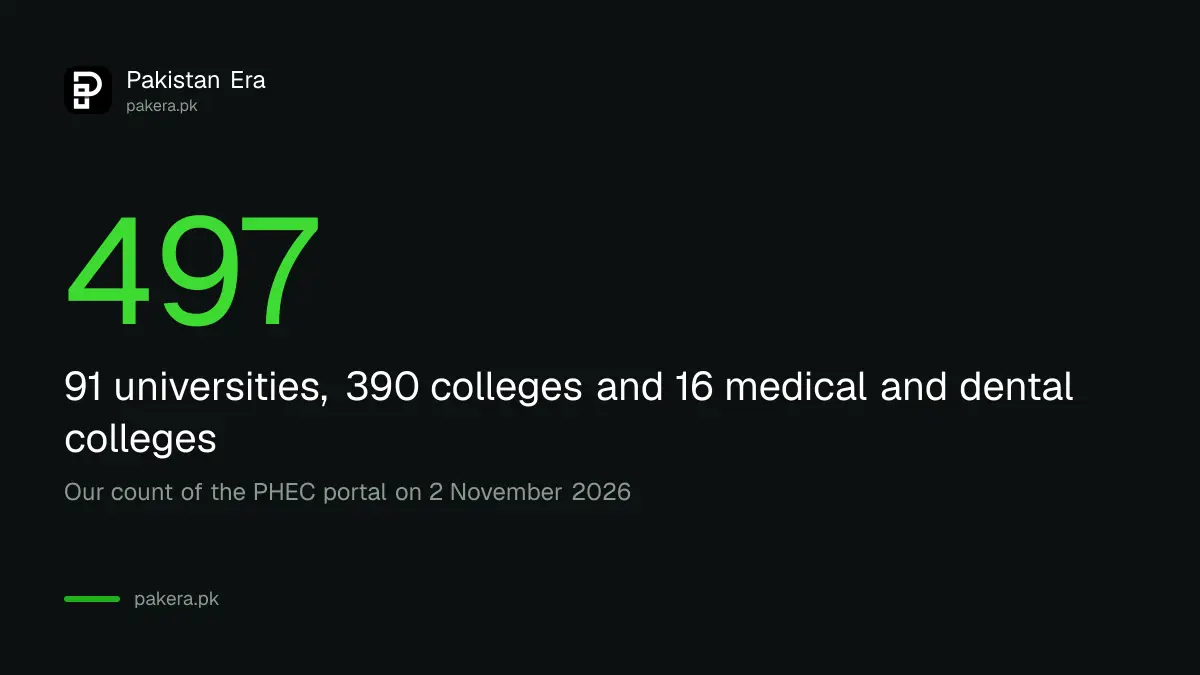
The Honhaar Scholarship 2026 university list on the PHEC portal names 497 institutes: 91 universities in 27 cities, 390 government colleges and 16 medical and dental colleges. Your degree must also be one of 70 selected disciplines, and the last date to apply is 9 November 2026. If your university or subject is not on the list, the scholarship cannot pay your fee, however good your marks are.
Every year students apply first and check the list later. Then the application stalls at the institute dropdown. We read the Punjab Higher Education Commission (PHEC) portal on 2 November 2026 and counted the list ourselves. Below are the universities by city, the medical colleges, the disciplines, the marks and income limits, and what to do if your institute is missing.
The Honhaar list has 497 institutes across three tabs
The institutes page on honhaarscholarship.punjabhec.gov.pk splits the list into three tabs: Universities, Colleges, and Medical and Dental Colleges. We counted 91 universities, 390 colleges and 16 medical and dental colleges, a total of 497 on 2 November 2026.
The counts are our own tally of the names shown on the page. PHEC does not print a total. The program brochure, a PHEC advertisement hosted on the University of Health Sciences website, promises 50,000 new scholarships this round and says the scheme covers tuition for the full 4 or 5 year degree.
| Tab on the portal | Institutes we counted | Examples |
|---|---|---|
| Universities | 91 in 27 cities | University of the Punjab, UET Lahore, LUMS, FAST Islamabad, GIKI |
| Colleges | 390 | Government graduate colleges across Punjab |
| Medical and Dental Colleges | 16 | Allama Iqbal Medical College, SIMS, QAMC Bahawalpur |
| Total | 497 | Count by us on 2 November 2026 |
Lahore has 33 of the 91 Honhaar universities
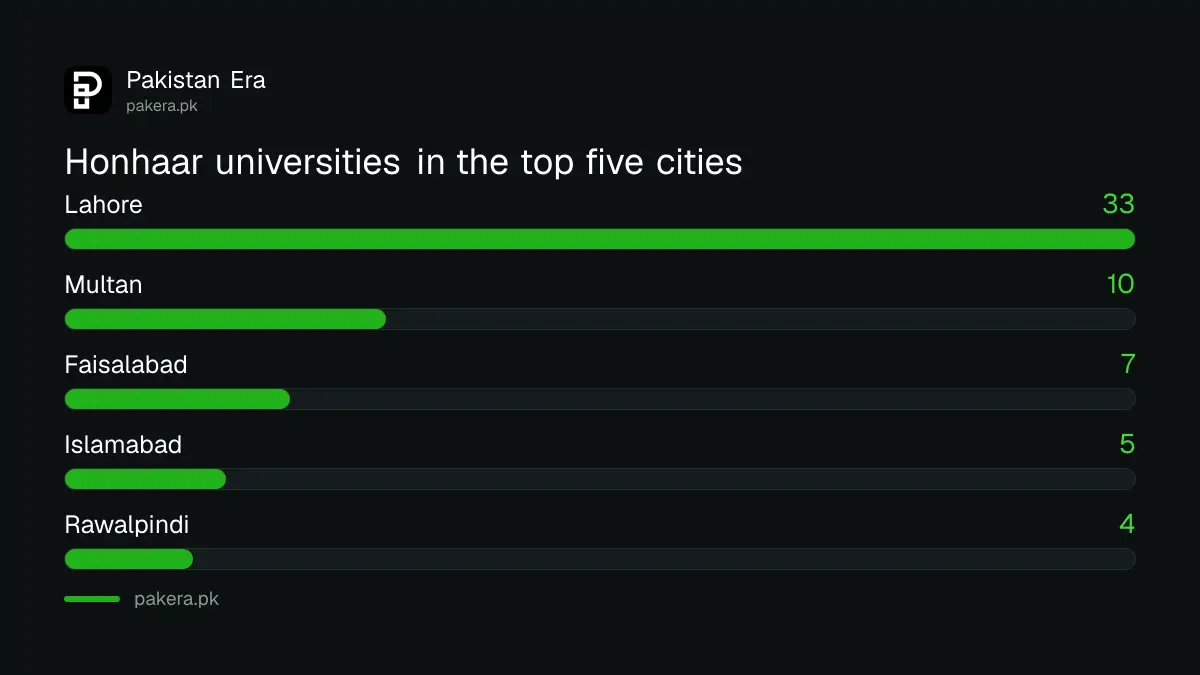
Lahore leads with 33 universities on the list, followed by Multan with 10, Faisalabad with 7, Islamabad with 5 and Rawalpindi with 4. The other 22 cities have one to three each, from Bhakkar and Chakwal to Murree, Okara and Wah Cantt.
The list mixes public, federal and private universities. In Lahore it runs from the University of the Punjab, GCU, UET, King Edward Medical University and UHS to LUMS, Forman Christian College, UCP, UMT, the University of Lahore and Superior University. Multan has Bahauddin Zakariya University, Nishtar Medical University, MNS University of Agriculture and the Women University.
A few institutes outside Punjab are on the list too, for Punjab-domiciled students who study there. These include FAST, Bahria, Riphah, PIEAS and the Virtual University under Islamabad, and GIKI under Swabi. A Karachi heading appears on the page but shows no institute under it. We did not find NUST or COMSATS in the visible list.
Only 16 public medical and dental colleges are on the list
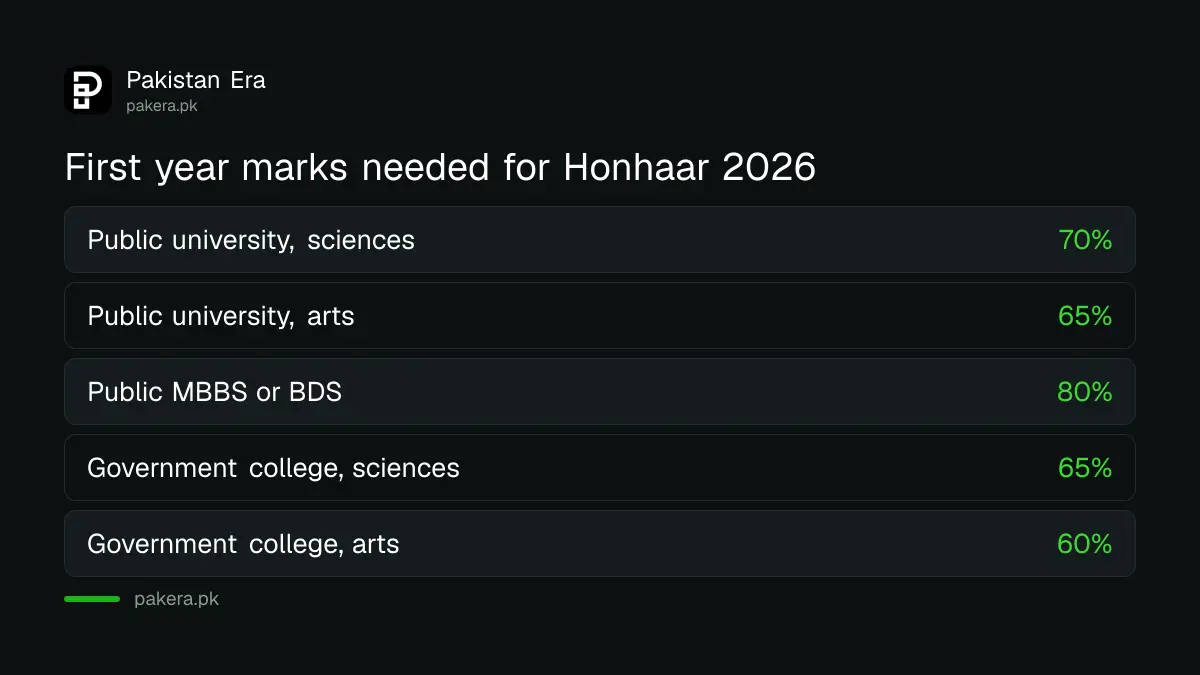
The medical tab lists 16 public colleges, and only students of these, plus medical universities in the main list, can claim MBBS or BDS fees. A first year MBBS or BDS student needs at least 80 per cent in FSc, the highest bar in the scheme.
The 16 are Allama Iqbal Medical College, Ameer-ud-Din Medical College, de'Montmorency College of Dentistry, Fatima Jinnah Institute of Dental Sciences, the Institute of Public Health, the Punjab Institute of Cardiology and SIMS, all in Lahore, plus DG Khan, Gujranwala, Khawaja Muhammad Safdar, Narowal, Nawaz Sharif (Gujrat), Quaid-e-Azam (Bahawalpur), Sahiwal, Sargodha and Sheikh Zayed (Rahim Yar Khan) medical colleges. Private medical colleges are not in this tab. If you are joining one, read the list of private medical colleges in Punjab and ask your college about other aid.
Your subject must be one of 70 Honhaar disciplines
The portal lists 70 selected disciplines. They cover the obvious ones, such as computer science, engineering, MBBS, BDS, law, business and pharmacy, but also English, Urdu, Punjabi, Islamic Studies, Education, History, Geography, Fine Arts, Mass Communication and Psychology.
The list also has newer fields: artificial intelligence, robotics, cyber security, data science, climate change, space sciences, solar technology and water technology. Technology diplomas such as civil, electrical, mechanical, textile and chemical technology are in too. If your exact degree title is different, check the program dropdown on the application form, which only shows programs approved for your chosen institute.
Marks and income limits depend on the type of institute
First year students at public and private universities need 70 per cent in sciences or 65 per cent in arts. Government college students need 65 or 60. Family income must be under Rs 350,000 a month for public institutes and Rs 500,000 for federal or private ones.
The portal weighs matric at 30 per cent and intermediate at 70 per cent. Students in their second semester or later can apply only if they study at a public university, public medical or dental college, or government college, and the income limit for them is Rs 350,000. All applicants need a Punjab domicile. There is no age limit, and the scheme is open to both men and women on merit.
| First year applicant at | Sciences | Arts | Monthly family income |
|---|---|---|---|
| Public university or college | 70% | 65% | Under Rs 350,000 |
| Public medical or dental college | 80% (MBBS, BDS) | Not offered | Under Rs 350,000 |
| Federal or private university | 70% | 65% | Under Rs 500,000 |
| HED government college | 65% | 60% | Under Rs 350,000 |
Check your institute and program before you apply
Open the institutes page first, then start the form. The application has three parts, personal, educational and socio-economic details, and asks for a family income affidavit on e-stamp paper. PHEC posts a sample affidavit on the portal.
- Open honhaarscholarship.punjabhec.gov.pk and click Institutes.
- Find your university, college or medical college in the right tab.
- Check that your degree falls in one of the 70 disciplines.
- Register or sign in, and fill the personal, educational and socio-economic sections.
- Upload your documents and the income affidavit on e-stamp paper.
- Submit before 9 November 2026. No hard copy is needed.
The opening of registration and the earlier rules are in our report on the Honhaar Scholarship 2026 registration for Punjab students. If your institute is missing, Honhaar is not your only option. Other awards with deadlines this season are in the November and December 2026 scholarship and admission last dates.
Common questions
How many universities are on the Honhaar Scholarship 2026 list?
We counted 91 universities in 27 cities on 2 November 2026, plus 390 colleges and 16 medical and dental colleges.
Is my private university covered by Honhaar?
Only if it is named on the list, and only for first semester or first year students of fall 2026. From the second semester on, only public institutes qualify.
Are NUST and COMSATS on the Honhaar list?
We did not find either in the visible list on 2 November 2026. Ask the PHEC helpline before you rely on that.
What is the last date for the Honhaar Scholarship 2026?
9 November 2026. The portal and the PHEC advertisement both give this date.
Does Honhaar pay hostel fees?
No. PHEC's terms say it covers tuition and admission charges, not boarding, lodging or refundable security.
Who do I contact if my institute is missing?
Call PHEC on 042-99231903 or 042-99231904, or email honhaar@punjabhec.gov.pk.
How we verified this
What we checked, where we read it, and what we could not confirm.
Last checked 2 November 2026. We read the institutes, eligibility and disciplines pages on the PHEC Honhaar Scholarship portal, the sample affidavit and the terms and conditions posted there, and the PHEC advertisement on the UHS website. Institute counts are our own tally of the names shown on the page; PHEC does not publish a total. We could not confirm why the Karachi heading shows no institutes, or whether any institute will be added before 9 November.
About the author
Public Services and Education Journalist
Fajr Riaz is a journalist and content writer at Pakistan Era, based in Lahore. She covers the questions people meet in everyday life in Pakistan: how a public service works, what a change in the rules means, and where to find a reliable answer.