How Net Run Rate Works: Pakistan's +1.240 in the ODI Tri-Series Worked Out Step by Step
Net run rate is runs per over scored minus conceded. See how Pakistan's +1.240 in the ODI tri-series is 6.07 minus 4.83, with Sri Lanka and England worked too.
Short answer: Net run rate is runs scored per over minus runs conceded per over, across all matches in the series. Pakistan's +1.240 after two tri-series matches is 6.07 runs an over scored minus 4.83 conceded. A team bowled out counts its full 50 overs, so England's 215 in 38.4 overs is worked out as 215 in 50.
Points decide who plays the final of the ODI tri-series at Lahore on 31 October 2026, and net run rate, called NRR, separates teams that finish level. Here we rebuild all three numbers in the table, step by step, from the two results played so far. Everything is arithmetic on published scores, and you can repeat it with a calculator.
The formula is runs per over scored minus runs per over conceded
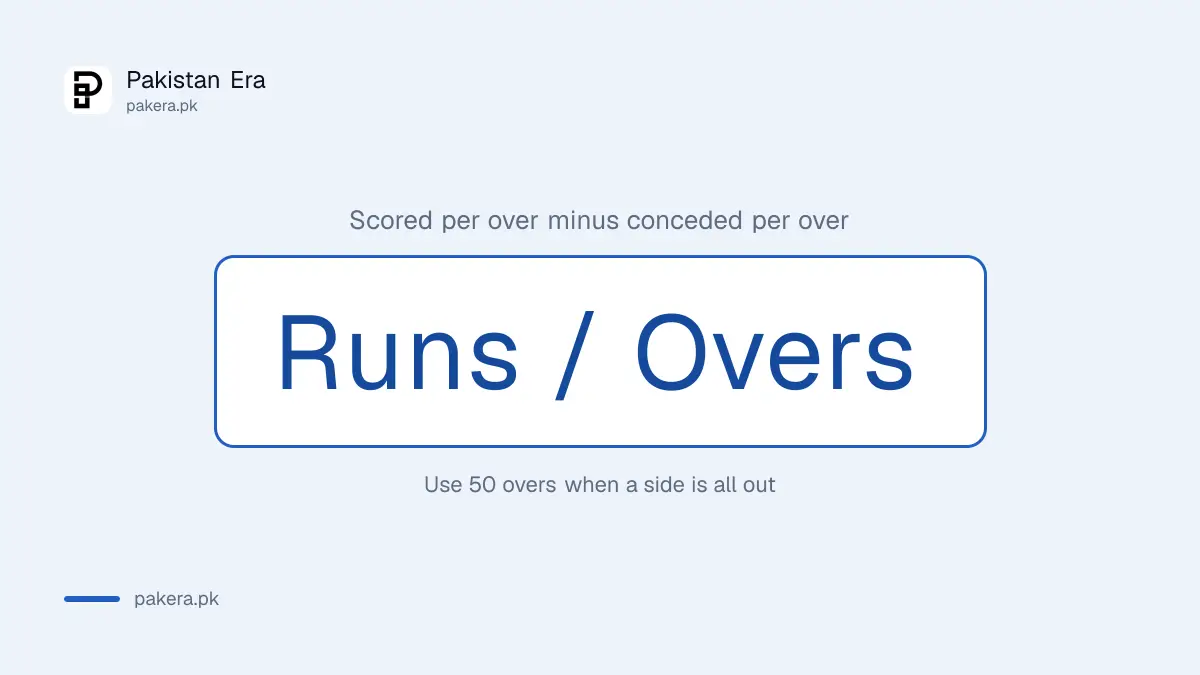
NRR is total runs scored divided by total overs faced, minus total runs conceded divided by total overs bowled. It uses every match, not one. A positive number means a team scores faster than it concedes.
The published series table shows Pakistan +1.240, Sri Lanka -0.740 and England -1.740 after Pakistan's wins on 18 and 20 October 2026. We checked that these figures follow from the scores. They do, to the third decimal place, which also tells us how the table treats a side that is bowled out.
A side bowled out is counted as using all 50 overs
When a team is all out, its overs are counted as the full quota of 50, not the 38.4 it actually batted. This is the usual rule in ODI tables, and it is the only reading under which the published numbers come out right. We did not open the ICC rule page text for it, so the proof here is the arithmetic.
| Match | Pakistan | Opponent | Overs counted |
|---|---|---|---|
| 18 October | 305 in 50 | Sri Lanka 268 in 48.1, all out | 50 each |
| 20 October | 302 for 9 in 50 | England 215 in 38.4, all out | 50 each |
If the real 38.4 overs were used, England's run rate would jump to about 5.56 and the table would not match. A team that collapses is not rewarded with a lower overs count.
Pakistan's +1.240 is 6.07 minus 4.83
Pakistan scored 305 plus 302, which is 607 runs, in 100 overs. That is 6.07 an over. They conceded 268 plus 215, which is 483 runs, over 100 overs, or 4.83 an over. The difference is +1.24.
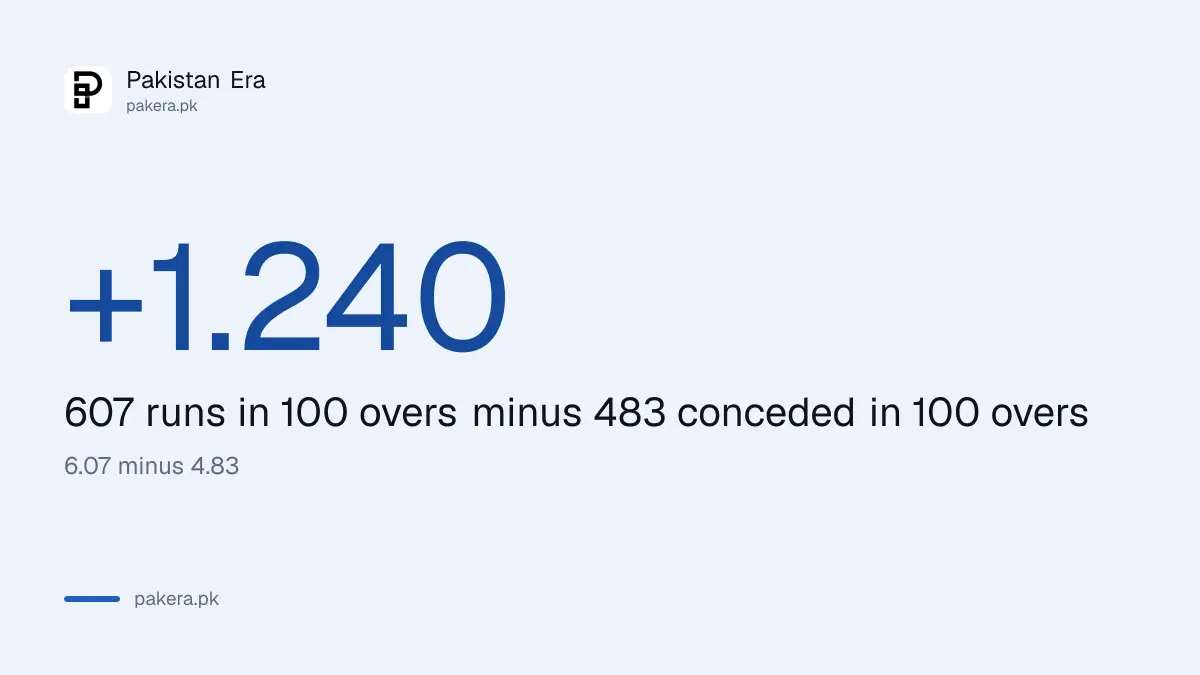
- Add Pakistan's runs: 305 + 302 = 607.
- Divide by overs faced: 607 / 100 = 6.07.
- Add the runs they conceded: 268 + 215 = 483.
- Divide by overs bowled: 483 / 100 = 4.83.
- Subtract: 6.07 - 4.83 = +1.24.
Both Pakistan wins are in our reports on the 37 run win over Sri Lanka and the 87 run win over England.
Sri Lanka's -0.740 and England's -1.740 follow the same way
Sri Lanka scored 268 in a counted 50 overs, which is 5.36 an over. They conceded 305 in 50, which is 6.10. The difference is -0.74. England scored 215 in a counted 50, 4.30 an over, and conceded 302 in 50, 6.04. The difference is -1.74.
| Team | Scored per over | Conceded per over | NRR |
|---|---|---|---|
| Pakistan | 6.07 | 4.83 | +1.240 |
| Sri Lanka | 5.36 | 6.10 | -0.740 |
| England | 4.30 | 6.04 | -1.740 |
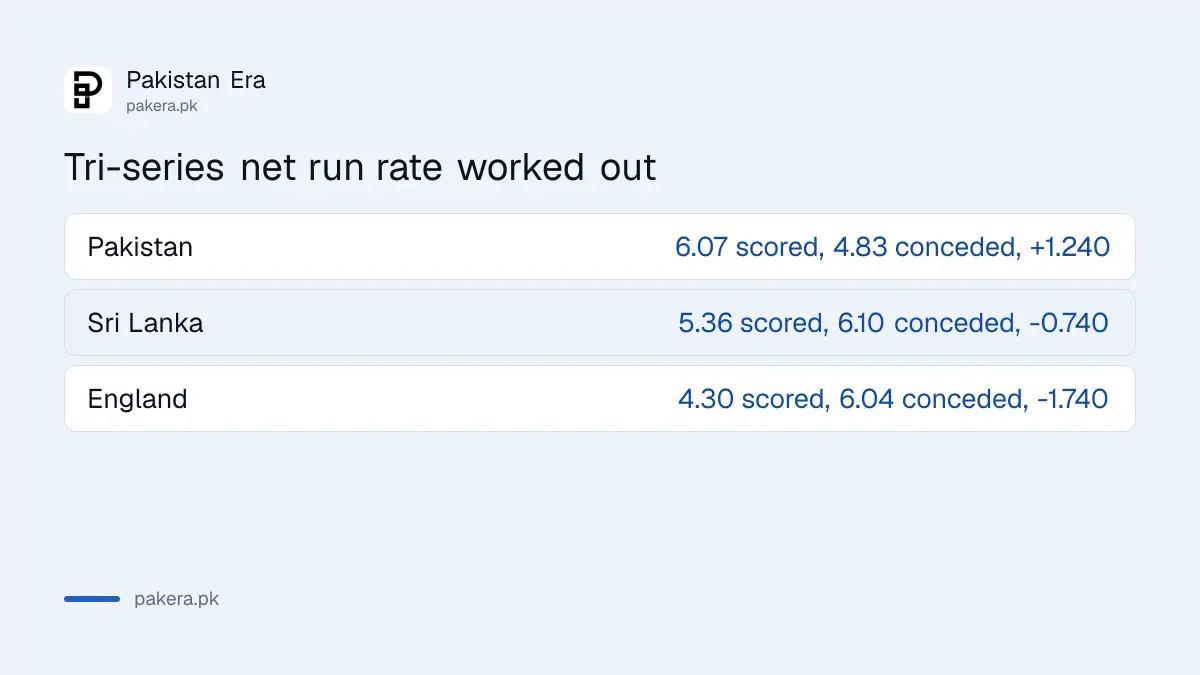
Every row matches the published table. Because each team has played only one or two games, the numbers will move a lot as more matches are added.
Rain, DLS and where NRR is used
When rain cuts a match, the target changes under the Duckworth-Lewis-Stern method, and NRR is then worked on the revised overs. We explain that method in the guide to DLS targets in rain-hit ODIs. We have not checked how this tri-series handles a washout, so read the series playing conditions before you rely on it.
NRR matters only when teams are level on points. The full table, with the remaining fixtures, is on the tri-series points table page.
Common questions
What is net run rate in cricket?
It is runs scored per over minus runs conceded per over across all a team's matches. A higher number is better.
Why does a team bowled out count 50 overs?
Because the usual ODI rule counts the whole quota when a side is all out. The published table matches this rule, as the arithmetic above shows.
What is Pakistan's net run rate?
+1.240 after two matches, which is 6.07 minus 4.83.
Does NRR decide the final place?
Only if teams are level on points. Points come first.
When is the tri-series final?
Saturday, 31 October 2026 at Lahore, at 1 pm PKT.
Can I work out NRR myself?
Yes. Add runs and overs for all matches, divide, and subtract. Use 50 overs for any innings where a side is all out.
How we verified this
What we checked, where we read it, and what we could not confirm.
Last checked 21 October 2026. The scores and the table come from the published series match list and points table, which we read on 21 October 2026. We also opened the ICC playing conditions page, but it links to PDFs we could not read, so we did not quote the NRR rule. Sri Lanka being all out in 48.1 overs is our reading of the reported score, since they finished 37 runs short with overs unused. Every NRR figure above is our own arithmetic, and it reproduces the published table to three decimals. We have not checked how a washout is treated in this series.
About the author

Public Services and Education Journalist
Fajr Riaz is a journalist and content writer at Pakistan Era, based in Lahore. She covers the questions people meet in everyday life in Pakistan: how a public service works, what a change in the rules means, and where to find a reliable answer.