How to Activate an eSIM in Pakistan
What an eSIM costs after the Rs 1,500 cap, which phones support it, the biometric step nobody can skip, and how transfers work now.
An eSIM is a SIM that is written into your phone instead of slotted into it. Same number, same network, no plastic.
Getting one in Pakistan takes a visit, your CNIC and a thumbprint. Since mid August 2026 it also costs less, because PTA has capped the issuance fee at Rs 1,500 and made the first ten handset transfers free.
What it costs now
Before the cap, pricing varied a lot by network. Zong and Ufone were reported at around Rs 2,000 for an eSIM or a conversion, while Jazz has often offered conversion free.
Rs 1,500 is now the ceiling, not the price. An operator can charge less and some do, so ask rather than assume. The background to the change is in our report on the Rs 1,500 cap and the ten free transfers.
The thing most guides leave out
A physical SIM is portable. You pop it out of one phone and into the next.
An eSIM is bound to the handset. There is nothing to move. When you change phone, the profile has to be issued again on the new device.
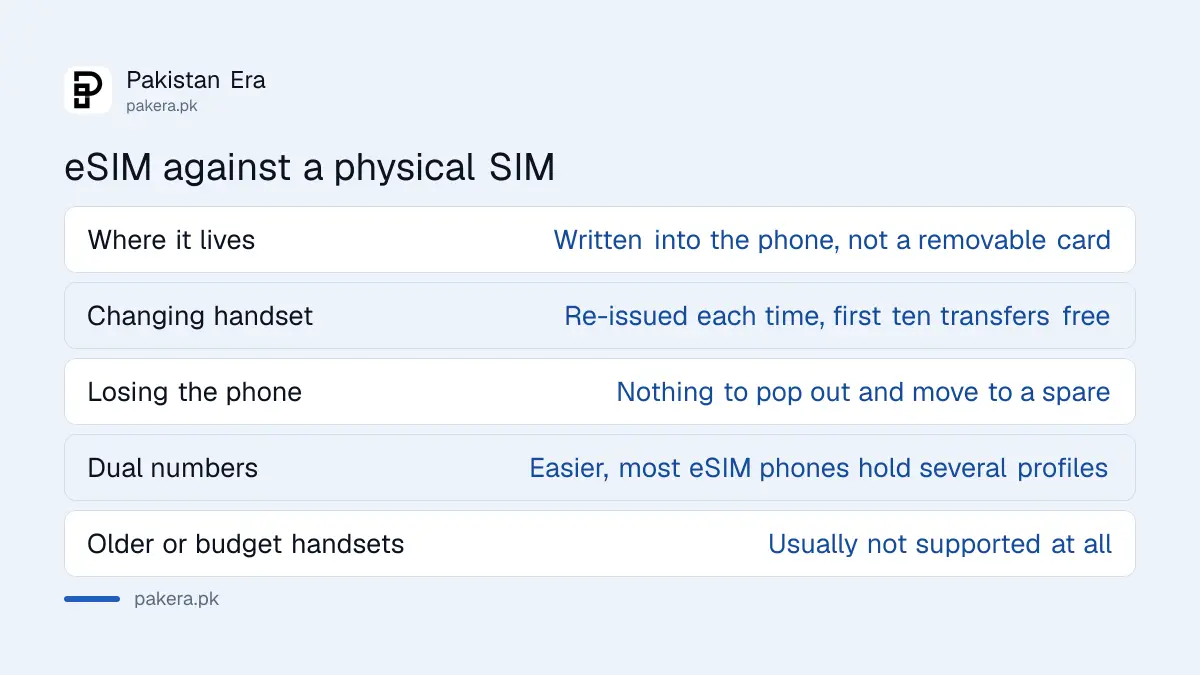
That is why the transfer allowance matters. Ten free transfers covers roughly a decade of ordinary phone changes. Before, each change could mean paying again and going in person, which was the main practical reason people stayed on plastic.
Check these four things before you go
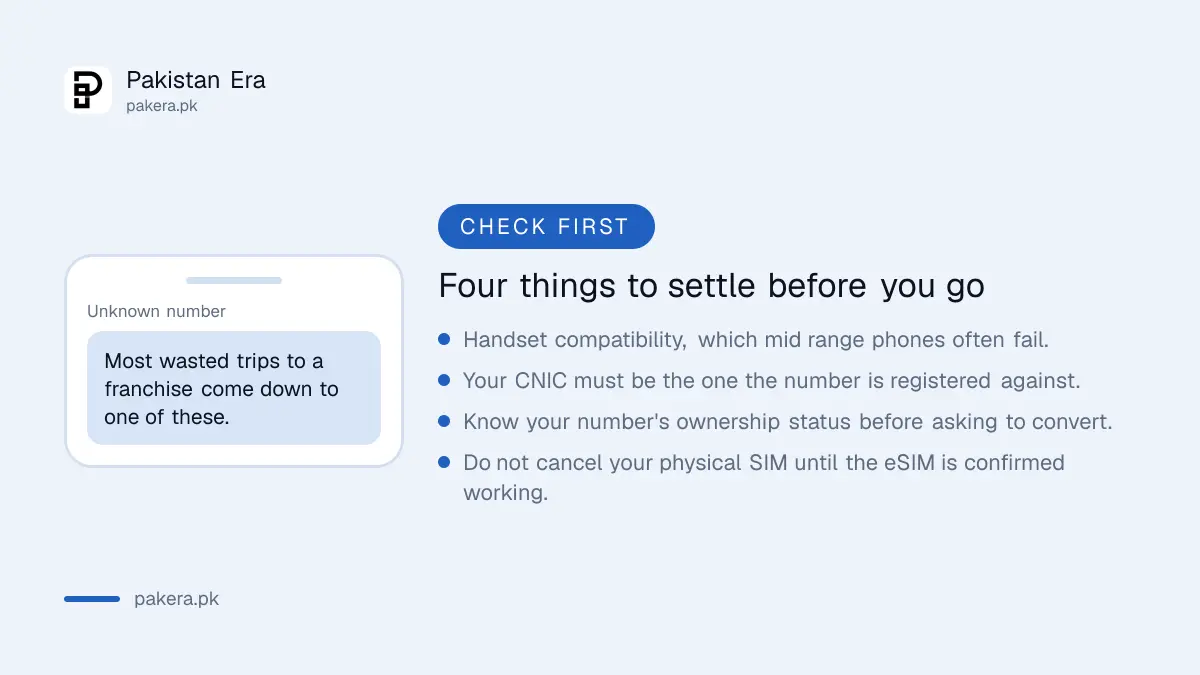
- Does your handset support eSIM? Recent iPhones and flagship Android models generally do. Mid-range and budget phones often do not, and this is the most common wasted trip.
There is a quick way to settle the compatibility question yourself. Dial *#06#. Alongside your IMEI, an eSIM capable phone also shows an EID, a longer number that only exists where eSIM hardware is present. No EID, no eSIM.
| Handset | eSIM support, broadly |
|---|---|
| iPhone | XS and XR generation onwards |
| Samsung flagships | S20 generation onwards |
| Google Pixel | Most models from Pixel 3 onwards |
| Mid-range and budget Android | Frequently not supported, check individually |
| Any phone | Dial *#06# and look for an EID |
The model ranges above are general guidance rather than a guarantee for every variant, since manufacturers ship region-specific versions. The EID check is the one that settles it for your actual handset.
- Is the number registered on your own CNIC? You cannot convert a number registered to somebody else.
- Do you know your ownership status? If you are not sure how many connections sit against your CNIC, check before you add another.
- Do you have a working backup? Do not cancel anything until the eSIM is confirmed live.
If you are unsure what is registered in your name, the check takes two minutes and we walk through it in the guide to finding and reporting SIMs issued against your CNIC.
How the activation works
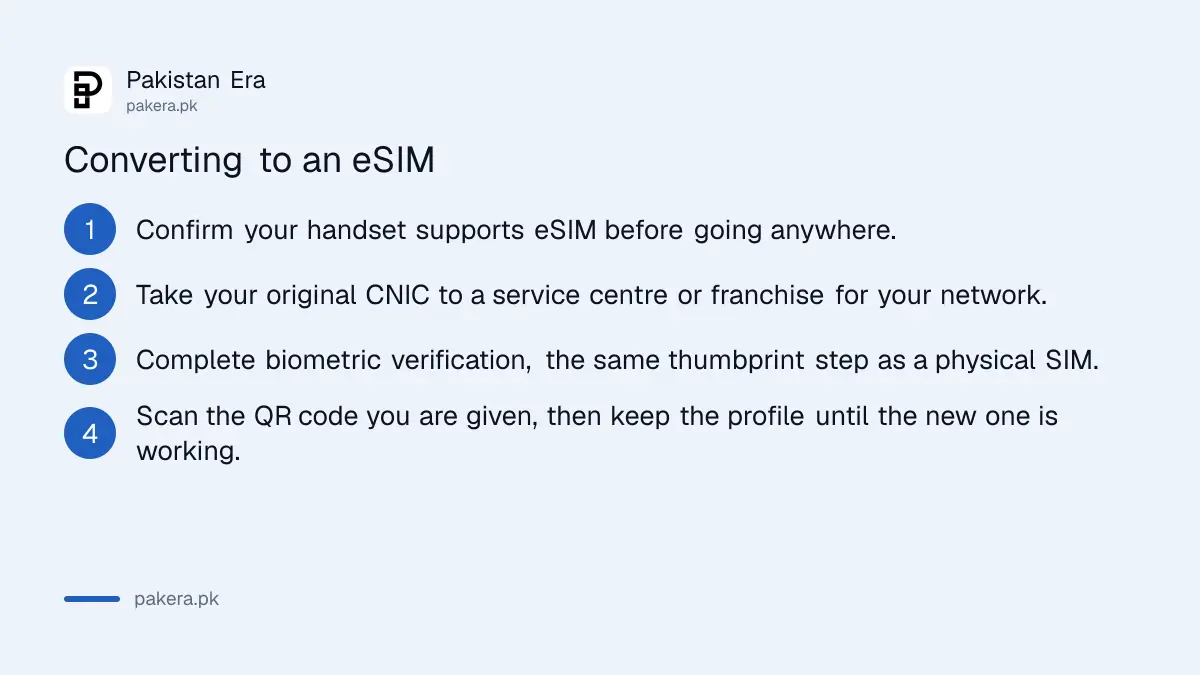
The process is broadly the same across networks, and we are giving you the common shape rather than a per-network script, because those flows change without notice and a stale walkthrough is worse than none.
- Go to a service centre or franchise for your network with your original CNIC. Some operators support an app-based conversion, others still require the visit.
- Complete biometric verification. This is the same thumbprint step as issuing a physical SIM and it cannot be skipped.
- Receive the QR code, usually printed or emailed.
- Scan it on the handset through the mobile data or SIM settings, where the option is typically called Add eSIM or Add data plan.
- Wait for the profile to register on the network, then test a call, an SMS and mobile data before you go anywhere.
- Only then remove or retire the physical SIM.
Confirm the current steps with your own operator. Jazz, Zong, Ufone and Telenor all offer eSIM, but availability differs between prepaid and postpaid and by handset model.
Biometric verification has not been waived
You may have read that Pakistan is moving to remote SIM verification using facial recognition through NADRA's Pak ID app. PTA has described that to a parliamentary committee as something it is working on with NADRA and the operators.
It is a proposal. The framework is still being finalised, no date has been announced, and nothing has been notified. Until it is, an eSIM means going in and giving a thumbprint like anyone else.
When it is worth it, and when it is not
An eSIM suits you if you change phone rarely, want two numbers on one handset, or travel and want to add a local plan without losing your Pakistani number.
It suits you less if you swap handsets often between family members, or if you rely on being able to drop your SIM into an old spare phone when the main one dies. That habit stops working with an eSIM, and it is worth thinking about before you convert.
If it does not work after activation
- Restart the handset before anything else. Profiles frequently need one to register.
- Check the line is switched on in settings. An added eSIM is not always enabled by default.
- Confirm mobile data is pointed at the right line if you are running two profiles.
- Go back to the operator if the profile shows as active but has no service. A QR code can be consumed without provisioning completing.
If the problem looks like a network fault rather than the profile, the usual causes and fixes are the same as for any SIM, and we covered them for Jazz and Zong separately.
Questions readers are asking
How much does an eSIM cost in Pakistan?
PTA has capped the initial issuance fee at Rs 1,500 from mid August 2026. Operators may charge less. Before the cap, Zong and Ufone were reported at around Rs 2,000 and Jazz often free.
Which networks support eSIM in Pakistan?
Jazz, Zong, Ufone and Telenor, with availability varying between prepaid and postpaid and by handset.
Do I need to go in person?
Usually yes, for biometric verification. Some operators offer app-based conversion, but the biometric requirement itself has not been removed.
Can I move my eSIM to a new phone?
Yes, and the first ten transfers are free under the revised policy. The profile is re-issued rather than physically moved.
Which phones support eSIM?
Recent iPhones and flagship Android models generally do. Many mid-range and budget handsets do not, so check your specific model before travelling to a franchise.
Can I keep my number when converting?
Yes. Converting from a physical SIM to an eSIM keeps the same number and the same network.
About the author

Senior Writer, Public Services and Technology
Shahid joined us in 2024 as an author. He is a senior contributor to Pakistan's leading technology websites. He writes detailed articles, mostly covering his expertise in the latest tech, mobiles, apps, gadgets, and step-by-step guides. His ideology is to help people understand the latest trends and explain complex methods through very easy-to-understand guides.