eSIM Fee Capped at Rs 1,500 With 10 Free Transfers
PTA has capped the eSIM issuance fee at Rs 1,500 and made ten device transfers free. Zong and Ufone were charging about Rs 2,000.
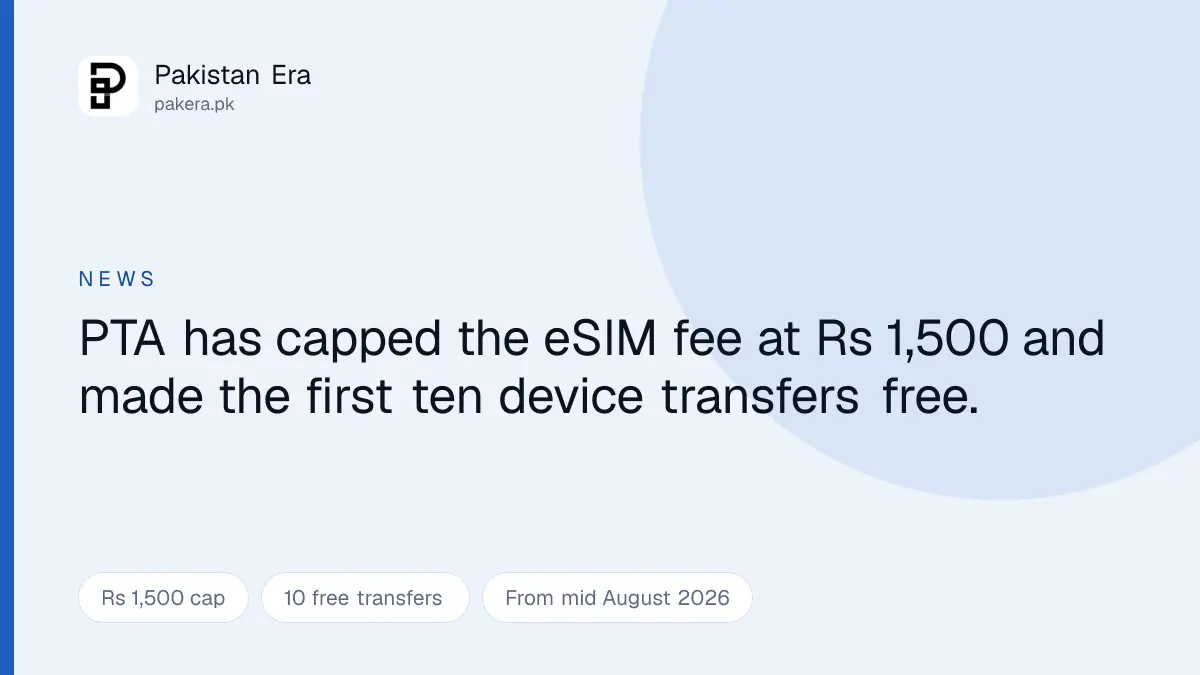
The Pakistan Telecommunication Authority has capped what an operator can charge you for an eSIM at Rs 1,500, and made the first ten transfers between handsets free.
The revised policy takes effect in the middle of August 2026, reported specifically as 17 August. It follows a direction from a Senate committee telling PTA to finalise a uniform eSIM transfer policy.
One thing to be straight about before the detail. PTA's website runs as a JavaScript application and its press release pages returned only a navigation shell to us, so we could not read the notification itself. Everything below is reported and corroborated across several outlets rather than read off PTA's own document.
What you were paying before
Pricing was inconsistent, which is what the Senate committee objected to.
| Item | Reported before | Under the new policy |
|---|---|---|
| Getting an eSIM | Around Rs 2,000 at Zong and Ufone, often free at Jazz | Capped at Rs 1,500 |
| Moving it to a new phone | Charged again, usually in person | First ten transfers free |
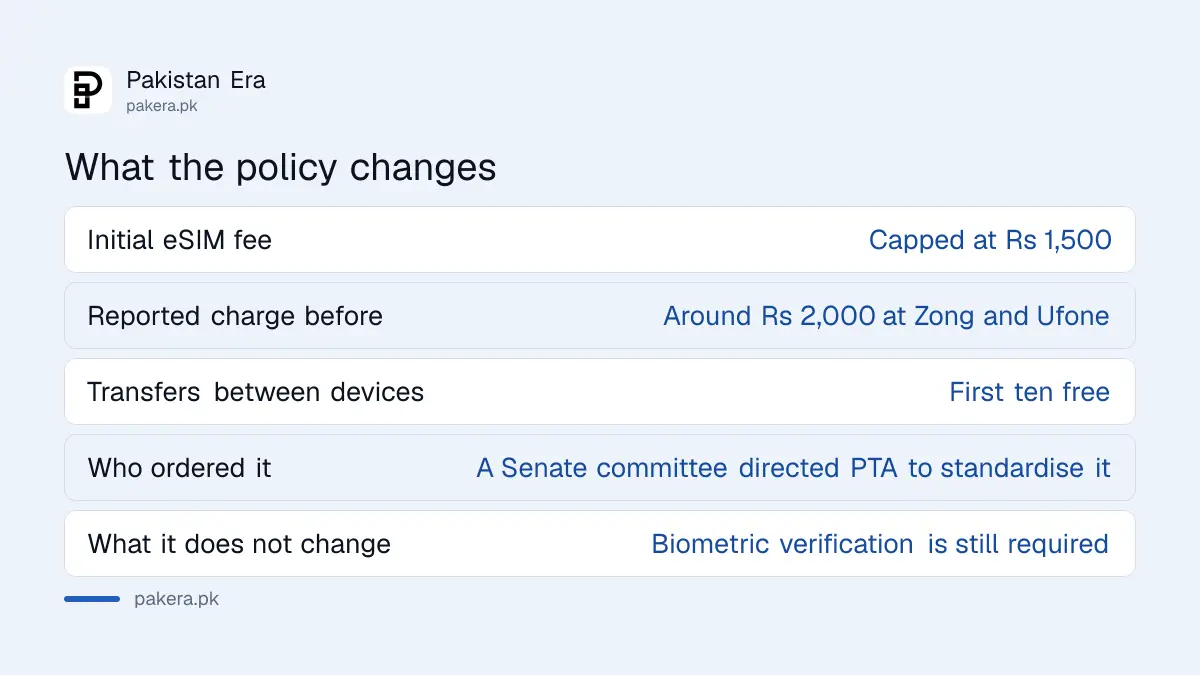
Those operator figures are reported rather than confirmed by the operators, so treat them as the shape of the change rather than a precise before and after.
The transfer rule matters more than the fee
The Rs 1,500 cap is the headline. The ten free transfers are the part that actually changes behaviour, and it is worth understanding why.
A physical SIM is a piece of plastic. When you buy a new phone, you move it across and you are done. An eSIM is written into the handset. It cannot be carried across, so changing phone means the profile has to be issued again.
Until now, that re-issuance often meant paying again and, in many cases, going to a service centre in person. For anyone who changes phone every couple of years, or who uses two handsets, that was a recurring cost and a recurring errand. It was the single strongest practical argument for staying on a physical SIM.
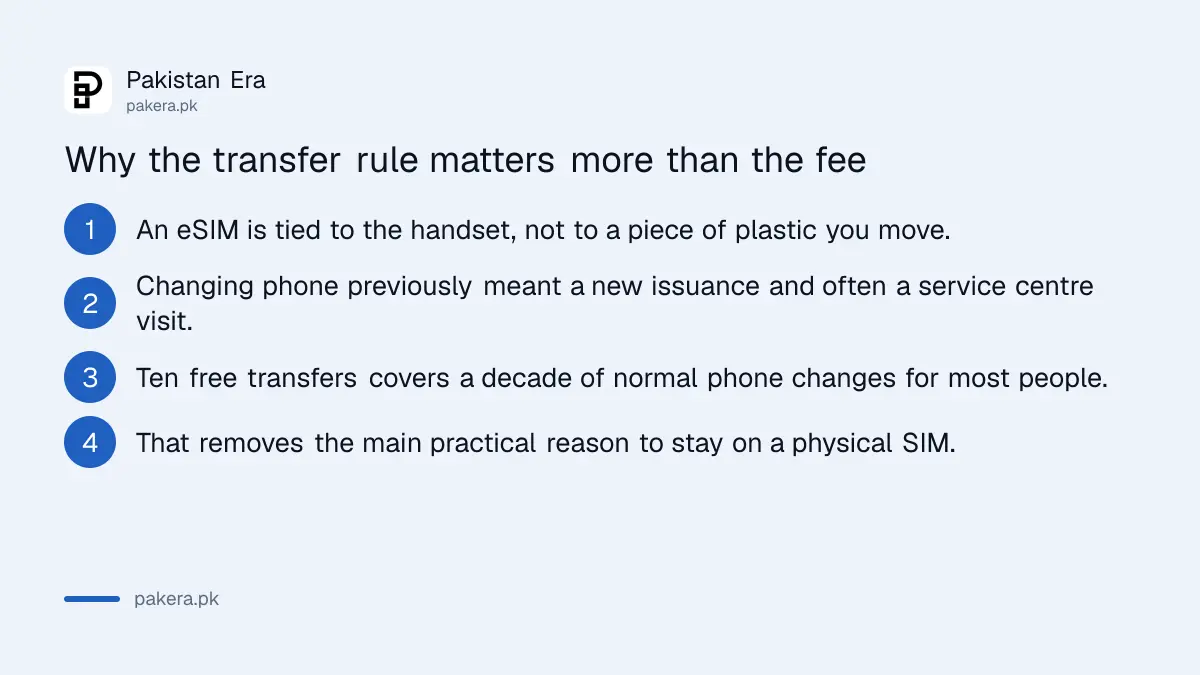
Ten free transfers covers roughly a decade of normal phone changes. That removes the objection.
Who this actually helps
Three groups get most of the benefit, and it is worth knowing whether you are in one of them.
- People who travel. An eSIM lets you add a local plan abroad while keeping your Pakistani number live on the same handset, instead of swapping cards and losing your OTPs.
- People running two numbers. Most eSIM phones hold several profiles, so a work and a personal number stop needing two handsets.
- People who change phone every year or two. This is the group the transfer allowance is really for, because they were paying the re-issuance cost most often.
If you keep one number in one phone for years, the cap saves you money once and the transfer rule will probably never come up.
What has not changed
Biometric verification still applies. Getting an eSIM issued still means your CNIC and your thumbprint, at a franchise, a service centre or through an approved app-based flow, exactly as with a physical SIM.
The rules on how many connections you may hold against one CNIC are unchanged too, and they are worth knowing before you add another line. We set them out in the guide to what actually changed in Pakistan's SIM rules.
Remote verification is proposed, not in force
PTA also told the committee it is working with NADRA and the cellular operators on a multi-factor subscriber verification system. Under it, NADRA is assessing whether SIM issuance could run through the Pak ID mobile app using facial recognition, letting people verify identity remotely instead of appearing for biometrics.
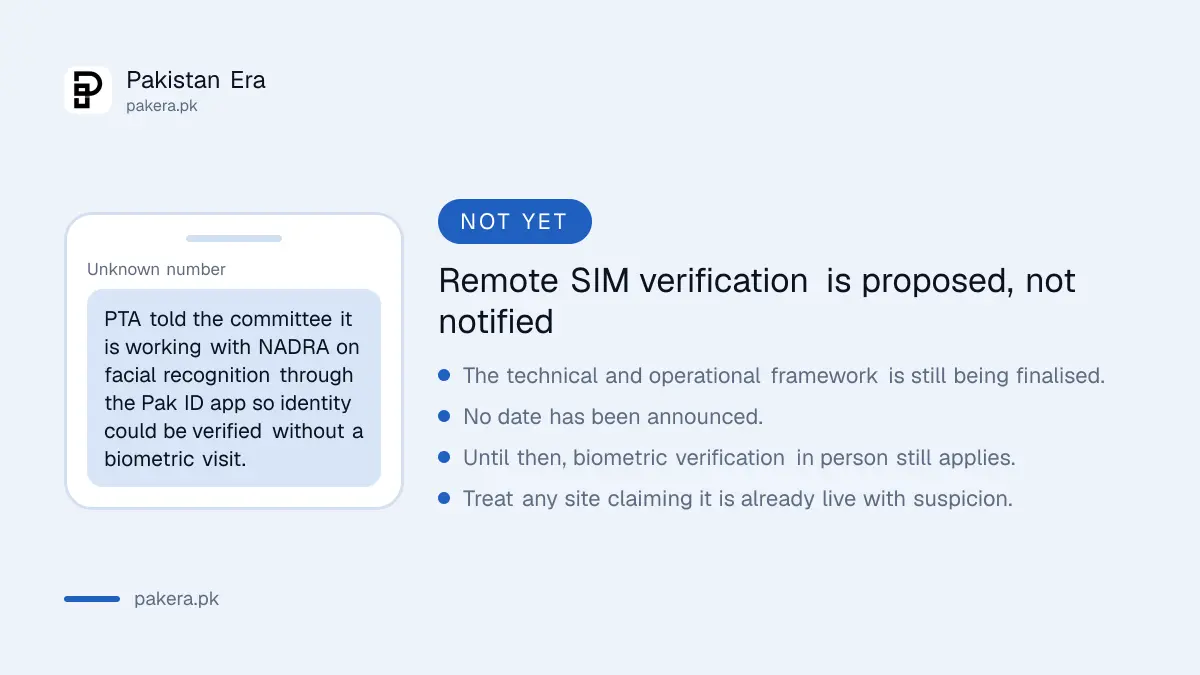
That would be a bigger change than anything in the eSIM pricing policy. But it is a proposal. The technical and operational framework is still being finalised, no date has been announced, and nothing has been notified.
We are flagging it clearly because sites are already describing it as though it exists. If a page tells you that you can get a SIM issued today with a selfie and no biometric visit, it is wrong.
What to do with this
- If you were quoted around Rs 2,000, wait. The cap takes effect in mid August and Rs 1,500 is the ceiling after that.
- Check your handset supports eSIM before you go anywhere. Most recent iPhones and flagship Android phones do; mid-range models often do not.
- Ask the operator to confirm the transfer count when you convert, so you know where you stand against the ten.
- Take your CNIC. Biometric verification has not been waived.
- Do not pay a third party to arrange an eSIM. It is issued by your operator against your own biometrics.
If you are converting from a physical SIM, the process and the handset requirements are set out in our guide to activating an eSIM in Pakistan, which we have updated for this change.
Questions readers are asking
How much does an eSIM cost in Pakistan now?
PTA has capped the initial issuance fee at Rs 1,500. Operators may charge less. The cap takes effect in mid August 2026, reported as 17 August.
Are eSIM transfers free?
The first ten transfers between compatible handsets are free under the revised policy. Beyond that, charges may apply.
Why was there a change?
A Senate committee directed PTA to finalise a uniform eSIM transfer policy, to make the technology more consumer friendly and cut unnecessary trips to customer service centres.
Do I still need biometric verification for an eSIM?
Yes. Nothing in this policy removes biometric verification. A separate proposal to allow remote verification through NADRA's Pak ID app is still under discussion and has not been notified.
Which networks offer eSIM in Pakistan?
Jazz, Zong, Ufone and Telenor all offer eSIM, though availability varies between prepaid and postpaid and by handset.
Can I move my eSIM myself when I change phone?
That depends on your operator's process. Some support app-based conversion, others still ask you to visit a service centre. The policy makes the transfer free, not necessarily remote.
About the author

Tax, Bills and Technology Writer
Ali Akhtar is a young and curious voice here at Pakistan Era. He is currently pursuing his A-Levels and has a growing interest in Pakistan’s changing industrial landscape and educational trends. Ali likes to write in a way that helps him explain and explore the world around him. His writing reflects the perspective of the new generation navigating the evolving trends of Pakistan where technology, youth innovation, and shifting opportunities are reshaping the country’s future.