New SIM Card Rules in Pakistan: What Actually Changed
PTA tightened SIM issuance in July 2026 and fined all four networks Rs 740 million. What actually changed, and what was already law.
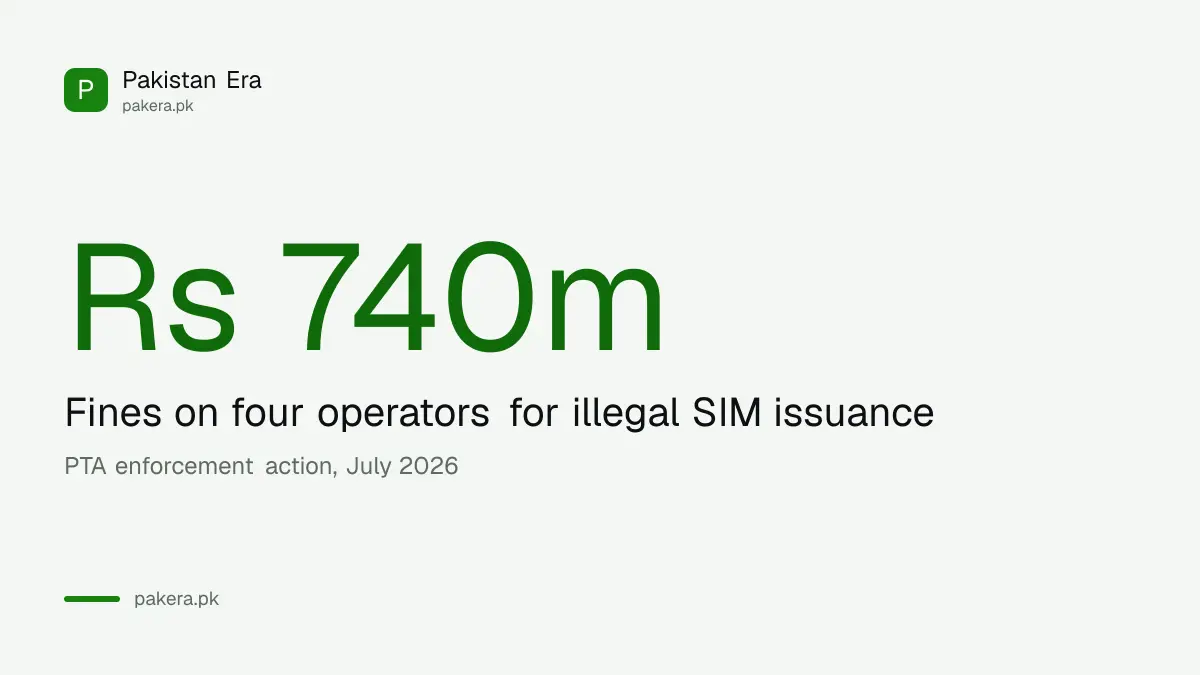
Four networks were fined Rs 740 million in one week. Not for dropped calls or slow data, but for handing out SIM cards to people who never asked for them.
That penalty, imposed by the Pakistan Telecommunication Authority in July 2026, is the reason the new SIM card rules in Pakistan exist. SIMs were being activated against real CNICs without the owner standing anywhere near the counter. The regulator went after the operators rather than the franchise staff, and then rewrote how a SIM gets sold.
Plenty of what you will read about this is wrong. One rule everyone is calling new has been in force since January 2024.
What are the new SIM card rules in Pakistan?
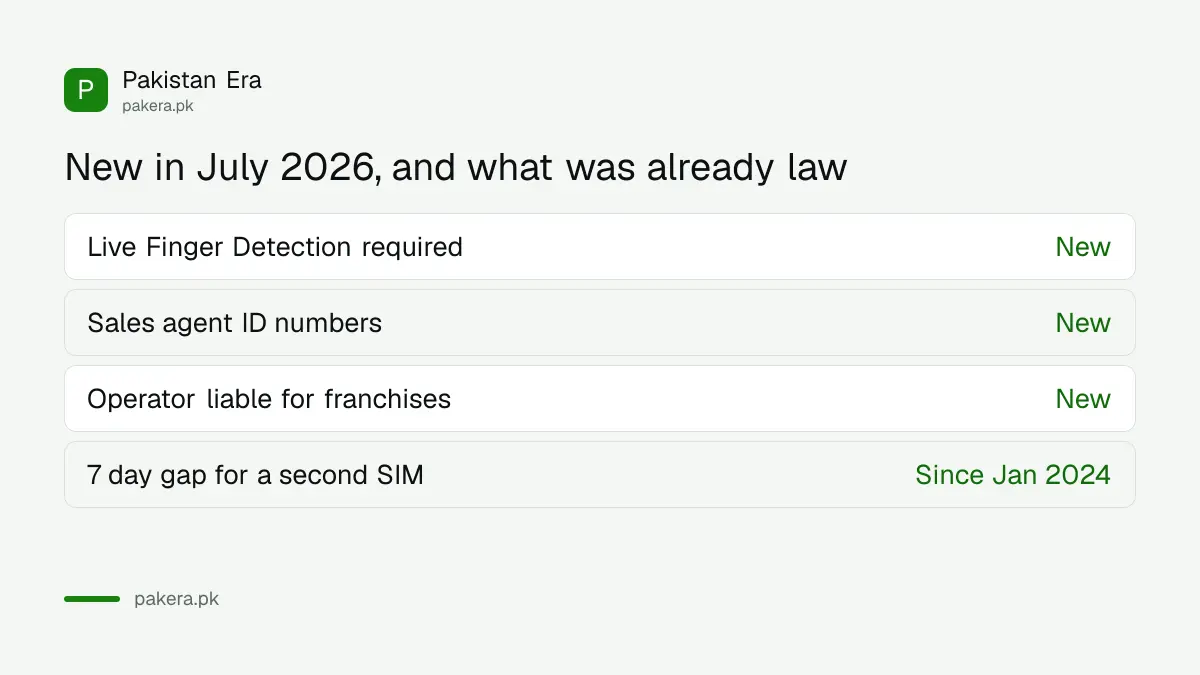
PTA tightened SIM issuance in July 2026. Every new SIM now needs biometric verification through NADRA using the original CNIC, devices must run Live Finger Detection, only authorised outlets can sell, each sales agent carries a unique ID, and the operator answers for what its franchises do.
Read that last part again, because it is the one with teeth. Before this, a franchise caught issuing illegal SIMs was a franchise problem. Now it is the operator's problem, and the Rs 740 million made clear what that costs.
The biometric requirement is not limited to buying a new connection either. It applies to duplicate SIM requests, ownership transfers, disowning a SIM you no longer want, and porting your number to another network. Anything that changes who a number belongs to now runs through a fingerprint.
Which rule is not actually new?
The seven day wait. A second SIM on the same CNIC has required a seven day gap since 24 January 2024, when PTA raised the buffer from eight hours. It is being reported everywhere as a 2026 change. It is not.
Worth knowing why the gap exists at all. Scammers used to walk into one franchise after another and activate a handful of SIMs inside a single afternoon, before any system caught up with them. An eight hour window barely slowed that down. Seven days breaks the pattern completely.
Your first SIM on a clean CNIC is still issued on the spot. The wait only starts from the second one.
| Rule | Status | In force since |
|---|---|---|
| Biometric via NADRA with original CNIC | Reinforced | July 2026 |
| Live Finger Detection on devices | New | July 2026 |
| Unique ID for every sales agent | New | July 2026 |
| Operator liable for franchise sales | New | July 2026 |
| Seven day gap before a second SIM | Already law | 24 January 2024 |
| No transfer for 365 days after activation | Already law | 24 May 2026 |
Why did PTA fine Jazz, Zong, Telenor and Ufone?
All four were penalised for activating SIMs against CNICs whose holders never consented and were never present. Investigators also found Live Finger Detection and geofencing controls were not being enforced properly on biometric devices, which is what let the fraud run.
Geofencing matters more than it sounds. A biometric device is meant to work only at the location it is registered to. Switch that off and the device travels, which means someone's thumbprint can be captured in one place and a SIM issued somewhere else entirely.
You will see a per operator breakdown circulating. We have left it out, because the figures being shared do not add up to the Rs 740 million total that every outlet agrees on. The total is solid. The split is not.
How do you check which SIMs are on your CNIC?
Send your 13 digit CNIC number, no dashes, to 668. The reply lists every number registered to you, which network it sits on, and when it was registered. The same information is available at cnic.sims.pk. Both are free.
Do it today rather than at some point. The whole reason those fines happened is that thousands of people had connections in their name they knew nothing about, and a SIM used for fraud is traced to whoever holds the CNIC, not whoever used it.
If something turns up that is not yours, our guide on reporting an unknown SIM registered on your CNIC walks through getting it removed. There is also a fuller walkthrough of checking every SIM tied to your identity card if the SMS reply confuses you.
What does this mean if you are buying a SIM this week?
Take the original CNIC, not a photocopy and not a picture on your phone. Go to a proper franchise or customer service centre. Expect the fingerprint scan to be stricter, and expect a second SIM to take seven days.
A few things follow from the new rules that are easy to miss:
- Roadside stalls and grocery counters cannot legally issue SIMs. If someone offers, walk away, because that is precisely the channel PTA is shutting down.
- Buying a SIM already activated in someone else's name is now a much worse idea. It cannot be transferred to you for 365 days from activation.
- The person serving you should have an identification number. Ask for it if anything feels irregular.
- Nobody should be taking your fingerprint anywhere other than at the registered outlet.
The stricter process is genuinely slower. That is the trade, and given what the fines revealed, it is a reasonable one.
What should you do if your SIM stops working?
Older connections registered before biometric systems existed are being flagged for re-verification, and lines that fail it get suspended. Re-verification takes about two minutes at a franchise with your original CNIC.
Steps if a number goes dead without warning:
- Check 668 first to confirm the number is still listed against your CNIC.
- Take your original CNIC to an authorised franchise of that network.
- Ask specifically for biometric re-verification rather than a replacement SIM.
- If the number was blocked rather than suspended, ask which rule triggered it, since the fix differs.
- Keep the receipt. Disputes go easier with a paper trail.
We have separate guides for reactivating an expired SIM and for getting a duplicate SIM, both of which now require the same biometric step.
Frequently asked questions
How many SIMs can I have on one CNIC?
PTA caps SIMs per identity card, and exceeding it can suspend every number on that CNIC until you disown the extras. Check your exact count by texting your CNIC to 668, since the figure that matters is the one on your own record.
Is the seven day SIM rule new in 2026?
No. PTA raised the buffer from eight hours to seven days on 24 January 2024. It is being widely misreported as part of the July 2026 changes.
Can I get a SIM without biometric verification?
No. Biometric verification through NADRA is mandatory for new SIMs, duplicates, ownership transfers, disowning and number portability. Anyone offering a SIM without it is selling an illegal connection.
Why was a SIM issued on my CNIC without me knowing?
Franchises were activating connections using captured biometrics and disabled geofencing. That is exactly what the Rs 740 million in fines was for. Report anything you do not recognise immediately.
Can I sell or transfer a new SIM?
Not for 365 days from activation, under a PTA advisory dated 24 May 2026. Buying a recently activated SIM from a third party leaves you with a number you cannot put in your own name for a year.
Does the new SIM policy affect my existing numbers?
Only if they need re-verification. Connections registered before biometric systems were standard are being flagged in phases, and failing to re-verify leads to suspension rather than permanent loss.
Work out your own figure
The same fraud that triggered these fines shows up in the handset market. Check an IMEI before you buy anything second hand.
IMEI Checker →About the author

Senior Writer, Public Services and Technology
Shahid joined us in 2024 as an author. He is a senior contributor to Pakistan's leading technology websites. He writes detailed articles, mostly covering his expertise in the latest tech, mobiles, apps, gadgets, and step-by-step guides. His ideology is to help people understand the latest trends and explain complex methods through very easy-to-understand guides.