How to Reactivate an Expired SIM in Pakistan
Take your CNIC to a service centre and verify biometrically. Whether you keep the number depends on whether it has already been reissued.
A SIM that has stopped working can usually be brought back. Whether you keep the number is a different question, and it depends on how long you have left it.
Update, 11 October 2026: An unused SIM can be suspended after 180 days and kept in quarantine.
That is the part worth understanding before you go anywhere.
An unused number does not wait for you
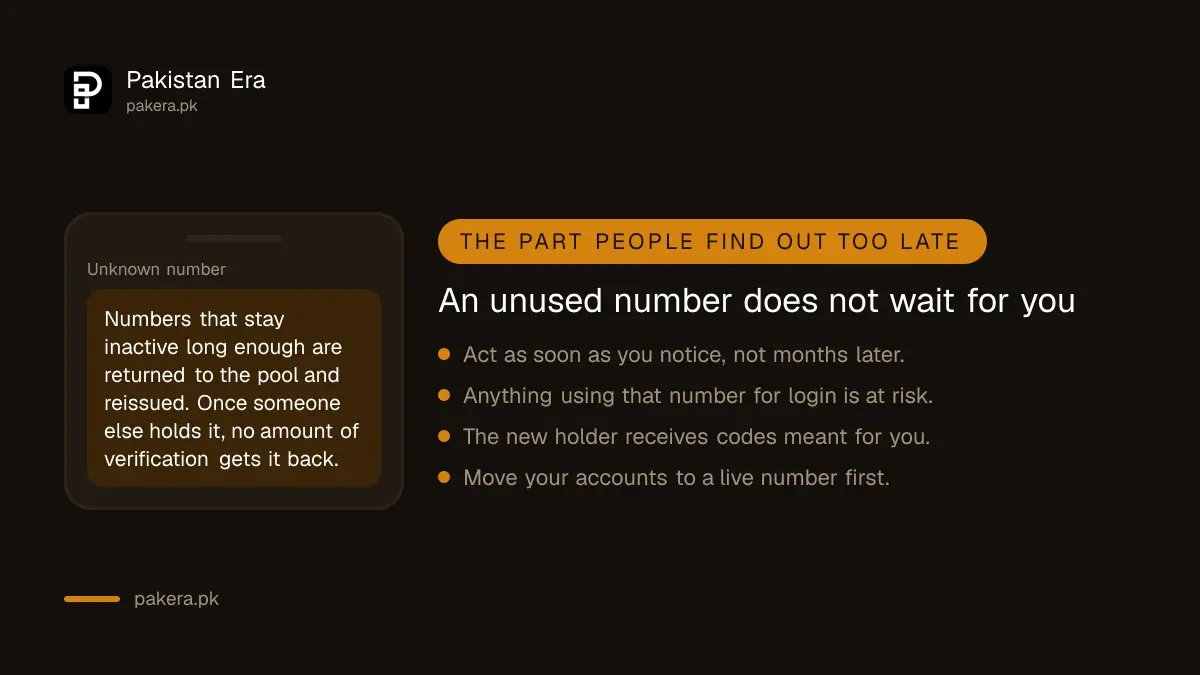
People treat an old number like a possession sitting in a drawer. It is not. A connection left inactive long enough is returned to the pool and reissued to somebody else.
Once that has happened, no amount of verification brings it back. The number belongs to another subscriber, and they have the same rights to it you once had.
There is a second consequence that matters more than the number itself. Anything still using that number to verify you, a bank, a wallet, an email account, now sends those codes to a stranger's phone. They did not steal anything. It is simply their number.
So if an old number still sits on any account of yours, move those accounts to a live number before you do anything else.
Why it stopped working
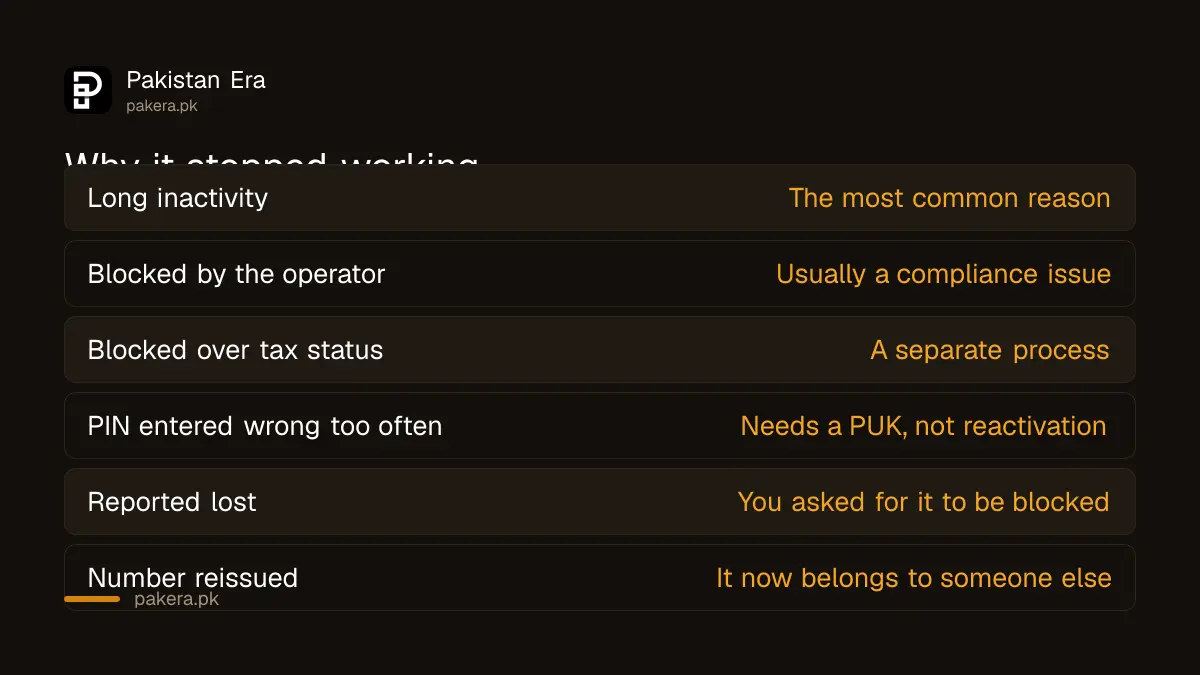
| Cause | What it needs |
|---|---|
| Long inactivity | Reactivation at a service centre |
| Blocked by the operator | Depends on why, ask at the centre |
| Blocked over tax status | A separate process, not ordinary expiry |
| PIN entered wrong too often | A PUK code, not reactivation |
| You reported it lost | A replacement SIM |
The fourth row sends a lot of people to the wrong counter. If your phone is asking for a PUK, the SIM is not expired, it is locked after too many wrong PIN attempts, and that is fixed with a code rather than a visit. We cover that in unblocking a SIM with a PUK code.
Getting it back
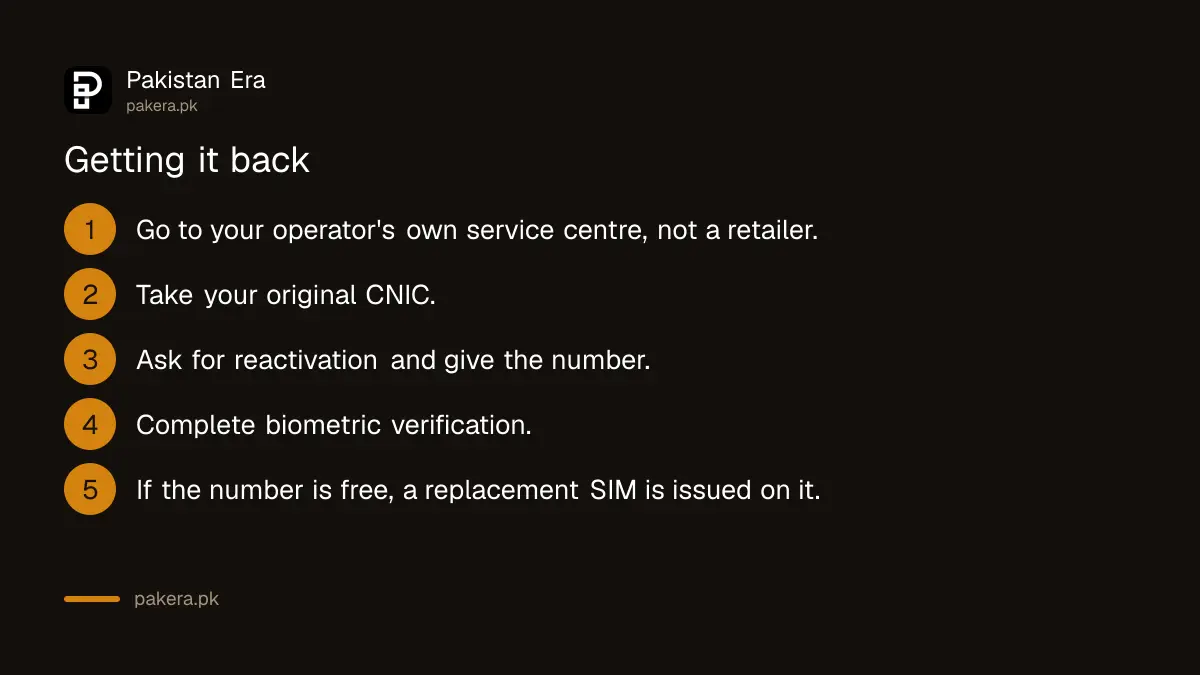
- Go to your operator's own service centre. A retail shop selling top-ups cannot do this.
- Take your original CNIC. Not a photocopy, not a photograph.
- Ask for reactivation and give the number.
- Complete biometric verification. This is mandatory and cannot be done remotely.
- If the number is still free, a replacement SIM is issued on it.
Take the old SIM if you still have it, though it is usually replaced rather than revived.
Biometric failure is common and is rarely about your account. Worn fingerprints, which are ordinary for anyone doing manual work, often fail on the first attempt and succeed on a better scanner. Ask them to try again rather than assuming you have been refused.
If the SIM was not registered to you
This stops more people than any other issue.
Reactivation is done for the registered owner, verified biometrically. If the connection is in a parent's, sibling's or former employer's name, you cannot reactivate it yourself, whoever has been paying for it.
The registered person has to attend with their own CNIC. If that is not possible, the number is effectively lost.
It is worth knowing which numbers sit against your own identity card before you need to, because people routinely find connections they never opened. That check is free and takes a minute, and it is in checking which SIMs are on your CNIC.
Blocking connected to tax status
A number blocked in connection with tax filing status is a different matter from an expired one, and the service centre is not where it is resolved.
That is a compliance question rather than a telecom one, and it is settled through your filing position rather than at a counter. Our guides to checking your filer status and becoming a filer cover the ground.
Ask at the service centre which category your block falls into before assuming it is simple expiry. They can see the reason, and it changes where you go next.
Keeping a number alive that you rarely use
Prevention is cheaper than any of the above, and it takes almost nothing.
A number stays active through use. An occasional outgoing call or message is usually enough to reset the inactivity clock, and it costs a rupee or two. Incoming calls alone are not always counted, which is why a number people ring but you never dial from can still lapse.
If you keep a second number for banking or for a business contact and rarely touch it, put a reminder in your phone every month or two and send a single message from it. That is the whole maintenance routine.
What we have not verified
We have not run this process, and we are not going to suggest otherwise.
We publish no replacement fee and no processing time, because we read neither at source and both vary by operator. We also do not name per-operator helplines here. Ask at the counter before agreeing to anything, and expect the answer to differ between networks.
What is consistent across all of them is the shape: operator service centre, original CNIC, biometric verification, and a number you keep only if nobody else has been given it.
Questions readers are asking
How do I reactivate an expired SIM?
Visit your operator's service centre with your original CNIC and complete biometric verification. If the number has not been reissued, a replacement SIM is issued on it.
Can I get my old number back?
Only if it has not been reassigned. Numbers left inactive long enough return to the pool and go to new subscribers.
Can I do it online?
No. Biometric verification has to be done in person.
The SIM is in my father's name. Can I reactivate it?
No. The registered owner must attend with their own CNIC, because verification is biometric.
My phone is asking for a PUK code. Is that the same thing?
No. That is a PIN lockout, fixed with a PUK code rather than a service centre visit.
What does it cost?
We are not quoting a fee, since we did not read a current price list at source. Confirm at the counter.
My number was blocked over tax status. Same process?
No. That is a compliance matter resolved through your filing position, not at a service centre.
About the author

Senior Writer, Public Services and Technology
Shahid joined us in 2024 as an author. He is a senior contributor to Pakistan's leading technology websites. He writes detailed articles, mostly covering his expertise in the latest tech, mobiles, apps, gadgets, and step-by-step guides. His ideology is to help people understand the latest trends and explain complex methods through very easy-to-understand guides.