How to Check if Your Phone Supports 5G in Pakistan
Four ways to check 5G support on your phone in Pakistan, and why a handset bought abroad may still never connect on a local network.
Your friend in Lahore says his phone jumped to 5G last week. Yours, bought the same month for roughly the same money, still says 4G. Before you blame the network, check the handset, because that is where the answer usually sits.
There are already 3.81 million 5G ready smartphones in the country according to Pakistan Telecommunication Authority figures, and locally manufactured 5G devices passed 961,000 units by May 2026. Plenty of people are holding a capable phone and do not know it. Plenty of others paid extra for one that will never connect here.
Four checks settle it, and the last one is the only one that is genuinely reliable.
How do you check if your phone supports 5G?
Open Settings, go to Mobile network or Connections, then Preferred network type. If 5G appears in that list, the hardware supports it. If the list stops at 4G or LTE, it does not, and no update will change that.
The wording differs by brand but the path is always roughly the same.
- Samsung: Settings, Connections, Mobile networks, Network mode.
- Xiaomi and Redmi: Settings, SIM cards and mobile networks, tap your SIM, Preferred network type.
- Infinix, Tecno and Itel: Settings, Mobile network, SIM settings, Preferred network type.
- Vivo and Oppo: Settings, Mobile network, tap the SIM, Preferred network type.
- iPhone: Settings, Mobile Data, Mobile Data Options, Voice and Data.
An iPhone only shows the 5G options when it is on a network that offers it, which trips people up. On an iPhone 12 or newer, absence of the menu means no coverage yet, not a phone that cannot do it.
Does the model name tell you anything?
Often, yes. Manufacturers selling into Pakistan usually put 5G directly in the name when a variant supports it, because it sells. A Galaxy A56 5G supports it. A Galaxy A07 4G does not, and the name is doing you a favour.
Where this breaks down is flagships. An iPhone 15 Pro or a Pixel 9 carries no 5G badge because every model in the range has it, so the absence of the label means nothing at that price point.
Check the exact model number rather than the marketing name. Settings, About phone, Model number gives you the string to search, and regional variants of the same phone genuinely differ. Our guide to checking your IMEI number shows how to pull the identifiers that matter.
Why does a 5G phone from abroad sometimes not work in Pakistan?
Because 5G is not one thing. It runs on bands, and a handset built for another market may not carry the band your operator uses here. The phone reports 5G support truthfully and still never connects, which is the single most expensive mistake in the used import market right now.
This is the part shopkeepers gloss over. A phone that ran 5G perfectly in Dubai or the UK can sit on 4G indefinitely in Karachi.
There is a second trap on top of it. An imported handset also needs PTA registration, and on an expensive phone that tax can exceed what you paid. Our breakdown of the Pixel 6 Pro price in Pakistan shows how badly that arithmetic can go.
What is the most reliable way to confirm 5G support?
Check your operator's own device list. Jazz publishes a supported handset page, and Zong maintains a list running past 2,000 devices across more than 100 brands. Those lists are built against the bands actually deployed here, so they answer the real question.
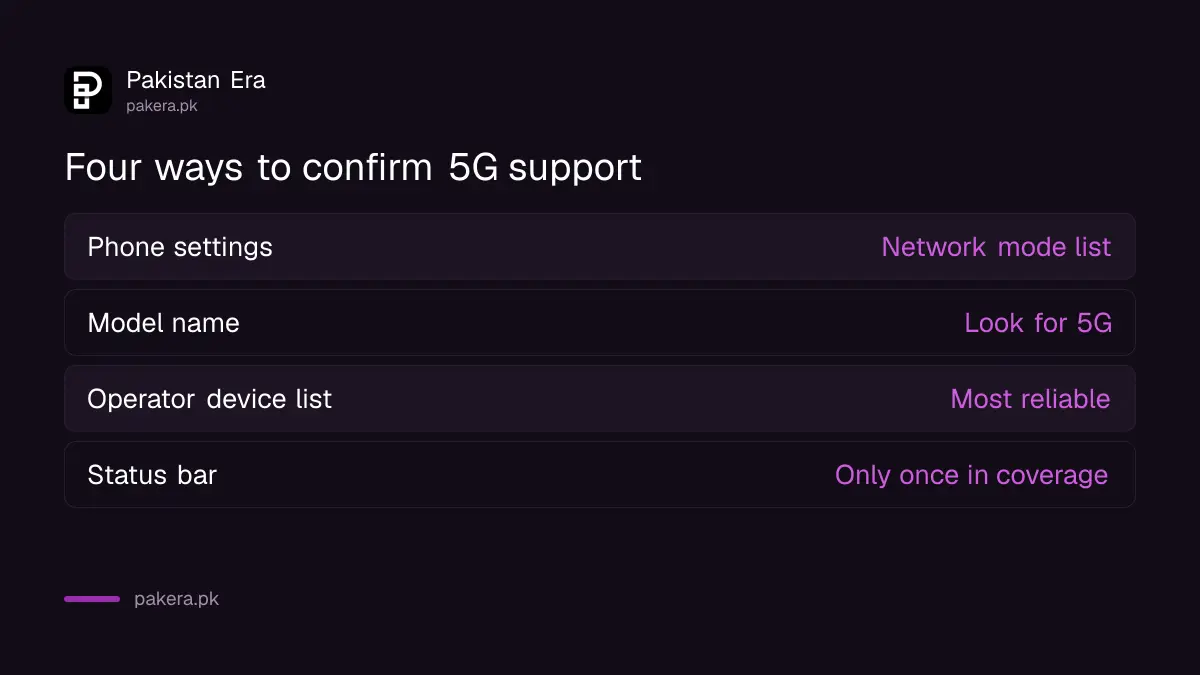
| Method | What it proves | Reliable? |
|---|---|---|
| Network mode in settings | The hardware has 5G radios | Mostly |
| 5G in the model name | The variant is a 5G variant | Only on mid-range |
| Operator device list | The phone works on this network's bands | Yes |
| 5G icon in the status bar | You are connected right now | Yes, but needs coverage |
| Shopkeeper's word | Nothing | No |
Search your exact model number on the list, not the family name. "Galaxy A56" and "Galaxy A56 5G" are different entries for a reason.
What if your phone supports 5G but still shows 4G?
Three ordinary explanations, in order of likelihood: you are outside coverage, 5G is switched off in your network settings, or your SIM has not been provisioned. Commercial service currently runs on roughly 449 tower sites across 22 cities, so most of the country is genuinely not covered yet.
- Confirm coverage. Service launched first in Islamabad, Rawalpindi, Lahore and Karachi, with other cities phased in. Outside those footprints your phone is behaving correctly.
- Turn it on. Set Preferred network type to 5G or to the automatic option that includes it. Many phones ship defaulted to 4G to save battery.
- Restart after switching. The handset re-registers with the network on boot, and this alone fixes it surprisingly often.
- Check the SIM. An old SIM may need swapping. Ask your operator's helpline whether yours is 5G provisioned.
- Toggle flight mode. Thirty seconds on, then off, forces a fresh network scan.
If none of that works and you are standing in a covered city, contact your operator. Ufone customers can dial 333, and our UPTCL app guide covers checking your connection status from the app instead.
Do you need to buy a new phone for 5G?
Only if yours genuinely lacks the radios. If your handset is on the operator list and sits in a covered city, you already have everything you need and there is nothing to buy.
Honest opinion: for most people in Pakistan right now, upgrading purely to reach 5G is premature. Coverage is 22 cities, the speed difference on a congested urban cell is smaller than the marketing suggests, and prices on 5G handsets keep falling. Waiting six months costs you very little.
Where it does make sense is if you were replacing your phone anyway. In that case buying 5G capable is sensible future-proofing rather than an upgrade in itself. Our roundups of the Tecno Camon 40 Pro and Vivo X300 cover current options.
Which brands sell the most 5G phones in Pakistan?
Locally manufactured 5G devices reached 961,326 units by May 2026. Samsung leads with 396,268 units and Vivo follows with 248,508, which between them account for roughly two thirds of local 5G production.

Local assembly matters more than brand loyalty here. Locally made handsets skip the import tax that makes a foreign-bought phone so expensive to register, so they land cheaper for the same specification.
That is also why the affordable end of the 5G market in Pakistan looks different from the global one. The phones that make sense here are the ones being built here.
Frequently asked questions about 5G phone support
How do I know if my phone is 5G in Pakistan?
Open Settings, Mobile network, Preferred network type. If 5G is listed, the phone supports it. Confirm against your operator's device list to be sure the bands match.
Can a software update add 5G to my phone?
No. 5G needs a modem built into the hardware. If the radios are not there, no update can add them.
Why does my 5G phone show 4G in Pakistan?
Most likely you are outside the 449 sites currently live, or 5G is switched off in your network settings. Check coverage first, then Preferred network type.
Do I need a new SIM to use 5G?
Usually not, though some older SIMs need replacing. Ask your operator's helpline whether your SIM is 5G provisioned before you buy anything.
Will a 5G phone bought abroad work in Pakistan?
Only if it carries the bands deployed here. Check your operator's supported device list before importing, and factor in the PTA registration tax.
Which cities have 5G in Pakistan?
Commercial service began in Islamabad, Rawalpindi, Lahore and Karachi, running on about 449 tower sites across 22 cities, with more added in phases.
Is 5G free on my current package?
Initially yes. Operators are expected to serve 5G through existing data bundles at launch rather than requiring a separate 5G package.
Work it out yourself
Thinking of importing a 5G handset instead? Check what FBR has assessed it at first.
PTA Tax Value Checker →See how much data your usage really needs once you are on a faster network.
Data Usage Calculator →About the author

Tax, Bills and Technology Writer
Ali Akhtar is a young and curious voice here at Pakistan Era. He is currently pursuing his A-Levels and has a growing interest in Pakistan’s changing industrial landscape and educational trends. Ali likes to write in a way that helps him explain and explore the world around him. His writing reflects the perspective of the new generation navigating the evolving trends of Pakistan where technology, youth innovation, and shifting opportunities are reshaping the country’s future.