Islamabad Bill to Make Doctors' Fees Public Clears Senate Committee
A Senate committee backed a bill making Islamabad doctors disclose fees in advance. Not law yet, and IHRA rules already require price display.
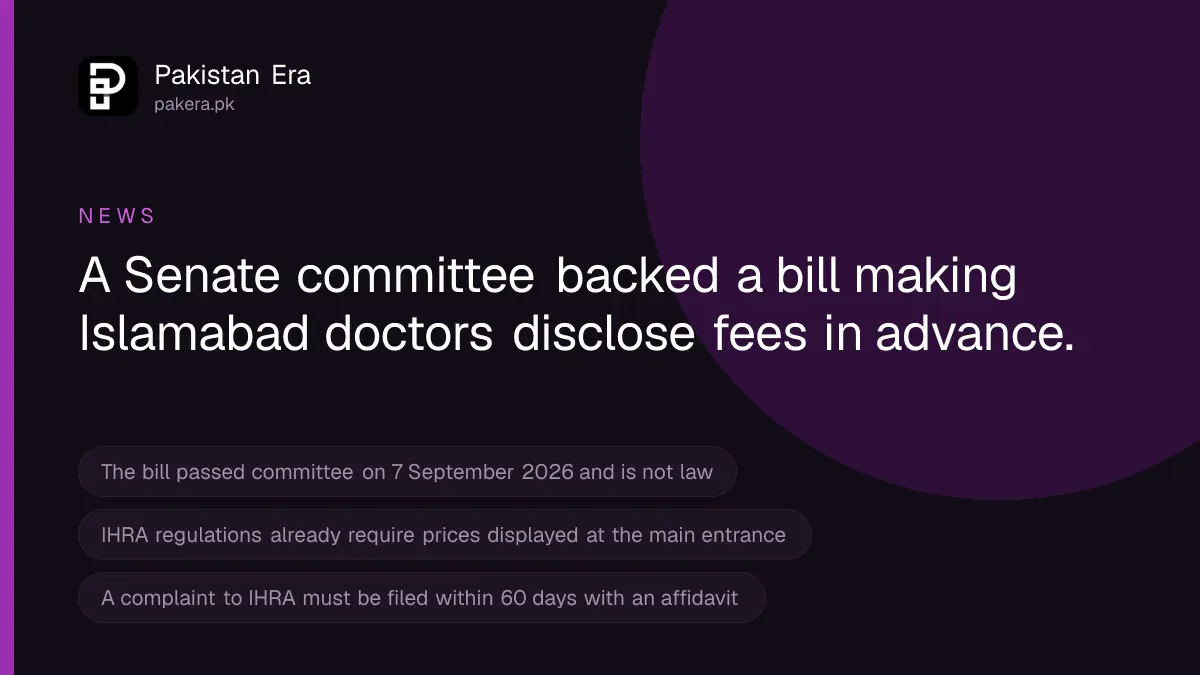
The Senate Standing Committee on Interior and Narcotics Control unanimously passed the Islamabad Consumers Protection (Amendment) Bill 2026 on 7 September 2026. Reporting says the bill, moved by Senator Samina Mumtaz Zehri, would require Islamabad doctors and hospitals to tell patients their consultation fees and other charges in advance. It is a committee vote on a private member's bill, it applies to Islamabad only, and it is not law.
A committee vote makes headlines, and this one made several that read as if the rule already exists. It does not. Two ministries opposed it in the room, and the bill has four stages to go. What patients in Islamabad have today is older and, on paper, stronger than most of them know: regulations from January 2024 that already require every hospital and clinic to display its prices at the main entrance. We read the Senate's own press release, the IHRA Act and regulations, and the reporting on the debate.
What did the Senate committee approve on 7 September?
A bill amending the Islamabad Consumers Protection Act 1995 so that doctors' fees and related charges are disclosed to patients before treatment. The committee passed it unanimously and sent it on with the Law Ministry's observations attached. The Senate's press release says that much and nothing about the content.
The Senate press release of 7 September 2026 records that the committee, chaired by Senator Faisal Saleem Rehman, "unanimously passed The Islamabad Consumers Protection (Amendment) Bill, 2026, after detailed consideration, directing that the bill be processed further along with the observations of the Ministry of Law and Justice". The same meeting cleared five other private members' bills on acid crimes, domestic workers, rape investigation, LPG refilling and the Penal Code.
What the bill would require comes from reporting, because the bill text is not on the Senate website. ProPakistani, The Nation and ARY News all describe a requirement that patients be informed in advance of doctors' consultation fees and other charges. Senator Zehri is reported as saying courts had already directed amendments to the law, and as citing the PIMS incident, the nursery fire at the Pakistan Institute of Medical Sciences that Express Tribune reported killed 14 newborns in August 2026. Weeks later senators were still asking why no case had been registered, and checking whether an FIR exists in Islamabad had become a parliamentary question.
The opposition in the room was from the government side. Minister of State for Interior Talal Chaudhry is reported as saying the matter falls under the Islamabad Healthcare Regulatory Authority, IHRA, and belongs with the health committee rather than interior. A Ministry of Law representative objected and asked that IHRA be called to brief the committee. The chair's reported answer was that senators are elected to legislate and institutions should cooperate.
Why is this not a new rule for patients yet?
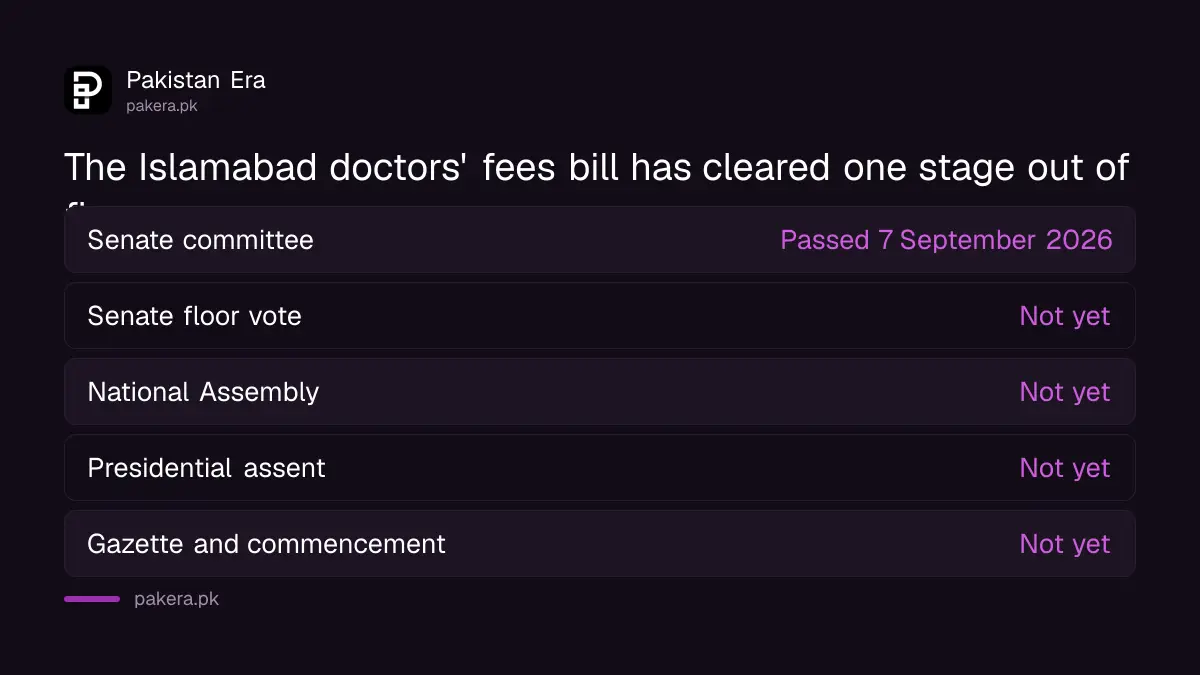
Because a committee is the first hurdle, not the last. The bill still has to pass the full Senate, then the National Assembly, then receive the President's assent and be published in the Gazette before a single clinic is bound by it. A private member's bill opposed by two ministries can stall at any of those steps.
| Stage | Status on 17 September 2026 |
|---|---|
| Senate Standing Committee on Interior | Passed unanimously, 7 September 2026 |
| Senate, full house | Not yet taken up |
| National Assembly | Not yet |
| Presidential assent | Not yet |
| Gazette notification and commencement | Not yet |
Jurisdiction matters as much as stage. Health is a provincial subject, and this bill amends an Islamabad Capital Territory law. Nothing in it would reach a clinic in Rawalpindi, twenty minutes away, where the Punjab Healthcare Commission is the regulator and the route for a complaint against a hospital or doctor in Punjab is a different form with a different body.
There is also the question the Law Ministry raised, and it is a fair one. The 1995 Act sends consumer complaints to the Court of Sessions, Islamabad, as the Authority. IHRA, created by its own Act in 2018, already investigates complaints about healthcare establishments and already regulates prices. Two laws pointing at the same fee board is the sort of thing that produces a case about which body hears the complaint, rather than a refund.
What does IHRA already require on fee display?
Display at the door. Regulation 92 of the IHRA Regulations 2024 says every healthcare establishment shall make the prices of all its services, including consultation by any of its personnel, accessible to the public "by displaying the same at the main entrance". That has been in the Gazette since 3 January 2024.
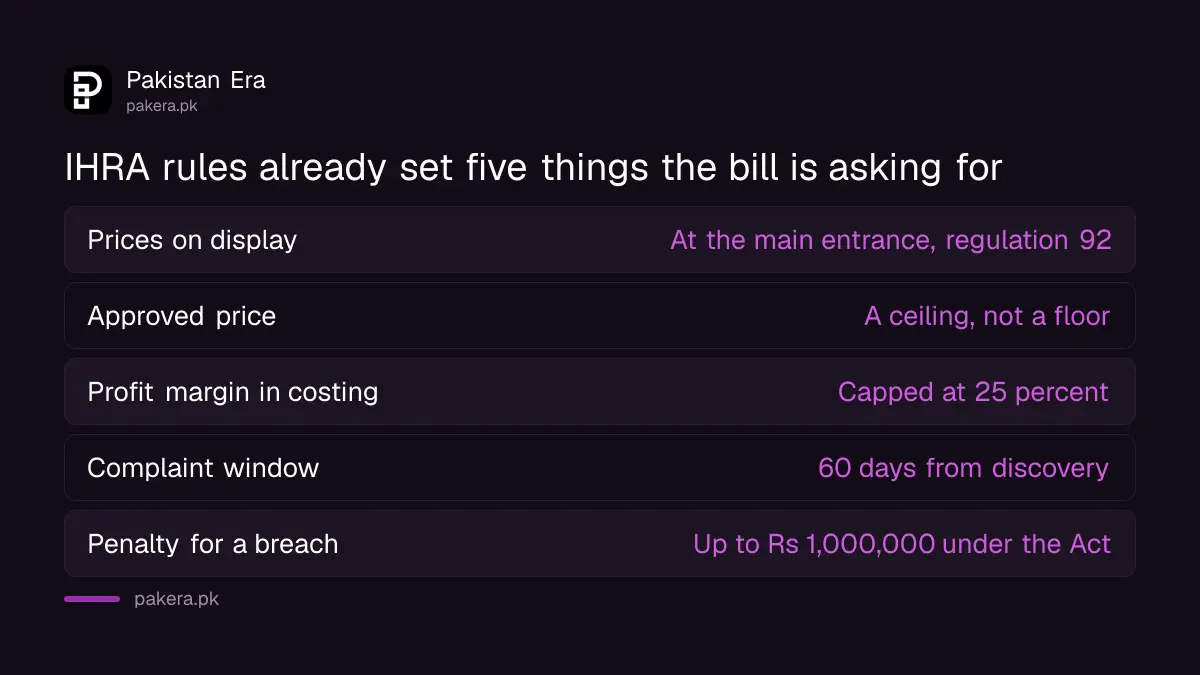
The pricing rules go further than a notice board. Under Part X of the regulations, every establishment must cost its services on an activity basis, add a profit margin of not more than 25 per cent, and submit the result to IHRA's pricing department. The approved figure is a maximum ceiling; a hospital may charge less, not more. The rules apply to public and private hospitals, trusts, charities and autonomous bodies, with public sector prices set by the bodies that run those hospitals.
- Scope: all healthcare establishments in Islamabad Capital Territory, regulation 87.
- Costing: activity based, margin capped at 25 per cent, IHRA approval within 30 days or the proposal is provisionally approved, regulation 89.
- Ceiling: the determined price is the maximum, regulation 89(7).
- Display: prices of all services and consultations at the main entrance and any other place IHRA notifies, regulation 92.
- Enforcement: the pricing department can order stoppage of services or seal premises, regulation 91.
The Act behind those regulations carries the teeth. Section 29 of the Islamabad Healthcare Regulation Act 2018 lets IHRA impose a penalty of up to Rs 1,000,000 for a contravention of the Act, rules or regulations, after a hearing. Section 22 puts the same ceiling on running an unlicensed establishment, and section 30 makes setting one up without registration an offence carrying up to five years or a fine of up to Rs 1 million.
So the honest summary is that the bill would write into consumer law a duty that health law already imposes. Whether that duty is enforced at the entrance of every Islamabad clinic is a different question, and the one Senator Zehri's bill is really about. We have not audited clinics for fee boards and do not claim to know how many comply.
Where can an Islamabad patient complain about a fee today?
To IHRA, within 60 days, in writing with an affidavit. The complaint goes online at ihra.gov.pk, by email, or in person at IHRA's office in the Pakistan Red Crescent Society building in H-8/2, and the helpline is 051-9199-902.
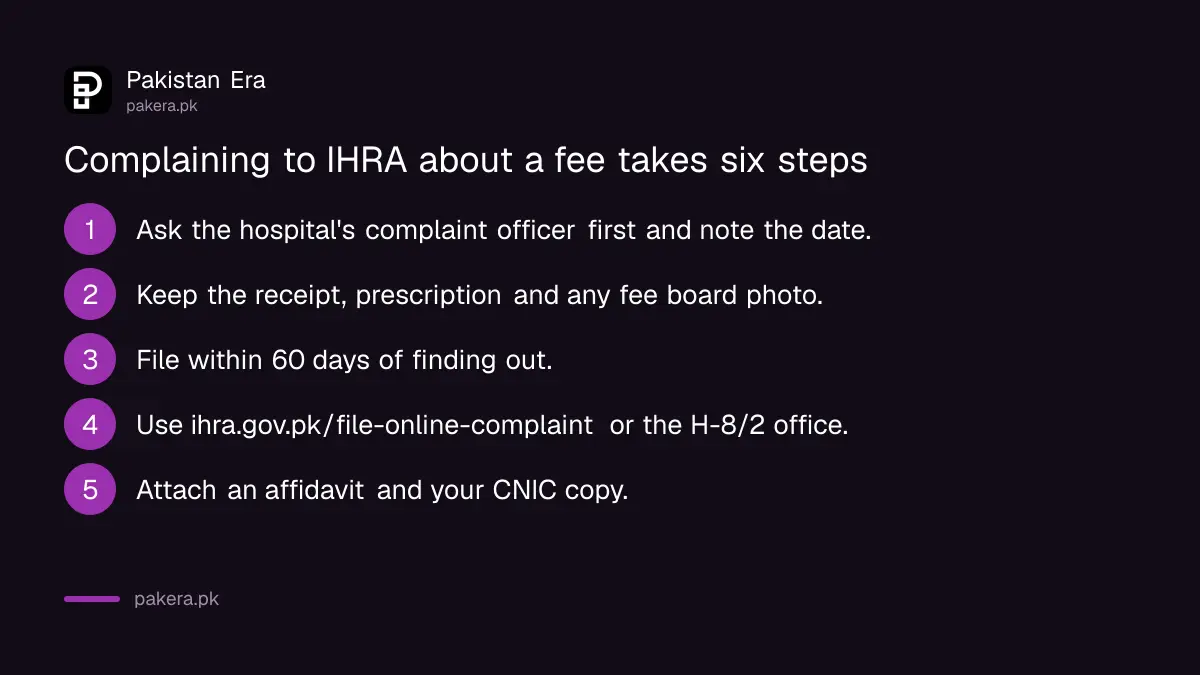
- Raise it with the hospital first. Regulation 43 obliges every establishment to run an internal complaint system with a named complaints officer and a register, so ask for that officer by title and note the date.
- Keep the evidence. The receipt, the prescription with the doctor's name, and a photo of the fee board or of the entrance where there is none.
- Count the days. Section 34 of the Act and regulation 94 both give 60 days from the date you learned of the problem, and IHRA's form repeats the limit.
- File online at ihra.gov.pk/file-online-complaint, choosing Doctor, Staff or Hospital as the type, or email info@ihra.gov.pk, or go to H-8/2 with the paper form.
- Attach an affidavit and a copy of your CNIC. The Act bars anonymous complaints, and the affidavit is a legal requirement, not a formality.
- Ask for the complaint registration number. Regulation 46 requires the desk to allot one, and it is what you quote on the helpline.
One caution before you sign the affidavit. Section 29(3) of the Act allows a penalty of up to Rs 200,000 on a complainant whose complaint is proved false, and IHRA's online form displays that warning. Complain about what you can show, not about what you suspect.
If IHRA itself does not respond, the complaint about the regulator goes elsewhere. A grievance against a federal body can be taken to the Wafaqi Mohtasib, which is free, or logged on the Pakistan Citizen's Portal, where it is tracked and routed to the department.
IHRA's complaint page states that fines can reach Rs 500,000, while the Act sets the general ceiling at Rs 1,000,000. Those two figures come from the same regulator and do not match, so we give both and let the Act govern.
The consumer court route exists on paper as well. The 1995 Act lists medicine among the services it covers, gives consumers a right to information about the price of services, and lets the Court of Sessions order compensation and impose a fine of up to Rs 40,000 or two years. Taking a shop or a service provider to consumer court in Pakistan costs nothing in court fees, but for a doctor's charge in Islamabad the regulator with a pricing department and a sealing power is the faster door.
What would change if the bill became law?
On the reporting available, patients would gain a consumer law right to know the fee before treatment, enforceable through the consumer Authority as well as IHRA. That adds a second forum and a criminal penalty, and it is the addition the Law Ministry wants explained before the Senate votes.
The gap the bill is aimed at is not hard to see. A price ceiling that sits in a file at IHRA helps a patient only if it is on the wall, and a wall notice helps only if somebody checks it. The committee's decision to send the bill forward with the Law Ministry's observations means the next step is a report to the full Senate, and possibly an IHRA briefing first. We will update when the bill is listed for a Senate vote or when its text appears on the Senate website.
Common questions about the Islamabad doctors' fees bill
Is it now compulsory for Islamabad doctors to display fees?
Under IHRA regulation 92, yes, since January 2024, at the main entrance. The Senate bill would add a separate consumer law duty, and that part is not law.
Does the bill apply in Rawalpindi, Lahore or Karachi?
No. It amends an Islamabad Capital Territory law. Provinces have their own healthcare commissions and consumer courts.
Who moved the bill and who opposed it?
Senator Samina Mumtaz Zehri moved it. Minister of State for Interior Talal Chaudhry and a Ministry of Law representative opposed it, saying the subject belongs to IHRA.
How long do I have to complain to IHRA?
60 days from the date you learned of the problem, under section 34 of the IHRA Act and regulation 94 of the 2024 regulations.
Can a hospital charge more than its IHRA approved price?
No. Regulation 89(7) makes the determined price a maximum ceiling. A hospital may charge less.
What can IHRA do to a clinic that breaks the fee rules?
Fine it up to Rs 1,000,000 under section 29 of the Act after a hearing, and under regulation 91 order stoppage of services or seal the premises.
How we verified this
What we checked, where we read it, and what we could not confirm.
Last checked 17 September 2026. We read the Senate of Pakistan's press release dated 7 September 2026 on senate.gov.pk covering the meeting of the Standing Committee on Interior and Narcotics Control chaired by Senator Faisal Saleem Rehman, which records that the committee unanimously passed the Islamabad Consumers Protection (Amendment) Bill, 2026 and directed that it be processed further with the observations of the Ministry of Law and Justice; the release does not describe the bill's provisions. We read the Islamabad Healthcare Regulation Act 2018 as published in the Gazette of Pakistan Extraordinary of 24 May 2018 on ihra.gov.pk, which is the source for section 22 and section 29 penalties of up to ten hundred thousand rupees, the section 29(3) penalty of up to two hundred thousand rupees for a false complaint, the section 30 offence, section 33 on complaints, section 34 on the sixty day limit, the affidavit and the bar on anonymous complaints, and the power to make regulations for the regulation and control of prices of healthcare services. We read the IHRA Regulations 2024 as published in the Gazette of Pakistan Extraordinary of 3 January 2024 on ihra.gov.pk, which is the source for regulation 43 on internal complaint systems, regulation 46 on registration numbers, Part X on pricing including regulations 87, 89, 91, 92 and 94. We read IHRA's complaint page and online complaint form at ihra.gov.pk, which give the helpline 051-9199-902, the email info@ihra.gov.pk, the office address in the Pakistan Red Crescent Society building in H-8/2, the complaint types, the 60 day notice and the Rs 200,000 false complaint warning; the complaint page's statement that fines can reach Rs 500,000 conflicts with the Act and both figures are given above. The content of the bill, the remarks of Senator Samina Mumtaz Zehri, Minister of State Talal Chaudhry, the Ministry of Law representative and the chair are from ProPakistani of 7 September 2026, ARY News of 7 September 2026, The Nation of 8 September 2026 and The News of 8 September 2026, and are reported; we could not find the bill text on the Senate website. The PIMS nursery fire and the figure of 14 newborns are from Express Tribune of 29 August 2026 and are reported. The Islamabad Consumers Protection Act 1995 was read as reproduced on the legal text site nasirlawsite.com, because the official copy on pakistancode.gov.pk is offered only as a PDF we could not open, so its provisions on the Authority, services, the right to price information, the seven day reply, penalties and appeal are taken from that reproduction. We have not inspected any clinic for a displayed price list and make no claim about compliance.
About the author

Senior Writer, Public Services and Technology
Shahid joined us in 2024 as an author. He is a senior contributor to Pakistan's leading technology websites. He writes detailed articles, mostly covering his expertise in the latest tech, mobiles, apps, gadgets, and step-by-step guides. His ideology is to help people understand the latest trends and explain complex methods through very easy-to-understand guides.