Islamabad Police Told to Fine Traffic Violators, Not File Section 279 Cases
Islamabad's DIG told traffic officers to fine violators, not file Section 279 cases. See what Section 279 means, how a fine differs and what to do if stopped.
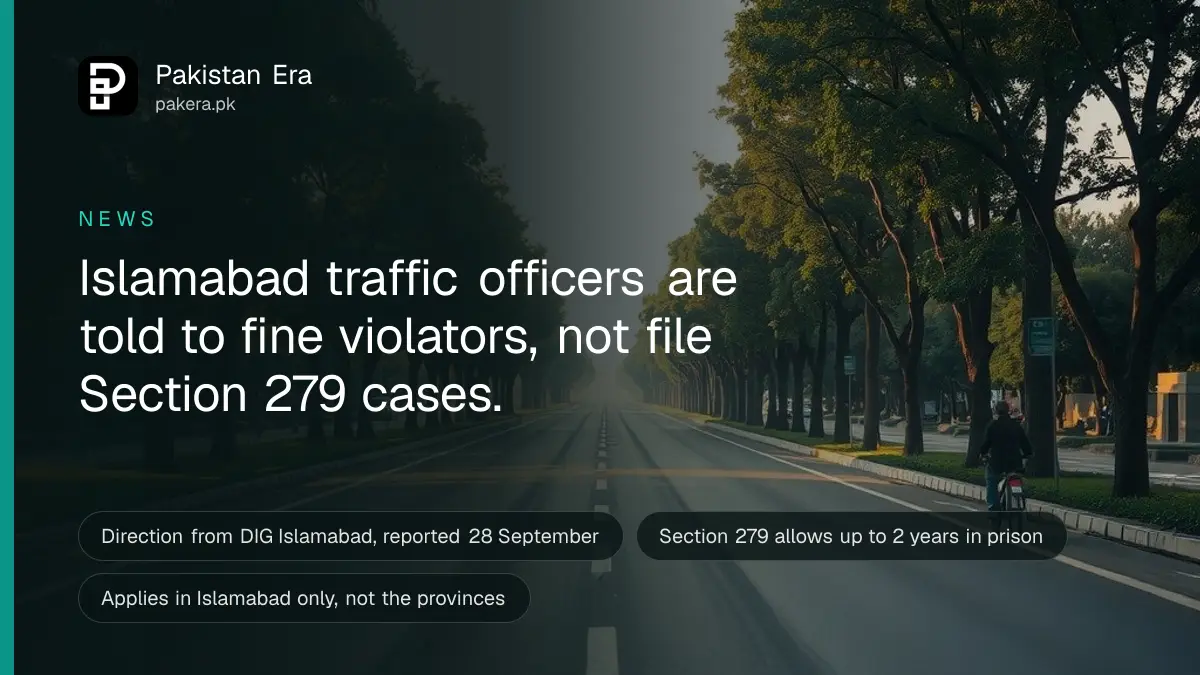
Islamabad traffic police have been told to stop registering criminal cases under Section 279 of the Pakistan Penal Code for ordinary traffic violations, and to issue fines instead. The direction came from DIG Islamabad Ali Waseem and was reported on 28 September 2026.
So a wrong-way turn, a missing helmet or a lane violation in Islamabad should now end with a ticket, not a First Information Report (FIR). An FIR is the police record that starts a criminal case. A ticket, which police call a challan, is paid and closed.
We could not find the order itself on the Islamabad Police website. When we read its news list on 30 September, the latest items ran from 27 to 30 September and none mentioned Section 279. The direction was announced through the Islamabad Police spokesperson, as reported, so we treat it as reported, not as a published order.
Islamabad police say fines, not criminal cases, for traffic violations
DIG Islamabad Ali Waseem told traffic officers not to register cases under Section 279 for traffic violations. He told them to fine violators under the traffic law instead, and to avoid unnecessary criminal cases against citizens, according to reports on 28 September 2026.
The DIG, or Deputy Inspector General, ranks just below the Inspector General in the Islamabad Police. The reported direction has four parts:
- No Section 279 cases for traffic violations.
- Fines under the law instead.
- Traffic staff to treat citizens with courtesy and respect.
- Citizens asked to follow the traffic rules and cooperate with traffic police.
Section 279 is a criminal offence, a challan is not
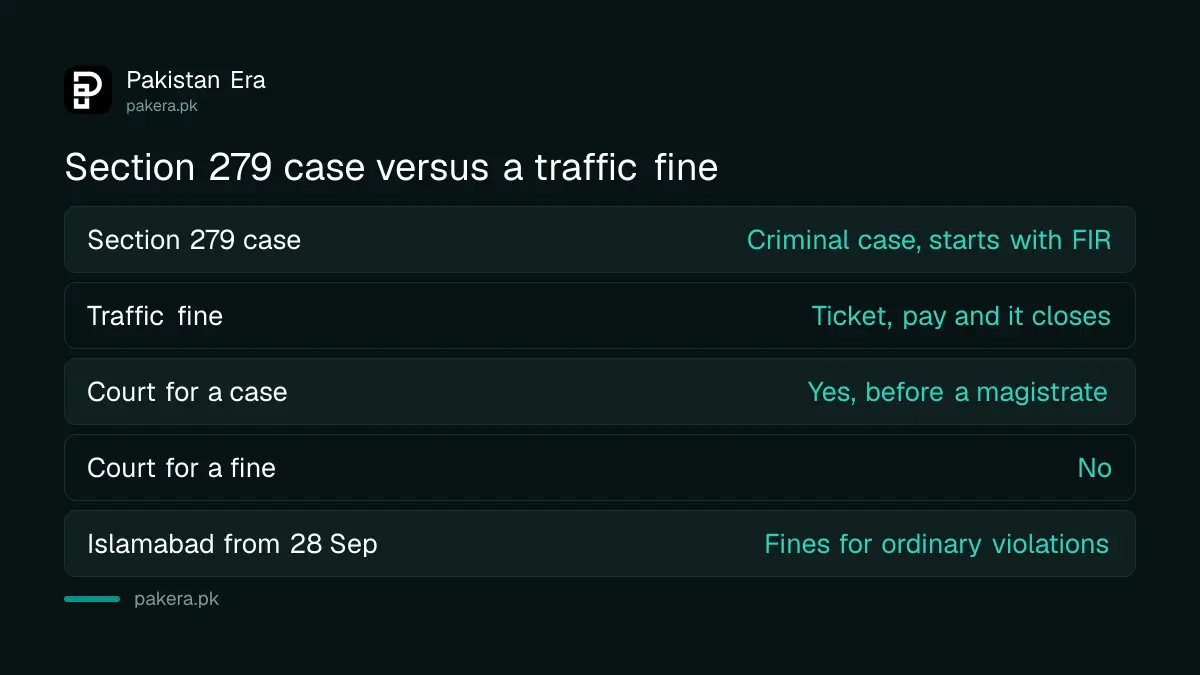
Section 279 of the Pakistan Penal Code covers driving so rashly or carelessly that it puts human life at risk. It can bring up to two years in prison, a fine of up to Rs 3,000, or both. A challan is a traffic fine with no court case.
We read the section in the Pakistan Penal Code on the Pakistan Code, the Ministry of Law and Justice's statute site. Its words are: whoever drives "in a manner so rash or negligent as to endanger human life, or to be likely to cause hurt or injury to any other person".
| Point | Section 279 case | Traffic fine (challan) |
|---|---|---|
| What it is | A criminal case, starting with an FIR | A traffic ticket |
| Maximum penalty | 2 years in prison, Rs 3,000 fine, or both | The fine written on the ticket |
| Court | Yes, the case goes before a magistrate | No court, you pay and it closes |
| Police record | Your name is in an FIR | A payment record only |
| Status in Islamabad now | Not to be used for ordinary violations, as reported | The route police have been told to use |
The difference matters beyond money. A Rs 3,000 fine sounds small. But an FIR puts your name in a criminal record, and that record can come up when you apply for a police character certificate.

Traffic FIRs in Islamabad had become common in 2026
Earlier in 2026, Islamabad Traffic Police filed Section 279 cases for violations that normally got a fine, according to reports. One report in June said 496 people were booked in two weeks, most of them for driving the wrong way on one-way roads.
That June report quoted police officers who did not give their names. By its count, 312 of the 496 cases were for one-way violations and 102 for rash driving and speeding.
The officers said an FIR can cause trouble with visas, jobs and university admission. The report also cited an Islamabad High Court ruling from October 2025 that warned against treating minor traffic violations as crimes. We could not read that ruling on the court's website, so it is reported only.
Rash driving that puts life at risk can still be a crime
The reported direction is about ordinary traffic violations. It does not repeal Section 279, which is an act of Parliament and stays in the Penal Code. Driving that truly puts people's lives at risk can still be treated as a crime.
Only Parliament can change the Penal Code. A DIG's direction changes how his officers use it in Islamabad. It does not apply to Punjab, Sindh or any other province, where traffic is policed under provincial law and by provincial police.
The reports do not say what happens in a crash where someone is hurt. Those cases can involve other sections of the Penal Code as well. If you are in a crash, the steps after a road accident in Pakistan still apply.
There is also no published list of which violations count as "ordinary". Speeding, one-wheeling and red-light jumping were among the violations police officers themselves called serious in the June report. Expect officers to keep some discretion there.
What to do if Islamabad police stop you or file an FIR
If Islamabad traffic police stop you for a violation, expect a ticket and pay it. If an FIR is registered for an ordinary violation after 28 September, you can complain to the Islamabad Police through its official channels and mention the DIG's reported direction.
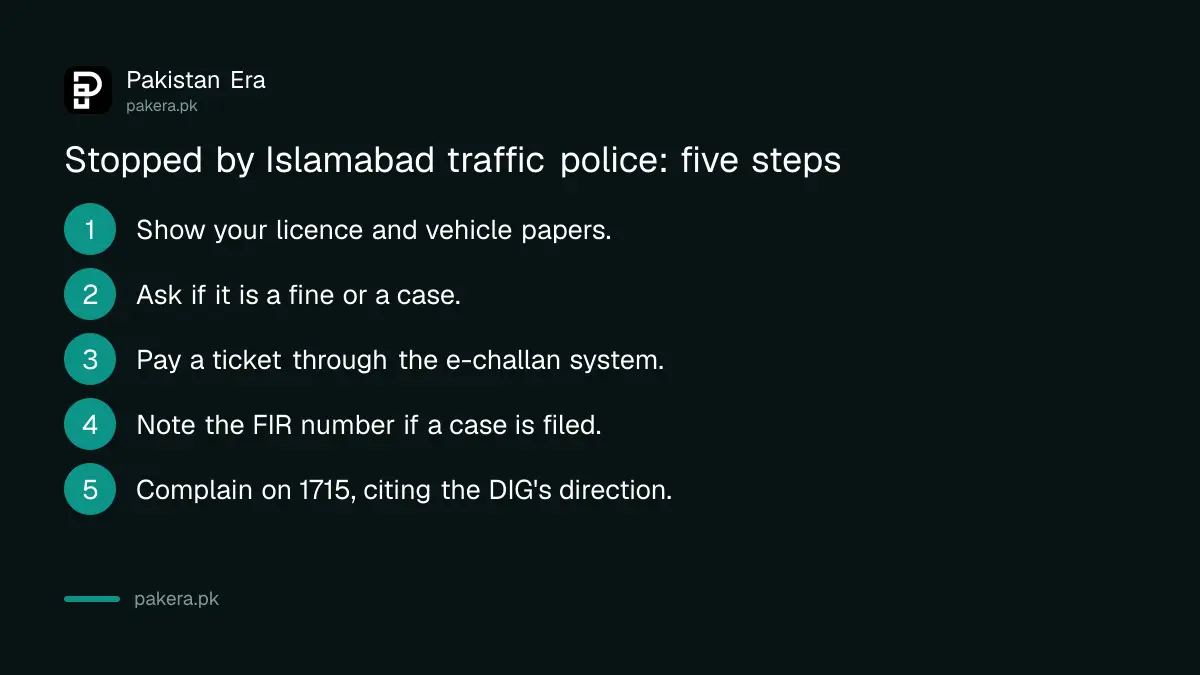
- Stay calm and show your driving licence and vehicle papers.
- Ask whether you are being fined or whether a case is being registered.
- If you get a ticket, pay it through the Islamabad e-challan system or an authorised collection point.
- If a case is registered, note the police station, date and FIR number. You can later check the FIR in Islamabad online.
- Complain through the IGP Complaint Cell on 1715 or the police's online complaint form, and mention the reported direction.
The helplines are listed on the Islamabad Police website: 1915 for traffic, 1715 for the IGP Complaint Cell and 15 for emergencies. The same site links to an Islamabad Police online complaint form.
One caution on fines. Islamabad Traffic Police do not publish a full fine table on their website. The old ITP "violation and fine" page no longer opens. So do not trust a fine list you see shared online unless it matches the amount printed on your own ticket.
Common questions
Will Islamabad police still register an FIR for a traffic violation?
Not for ordinary violations, according to the DIG's direction as reported on 28 September 2026. Traffic officers were told to fine violators instead of registering Section 279 cases.
What is Section 279 of the Pakistan Penal Code?
It is the offence of rash or negligent driving on a public road that endangers life or may cause injury. The penalty is up to two years in prison, a fine of up to Rs 3,000, or both.
Does this change apply in Lahore, Karachi or Peshawar?
No. It is a direction to Islamabad traffic officers only. Provinces have their own traffic police and rules.
Has Section 279 been removed from the law?
No. It is still in the Pakistan Penal Code. Only Parliament can remove or change it.
Is the order published on the Islamabad Police website?
Not when we checked on 30 September 2026. It was announced through the police spokesperson, as reported, and we could not find a written order.
How much is a traffic fine in Islamabad?
Islamabad Traffic Police do not publish a full fine table online. The amount is printed on your ticket, so go by that.
How we verified this
What we checked, where we read it, and what we could not confirm.
Last checked on 30 September 2026. We read Section 279 in the Pakistan Penal Code PDF on the Pakistan Code site of the Ministry of Law and Justice. We read the Islamabad Police website, its news list from 23 to 30 September and its helpline numbers. The DIG's direction, the June figures and the October 2025 court ruling are from news reports, because we could not find them on an official site. We will update this if the police publish the order.
About the author

Public Services and Education Journalist
Fajr Riaz is a journalist and content writer at Pakistan Era, based in Lahore. She covers the questions people meet in everyday life in Pakistan: how a public service works, what a change in the rules means, and where to find a reliable answer.