Japan's New Scholarship Money Is Not for Students. It Is for Civil Servants.
The JDS grant covers 16 Masters and one PhD, restricted to federal civil service officers. Aggregators are selling it as a student scheme.
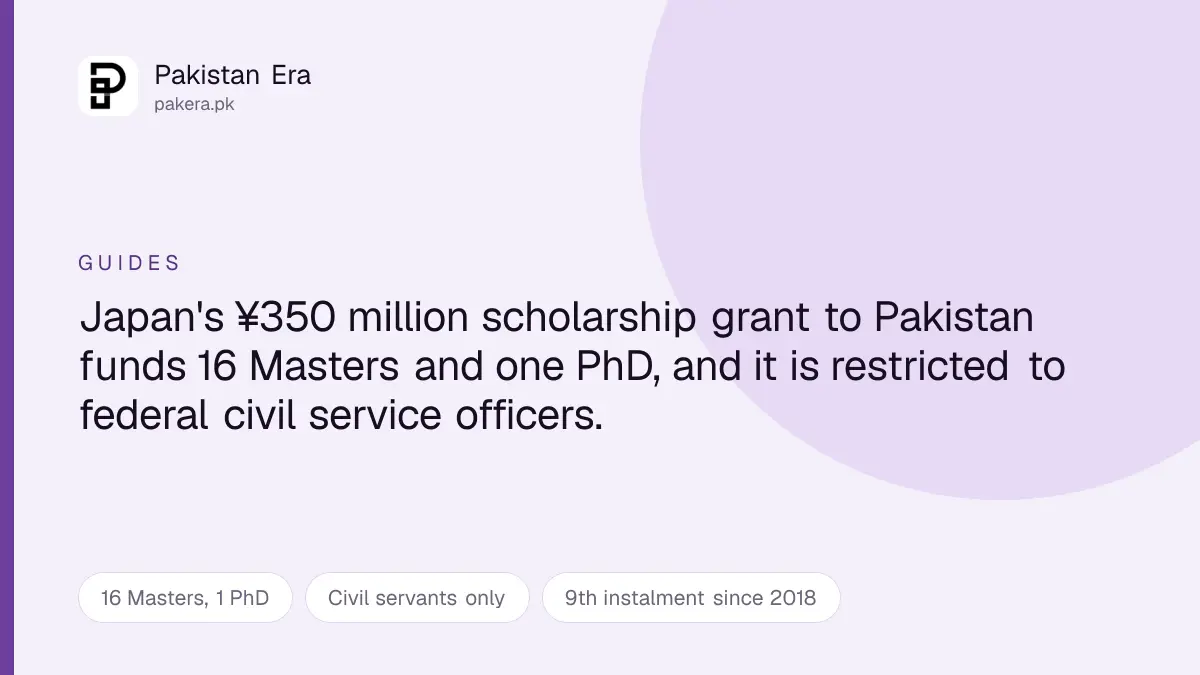
Japan has given Pakistan 350 million yen for scholarships. The headlines say Japan has extended its scholarship programme for Pakistanis.
Both are true. Here is what neither says clearly.
The money funds sixteen Masters places and one PhD. Seventeen people. And it is restricted to serving federal civil service officers.
If you are a student, a graduate or anyone outside government service, this particular scheme is closed to you.
What the grant actually covers
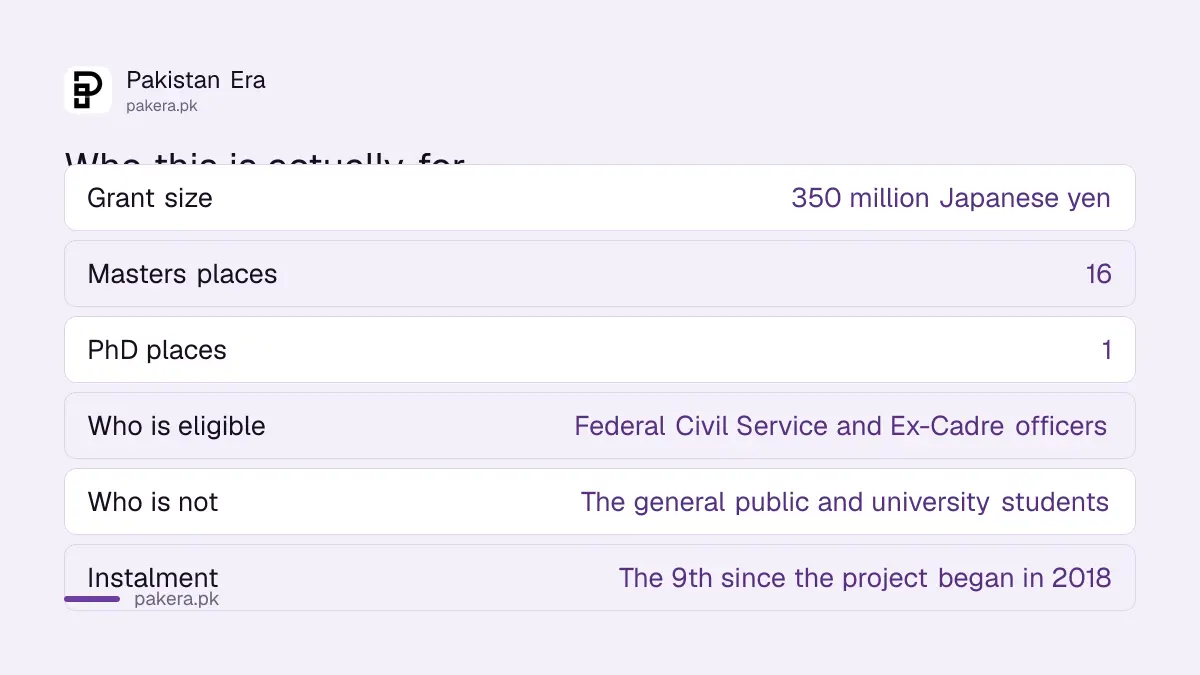
| Detail | Position |
|---|---|
| Grant | 350 million Japanese yen |
| Masters places | 16 |
| PhD places | 1 |
| Eligible | Young Federal Civil Service and Ex-Cadre officers |
| Delivered through | JICA, Japan's international cooperation agency |
| Instalment | The ninth since the project began in 2018 |
The agreement was signed in Islamabad, with Notes Verbale exchanged between Japan's Ambassador AKAMATSU Shuichi and Muhammad Humair Karim Kidwai, Secretary of the Ministry of Economic Affairs.
Why the reporting misleads without lying
Nothing in the coverage is false. The problem is what gets put next to what.
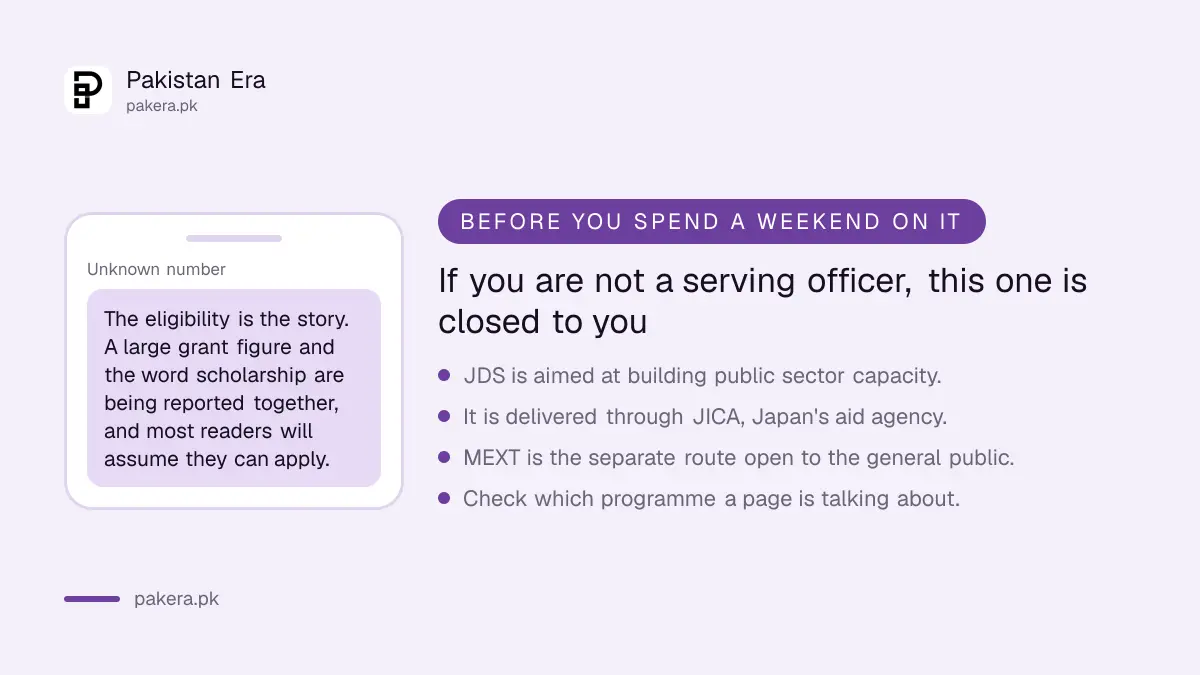
A very large number, 350 million yen, sits beside the word "scholarship" and the phrase "for Pakistanis". A reader does the obvious arithmetic in their head and concludes there is a substantial pool of funding they might compete for.
The eligibility line, which is the single most important fact for a reader deciding whether to spend a weekend on an application, tends to appear far down the story or not at all.
We think the eligibility is the story. Seventeen places for serving officers is a different piece of news from a scholarship programme being extended for Pakistanis, even though both sentences describe the same grant.
This is not a criticism of the programme
Worth saying plainly, because the correction could be read as a complaint.
JDS exists to build public sector capacity. Sending mid-career officials to study abroad and return to government is a legitimate aim, and it is a common form of development assistance. Seventeen well placed officers may do more lasting good than seventeen students would.
Our objection is not to the programme. It is to a reader wasting an evening discovering they were never eligible.
The routes to Japan that are open to you
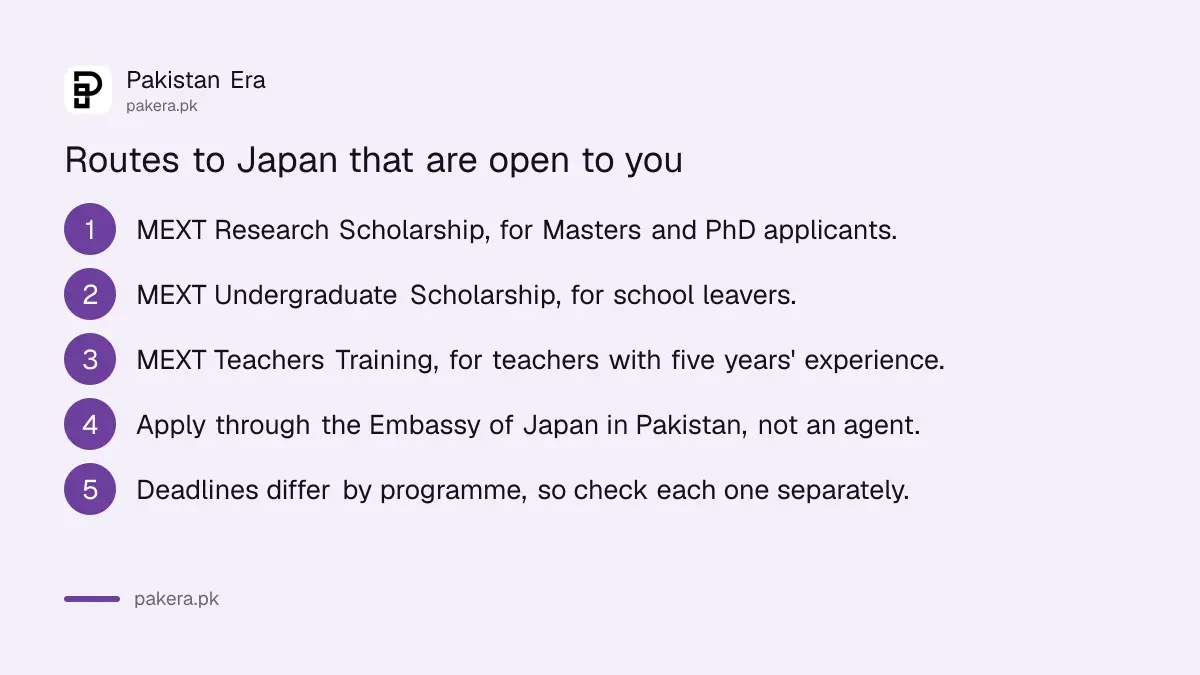
If you want to study in Japan and you are not a civil servant, the route is MEXT, the Japanese government's scholarship programme administered through the Embassy of Japan in Pakistan.
- MEXT Research Scholarship, for Masters and doctoral applicants.
- MEXT Undergraduate Scholarship, for school leavers.
- MEXT Teachers Training, for teachers with five or more years of experience in a primary or secondary school, public or private.
We are deliberately not printing deadlines for these. The programmes run on separate annual cycles, at least one cycle we looked at has already closed for this year, and a date copied from an old page is exactly how somebody misses a live window.
Go to the Embassy of Japan in Pakistan's own site and check the programme you want. Do not use an agent, and do not pay anyone to apply on your behalf for a government scholarship.
How to tell these schemes apart
The names blur, so here is the short version.
JDS is aid delivered through JICA for public sector officers. MEXT is the education ministry's scholarship, open to the public. They are different bodies, different purposes and different application routes, and a page that talks about "Japanese scholarships" without saying which one is not much use to you.
The same discipline applies to any funding page you read. Check which specific programme it describes, and check the date on it.
We made the same point this week about the HEC DAAD PhD scholarships, where the full doctorate and the short research grant are two different offers that applicants routinely mix up. That one closes on 31 August and is open to researchers rather than officials.
Where to look next
Postgraduate funding is one of the few areas where a careful reader genuinely beats a fast one, because the schemes are small, specific and easy to misread.
Other routes we have covered include the Chevening scholarship for the UK, which runs on its own calendar.
If you are converting a foreign qualification for use in Pakistan afterwards, or the other way round, equivalence is handled through IBCC and set out in our equivalence guide.
Questions readers are asking
Can students apply for Japan's JDS scholarship?
No. The JDS programme is restricted to young Federal Civil Service and Ex-Cadre officers of Pakistan.
How many places does the grant fund?
Sixteen Masters places and one PhD, seventeen in total, from a grant of 350 million Japanese yen.
What is the difference between JDS and MEXT?
JDS is development assistance delivered through JICA for public sector officers. MEXT is the Japanese education ministry's scholarship programme, open to the general public through the embassy.
How do I apply for a Japanese government scholarship?
Through the Embassy of Japan in Pakistan for MEXT programmes. Check each programme separately, because they run on different cycles.
Is there a deadline?
Each MEXT programme has its own, and at least one cycle has already closed this year. We are not printing dates because a stale one could cost you the window. Check the embassy site.
Should I use an agent?
No. These are government scholarships and nobody needs to be paid to submit your application.
Is JDS new?
No. This is the ninth instalment since the project began in 2018.
About the author

Public Services and Education Journalist
Fajr Riaz is a journalist and content writer at Pakistan Era, based in Lahore. She covers the questions people meet in everyday life in Pakistan: how a public service works, what a change in the rules means, and where to find a reliable answer.