Jwandun Card KP: Check Eligibility on 9930 and Get Free OPD at 59 Mardan Facilities
Check Jwandun Card eligibility by sending your CNIC to 9930. A PMT score of 26 or less gets free OPD, tests and medicines at 59 Mardan facilities. See the list.
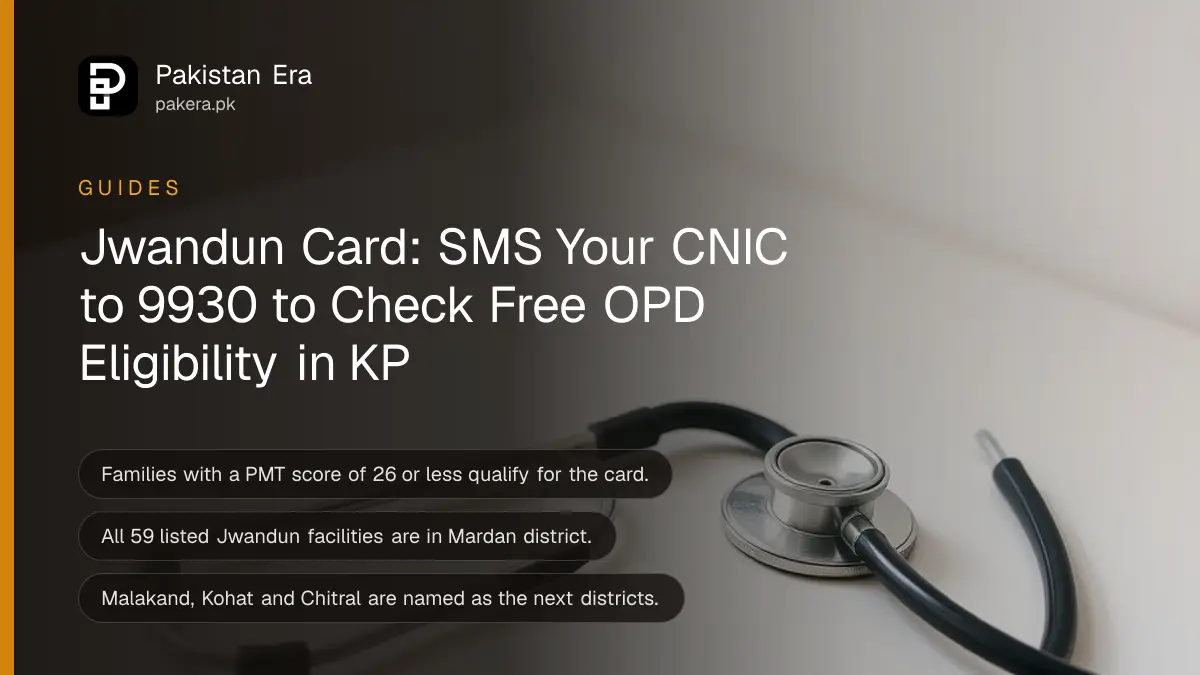
To check whether your family qualifies for the Jwandun Card, the free OPD card of Khyber Pakhtunkhwa, send your CNIC number by SMS to 9930. The reply gives your poverty (PMT) score, and a score of 26 or less makes you eligible. Then register at one of the 59 listed health facilities in Mardan, with your CNIC or B-Form. The helpline is 0800-89898, the same 24 hour line as the Sehat Card Plus.
The Jwandun Card, also written Zwandun, fills the gap the Sehat Card leaves: the Sehat Card pays only when a patient is admitted, while Jwandun pays for ordinary doctor visits, basic tests and medicines. Below are the eligibility rule, the districts, every type of facility on the list, what is free and how to register. We read the Sehat Card Plus KP website's Jwandun pages on 25 October 2026.
Send your CNIC to 9930 to check Jwandun Card eligibility
The Jwandun Card uses your family's PMT score from the Benazir Income Support Programme survey. Send your 13-digit CNIC number to 9930; the reply shows your score. If it is 26 or below, and you live in a covered district, you qualify.
- Open a new SMS and type your CNIC number without dashes.
- Send it to 9930 and wait for the reply with your PMT score.
- If the score is 26 or less, go to a listed facility near you, or contact your area's community health worker.
- Register yourself and your family there with CNICs and B-Forms.
- After registration, use the same facility for free OPD visits through the year.
Do not confuse this with the Sehat Card SMS. The number 9780 checks Sehat Card Plus eligibility for admission. The number 9930 is for the Jwandun OPD card.
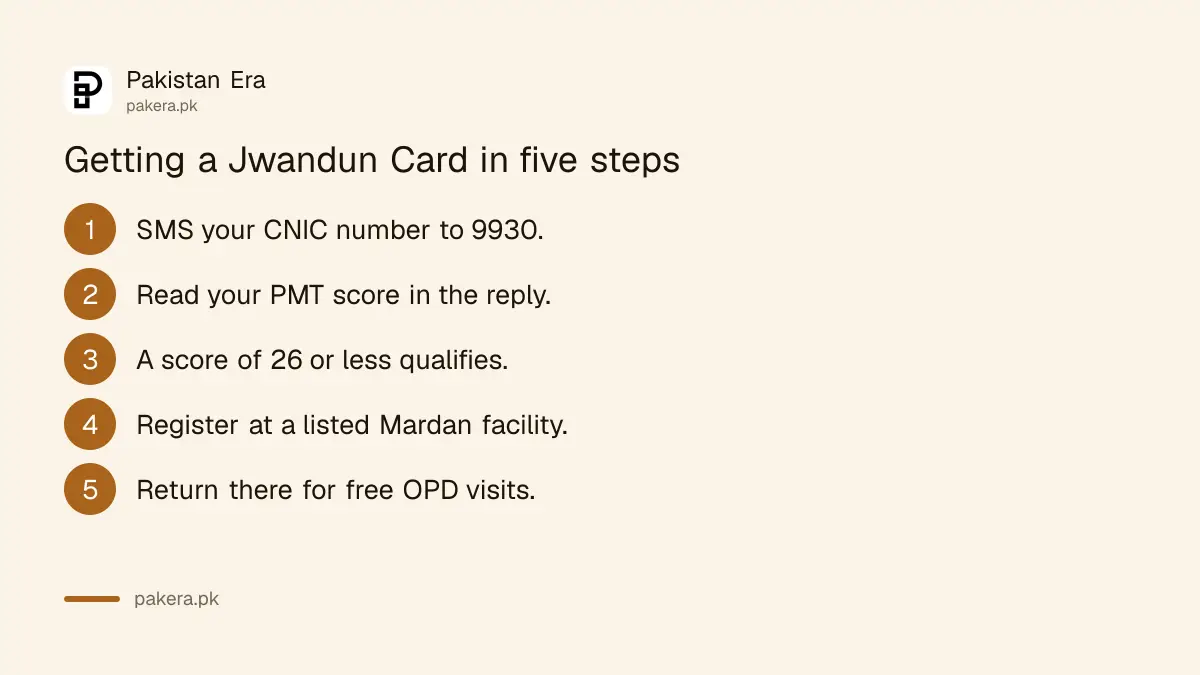
Only families with a PMT score of 26 or less qualify
The programme says the Jwandun Card covers families with a PMT score of 26 or below, using NADRA and BISP records. Every member of an eligible family is covered, including women, children and older people. The PMT score is a poverty rating from the BISP survey.
Your PMT score is not something you can change at a hospital. If you think it is wrong, it can only be updated through a new BISP survey. The steps for a BISP not eligible result and a fresh NSER survey apply here too.
For comparison, BISP's own Kafaalat cash programme uses a higher cut-off. The BISP Kafaalat PMT cut-off of 32 means some families get BISP cash but are still above the Jwandun line of 26.
Mardan has the facilities now, and three districts are named next
The Jwandun pilot started in Mardan district, and all 59 facilities on the current list are in Mardan. The programme names Malakand, Kohat and Chitral as the next districts. One of its pages already lists all four as eligible, while a reply on the site says only Mardan residents qualify.
The official Jwandun Card outpatient care page says the scheme will be expanded to Malakand, Kohat and Chitral gradually. Its Urdu explainer from January 2026 lists residents of all four districts as eligible. But a programme reply on the registration notice says only permanent residents of Mardan with a score of 26 or less are eligible.
Our reading: if you live in Malakand, Kohat or Chitral, send the 9930 SMS and call 0800-89898 before travelling, because the facility list we read has no centre outside Mardan yet.
59 Jwandun facilities are listed in Mardan
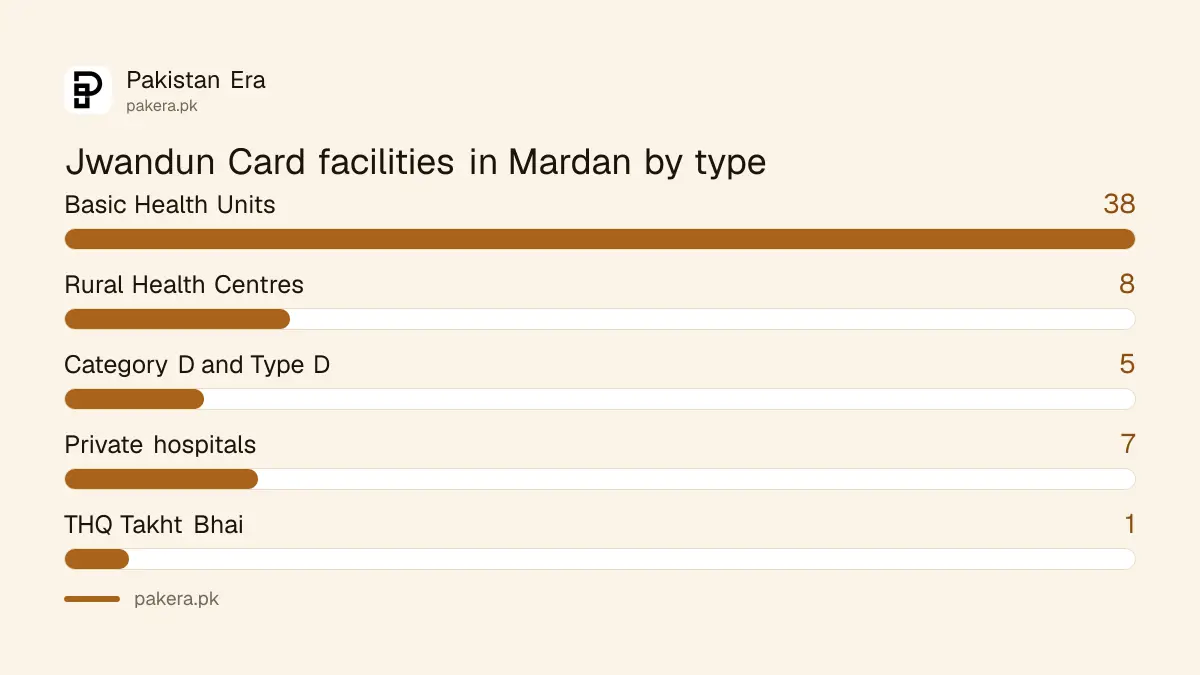
The list has 59 facilities in Mardan: 38 Basic Health Units, 8 Rural Health Centres, 5 Category D and Type D hospitals, the THQ hospital at Takht Bhai, 6 private secondary care hospitals and 1 private tertiary hospital.
| Facility type | Number | Examples |
|---|---|---|
| Basic Health Unit (BHU) | 38 | Akbar Abad, Babini, Jalala, Takkar, Sheikh Yousaf |
| Rural Health Centre (RHC) | 8 | Bakhshali, Charbanda, Ghumbat, Manga, Palo Deri |
| Category D and Type D hospital | 5 | Katlang, Lund Khwar, Rustam, Shahbar Garhi |
| Tehsil Headquarters hospital | 1 | Takht Bhai |
| Private secondary care | 6 | Al-Khidmat Mashal Medical Complex, Sajida Islam General Hospital, Saeed Medical Complex |
| Private tertiary care | 1 | Zia Darman Hospital |
The full list with all 59 names is on the programme's outpatient care page. Pick the one closest to home, because you register at a facility and return there.
Free check-ups, basic tests and medicines are covered
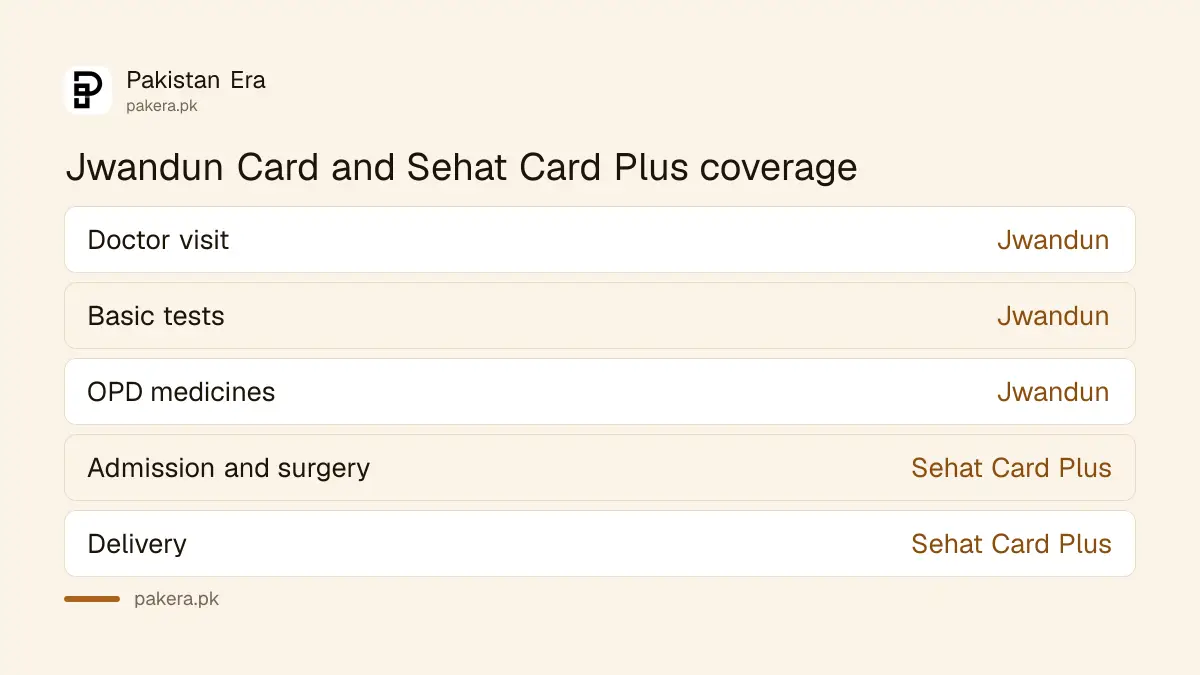
The Jwandun Card pays for a general OPD check-up and consultation, basic diagnostic and lab tests, prescribed medicines under the programme's policy, referral to a bigger hospital when needed, and free advice on pregnancy and mother and child health.
| Covered by Jwandun | Covered by Sehat Card Plus |
|---|---|
| OPD doctor visit and consultation | Hospital admission and operations |
| Basic lab and diagnostic tests | Tests during admission |
| Prescribed medicines, per policy | Medicines during admission and 5 days after |
| Pregnancy, mother and child advice | Delivery and maternity admission |
| Referral to a bigger hospital | Admission at the referred hospital |
The programme's benefit package names five areas: reproductive health, school-age care, infectious diseases, non-communicable diseases such as diabetes and blood pressure, and access to health services. The two cards work together; a patient referred by a Jwandun facility for admission would use the Sehat Card Plus at the hospital.
KfW funds the scheme and State Life runs it
The Khyber Pakhtunkhwa government launched the OPD pilot on 19 February 2025 at the Chief Minister's House in Peshawar. Germany's development bank KfW funds it, and State Life Insurance runs it. Registration in Mardan began in July 2025.
The programme describes it as a two-year initiative with a budget of about Rs 2.2 billion. An October 2024 notice on the same site described a pilot of 4.9 million euros for about 120,000 families, with KfW paying 90 per cent and the province 10 per cent. The figures were given at different stages, so treat them as plans rather than spending.
State Life's Mardan office is at Office No 205, Street 4, Sector J, Sheikh Maltoon Town.
Common questions
How do I check Jwandun Card eligibility?
Send your CNIC number by SMS to 9930. A PMT score of 26 or less means your family qualifies.
Is the Jwandun Card the same as the Zwandun Card?
Yes. The programme uses both spellings for the same KP OPD card.
Which districts have the Jwandun Card?
Mardan now. Malakand, Kohat and Chitral are named as the next districts.
Do I need a separate card?
The programme says to show your CNIC, or B-Form for a child, at a listed facility. No other document is needed.
Does the Jwandun Card cover hospital admission?
No. Admission is covered by the Sehat Card Plus. You can check KP Sehat Card Plus eligibility separately on 9780.
What is the Jwandun Card helpline?
0800-89898, free and open 24 hours.
How we verified this
What we checked, where we read it, and what we could not confirm.
Last checked 25 October 2026. We read the Sehat Card Plus KP website on sehatsahulat.com.pk on 25 October 2026: the outpatient care (Jwandun) page with its list of 59 facilities, the OPD scheme launch notice of 19 February 2025, the registration notice of July 2025, the January 2026 Urdu explainer and the October 2024 funding notice. The facility counts are our tally of that list. The programme's pages disagree on whether Malakand, Kohat and Chitral residents can register now, and we report both. We did not send a 9930 SMS or visit a facility. This page is information only; for medical advice, speak to a doctor.
About the author
Public Services and Education Journalist
Fajr Riaz is a journalist and content writer at Pakistan Era, based in Lahore. She covers the questions people meet in everyday life in Pakistan: how a public service works, what a change in the rules means, and where to find a reliable answer.