K-Electric Loadshed Exempt Areas 2026: October Review List for Karachi and How Your Feeder Gets Exempt
K-Electric's October 2026 review made parts of Korangi, Federal B Area, Surjani, SITE and Jacob Lines loadshed exempt. See every area and check your own feeder.
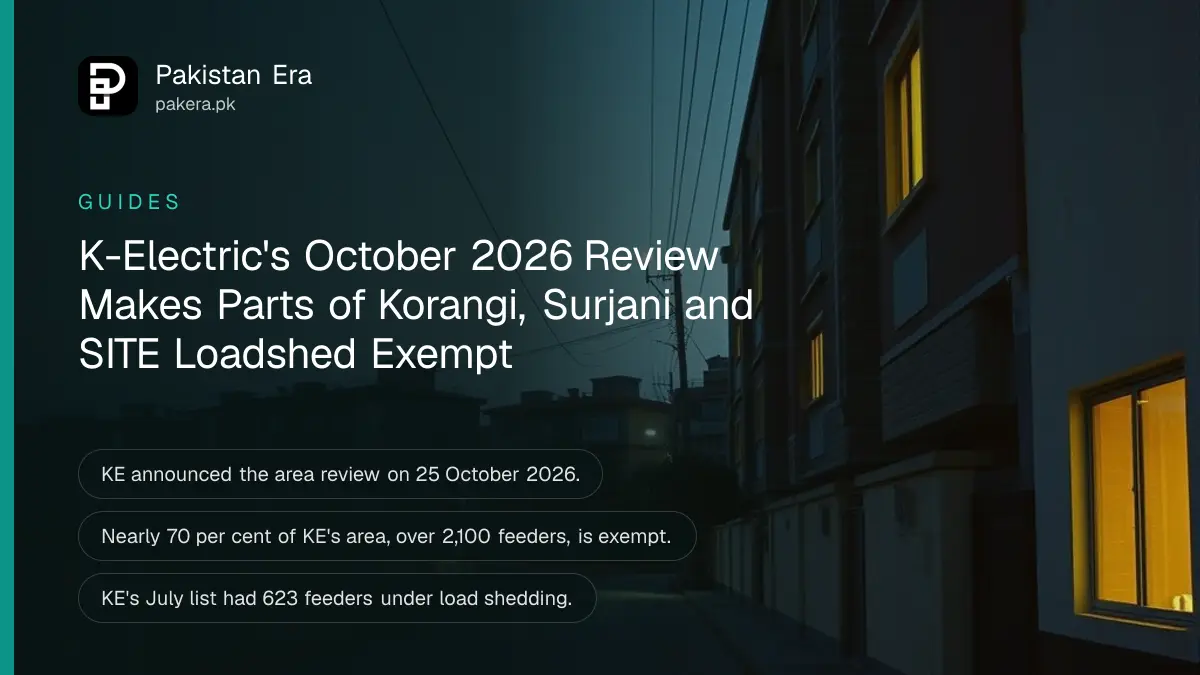
K-Electric's October 2026 network review made parts of Korangi, Azizabad, Federal B Area, Surjani Town, SITE, Jacob Lines and Ibrahim Hyderi loadshed exempt, and moved areas including Martin Quarters and parts of Orangi Town from high loss to medium loss. KE announced the review on 25 October 2026 and says the updated schedule took effect at once.
If your area is on the list below, your feeder should no longer have scheduled cuts. If it is not, the rest of this page shows how KE decides, what the July category list says about your feeder, and what actually moves an area out of load shedding.
These areas became loadshed exempt in October 2026
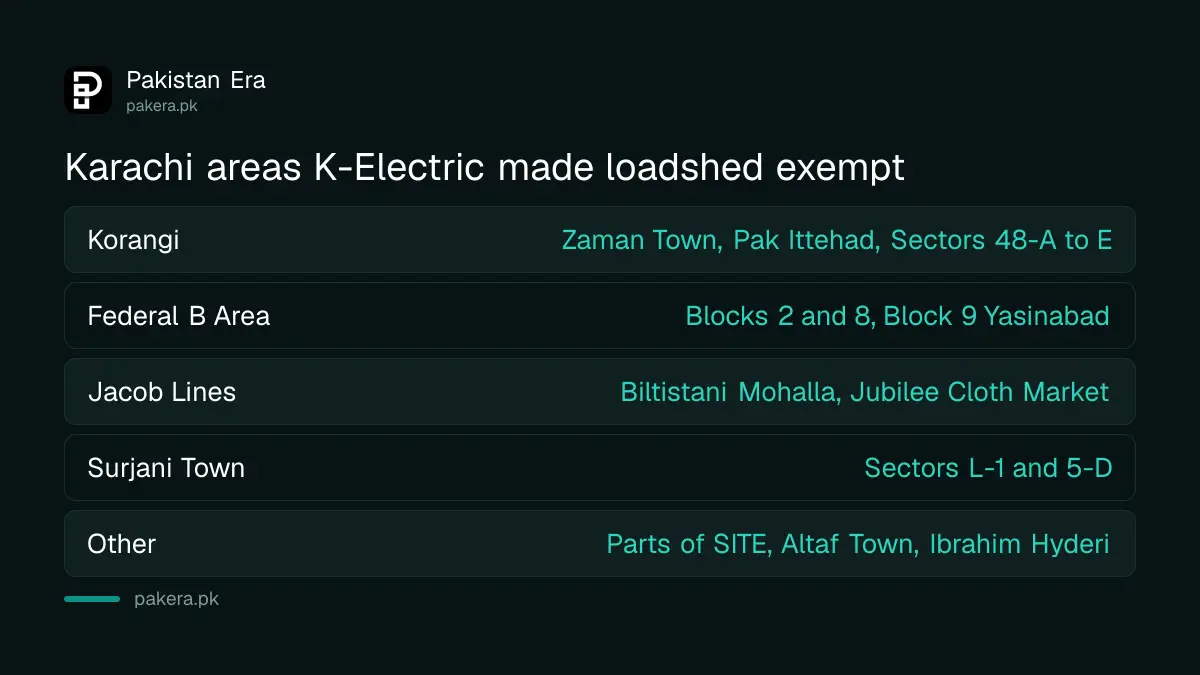
KE says these areas moved from the medium loss group to the low loss group, which is exempt from load shedding. KE names them in its 25 October 2026 release on the quarterly network review.
| Part of Karachi | Areas KE named as newly exempt |
|---|---|
| Korangi | Abdullah Shah Noorani Colony, Pak Ittehad Colony, Zaman Town, Sectors 48-A, B, C, D and E |
| Azizabad and Federal B Area | Block 2 and Block 8 Federal B Area, Bhangoria Goth, Block 9 Yasinabad, Naimat Colony |
| Roads and markets | Kyani Shaheed and Randle Road, APWA Complex Road, Jubilee Cloth Market, Biltistani Mohalla Jacob Lines |
| Other areas | Shah Abdul Latif Bhitai Colony, Altaf Town, Deh Dih Tapo Ibrahim Hyderi Goth |
| SITE and Surjani Town | Some parts of SITE, Sectors L-1 and 5-D Surjani Town |
KE gives area names, not feeder names, so one street in a named area can still sit on a different feeder. The account number check on KE's schedule page is the final word for your house.
These areas moved from high loss to medium loss
A second group did not become exempt but moved down one step, from high loss to medium loss. KE says these areas will see a reduction in load shedding.
- Saadat Colony, Moria Khan Goth, Soldier Bazar, Tagore Street, Aminabad Society, and Martin Quarters in Jamshed Town.
- Parts of Orangi Town: Khawaja Ghareeb Nawaz, Millat Colony, Madina Colony and Al-Mustafa Colony.
One detail is worth checking yourself. KE's schedule file, dated 22 October and applicable from 23 October, still lists a feeder named Sadat Colony under the Airport grid with four cuts that add up to 12 hours a day. That may be a different feeder from the Saadat Colony area KE named, or the file may not reflect every change. The feeder named Kyani Shaheed, on the other hand, appears in KE's July list and is gone from the October file, which fits KE's release.
KE sets load shedding by losses on each feeder
KE decides load shedding feeder by feeder. Its schedule file says the cuts depend on the losses on each feeder, measured from electricity theft and unpaid bills, under the National Power Policy. Low loss feeders are exempt; medium and high loss feeders get scheduled cuts.
KE calls this measure Aggregated Technical and Commercial losses, or AT&C. Technical loss is power lost in wires and transformers. Commercial loss is power used but never paid for, through hooks on the line or unpaid bills. KE says nearly 70% of its service area, more than 2,100 feeders, is already exempt.
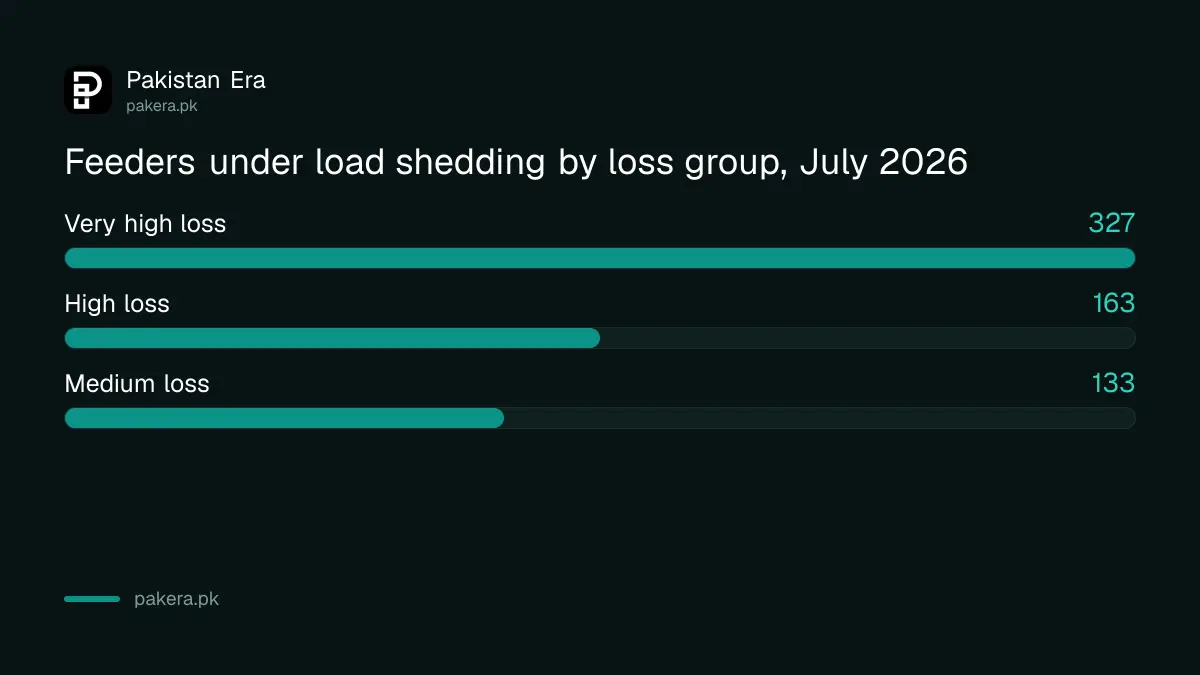
KE's July 2026 list of feeders under load shedding has 623 feeders with their loss percentage and group. We counted 327 very high loss, 163 high loss and 133 medium loss feeders in it.
| Group in KE's July list | Feeders | Loss range we read |
|---|---|---|
| Very high loss | 327 | About 49.5% to 99.4% |
| High loss | 163 | About 26.9% to 56.4% |
| Medium loss | 133 | About 8.6% to 42.5% |
The ranges overlap, so the loss figure alone does not fix the group. KE does not publish the cut off points on the page, and we could not find them in the files.
Paying bills and cutting theft is what moves an area out
KE credits the October changes to timely bill payment, lower theft and work with area representatives. It says it has run nearly 5,000 drives against illegal hooks since July 2026 and removed more than 44,000 kilogrammes of illegal wire. The previous review was in July 2026.
So an area moves when its feeder's losses fall. One family paying on time does not change the group on its own, but a street that pays and stops hooks does. KE says high theft areas stay under watch until the next review. The K-Electric defaulters list shows which areas carry the most unpaid dues.
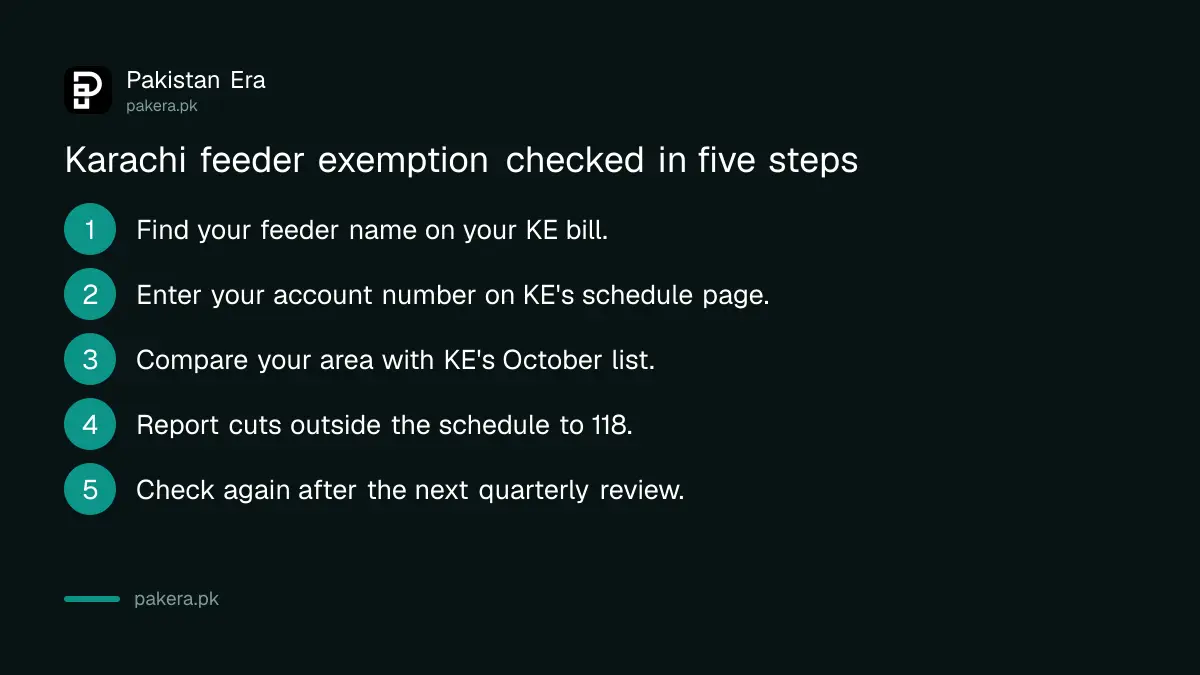
- Find your feeder name at the top of your KE bill or under the Power tab in the KE Live app.
- Enter your account number on KE's Load-Shed Schedule page to see your current cycles.
- If your area is named above but you still get cuts, call 118 and give your feeder name.
- Report hooks on your street through KE's theft reporting channels.
- Pay your own bill before the due date, and check again after the next review.
Your timings and complaints come from KE's own channels
The feeder timings that apply from 23 October are set out in the K-Electric load shedding schedule, with the common patterns. A cut outside those timings is a fault, and the fastest routes are 118, the KE Live app and WhatsApp, all covered in the K-Electric complaint guide.
If you report theft, the general steps and what to expect are in reporting electricity theft in Pakistan. Keep a note of your complaint number either way.
Common questions
Which Karachi areas are loadshed exempt in October 2026?
KE named parts of Korangi, Azizabad and Federal B Area, Jacob Lines, Ibrahim Hyderi Goth, SITE and Surjani Town, plus several roads and markets, in its 25 October 2026 review. The full list is in the first table above.
What does "your area is exempted from load shedding" mean?
It means your feeder is in KE's low loss group, so it has no scheduled load shedding. Faults can still cut power, and those should be reported to 118.
How often does KE review loadshed areas?
KE calls it a quarterly review. The last one before October was in July 2026.
Can one house get exemption on its own?
No. KE sets load shedding by feeder, so the whole feeder's losses decide the group.
My area is on the list but power still goes. What do I do?
Check your feeder on KE's schedule page by account number. If it shows no load shedding, report each cut to 118 as a fault.
How we verified this
What we checked, where we read it, and what we could not confirm.
Last checked 28 October 2026. We read KE's release Several areas gain loadshed exemption following network review, dated 25 October 2026 in its text, and KE's Load-Shed / Maintenance Schedule page, from which we downloaded the July 2026 feeder category list and the schedule file that applies from 23 October 2026. The feeder counts and loss ranges are our own reading of KE's list; a few loss figures sit on broken lines and were not read. We could not match every area name in the release to a feeder name, and KE does not publish the loss cut off points for each group.
About the author

Senior Writer, Public Services and Technology
Shahid joined us in 2024 as an author. He is a senior contributor to Pakistan's leading technology websites. He writes detailed articles, mostly covering his expertise in the latest tech, mobiles, apps, gadgets, and step-by-step guides. His ideology is to help people understand the latest trends and explain complex methods through very easy-to-understand guides.