Life Insurance Claim Refused for a Hidden Illness in Pakistan: The 2 Year Rule
Life insurance claim refused for non-disclosure in Pakistan? Section 80 bars it after 2 years unless fraud is proved. The law, a 2024 case and the fix.
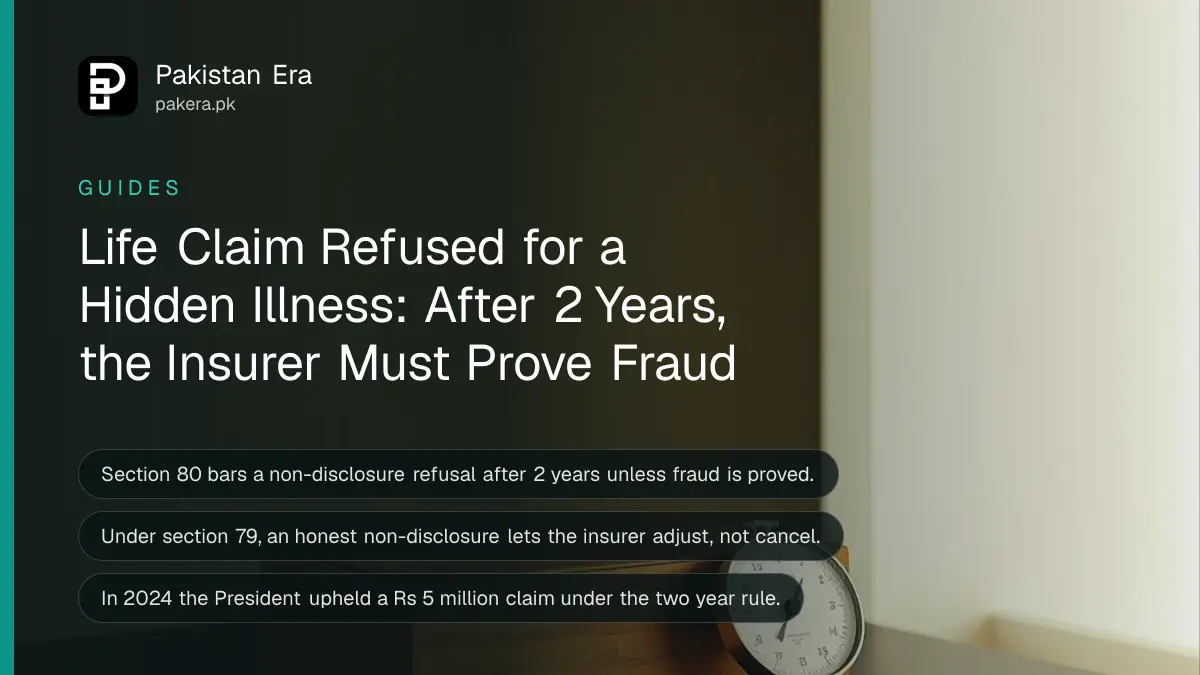
If a life insurance claim in Pakistan is refused because the insured person "hid" an illness, check how old the policy was at death. Under section 80 of the Insurance Ordinance, 2000, once a life policy has run 2 years, the insurer cannot question it for a false or incomplete proposal unless it proves the statement was material, made fraudulently and known to be false. Challenge the refusal in writing, then at the Insurance Ombudsman.
| Policy age at death | What the insurer must show to refuse for non-disclosure |
|---|---|
| Under 2 years | Section 79 applies: it can avoid the policy only if the non-disclosure was fraudulent, or it would not have issued the policy on the same terms |
| 2 years or more | Section 80 applies: the statement was on a material matter, made fraudulently, and the policyholder knew it was false |
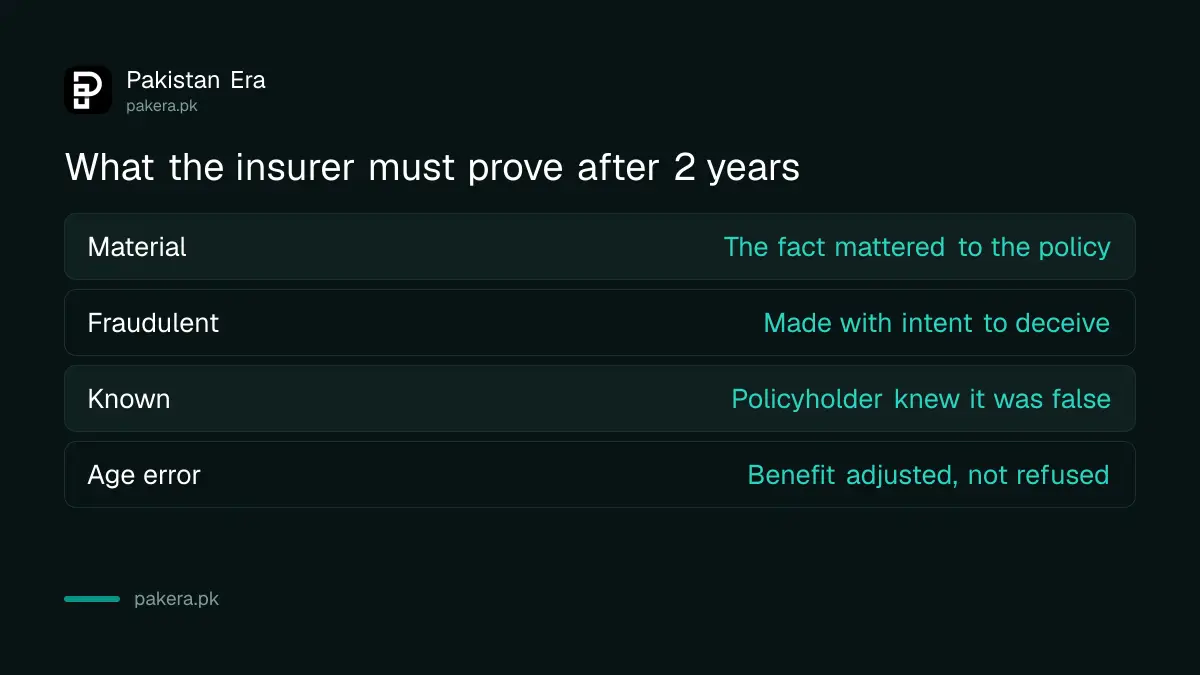
| Any age | A wrong age can still be corrected by adjusting the benefit |
The refusal letter usually arrives months after the funeral. It says the deceased had diabetes, or blood pressure, or a heart problem, and did not mention it on the form. Many families accept that and give up. The law gives them more ground than the letter suggests, especially when the policy is more than two years old.
Section 80 stops insurers questioning a policy after two years
Section 80 of the Insurance Ordinance, 2000 says no life policy can be called in question by the insurer, after two years from the date it was effected, on the ground that a statement in the proposal or a medical report was inaccurate or false.
There is one exception, and it is narrow. The insurer must show three things together:
- The statement was on a material matter, or hid facts that were material to disclose.
- It was made fraudulently by the policyholder.
- The policyholder knew at the time that it was false, or that it hid material facts.
All three must be shown. An insurer that only says "the illness was not disclosed" has not proved fraud or knowledge. That gap is the heart of most successful challenges.
Inside two years, section 79 still protects honest mistakes
A policy less than two years old has less protection, but not none. Section 79 says an insurer may not avoid a policy only because of a failure to disclose or a misrepresentation if the failure was not fraudulent, or if it would have issued the policy on the same premium and terms anyway.
For a non-fraudulent failure, the insurer is entitled to be put in the position it would have been in had the fact been disclosed. In plain words, it can adjust, but it cannot simply cancel. Only a fraudulent failure or misrepresentation lets it avoid the contract.
Section 81 adds a further safety valve. In a case before the Insurance Tribunal, the Tribunal may disregard an avoidance for fraud if refusing payment would be harsh and unfair, and allow the whole or part of the claim.
A 2024 case shows how the two year rule works
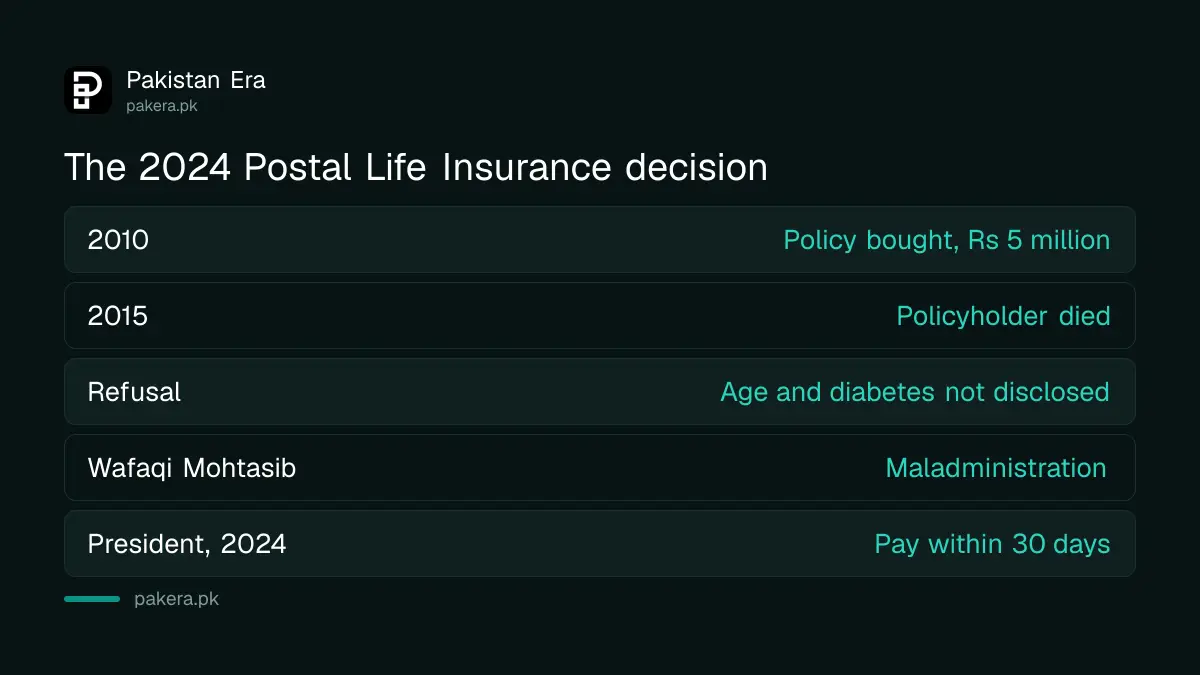
On 6 February 2024 the President's office announced a decision on a Postal Life Insurance claim. A father had bought a policy in 2010 for Rs 5 million and died in 2015. The insurer refused, saying he had concealed his date of birth and a diabetes condition.
The son complained to the Wafaqi Mohtasib, which called the refusal maladministration. The insurer appealed to the President, who rejected the appeal and directed payment of Rs 5 million to the legal heirs within 30 days. The decision relied on section 80, and on a Lahore High Court view that hiding diabetes or hypertension could not be called fraud.
| Point | Detail |
|---|---|
| Policy bought | 2010, sum assured Rs 5 million |
| Death | 2015, five years later |
| Reason for refusal | Date of birth and diabetes not disclosed |
| First forum | Wafaqi Mohtasib: maladministration |
| Final decision | President: pay Rs 5 million within 30 days |
Challenge the refusal in five steps
Start with the insurer, in writing, and give it the law. The Insurance Ordinance then gives the insurer one month to answer before you can go to the Insurance Ombudsman. Keep copies and dated receipts of everything.
- Ask the insurer for the refusal in writing, with the exact clause and the evidence it relies on, such as the proposal form and medical records.
- Work out the policy's age at death from the date of commencement on the policy schedule.
- Write a reply. Cite section 80 if the policy was 2 years or older, and section 79 if younger. Say the claimant intends to complain to the Insurance Ombudsman if the claim is not paid.
- Wait one month. Section 129 of the Ordinance lets you file with the Insurance Ombudsman if the insurer does not reply, or replies unsatisfactorily, within one month. You then have a further three months.
- File with the Federal Insurance Ombudsman, helpline 1082, attaching the policy, the refusal, your reply and the death certificate.
The Federal Insurance Ombudsman complaint is free and needs no lawyer. If you want a binding court order instead, the choice between forums is set out in insurance claim: consumer court or Insurance Tribunal. The Ombudsman will not hear a case already pending in court, so pick one route.
Gather the papers that answer the insurer's evidence
The insurer's case rests on what the deceased knew when signing. Your papers should show what was actually asked, who filled the form, and whether any illness was diagnosed before that date.
- The proposal form copy. Ask the insurer for it. Check whether the agent filled it and whether the questions were explained.
- Medical records. Note the date an illness was first diagnosed. A diagnosis after the policy began is not a non-disclosure.
- Any medical test the insurer ran. If it tested and still issued the policy, say so.
- The CNIC. If age is disputed, the CNIC date of birth matters. Section 80 lets the insurer adjust benefits for a wrong age, not cancel the whole claim.
- The death certificate and the claim forms, as listed in the steps for a life insurance death claim.
Common questions
Can an insurer refuse a life claim after two years for a hidden illness?
Only if it proves the statement was material, made fraudulently, and that the policyholder knew it was false. That is section 80 of the Insurance Ordinance, 2000.
Is not mentioning diabetes or blood pressure fraud?
Not automatically. The 2024 President's decision relied on a Lahore High Court view that hiding diabetes or hypertension could not be termed fraud. Each case turns on its facts.
Can the insurer cut the claim for a wrong age?
Yes. Section 80 lets the insurer ask for proof of age at any time and adjust the benefit if the age on the proposal was wrong. That is an adjustment, not a full refusal.
Where do I complain about a refused life claim?
First to the insurer in writing. After one month, the Federal Insurance Ombudsman on 1082. The Insurance Tribunal is the court route.
The policy was less than two years old. Is the claim lost?
No. Under section 79, the insurer may not avoid the policy for a non-fraudulent failure to disclose. It can only adjust its position.
Does this apply to takaful plans?
Sections 79 and 80 are written for life insurance policies. Ask the Insurance Ombudsman how they apply to your family takaful plan when you file.
How we verified this
What we checked and where we read it.
Last checked 24 November 2026. We read sections 79, 80, 81 and 129 in the full text of the Insurance Ordinance, 2000, and the President's office press release of 6 February 2024 on the Postal Life Insurance claim. The Ombudsman's 1082 line is from fio.gov.pk.
The press release names the Lahore High Court view but not the case citation. This page explains the law in plain words and is not legal advice for a particular claim.
Free on WhatsApp
Get last dates and rule changes on WhatsApp
We post new last dates, fee changes and fixes for common problems, a few short posts a day.
Follow Pakera on WhatsAppOther followers cannot see your number.
Pakera Solves It
Which online process wasted your time this week?
A portal that will not load, a form nobody explains, a complaint that went nowhere. Tell us. Every week we pick one, solve it step by step and publish the answer.
About the author

Tax, Bills and Technology Writer
Ali Akhtar is a young and curious voice here at Pakistan Era. He is currently pursuing his A-Levels and has a growing interest in Pakistan’s changing industrial landscape and educational trends. Ali likes to write in a way that helps him explain and explore the world around him. His writing reflects the perspective of the new generation navigating the evolving trends of Pakistan where technology, youth innovation, and shifting opportunities are reshaping the country’s future.