How to Report Corporal Punishment at a School in Islamabad
Report corporal punishment at an Islamabad school or madrasa: what the 2021 Act bans, how to record it and how to complain to the school, PEIRA or a magistrate.
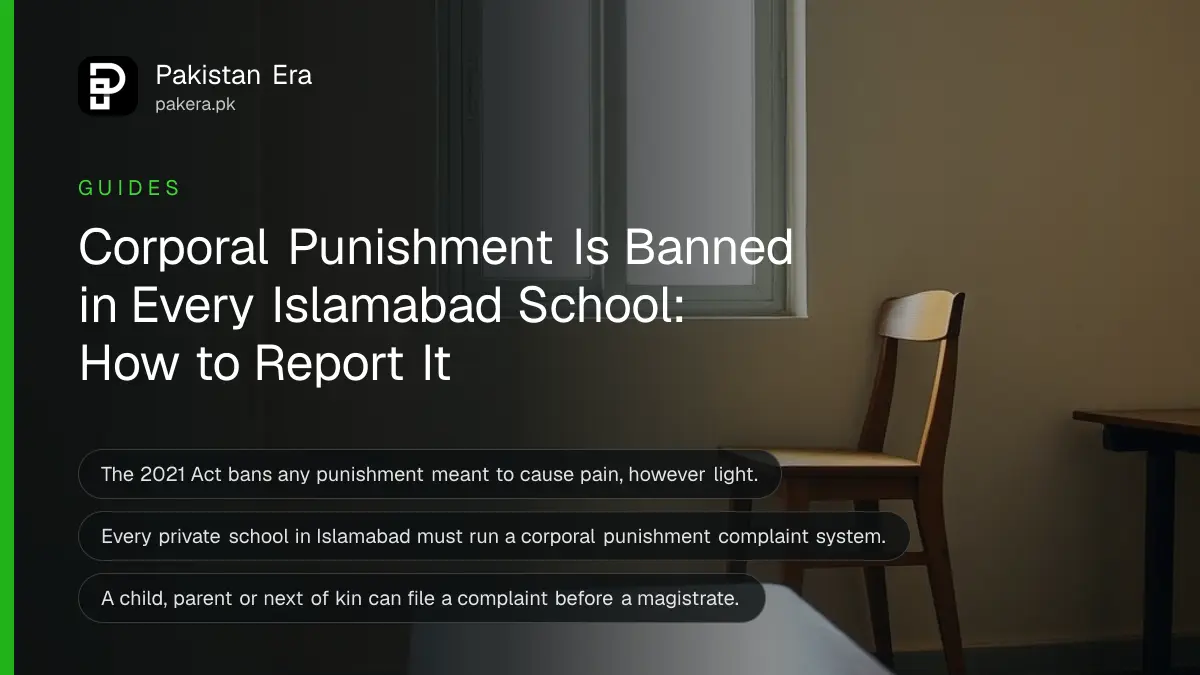
Hitting, slapping, pinching, humiliating or scaring a child is banned in every school, madrasa and care home in Islamabad under the ICT Prohibition of Corporal Punishment Act, 2021. Report it first to the school's own complaint system, then to PEIRA for a private school, and file a complaint before a magistrate if you want criminal action.
Many parents still hear that a "light slap" is part of discipline. In the Islamabad Capital Territory, the law says otherwise. The 2021 Act removes the old legal cover for punishing children, and it covers private, government and religious schools alike. Here is what counts, and where to take a complaint.
| Where it happened | Where to complain |
|---|---|
| Private school in Islamabad | School's complaint system, then PEIRA at complaints.peira.gov.pk or 051 9107746 |
| Any school, madrasa or care home | Criminal complaint before a magistrate, under Section 5 of the Act |
| Injury or assault | Police, as hurt, assault or criminal force under the Pakistan Penal Code |
| Federal government department failing to act | Wafaqi Mohtasib's children's complaints office |
The 2021 Act bans every kind of physical and humiliating punishment
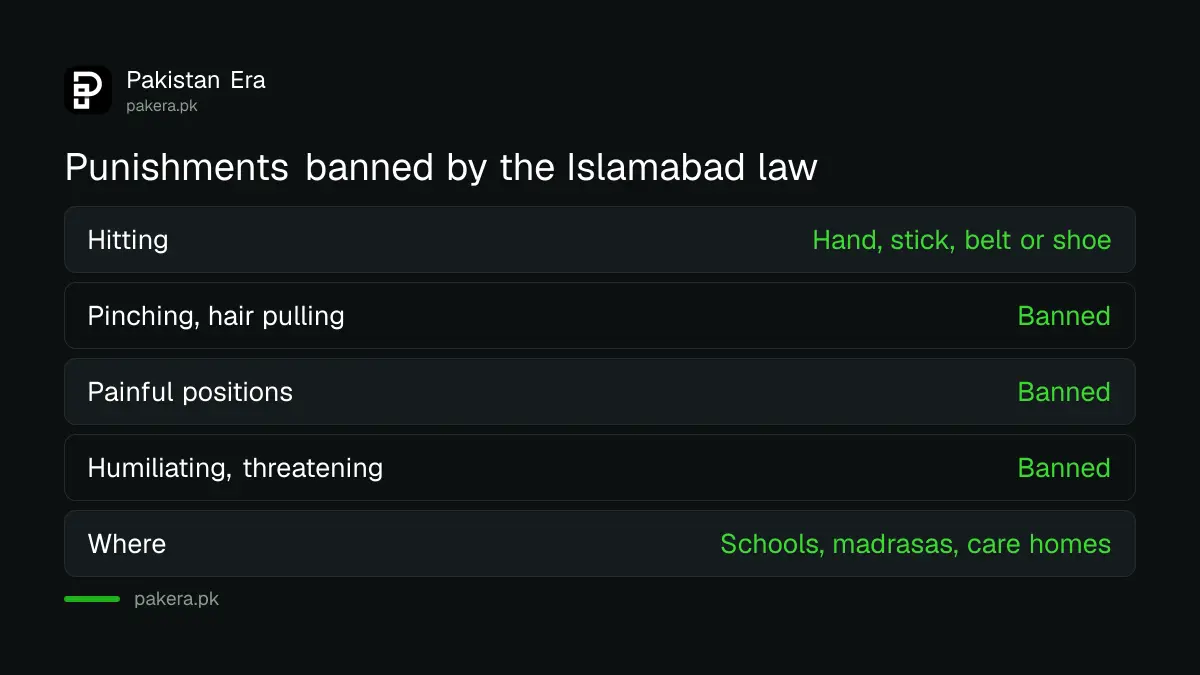
The Act defines corporal punishment as any punishment using physical force meant to cause pain or discomfort, however light. It names hitting, slapping, spanking, kicking, shaking, pinching, pulling hair, boxing ears and forcing a child into uncomfortable positions. Humiliating, threatening or ridiculing a child is covered too.
The ban applies to every person, in every type of educational institution in Islamabad: formal and non-formal, religious and secular, public and private, registered or not. It also covers child care institutions, rehabilitation centres and workplaces. A "child" is anyone under 18.
Section 3 says the ban applies notwithstanding Section 89 of the Pakistan Penal Code, the old clause on acts done in good faith for a child's benefit. Discipline must respect the child's dignity, and no punishment may harm the child's physical, mental or emotional development.
| Covered by the Act | Examples named in the law |
|---|---|
| Physical punishment | Hitting with a hand, stick, belt or shoe; kicking; shaking; pinching; pulling hair; boxing ears |
| Painful positions | Forcing a child to stay in uncomfortable positions |
| Forced ingestion | Washing the mouth with soap, forcing hot spices |
| Non-physical punishment | Belittling, humiliating, threatening, scaring or ridiculing |
Record what happened before you complain
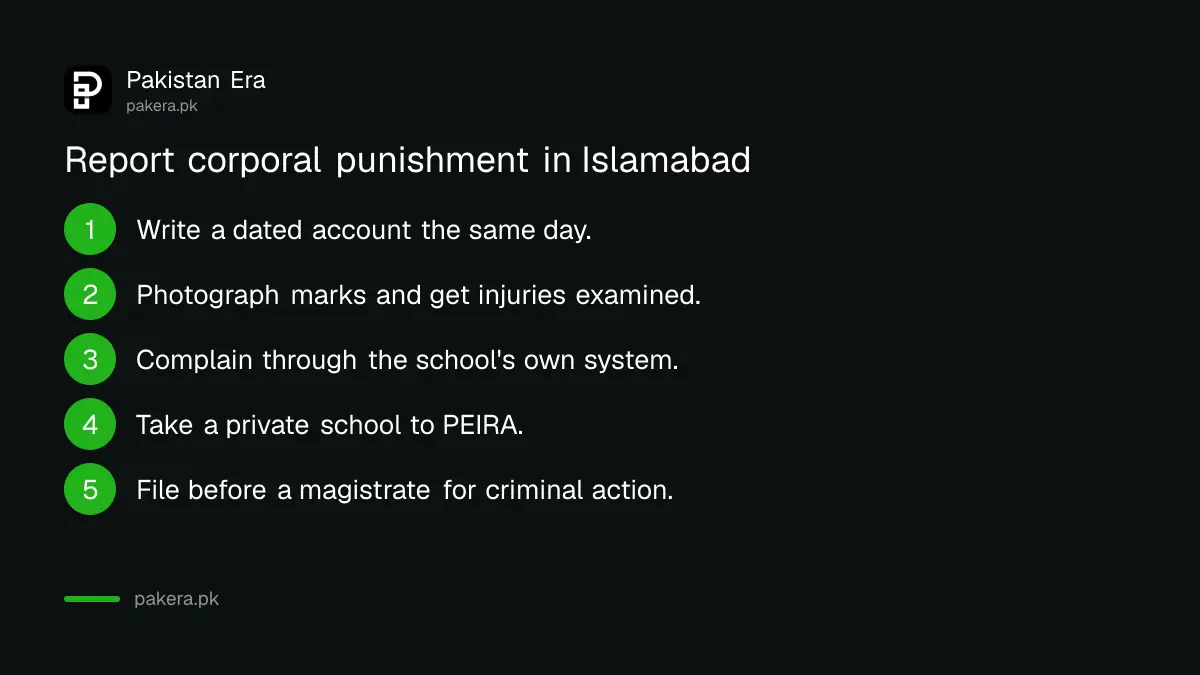
Write down the date, time, place, the teacher or staff member, what was done, and who saw it, on the same day if you can. If there is any mark or injury, get it examined and recorded at a government hospital and photograph it. Keep the child's own words in writing.
- Write a dated account: what happened, when, where, who did it and who saw it.
- Photograph any marks the same day, and again a day later.
- Get any injury examined and recorded at a government hospital.
- Note the names of other children or staff who saw it.
- Save any messages from the school about the incident.
Talk to the child calmly and do not push for details on camera. A short, clear written account in the parent's words is enough to start a complaint.
Every private school must run its own complaint system
Section 6 of the Act requires every private institution to set up a complaint system for corporal punishment. At registration, the school must give a written undertaking to do so, or it risks cancellation of its registration. Ask the school for its complaint procedure in writing.
Submit your written complaint to the principal through that system and keep a stamped copy. A school that has no complaint system at all is itself breaking Section 6, and that is worth adding to any complaint you take further.
Take a private school to PEIRA if it does not act
The Private Educational Institutions Regulatory Authority (PEIRA) runs a complaint portal for private schools in Islamabad. It lists misconduct, harassment and policy violations among the issues it takes. Register as "Parent / General Public", describe the incident and attach your evidence.
| PEIRA contact | Detail |
|---|---|
| Complaint portal | complaints.peira.gov.pk |
| Complaints email | complaints_cell@peira.gov.pk |
| Complaints cell phone | 051 9107746 |
| Member Academics | 051 9107747 |
PEIRA says the system keeps the complainant's identity confidential. The same portal handles fee disputes; the details are in the guide to complain about a private school fee in Islamabad. For a school building you think is unsafe, see how to report an unsafe school building.
A magistrate can take criminal action on your complaint
Section 5 says a magistrate's court takes cognizance of an offence under the Act on a complaint by the child, the parent or the next of kin. Section 4 adds the Pakistan Penal Code punishments for hurt, assault or criminal force, and service penalties for staff.
The service penalties run from minor ones, such as censure or a held promotion, to major ones: demotion, compulsory retirement, removal or dismissal from service. Dismissal bars future employment; removal does not. For an injury, you can also go to the police under the Penal Code.
Where a federal government office fails to act on a complaint about a child, the Wafaqi Mohtasib's children's complaints office is the next step. If the abuse moved online, such as a video shared to shame a child, the cyberbullying law for children also applies.
Common questions
Is a light slap allowed in Islamabad schools?
No. The Act covers any punishment using physical force meant to cause pain or discomfort, however light, and names slapping directly.
Does the law cover madrasas?
Yes. It covers formal, non-formal and religious institutions, public and private, registered or unregistered, in the Islamabad Capital Territory.
Is shouting at or insulting a child covered?
Yes. The Act includes non-physical punishment that belittles, humiliates, threatens, scares or ridicules a child.
Who can file a complaint before a magistrate?
The child who was punished, the parent, or the next of kin, under Section 5.
Does this law apply in Rawalpindi or Lahore?
No. It extends to the Islamabad Capital Territory only. Other provinces have their own laws and rules.
What can happen to the teacher?
Penal Code punishments for the offence, plus service penalties from censure up to dismissal from service.
How we verified this
What we checked and where we read it.
We checked the Islamabad Capital Territory Prohibition of Corporal Punishment Act, 2021 (the passed text posted by PEIRA), Section 13(3) of the Right to Free and Compulsory Education Act, 2012, which also bars corporal punishment and mental harassment, PEIRA's Complaint Redressal System home page and PEIRA's contact page on 24 November 2026. The Act lets the government prescribe a further complaint authority for private institutions; no such notification is posted on the PEIRA site. Sources: ICT Prohibition of Corporal Punishment Act 2021 and PEIRA Complaint Redressal System.
Free on WhatsApp
Get last dates and rule changes on WhatsApp
We post new last dates, fee changes and fixes for common problems, a few short posts a day.
Follow Pakera on WhatsAppOther followers cannot see your number.
Pakera Solves It
Which online process wasted your time this week?
A portal that will not load, a form nobody explains, a complaint that went nowhere. Tell us. Every week we pick one, solve it step by step and publish the answer.
About the author
Public Services and Education Journalist
Fajr Riaz is a journalist and content writer at Pakistan Era, based in Lahore. She covers the questions people meet in everyday life in Pakistan: how a public service works, what a change in the rules means, and where to find a reliable answer.