Literacy Rate in Pakistan by Province and District: Census 2023 Figures
Pakistan's literacy rate is 60.65% in the 2023 census. See every province, the top and bottom five districts, the gender gap and 25.37 million out of school.
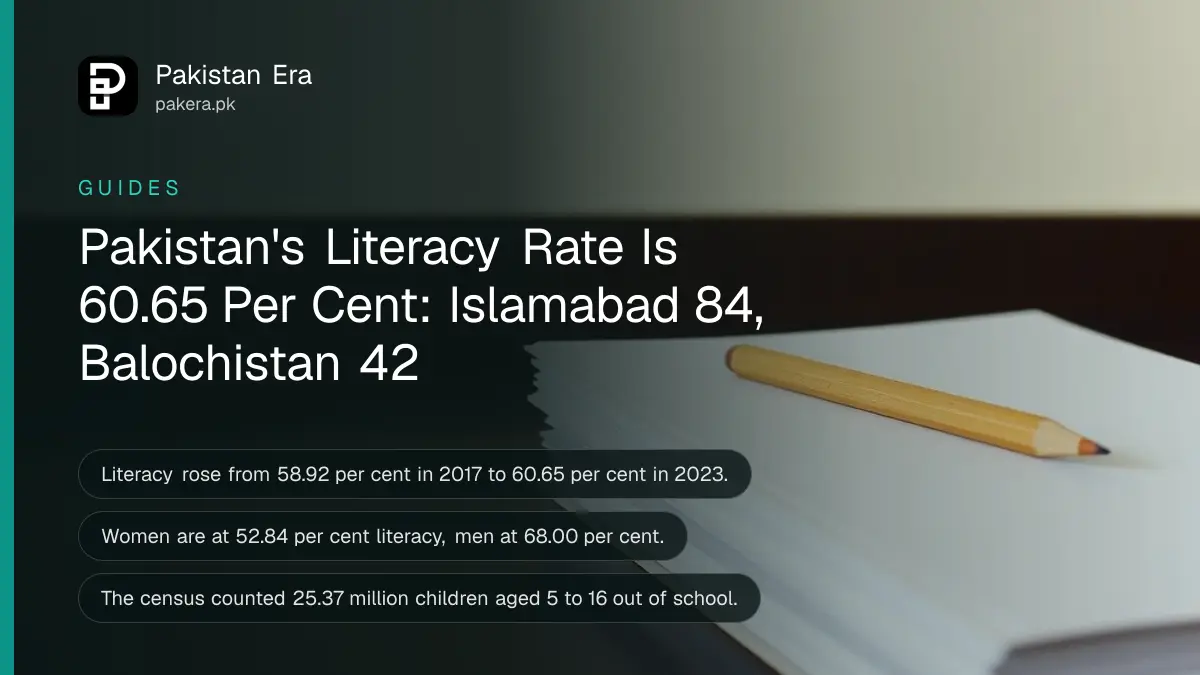
Pakistan's literacy rate is 60.65 per cent, according to the 2023 census by the Pakistan Bureau of Statistics (PBS). That is up from 58.92 per cent in 2017. Islamabad leads at 83.97 per cent, Punjab has 66.25, Sindh 57.54, Khyber Pakhtunkhwa 51.09 and Balochistan 42.01.
Put simply, about 4 in 10 Pakistanis aged 10 and above cannot read and write a simple sentence. In six years the rate rose by only 1.73 points. We went through the PBS National Census Report 2023 and set out the numbers below: province by province, the best and worst districts, the gap between men and women, and the children who are not in school.
| Area | Literacy rate, 2023 census | Urban | Rural |
|---|---|---|---|
| Pakistan | 60.65% | 74.09% | 51.56% |
| Islamabad Capital Territory | 83.97% | 82.91% | 84.88% |
| Punjab | 66.25% | 77.30% | 58.37% |
| Sindh | 57.54% | 72.26% | 38.14% |
| Khyber Pakhtunkhwa | 51.09% | 65.55% | 48.35% |
| Balochistan | 42.01% | 55.86% | 35.74% |
Pakistan's literacy rate is 60.65 per cent, up 1.73 points since 2017
The 2023 census counted 104.1 million literate people aged 10 and above, a rate of 60.65 per cent. The 2017 census put it at 58.92 per cent. Men are at 68.00 per cent and women at 52.84 per cent.
PBS counts a person as literate if they are 10 or older and can read and write a simple statement with understanding, in any language. That is a low bar. It does not mean the person finished school or can fill in a bank form alone.
| Group | 2017 census | 2023 census | Change |
|---|---|---|---|
| All | 58.92% | 60.65% | +1.73 points |
| Men | 67.79% | 68.00% | +0.21 points |
| Women | 49.69% | 52.84% | +3.15 points |
| Urban areas | 73.22% | 74.09% | +0.87 points |
| Rural areas | 50.06% | 51.56% | +1.50 points |
Women gained the most, by our arithmetic on the PBS table. Male literacy barely moved in six years.
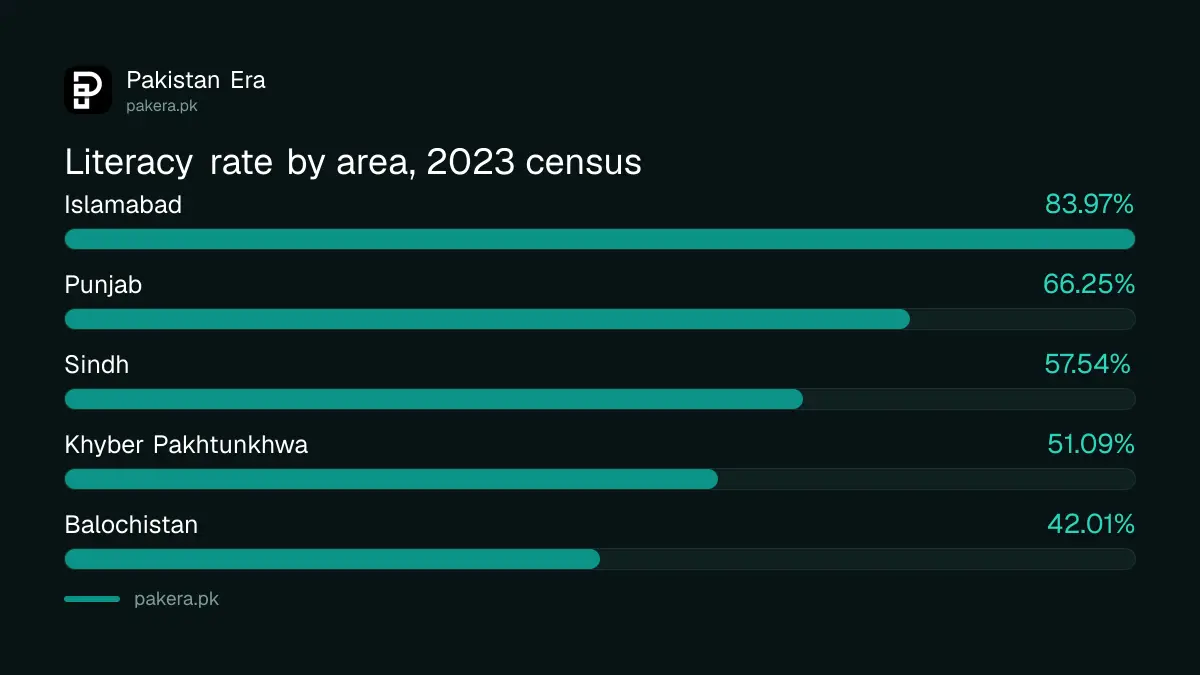
Islamabad and Punjab lead, Balochistan trails by 42 points
Islamabad has the highest literacy rate at 83.97 per cent. Balochistan has the lowest at 42.01 per cent. Punjab is the only province above the national average. Sindh, Khyber Pakhtunkhwa and Balochistan all fall below it.
The urban and rural split tells a sharper story. In rural Sindh only 38.14 per cent can read and write, against 72.26 per cent in Sindh's cities. That 34 point gap is the widest of any province. Rural Punjab, at 58.37 per cent, does better than urban Balochistan at 55.86 per cent.
The report also counts how many of Pakistan's 136 districts sit above the national average. Only 39 do. The other 97 fall below it. All 34 districts of Balochistan are below the national rate.
Five districts are above 80 per cent and five are below 24 per cent
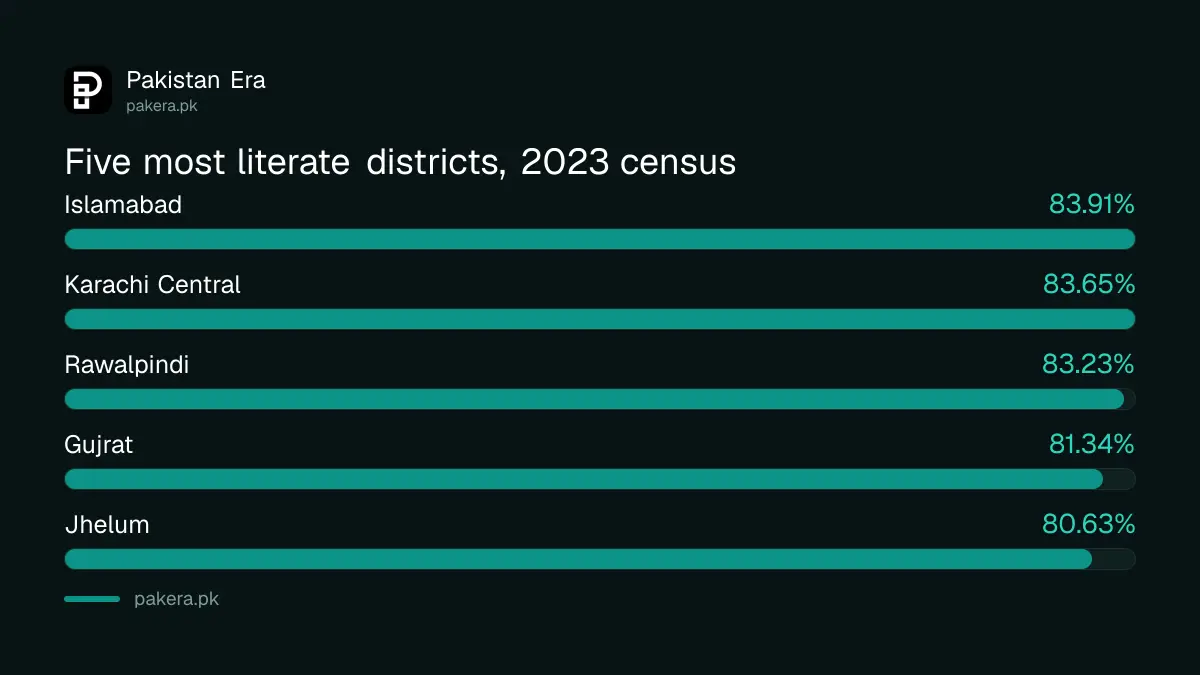
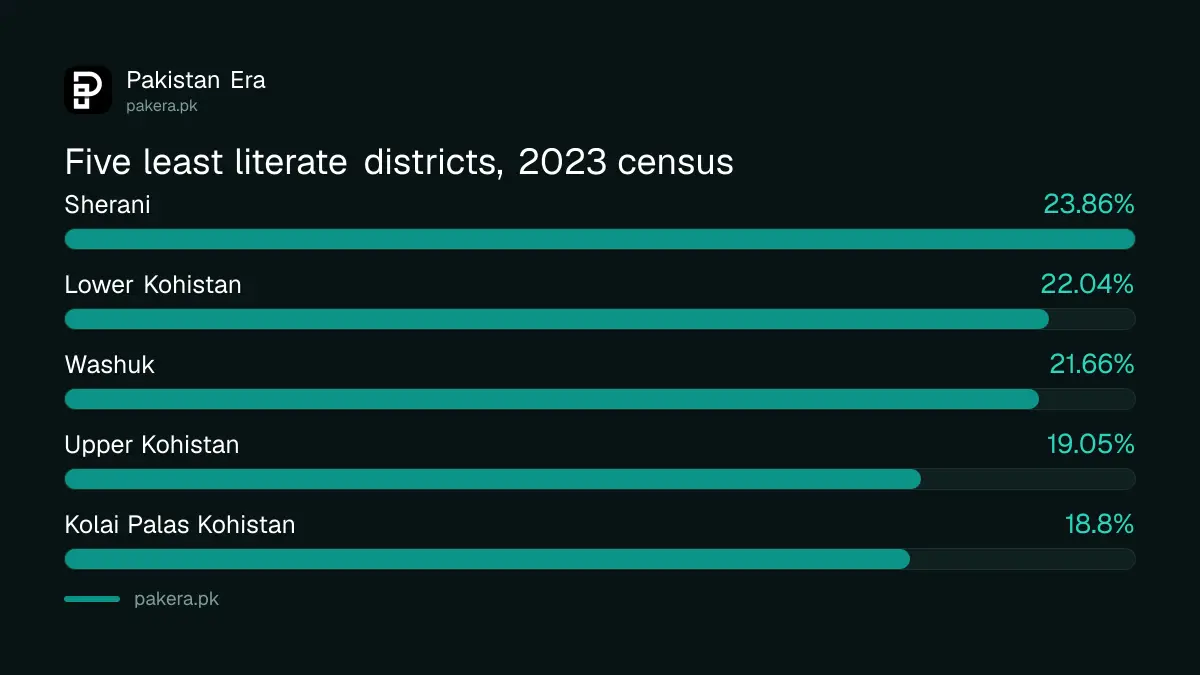
The census report names Islamabad (83.91 per cent), Karachi Central (83.65), Rawalpindi (83.23), Gujrat (81.34) and Jhelum (80.63) as the most literate districts. The least literate are Kolai Palas Kohistan (18.80), Upper Kohistan (19.05), Washuk (21.66), Lower Kohistan (22.04) and Sherani (23.86).
| Most literate districts | Rate | Least literate districts | Rate |
|---|---|---|---|
| Islamabad | 83.91% | Kolai Palas Kohistan (KP) | 18.80% |
| Karachi Central (Sindh) | 83.65% | Upper Kohistan (KP) | 19.05% |
| Rawalpindi (Punjab) | 83.23% | Washuk (Balochistan) | 21.66% |
| Gujrat (Punjab) | 81.34% | Lower Kohistan (KP) | 22.04% |
| Jhelum (Punjab) | 80.63% | Sherani (Balochistan) | 23.86% |
A child born in Rawalpindi is more than four times as likely to grow up literate as one born in Kolai Palas, by these rates. The report also lists Karachi East, Korangi, Lahore, Karachi South, Sialkot, Chakwal, Abbottabad, Gujranwala, Narowal, Haripur, Upper Chitral, Faisalabad, Toba Tek Singh, Mandi Bahauddin and Attock above 70 per cent.
The gap between men and women is widest in Khyber Pakhtunkhwa
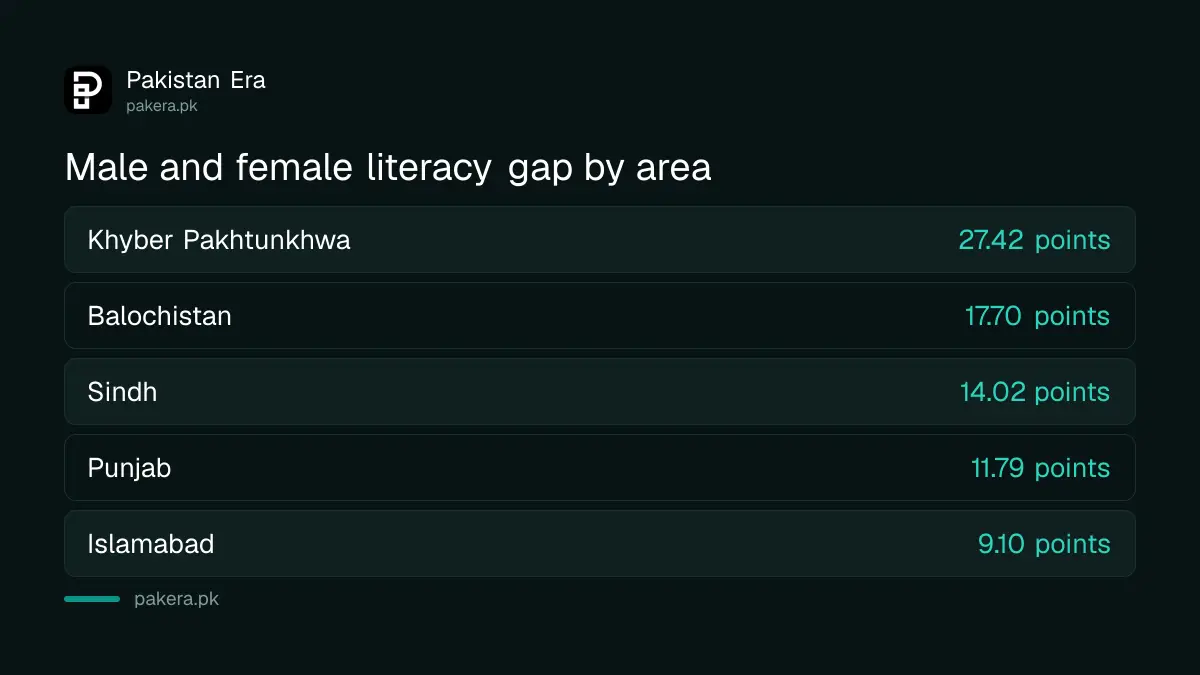
Nationally, 68.00 per cent of men and 52.84 per cent of women are literate, a gap of 16.16 points. Khyber Pakhtunkhwa has the widest gap at 27.42 points. Islamabad has the narrowest at 9.10 points.
| Province | Men | Women | Gap |
|---|---|---|---|
| Khyber Pakhtunkhwa | 64.57% | 37.15% | 27.42 points |
| Balochistan | 50.50% | 32.80% | 17.70 points |
| Sindh | 64.23% | 50.21% | 14.02 points |
| Punjab | 71.98% | 60.19% | 11.79 points |
| Islamabad | 88.23% | 79.13% | 9.10 points |
The report lists 14 districts where the gap is more than 30 points, and every one of them is in Khyber Pakhtunkhwa: Hangu, Khyber, Karak, Lakki Marwat, Kohat, Orakzai, Bannu, Torghar, Tank, Buner, Mohmand, Batagram, Upper Dir and Shangla. Rural women in Sindh are the least literate group of all, at 27.52 per cent.
25.37 million children aged 5 to 16 are out of school
The census counted 71.27 million children aged 5 to 16. Of them, 25.37 million, or 35.60 per cent, are not in school. Most of these children, 28.11 per cent of the age group, have never been to school at all. Another 7.49 per cent started and then dropped out.
These children are the literacy rate of 2033. If a third of them stay out of school, the national rate will keep crawling up by one or two points each census.
What these numbers mean for your family
For a household, the useful step is to make sure every child aged 5 to 16 is enrolled. Poor families on the BISP list can get a quarterly stipend for each child who attends school. The amounts and rules differ by programme, so compare the school stipends for poor children before you apply.
- Get your child's B-form from NADRA first, because schools and stipend schemes ask for it. The steps are in the NADRA B-form registration guide.
- Enrol the child in the nearest government school. Article 25A of the Constitution makes education free and compulsory from age 5 to 16.
- If you are on the BISP list, enrol the child in Benazir Taleemi Wazaif through the BISP office or app.
- In Khyber Pakhtunkhwa, check whether an out-of-school daughter qualifies for the KP Taaleem Card for girls.
- Keep attendance up. Stipend schemes such as Taleemi Wazaif are tied to school attendance.
For an adult in the family who cannot read, a phone with voice messages and a trusted relative for bank and NADRA forms is the practical fix today. Never sign or thumb-print a form you cannot read without someone you trust reading it out first.
Common questions
What is the literacy rate of Pakistan in the 2023 census?
It is 60.65 per cent for people aged 10 and above. Men are at 68.00 per cent and women at 52.84 per cent.
Which province has the highest literacy rate?
Punjab, at 66.25 per cent. Islamabad Capital Territory is higher at 83.97 per cent, but it is not a province.
Which district has the highest literacy rate in Pakistan?
Islamabad, at 83.91 per cent in the district list, followed by Karachi Central at 83.65 and Rawalpindi at 83.23.
Which district has the lowest literacy rate?
Kolai Palas Kohistan in Khyber Pakhtunkhwa, at 18.80 per cent. Upper Kohistan is next at 19.05 per cent.
How does PBS decide who is literate?
A person aged 10 or older who can read and write a simple statement with understanding, in any language, counts as literate.
How many children are out of school in Pakistan?
The 2023 census counted 25.37 million children aged 5 to 16 out of school, which is 35.60 per cent of that age group.
How we verified this
What we checked and where we read it.
We checked these figures on 25 November 2026 in the Pakistan Bureau of Statistics census page and its National Census Report 2023 PDF, sections 3.8 and 3.9 (Table 3.3), Table 4.20 (2017 and 2023 literacy by sex and area), Table 4.21 (literacy by administrative unit), the district ranking text under Figure 4.12, and Table 4.22 (out-of-school children). The changes between 2017 and 2023 are our own arithmetic on the PBS tables.
One small difference in the report: Islamabad is 83.97 per cent in the provincial table and 83.91 per cent in the district ranking. We use the first for the territory and the second in the district list. The report's bracket summary also places Sherani and Lower Kohistan below 20 per cent, while its ranking text gives 23.86 and 22.04 per cent; we use the ranking figures.
Free on WhatsApp
Get last dates and rule changes on WhatsApp
We post new last dates, fee changes and fixes for common problems, a few short posts a day.
Follow Pakera on WhatsAppOther followers cannot see your number.
Pakera Solves It
Which online process wasted your time this week?
A portal that will not load, a form nobody explains, a complaint that went nowhere. Tell us. Every week we pick one, solve it step by step and publish the answer.
About the author

Senior Writer, Public Services and Technology
Shahid joined us in 2024 as an author. He is a senior contributor to Pakistan's leading technology websites. He writes detailed articles, mostly covering his expertise in the latest tech, mobiles, apps, gadgets, and step-by-step guides. His ideology is to help people understand the latest trends and explain complex methods through very easy-to-understand guides.