MDI on Your Electricity Bill in Pakistan: What It Means and What to Do About a Load Extension Notice
MDI on an electricity bill in Pakistan is the month's highest load in kW. What a high MDI means, the 15 day load notice, automatic extension, the 6 month cap.
MDI on an electricity bill stands for Maximum Demand Indicator: the highest load, in kilowatts (kW), your meter recorded in the month. If that figure runs above your sanctioned load, NEPRA's Consumer Service Manual lets your electricity company send a load extension notice on the bill. On most home meters up to 8 kW, if you ignore it, the company recovers a bigger security deposit through the bill in 3 to 6 instalments and extends your load automatically.
So a high MDI is not a fine by itself. It is a signal that your home now draws more power at one time than the load written on your connection. This applies to customers of every ex-WAPDA company, including LESCO, IESCO, MEPCO, FESCO, GEPCO, PESCO, HESCO, SEPCO, QESCO and TESCO. K-Electric works under its own version of the manual.
MDI, sanctioned load and connected load are three different numbers
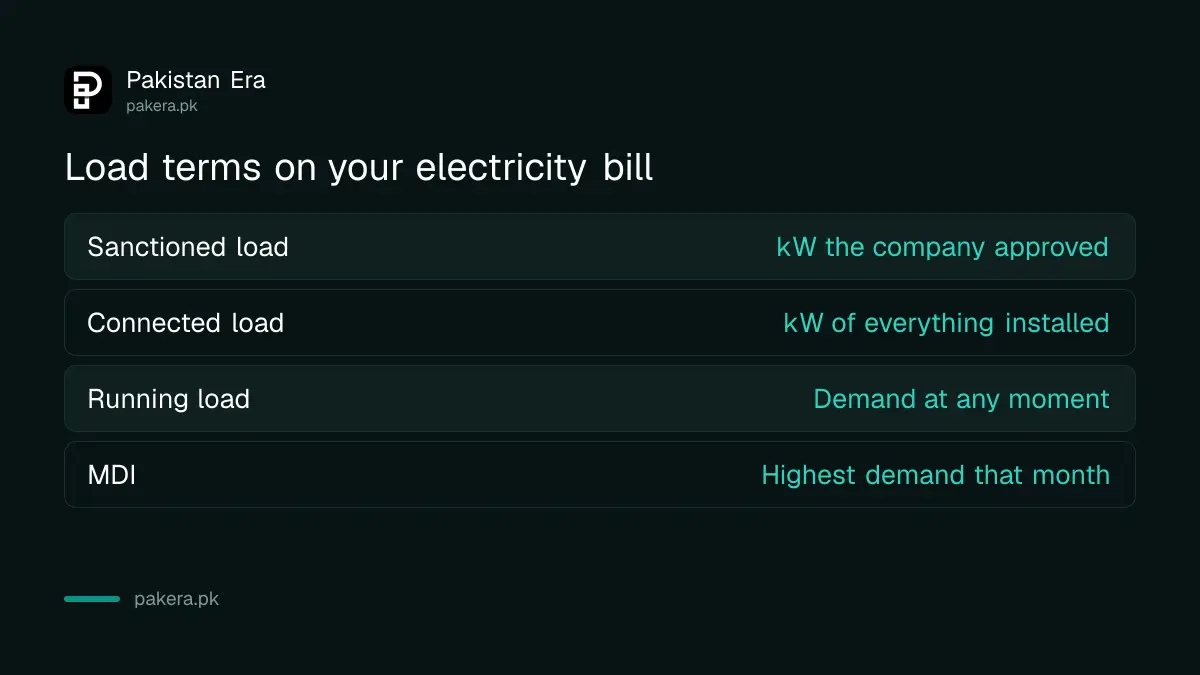
Your bill and meter carry three load figures. Sanctioned load is what the company approved for your connection. Connected load is everything installed in the premises. MDI is the highest demand the meter actually recorded. Trouble starts when MDI goes above sanctioned load.
| Term | What it means | Where it comes from |
|---|---|---|
| Sanctioned load | The load in kW your company approved | Printed on your bill and contract |
| Connected load | Total kW of everything installed at the premises | Your application and wiring test report |
| Running load | The demand in kW at any given moment | Recorded by the meter |
| MDI | The highest demand the meter recorded in the month | Read by the meter reader |
A simple example: a home sanctioned at 2 kW runs one 1.5 ton inverter AC, an electric water heater and an iron at the same time on a cold evening. The meter can record a demand well above 2 kW for that period. That peak becomes the month's MDI, even if the average use was low.
Meter readers record MDI on meters up to 8 kW
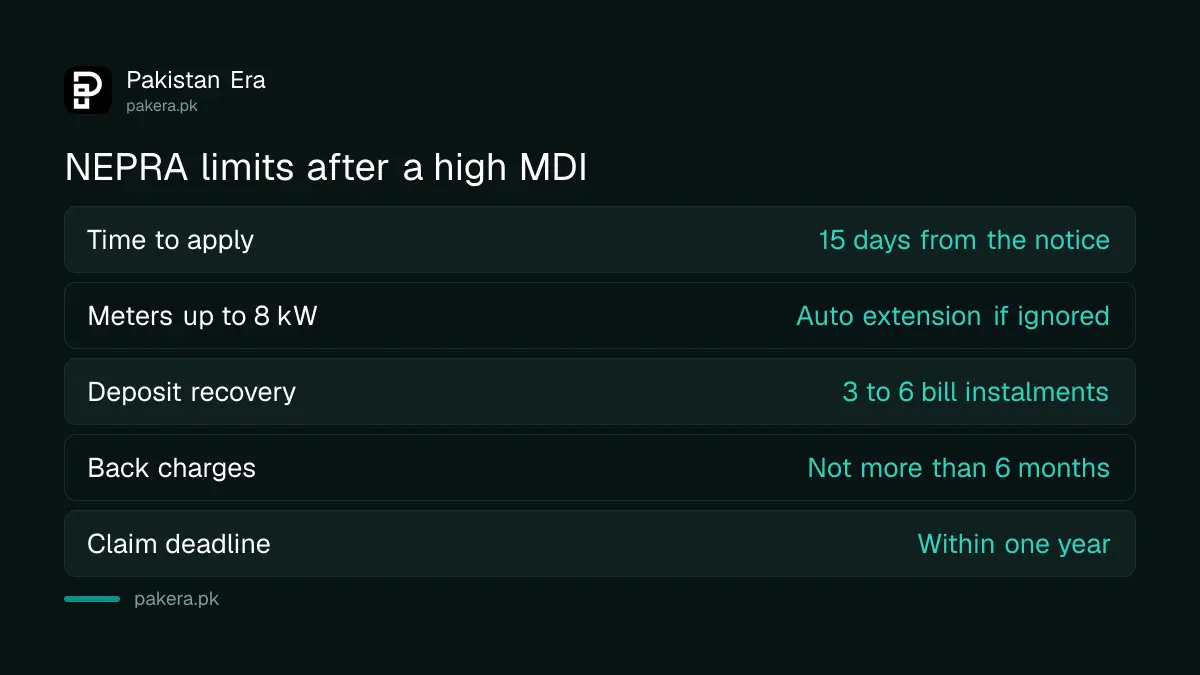
NEPRA's manual says that where static or digital meters are installed with load up to 8 kW, meter readers record the current month's MDI. If it shows an unauthorised extension of load, the company issues a notice through the electricity bill asking you to regularise the load.
If you do not respond, the manual lets the company recover the extra security deposit through your electricity bills in 3 to 6 instalments, and extend the load automatically. If a single phase meter approaches 5 kW, the company issues a notice for extension of load and installs a time of use (ToU) meter.
A ToU meter charges different rates at peak and off-peak hours. That changes how your bill is worked out, so read the electricity peak hours before the new meter arrives. The size of the deposit itself is explained in the security deposit on your electricity bill rules.
You get 15 days to apply once a notice arrives
When a consumer extends load beyond the sanctioned load, NEPRA's manual says a notice is issued to apply for extension, and the consumer must apply within 15 days of receiving it. The company may disconnect supply if the consumer does not apply and complete the formalities.
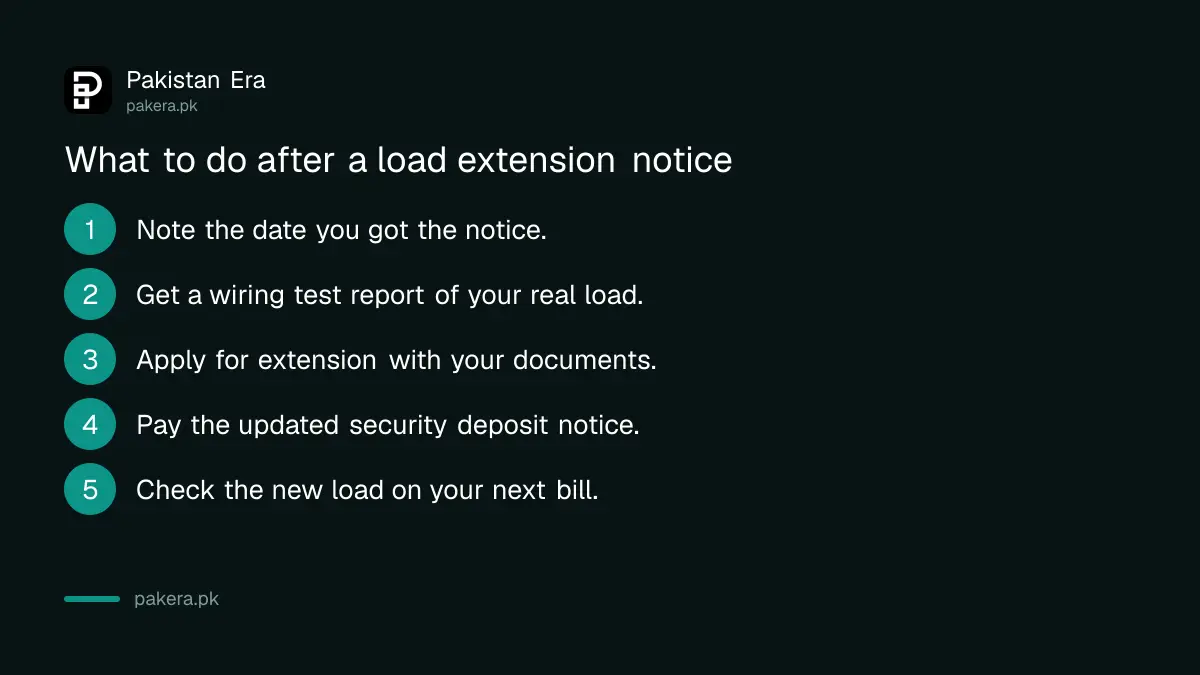
- Read the notice on your bill and note the date you received it.
- Ask a licensed wiring contractor or the Electric Inspector for a test report of your actual load.
- Apply for extension of load with the application form, test report, copy of last paid bill, attested CNIC and power supply contract.
- Pay the demand notice for the updated security deposit, and any capital cost if it applies.
- Keep the receipt and check that the next bill shows the new sanctioned load.
The full application, including the online route on the ENC portal, is set out in how to extend electricity load or get three phase. The paid bill must have no arrears, deferred amount or pending instalments, or the application will not move.
Back charges for a high MDI are capped at 6 months
If a consumer with load under 5 kW uses more, especially where fixed charges apply, the company must issue a notice and extend the load. Fixed charges and power factor penalties cannot be charged for more than 6 months back, and any such claim must be raised within one year.
The same cap covers bigger customers. If a B-1 industrial consumer's MDI goes above 25 kW, the company issues a notice to change the tariff to B-2, and the tariff difference or power factor penalty cannot go back more than 6 months. Rates for each industrial band are in the industrial electricity tariff list.
If the company missed MDI or fixed charges by its own mistake, it can still bill them later, but only within one year and for a maximum of 6 months. The bill must be labelled a supplementary bill and show the reason, amount, period and taxes. A supplementary bill without those details can be challenged.
Lower demand, or reduce the load you pay for
If the high MDI came from one unusual month, you can bring it down by not running heavy appliances together. If your home really uses less than the sanctioned load, NEPRA's manual allows a reduction of load to any lower limit shown by the test report, and the deposit difference is refunded.
- Run the electric geyser, iron, washing machine and water motor at different times.
- Do not run two large air conditioners and an electric heater together.
- Switch heavy loads off before the evening peak if you are on a ToU meter.
- Keep the test report: it is the document that sets your load either way.
Common questions
What is MDI on an electricity bill?
Maximum Demand Indicator. It is the highest load in kW your meter recorded during the month.
Is a high MDI a fine?
No. It can lead to a load extension notice, a higher security deposit and, on bigger connections, a tariff change, but it is not a penalty on its own.
How long do I have to respond to a load extension notice?
NEPRA's manual gives 15 days from receiving the notice to apply for extension of load.
Can the company extend my load without asking?
On static or digital meters up to 8 kW, yes, if you do not respond. It recovers the deposit through the bill in 3 to 6 instalments.
How far back can extra charges go after a high MDI?
No more than 6 months, and the claim must be raised within one year.
Can I reduce my sanctioned load?
Yes. Apply with a test report showing the lower load. The security deposit is updated and the difference refunded.
How we verified this
What we checked and where we read it.
We checked these rules on 15 November 2026 in the NEPRA Consumer Service Manual, November 2025 edition, published on LESCO's website. MDI recording and automatic extension on meters up to 8 kW are in clause 2.14, the documents for extension or reduction in clause 2.14(4), the 15 day notice in clause 8.2.10, the 6 month cap in clauses 7.5.3 and 7.5.5, and the deposit refund on reduction in clause 5.2.4. Definitions of connected, running and sanctioned load are in chapter 1. The manual's definition entry for MDI is printed as a heading only, so the meaning above follows how the manual uses the term. K-Electric publishes its own manual on ke.com.pk.
About the author

Tax, Bills and Technology Writer
Ali Akhtar is a young and curious voice here at Pakistan Era. He is currently pursuing his A-Levels and has a growing interest in Pakistan’s changing industrial landscape and educational trends. Ali likes to write in a way that helps him explain and explore the world around him. His writing reflects the perspective of the new generation navigating the evolving trends of Pakistan where technology, youth innovation, and shifting opportunities are reshaping the country’s future.