Tax-Free Income in Pakistan: 14 Kinds of Income the Income Tax Ordinance Exempts, and the Conditions
Tax-free income in Pakistan: agricultural income, scholarships, provident fund, gratuity, pension at 70 and returning expat foreign income, with each condition.
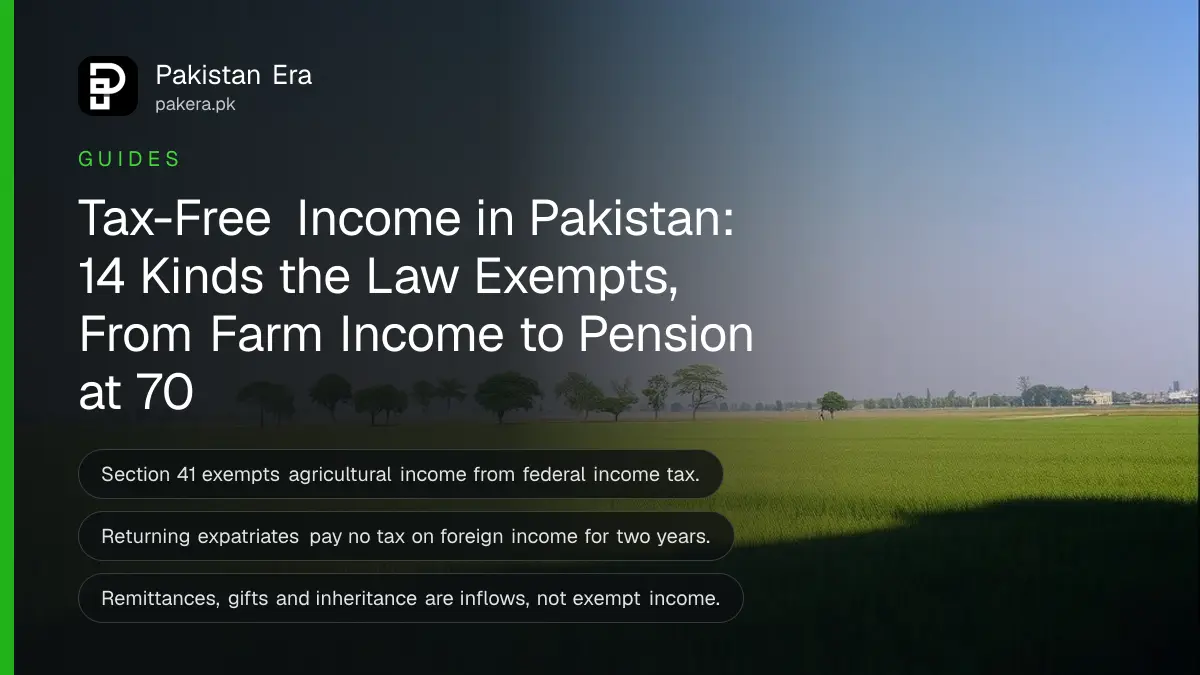
Pakistan's Income Tax Ordinance, 2001 exempts 14 common kinds of personal income from federal income tax. They include agricultural income, education scholarships, provident fund balances, government and approved-fund gratuity, pension for people aged 70 and above, and foreign income for two years after an expatriate returns. Each has conditions, and most still belong in your tax return as exempt income.
Exemptions sit in two places: sections 41 to 51 of the Ordinance, and Part I of the Second Schedule. Below is the list for individuals, the condition attached to each, and how to show it so your wealth statement still balances.
The 14 kinds of tax-free income for individuals
These exemptions cover income from land, study, awards, separation, foreign work, retirement and some salary benefits. Some are full, such as a recognised provident fund. Others have a cap or a condition, such as gratuity limits or a two-year window for returning expatriates.
| Income | Condition | Law |
|---|---|---|
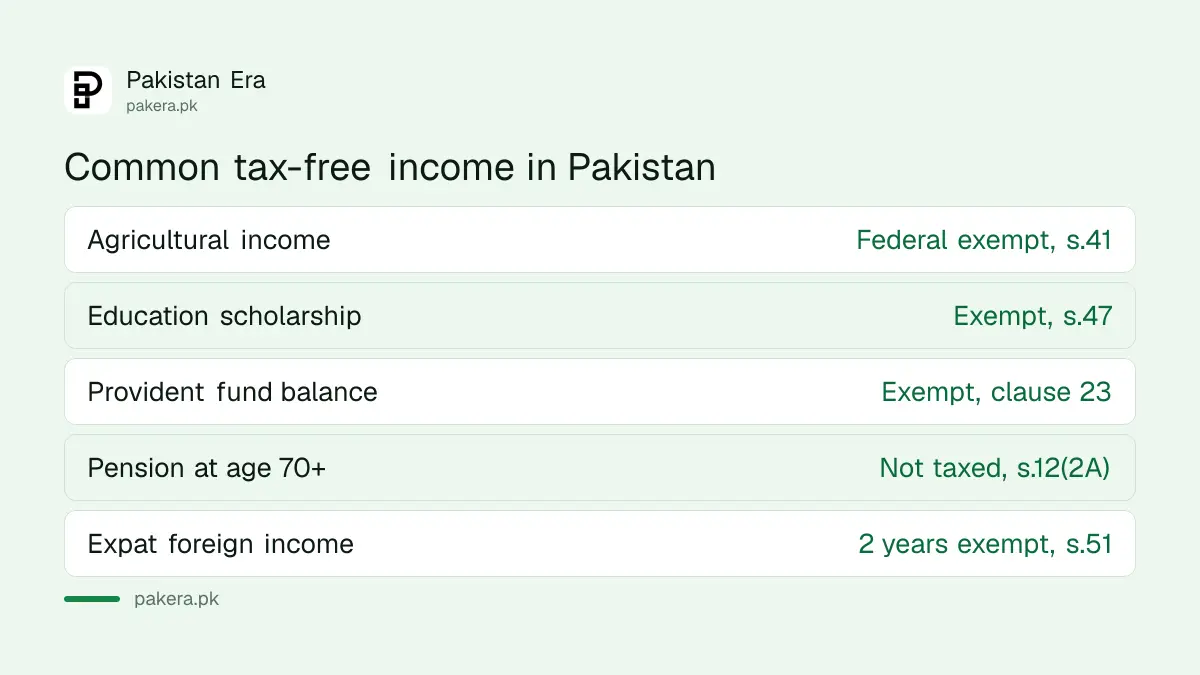
| Agricultural income | From land in Pakistan used for farming. Provinces tax it separately | Section 41 |
| Scholarship | Granted to meet the cost of your education, not paid by an associate | Section 47 |
| President's honours and awards | Allowances with an honour, award or medal, and money awards from the President | Section 45 |
| Support payments | Received by a spouse under an agreement to live apart | Section 48 |
| Foreign income of a returning expatriate | Citizen non-resident in all four previous tax years. Year of return and next year | Section 51(1) |
| Salary earned abroad in the year you leave | Citizen who leaves Pakistan and stays abroad that tax year | Section 51(2) |
| Foreign income of a short-term resident | Resident only because of a job, in Pakistan up to three years, income not brought in | Section 50 |
| Pension at 70 and above | Not charged to tax at all | Section 12(2A) |
| Recognised provident fund balance | Accumulated balance paid to the employee | Clause (23), Second Schedule |
| Gratuity | Full for government staff and approved funds, otherwise capped | Clause (13) |
| Commutation of pension | From government or an FBR-approved scheme | Clause (12) |
| Medical allowance | Up to 10% of basic salary, if no free treatment is given | Clause (139) |
| Leave encashment before retirement | Government and armed forces employees | Clause (19) |
| Benevolent grant | Paid from the federal employees' Benevolent Fund | Clause (24) |
Agricultural income is exempt from federal tax only
Section 41 exempts agricultural income from federal income tax. That covers rent or revenue from farmland in Pakistan and income from farming it. But provinces levy their own agricultural income tax, so a farmer may still owe tax to the province and file a provincial return.
In Punjab that tax is collected under provincial law, and the Punjab agricultural income tax guide sets out the rates. Income from a farm business that is not "agricultural income", such as a processing unit, is not covered by section 41.
Scholarships, awards and support payments are tax free
Section 47 exempts any scholarship given to meet the cost of your education. The exemption is lost if the scholarship is paid, directly or indirectly, by an associate, such as your own company or a close relative's business. Section 45 exempts President's awards. Section 48 exempts separation support payments.
A scholarship that is really salary, for example a stipend tied to working for the payer, is a matter of facts. If the payment is for your education costs and comes from an unrelated body, such as a university or a foreign government, it falls under section 47.
Returning expatriates get two tax-free years on foreign income
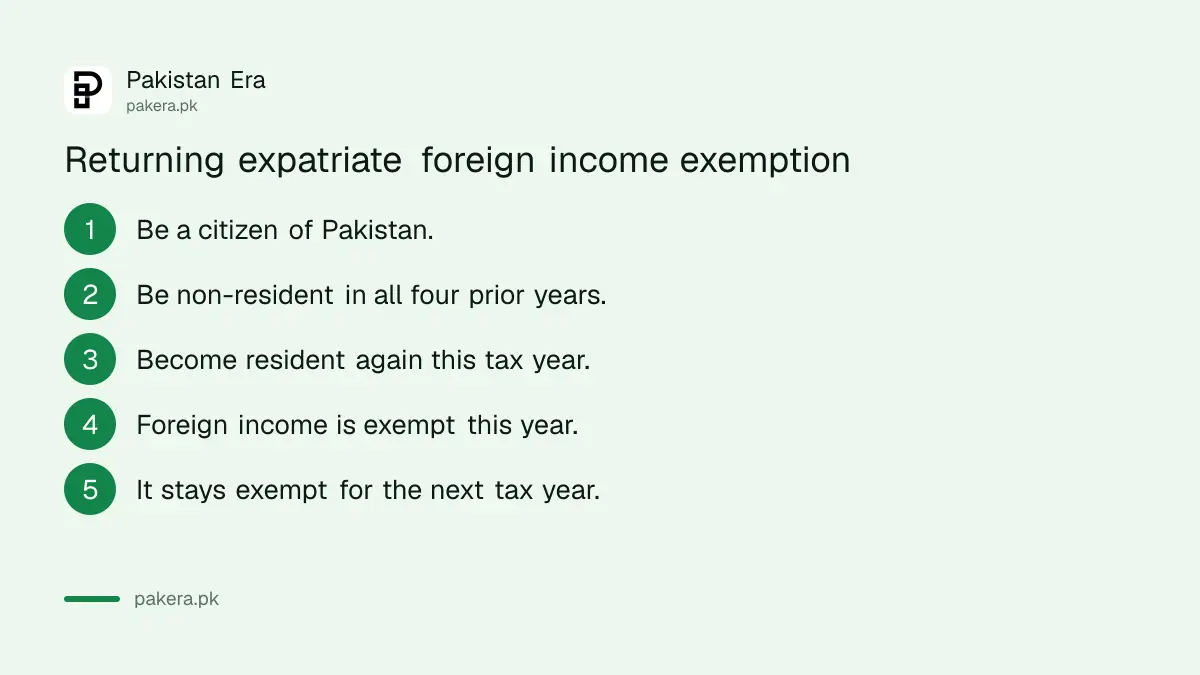
Section 51(1) exempts foreign-source income of a Pakistani citizen who was not resident in any of the four tax years before becoming resident again. The exemption covers the tax year of return and the next tax year. Pakistani-source income is taxed as normal.
Example: you worked in Saudi Arabia from 2019 and were non-resident every year. You move back in tax year 2027. Rent from a flat you still own in Riyadh is exempt in tax years 2027 and 2028. Rent from a shop in Lahore is taxed.
Section 51(2) covers the other direction. If you leave Pakistan during a tax year and stay abroad for the rest of it, salary you earn abroad in that year is exempt. Moving home goods? The transfer of residence rules for returning Pakistanis cover customs. Foreign assets still go in the foreign assets statement under section 116A.
Retirement money is mostly exempt
A recognised provident fund balance, commutation of pension from government or an approved scheme, and government or approved-fund gratuity are all exempt. Pension is not charged to tax once you reach 70. Below 70, pension from a former employer above Rs 10 million a year is taxed.
Gratuity from a private employer without an approved fund is only partly exempt: up to Rs 300,000 under an FBR-approved scheme for all employees, otherwise 50% of the amount or Rs 75,000, whichever is less. A second gratuity from any employer is not exempt. For pension details, see how pensioners file a tax return.
What is not tax-free income, even if people say it is
Foreign remittances, gifts and inheritance are not "exempt income" in the Second Schedule. Remittances are money received, not income. The law protects up to Rs 5 million a year in remittances from being treated as unexplained income under section 111(4), with a bank certificate.
That difference matters when you fill in the wealth statement. Remittances, gifts and inheritance are shown as inflows that explain your assets, not as exempt income. The Rs 5 million remittance rule and the rules on gifts from relatives explain each one.
How to show exempt income in your return
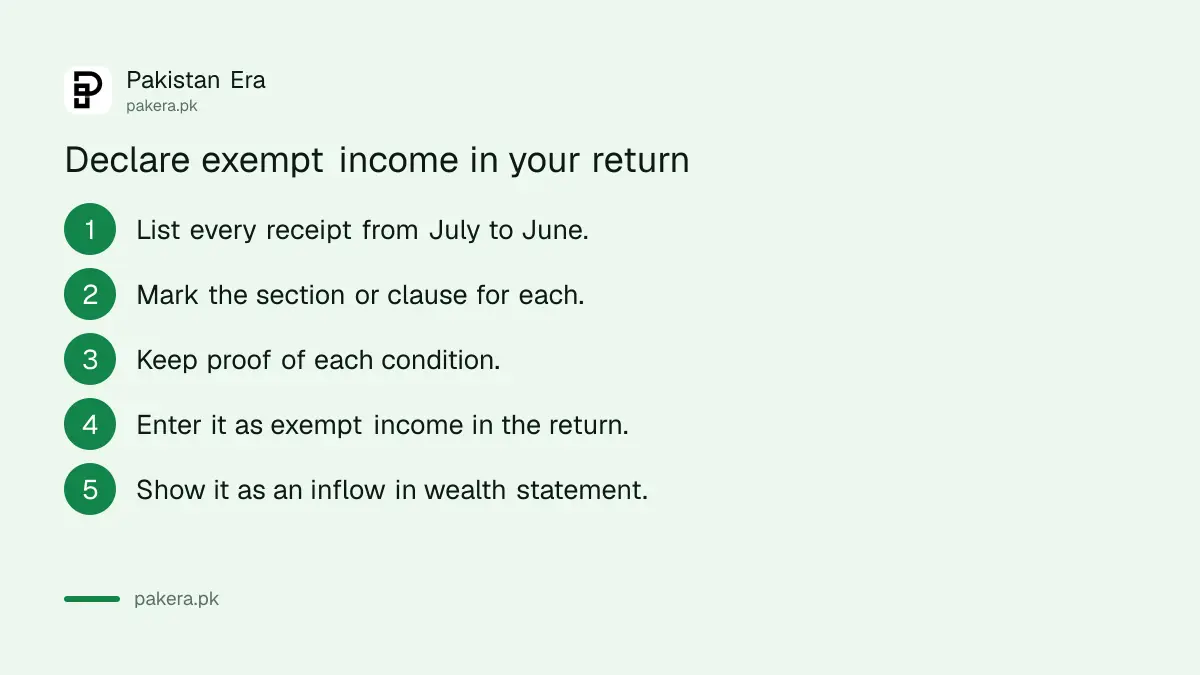
Exempt income still goes in your return, so FBR can see where your money came from. Enter it under exempt income, keep proof of the condition you rely on, and make sure it appears as an inflow in your wealth statement reconciliation.
- List every receipt in the tax year, July to June.
- Mark which ones meet a condition in the table above, and note the section or clause.
- Gather proof: the scholarship letter, provident fund statement, gratuity letter, passport stamps or residency proof for the expatriate exemption.
- Enter taxable income in its normal head and exempt income in the exempt section of the return.
- Show the same amounts as inflows in the wealth statement, so your closing assets match. The wealth statement guide shows where each goes.
Common questions
Is agricultural income taxable in Pakistan?
Not under federal income tax, because section 41 exempts it. Provinces charge their own agricultural income tax on it.
Is a scholarship taxable in Pakistan?
No, if it meets the cost of your education and is not paid by an associate, under section 47.
Do returning overseas Pakistanis pay tax on foreign income?
Not for the year of return and the next year, if they were non-resident in each of the four previous tax years.
Is pension taxable after age 70?
No. Section 12(2A) says an individual who has reached 70 is not charged to tax on pension income.
Are foreign remittances tax-free income?
They are not income at all. Up to Rs 5 million a year through banks cannot be treated as unexplained income under section 111(4).
Do I need to declare exempt income in my return?
Yes. Show it as exempt income and as an inflow in the wealth statement, so your assets are explained.
How we verified this
What we checked and where we read it.
We checked sections 12(2A), 41, 45, 47, 48, 50, 51 and 111(4), and clauses (12), (13), (19), (23), (24) and (139) of Part I of the Second Schedule, in the Income Tax Ordinance, 2001 amended up to 30 June 2026 on FBR's download server, on 15 November 2026. The Finance Act, 2025 removed the old general pension exemption in clause (8) and replaced it with the age 70 and Rs 10 million rules in section 12(2A). The examples are our own.
About the author

Tax, Bills and Technology Writer
Ali Akhtar is a young and curious voice here at Pakistan Era. He is currently pursuing his A-Levels and has a growing interest in Pakistan’s changing industrial landscape and educational trends. Ali likes to write in a way that helps him explain and explore the world around him. His writing reflects the perspective of the new generation navigating the evolving trends of Pakistan where technology, youth innovation, and shifting opportunities are reshaping the country’s future.