Agricultural Income Tax in Punjab 2026-27: Who Pays, Rates and How to File
Punjab taxes farm income, not FBR. You pay the greater of a land tax and an income tax. See who files, what you can deduct and the penalties for default.
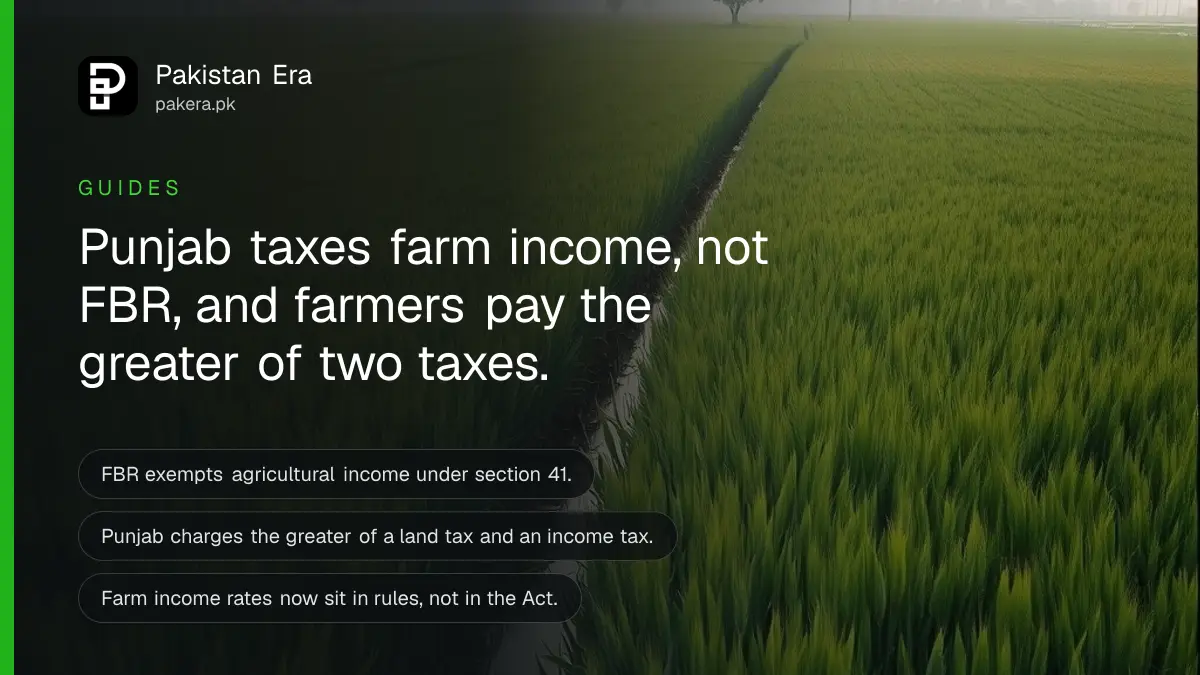
Punjab charges its own tax on farm income, under the Punjab Agricultural Income Tax Act 1997, and the Board of Revenue's Collector assesses it. FBR does not tax that income. The amount you pay is whichever is greater of a tax on your cultivated land and a tax on your farm income, at rates set by rules.
The rates are the unsettled part. We read the law on the Punjab Assembly's own legal database and found it no longer prints any rate. The figures farmers talk about come from notifications we could not open, so we mark them as reported below.
This page covers who pays, how the two taxes work, what you can deduct, how to register and what happens if you do not file. Money schemes for farmers sit in the six Punjab schemes for farmers.
Farm income is taxed by Punjab, not by FBR
Section 41 of the federal Income Tax Ordinance exempts agricultural income from federal income tax. Punjab taxes it instead. The provincial Act covers rent or revenue from land in Punjab used for agriculture, income from farming it, and income from a farm building on or near that land.
Livestock income is out. The 2024 amendment briefly brought income from livestock into the definition and its costs into the deductions. The Punjab Agricultural Income Tax (Amendment) Act 2025, which came into force on 5 August 2025, omitted both.
You pay the higher of two taxes
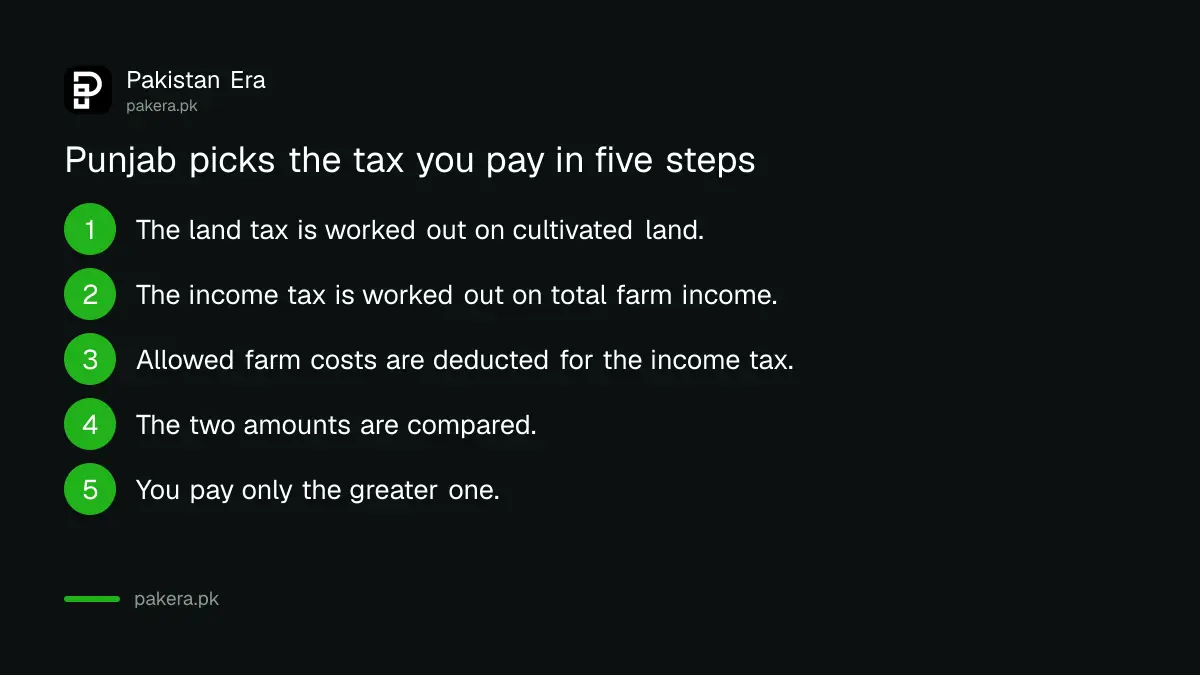
Section 3 sets two charges. One is a tax on the owner's cultivated land, where the land itself is treated as the income. The other is a tax on total agricultural income. Section 3(4) says you pay only one of them, whichever is greater.
| Charge | What it is based on | Section |
|---|---|---|
| Land tax | Cultivated land in the tax year, treated as income | 3(1) |
| Income tax | Total agricultural income after allowed deductions | 3(3) |
| What you pay | The greater of the two, never both | 3(4) |
Cultivated land means land sown at least once in the tax year, plus a fruiting orchard. Planted forest and forest nursery land do not count.
The rates are set by rules, and the 2026 position is disputed
The Act used to print the rates in two schedules. The 2024 amendment removed both and replaced them with the words "as may be prescribed". So the rates now sit in rules and notifications, not in the Act you can read. Section 11 adds that any change in the rates must be laid before the Provincial Assembly with the annual budget.
The old land schedule, which the Act's footnote still prints, charged nothing up to 12.5 acres, then Rs 300, Rs 400 and Rs 500 an acre in higher bands. It has been omitted.
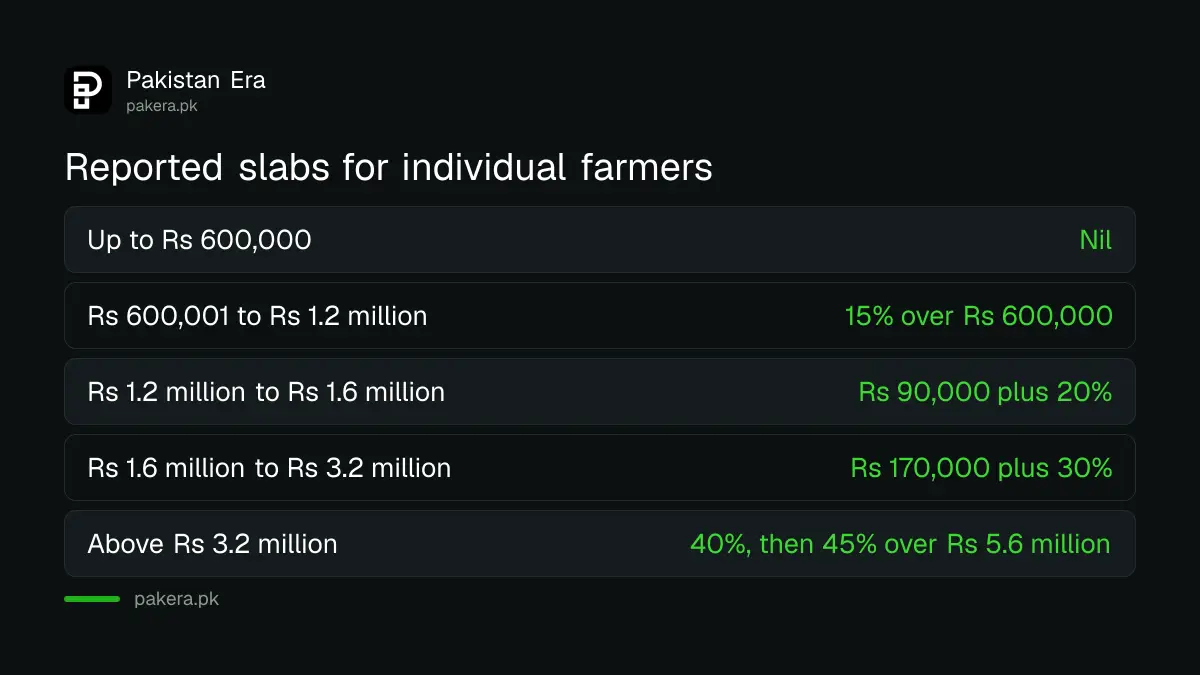
Current income slabs were reported after two Punjab notifications of March 2025. We could not open the Gazette copy, so treat these as reported, not confirmed.
| Annual agricultural income (individual), reported | Tax, reported |
|---|---|
| Up to Rs 600,000 | Nil |
| Rs 600,001 to Rs 1,200,000 | 15% of the amount over Rs 600,000 |
| Rs 1,200,001 to Rs 1,600,000 | Rs 90,000 plus 20% over Rs 1,200,000 |
| Rs 1,600,001 to Rs 3,200,000 | Rs 170,000 plus 30% over Rs 1,600,000 |
| Rs 3,200,001 to Rs 5,600,000 | Rs 650,000 plus 40% over Rs 3,200,000 |
| Above Rs 5,600,000 | Rs 1,610,000 plus 45% over Rs 5,600,000 |
Companies were reported to pay 20 per cent if small and 29 per cent otherwise. In April 2026 the Punjab Assembly Speaker was reported to have ruled the revised notifications void, because they were not laid before the House at budget time. Later reports said the Assembly reinstated them. We found no official page that settles it.
Our advice is plain. Before you pay, ask the Collector or the Board of Revenue which rates apply to your tax year, and get the answer in writing.
What you can deduct from farm income
Section 4-A lists the costs you may subtract before the income tax is worked out. Labour is first, and the 2024 amendment added labour from adult family members. The list covers most of a farm's running costs.
- Labour for tilling, sowing, harvesting and marketing.
- Seed, fertilizer and pesticide.
- Hire of tractors and machinery, and repair of watercourses.
- Ushr, local cess, abiana (water rate) and rent of agricultural land.
- Electricity and fuel for tubewells, and agricultural loan mark-up.
- Depreciation at 15 per cent of written down value.
Keep bills. Each deduction needs a record behind it.
Who must file a return and how to register
Section 4(3) requires a return from anyone whose total agricultural income exceeds the maximum amount not chargeable to tax. The old test based on 50 acres of irrigated land was removed in 2024, so the income limit now decides. If your land sits in more than one patwar circle, you must also file a statement showing where it is.
The Board of Revenue runs an online portal at ait.punjab.gov.pk, titled the Agriculture Income Tax Filing Portal. We opened it and read the routes in its page code. It has farmer registration, login and OTP verification pages. We did not create an account, so we cannot describe the form fields.
- Collect your land details. A fard of your land in Punjab shows the ownership and area.
- Add up your farm income for the tax year, which is the agricultural year under the Punjab Land Revenue Act 1967.
- Total the allowed costs from section 4-A and keep the bills.
- Register on the portal and file the return, or ask your patwari or the Collector's office how filing works in your district.
- Pay the tax through the challan the Collector's system gives you.
- Keep the receipt. It is proof of tax paid on your farm income.
The return due date is set by rules, and we could not find a date on an official page. Ask the Collector.
Why the receipt matters for your FBR return
Federal law accepts agricultural income as the explanation for unexplained money or investments. The Ordinance says the explanation is accepted only to the extent of agricultural income worked back from the agricultural income tax paid under provincial law. So the Punjab receipt is the proof.
Section 3B of the Punjab Act also ties the two systems together. If you declare agricultural income in your federal return, you pay the Punjab tax on that income at the prescribed rate. Declare the same figure in both places. When you file your income tax return and wealth statement, keep the Punjab receipt with your papers.
Penalties for late filing, concealment and late payment
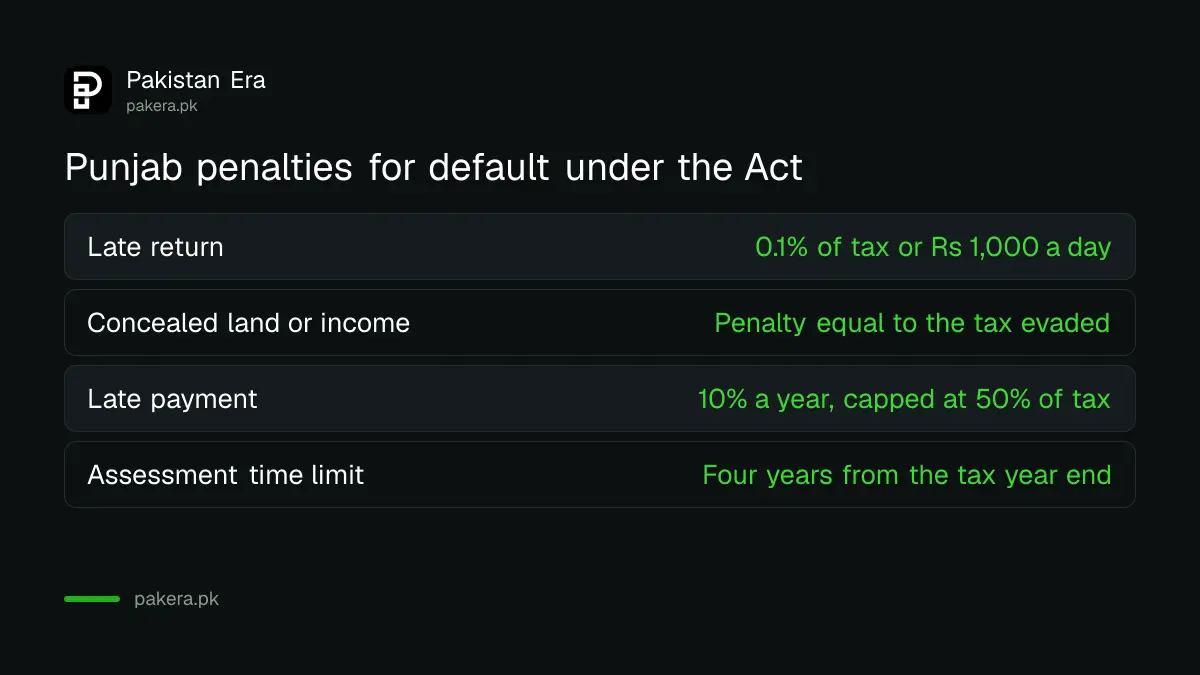
The Act has three penalties: one for a late return, one for hiding land or income, and a surcharge for late payment.
| Default | What the Act says |
|---|---|
| Late return or statement | 0.1% of the tax or Rs 1,000 for each day of default |
| Minimum for a late return | Rs 10,000 up to Rs 1.2 million income, Rs 20,000 up to Rs 40 million, Rs 50,000 above |
| Concealed land or income | A penalty equal to the tax evaded |
| Late payment | 10% a year on the tax overdue, capped at 50% of the tax |
The Collector must give you a reasonable chance to be heard first. Appeals go under the Punjab Land Revenue Act 1967. One rule catches families: if you transfer land to your wife or to an heir under 18, you stay liable for the tax until the child turns 18.
Common questions about Punjab agricultural income tax
Does FBR tax my farm income?
No. Section 41 of the Income Tax Ordinance exempts agricultural income from federal tax. Punjab taxes it under its own Act.
Do I pay both the land tax and the income tax?
No. Section 3(4) says you pay only one, whichever is greater.
Is income from livestock taxed under this Act?
Not since 5 August 2025. The 2025 amendment omitted the livestock clauses that the 2024 amendment had added.
What is the tax rate for 2026-27?
The Act no longer prints it. Reported slabs run from nil up to Rs 600,000 to 45 per cent above Rs 5.6 million, but their status was disputed in April 2026. Confirm with the Collector.
How long can the Collector go back?
Four years. Section 4(4) bars assessment on a return after four years from the end of the tax year in which the income was first assessable.
How we verified this
What we checked, where we read it, and what we could not confirm.
Last checked 7 October 2026. We read the consolidated Punjab Agricultural Income Tax Act 1997 on the Punjab Assembly's law database, including its footnotes on the 2024 and 2025 amendments, and the gazetted Punjab Agricultural Income Tax (Amendment) Act 2025. We read section 41 of the Income Tax Ordinance, 2001, amended up to 30 June 2026, on FBR's download site. We opened the Board of Revenue's AIT portal at ait.punjab.gov.pk. We could not open Notifications 147 and 148 of 2025, or any rules, so the rate slabs, the company rates and the April 2026 dispute are reported and not confirmed. The return due date is not stated for the same reason. Nothing here is tax advice.
About the author

Tax, Bills and Technology Writer
Ali Akhtar is a young and curious voice here at Pakistan Era. He is currently pursuing his A-Levels and has a growing interest in Pakistan’s changing industrial landscape and educational trends. Ali likes to write in a way that helps him explain and explore the world around him. His writing reflects the perspective of the new generation navigating the evolving trends of Pakistan where technology, youth innovation, and shifting opportunities are reshaping the country’s future.