Pakistan Railways Seeks Firms for 480 km ML-1 Karachi to Rohri Upgrade, ADB Weighs Loan
Pakistan Railways invited firms on 7 October 2026 to supervise the 480 km ML-1 Karachi to Rohri upgrade. ADB is weighing a loan, and Rs 10bn went to Thar rail.
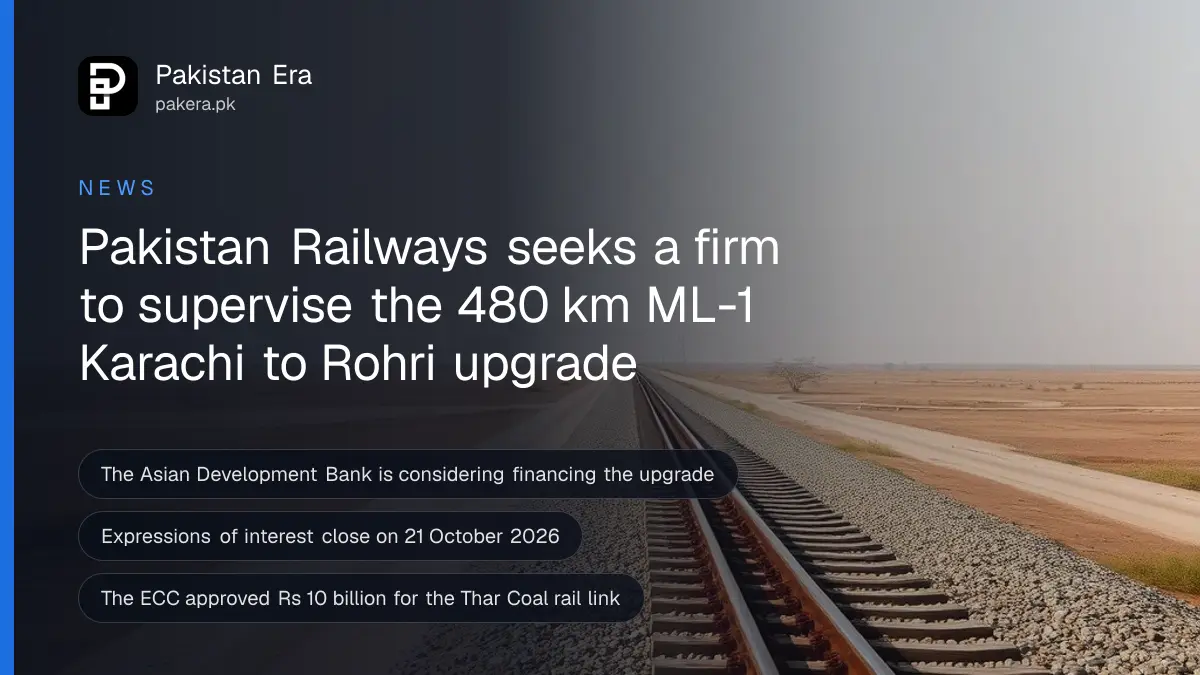
Pakistan Railways on 7 October 2026 invited consulting firms to supervise the upgrade of about 480 km of Main Line-1 between Karachi and Rohri, a project the Asian Development Bank (ADB) is considering financing. Expressions of interest close on 21 October 2026, and the supervision contract is expected to start in the first quarter of 2027 and run for 72 months.
A day later, on 8 October, the Economic Coordination Committee (ECC) of the Cabinet approved Rs 10 billion for the Ministry of Railways to fund the Thar Coal Rail Connectivity Project. We read the Pakistan Railways public notice and the ECC press release on 9 October 2026.
Main Line-1, or ML-1, is the Karachi to Peshawar trunk line. Most long-distance passenger trains in Pakistan, including the Karachi to Lahore expresses, run on it. The Karachi to Rohri stretch is its busiest southern section.
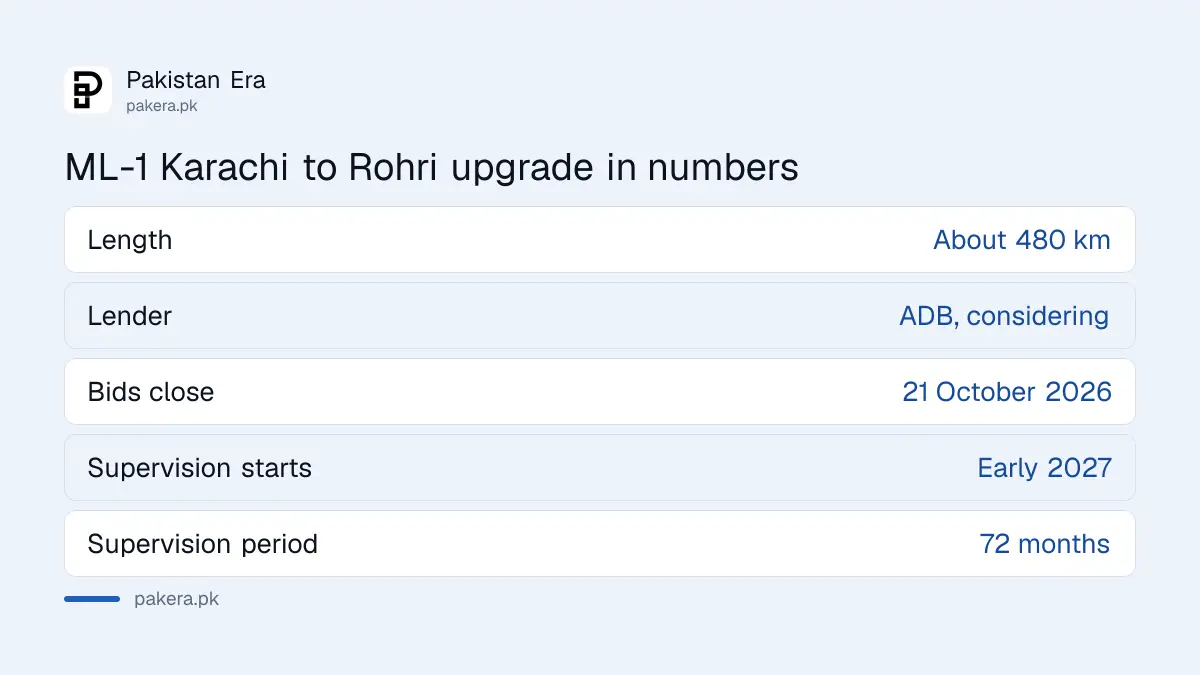
Pakistan Railways wants one firm to supervise the Karachi to Rohri works
The notice asks for one project management and construction supervision consultant for the whole 480 km section. That firm will oversee several civil and track contracts plus one signalling and telecom contract, on behalf of the ML-1 Project Implementation Unit in Lahore.
The upgrade itself covers four kinds of work, according to the notice:
- Civil and track works along about 480 km.
- Bridges and culverts.
- Stations and yards.
- Signalling and telecommunication systems.
The Ministry of Railways is the executing agency and Pakistan Railways is the implementing agency. Firms must register on ADB's Consultant Management System and submit their expression of interest there by 21 October 2026, Manila time. Shortlisted firms will be selected on quality and cost, weighted 80 to 20.
The size of the job is clear from the numbers. The notice budgets 1,262 person-months of expert time, 612 international and 650 national, over 72 months. That period covers building, the defects liability period and maintenance.
ADB is considering the loan, but it is not signed
The notice says ADB "is considering financing" the project. That means the loan is not yet approved. Hiring the supervision consultant early is normal for an ADB project, and it does not guarantee that construction will start on a fixed date.
Reports on 7 October said the Prime Minister had also ordered faster work on ML-1 and approved using commercial projects on railway land to raise bank finance for it. We could not find that decision on an official page, so treat it as reported. Pakistan Railways' own website does list a separate call for private partners to develop 25 commercial railway sites in major cities.
| Item | Detail | Status |
|---|---|---|
| Section | Karachi to Rohri, about 480 km | Confirmed in notice |
| Lender | Asian Development Bank | Considering financing |
| Expressions of interest close | 21 October 2026 | Confirmed in notice |
| Supervision starts | First quarter of 2027 | Expected |
| Supervision period | 72 months | Planned |
| Thar Coal rail link | Rs 10 billion grant | Approved by ECC, 8 October 2026 |
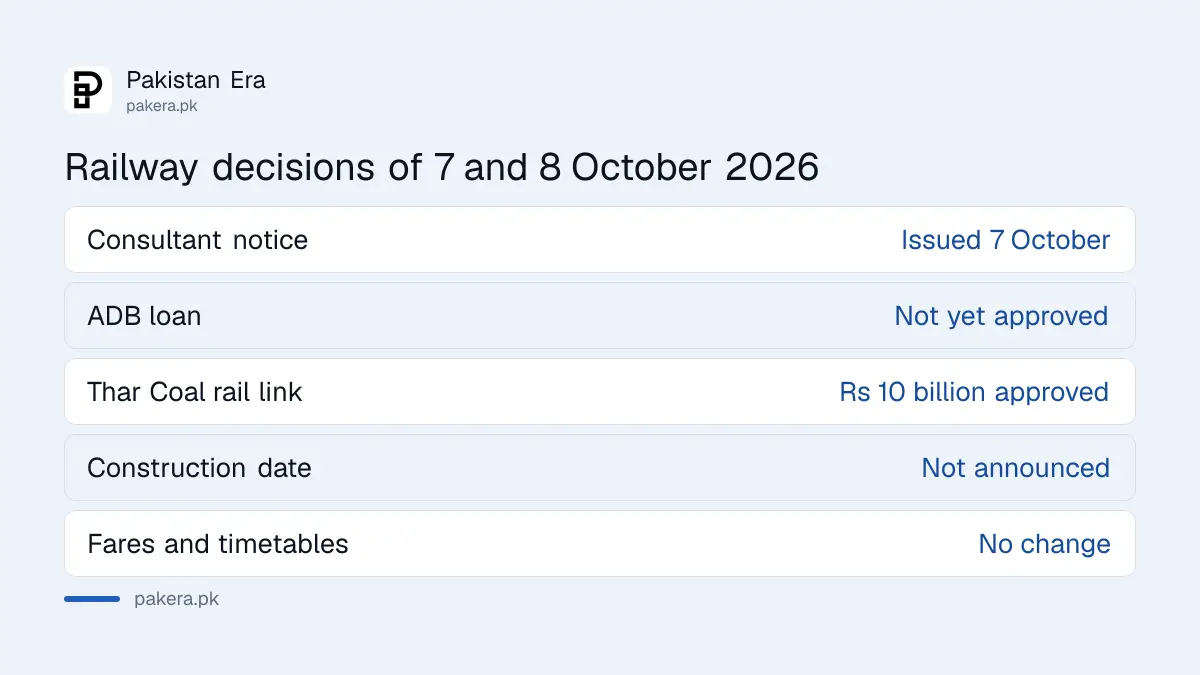
The ECC gave Rs 10 billion for the Thar Coal rail link
On 8 October the ECC approved a Technical Supplementary Grant of Rs 10.0 billion for the Ministry of Railways. The money provides budget cover for the Thar Coal Rail Connectivity Project, which will carry Thar coal by rail to power plants and other industry.
A Technical Supplementary Grant is extra money given to a ministry during the year, on top of its budget. The ECC said the link will help Pakistan use its own Thar coal for power generation. The release did not give the route, length or completion date.
What changes for passengers on the Karachi line
Nothing changes on timetables or fares now. The work will happen on a line that stays open, so once construction starts, expect slower running and some delays on the Karachi to Rohri stretch.
The notice says the consultant must manage works "under live railway operating conditions". That is the normal way to rebuild a busy line: trains keep running while one track or one bridge at a time is closed. In practice, Karachi trains may run late during the work years.
For now, check your train before you travel. You can check Pakistan Railways train timings for any delay, and check current fares on popular routes. Neither has changed because of this notice.
Our view: ML-1 has been announced, re-scoped and delayed for years. A dated tender notice with an ADB lender is a more concrete step than another speech. The loan approval is the next thing to watch.
Common questions
What is ML-1?
Main Line-1 is Pakistan Railways' main north to south line, from Karachi to Peshawar. Most long-distance passenger trains use it.
Which part of ML-1 is being upgraded first?
The Karachi to Rohri section, about 480 km, according to the Pakistan Railways notice of 7 October 2026.
Who is paying for the Karachi to Rohri upgrade?
The Asian Development Bank is considering financing it. The loan was not described as approved in the notice.
When will construction start?
No construction date was given. The supervision consultant is expected to start in the first quarter of 2027.
What did the ECC approve for railways on 8 October 2026?
Rs 10 billion for the Thar Coal Rail Connectivity Project, as a Technical Supplementary Grant to the Ministry of Railways.
How we verified this
What we checked, where we read it, and what we could not confirm.
Last checked on 9 October 2026. The ML-1 details come from the Pakistan Railways public notice dated 7 October 2026, "Invitation for Submission of Expression of Interest, Project No. 60009-001". The Thar rail grant comes from Press Information Department release 100 of 8 October 2026 on the ECC meeting. We could not confirm the reported Prime Minister's decision on ML-1 financing on an official page.
About the author

Tax, Bills and Technology Writer
Ali Akhtar is a young and curious voice here at Pakistan Era. He is currently pursuing his A-Levels and has a growing interest in Pakistan’s changing industrial landscape and educational trends. Ali likes to write in a way that helps him explain and explore the world around him. His writing reflects the perspective of the new generation navigating the evolving trends of Pakistan where technology, youth innovation, and shifting opportunities are reshaping the country’s future.