How to Apply for a New Water Connection
There is no single WASA. Which office serves you, the documents, the survey and demand notice, and why old dues attach to the property.
There is no single WASA, and that is the first thing to get right. Water and sanitation is run city by city. WASA Lahore sits under the Lahore Development Authority, and Rawalpindi, Faisalabad, Multan and Gujranwala each have their own WASA under their own development authority. Apply to the one that serves your address, not to a national body, because there is not one.
Outside the WASA cities, water supply is usually handled by the municipal committee, the tehsil administration or a cantonment board. The shape of the process is similar, but the office and the forms are not.
Water and sewerage usually travel together
People apply for water and are surprised to find sewerage charges appear on the same bill. In most WASA areas the two services are billed together, and a connection application typically covers both.
| Item | What to expect |
|---|---|
| Water supply | The connection itself, from the main to your property |
| Sewerage | Normally billed alongside water in WASA areas |
| Connection charge | Set by a demand notice after a survey |
| Property type | Domestic, commercial and industrial are priced differently |
| Road cutting | A separate cost where the main is across a road |
Ask about the sewerage position at the same time. Discovering afterwards that a property is not connected to a sewer, or that connection requires work you did not budget for, is the expensive version of this.
What the office will want from you
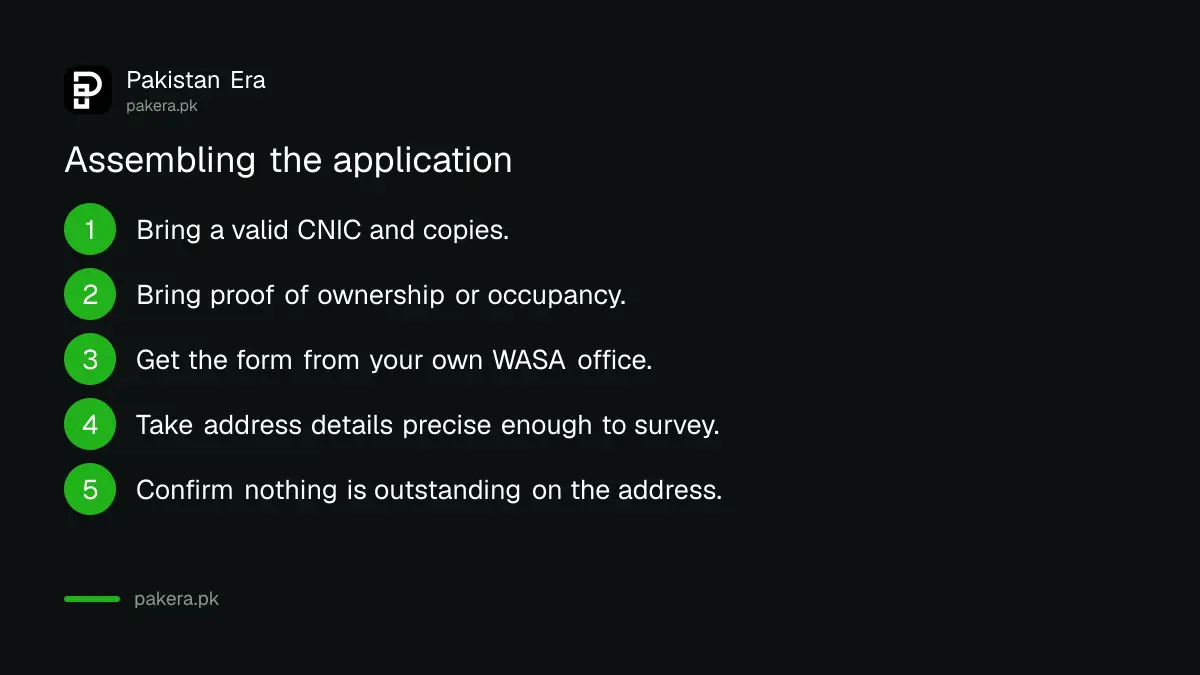
- Your CNIC, valid and not expired, with copies.
- Proof of ownership or occupancy, such as a registry, allotment letter or sale deed.
- The application form for your own WASA or municipal office.
- A site plan or address details precise enough to locate the property.
- Confirmation that nothing is outstanding against the address.
If your ownership document is a land record rather than an allotment, our guide to getting a fard in Punjab covers obtaining it. Take originals as well as copies, because counters generally want to see the original once.
The survey, then the demand notice
After the application, the office surveys the site. It checks where the main is, how far the connection has to run, what the property is used for, and whether any road cutting or restoration is needed.
That survey produces a demand notice, which is the document telling you what to pay and where. Pay it through the channel the notice names and keep the receipt. As with electricity and gas, the demand notice is the bill, and money asked for outside it is not part of the process.
We are not quoting connection charges here. They vary by city, by property category and by the distance and roadworks involved, and we could not read a current schedule on a WASA page. Ask your own office for the schedule and get the figure in writing.
Old dues attach to the property
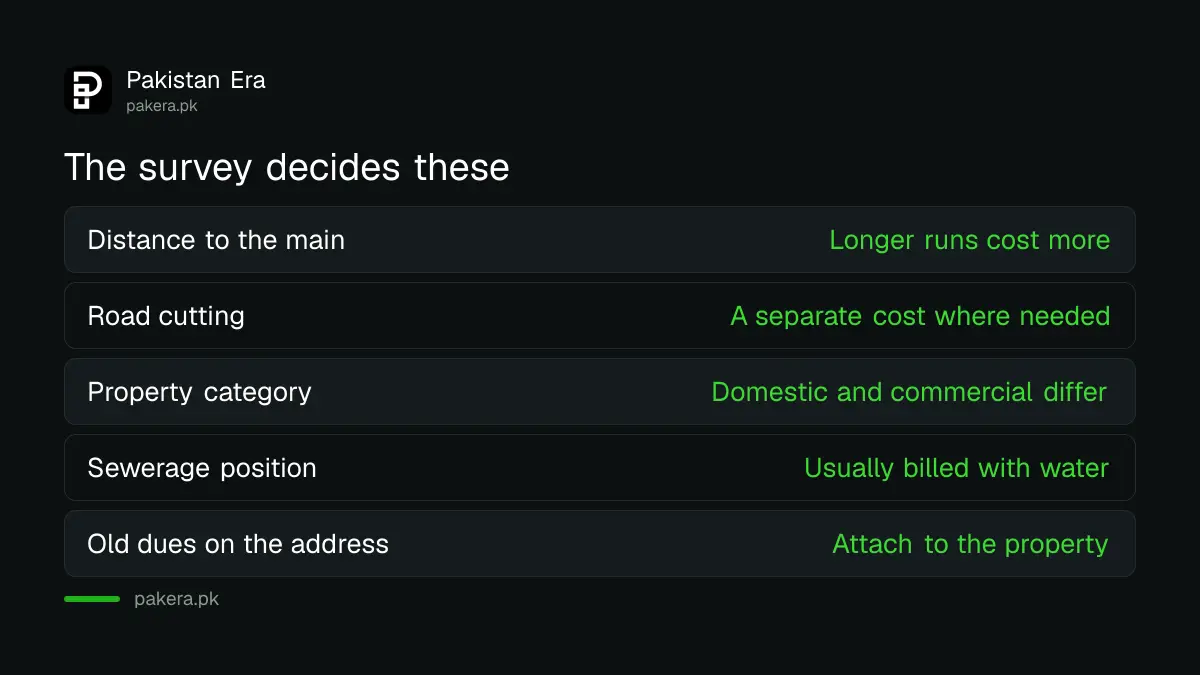
This is the same trap as electricity. An unpaid water and sewerage balance sits against the premises, and buying or renting does not clear it. Check the position before you apply, and certainly before you buy.
Look up the billing history for the address if a connection previously existed. Our guide to checking a WASA bill online shows the lookup, and if the paper bill is missing, getting a duplicate bill covers the utilities generally.
Doing the utilities together saves a month
If you are setting up a property from scratch, run the applications in parallel rather than in sequence. Water, electricity and gas each involve their own office, their own survey and their own demand notice, and each waits on documents you already have in hand.
For gas, the application goes to SNGPL or SSGC depending on region, and we cover it in our guide to a new gas connection. Assemble one folder of CNIC copies, ownership proof and address details, and use it for all three.
If the application stalls
Most delays are documents or dues rather than refusal. Ask at the counter what is outstanding and get the answer in writing, because a written reason is something you can act on and a verbal one is not.
Where the office is unresponsive, escalate within the WASA or development authority rather than starting again. Keep your application number, the date of submission and the name of anyone you dealt with, since those are the details any escalation will ask for first.
Common questions about a new water connection
Which office do I apply to?
The WASA serving your city, which sits under that city's development authority. Outside WASA cities it is the municipal committee, tehsil administration or cantonment board.
Can I apply online?
Availability differs by city and several WASAs offer online services for billing rather than for new connections. Check your own WASA and expect to attend in person for the application.
What does a connection cost?
It depends on the city, the property category and the distance and roadworks. We could not read a current schedule, so ask your office and get the figure in writing.
Does the bill include sewerage?
In most WASA areas water and sewerage are billed together. Confirm the sewerage position for your property at the time you apply.
Can a tenant apply?
Usually with the owner's documented consent, because the charges attach to the property. Ask the office what consent it accepts.
How we verified this
What we checked, where we read it, and what we could not confirm.
Last checked 26 August 2026. We opened lda.gop.pk on that date and it responded. We could not read a new connection procedure page, a document checklist or a charges schedule on a WASA site, so the document list, the survey and demand notice sequence and the sewerage billing position are reported, drawn from how the WASAs and municipal offices describe these services, and no connection charge is quoted anywhere on this page for that reason. Water and sanitation is a provincial and municipal subject and arrangements differ between cities, so confirm everything with the office that serves your own address.
About the author

Tax, Bills and Technology Writer
Ali Akhtar is a young and curious voice here at Pakistan Era. He is currently pursuing his A-Levels and has a growing interest in Pakistan’s changing industrial landscape and educational trends. Ali likes to write in a way that helps him explain and explore the world around him. His writing reflects the perspective of the new generation navigating the evolving trends of Pakistan where technology, youth innovation, and shifting opportunities are reshaping the country’s future.