How to Register an NGO in Pakistan: Society, Trust or Company
An NGO in Pakistan can register as a society, a trust or a Section 42 company. Each route suits a different kind of organisation. Here is how to choose.
Before you register an NGO in Pakistan, pick the legal structure, not just the name. A society, a trust and a Section 42 company are three different laws with three different registrars, and the one that suits a neighbourhood welfare group is usually the wrong one for an organisation planning to run a hospital or manage a large endowment.
We get asked this constantly by people who already have a mission and a founding group, and just want to know where to file. The honest answer is that it depends on what the organisation actually does day to day, so that is where we start.
Three laws, three kinds of organisation
A society suits a membership based welfare or cultural body. A trust suits an organisation built around dedicated property or funds. A Section 42 company suits a larger non profit that wants a corporate structure. Match the law to the work, not the other way round.
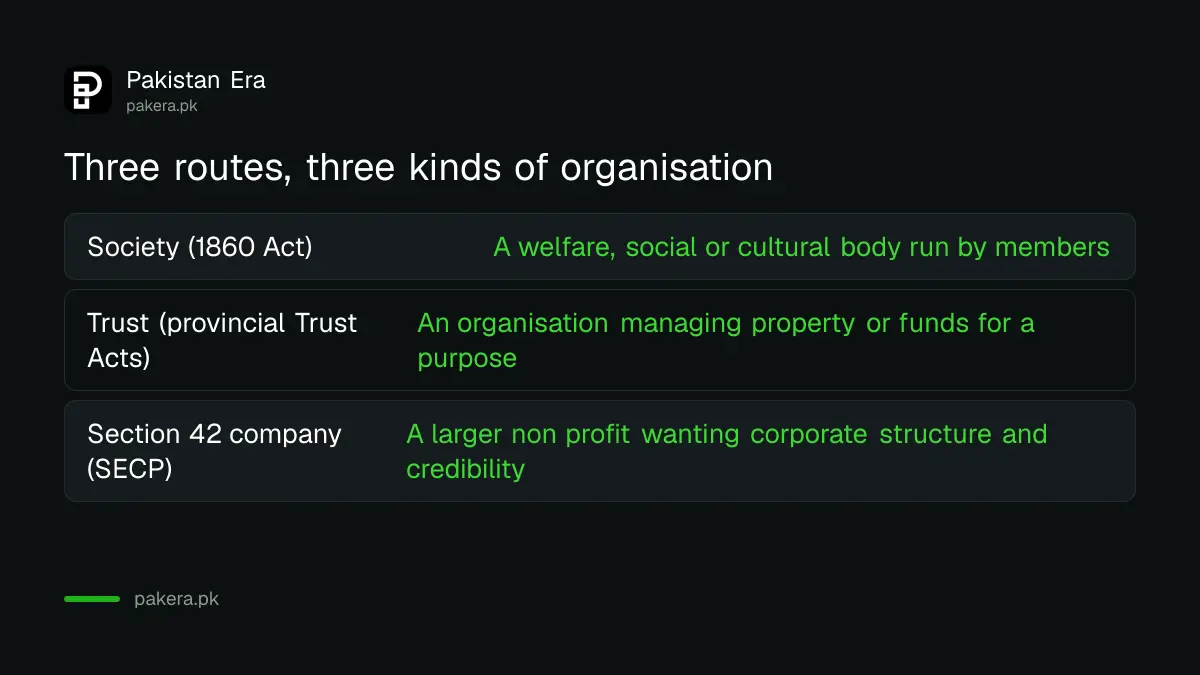
| Route | Suits |
|---|---|
| Society (Societies Registration Act 1860) | A welfare, educational, cultural or sports body run by members |
| Trust (provincial Trust Acts) | An organisation managing dedicated property, land or funds for a stated purpose |
| Section 42 company (SECP) | A larger non profit wanting a corporate structure, a board and public credibility |
None of the three is universally "better." A small community group adds overhead it does not need by registering as a company, and a large non profit running schools across provinces outgrows what a basic society filing can support.
Registering a society under the 1860 Act
A society needs at least 20 members, including at least 7 office bearers, before you can file anything. That threshold comes from the Societies Registration Act 1860 and is confirmed on the Islamabad Capital Territory's own registration page for the federal territory.
You will need a memorandum of association signed by every member, and rules (often called articles) with every page signed by at least three office bearers. Add minutes from the society's first meeting, CNICs for members and office bearers, and proof of an office address.
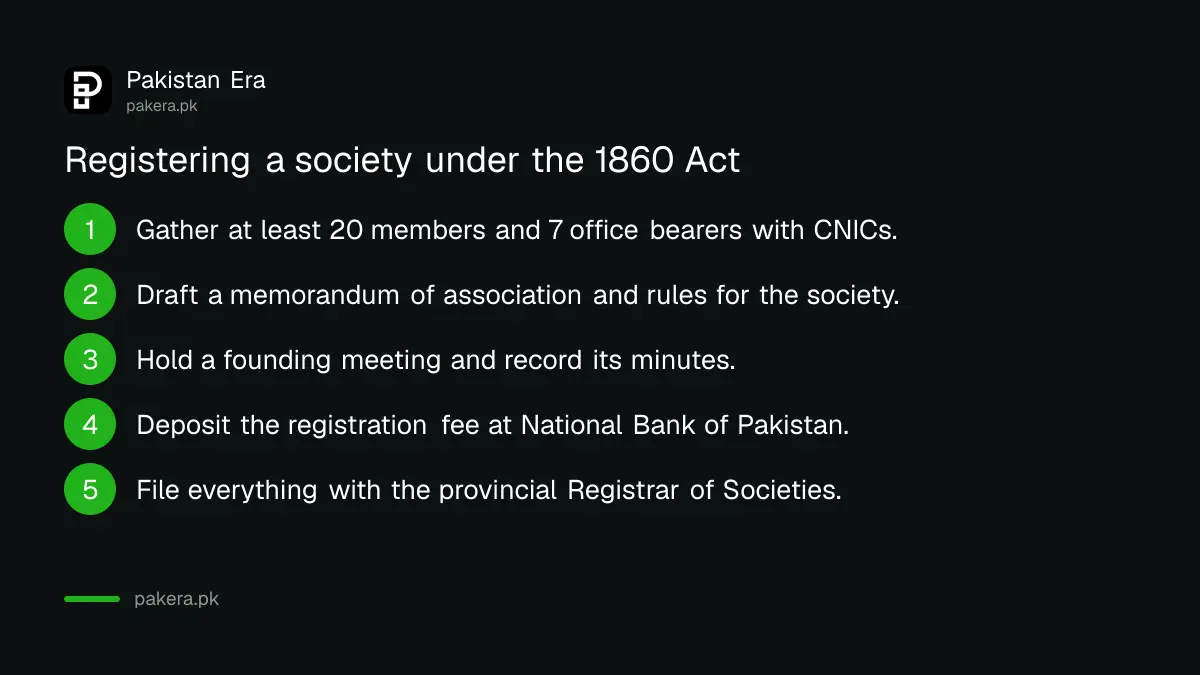
- Gather at least 20 members and 7 office bearers, each with a CNIC.
- Draft the memorandum of association and the society's rules.
- Hold a founding meeting and write down its minutes properly.
- Deposit the registration fee, reported as Rs 500 in Islamabad, at National Bank of Pakistan.
- File the full set of documents with your province's Registrar of Societies.
The Rs 500 fee and the National Bank challan process are confirmed for Islamabad specifically. Punjab's Registrar of Societies sits under the Social Welfare and Bait-ul-Mal Department, Sindh's under its own Social Welfare Department, and each may run a slightly different fee or form, so check with your province's office before assuming the Islamabad figures apply everywhere.
Setting up a trust for property or an endowment
A trust works differently. Instead of members running an organisation together, trustees hold and manage property or funds for a purpose named in a trust deed, under rules that bind them to that purpose specifically.
Trusts in Pakistan used to run on the federal Trust Act 1882, but after the 18th Amendment moved the subject to the provinces, each one passed its own law in 2020: the Punjab Trusts Act, the Sindh Trusts Act, the Khyber Pakhtunkhwa Trust Act, the Balochistan Trust Act and the Islamabad Capital Territory Trust Act. If the trust holds immovable property, the deed has to be registered before the sub-registrar under the Registration Act 1908, on stamp paper carrying the right stamp duty. This structure suits a family endowment, a hospital trust or a scholarship fund far better than a membership based society, because the law is built around the property and its purpose rather than around a rotating membership.
Getting a Section 42 licence from SECP for a non profit company
If the organisation wants to look and run like a company, with a board, formal shares in guarantee rather than profit, and a more recognisable corporate footing, the route is a licence under Section 42 of the Companies Act 2017 from the Securities and Exchange Commission of Pakistan.
You apply before you incorporate, not after. The application goes to SECP with the proposed name's availability letter, a draft memorandum and articles of association, a list of promoters with their occupations and addresses, and CNIC or passport copies for each one. Once granted, the licence runs for 5 years and can be renewed for further 5 year terms. The exact current licence fee is reported rather than confirmed on SECP's own fee page, which did not load for us directly, so check that figure with SECP or a company secretary before budgeting for it.
This route takes longer and costs more than a society filing, and it is meant for an organisation that expects to grow, hold significant assets or deal regularly with donors and banks that want to see a formal SECP registration rather than a society certificate.
Registration is the start, not the end
Whichever route you choose, the paperwork does not stop on registration day. A society has to file annual progress and audit reports with its registrar. A Section 42 company renews its licence every 5 years and files its own annual returns. A trust has to act strictly within the purpose named in its deed, and trustees who stray from it expose themselves personally.
Donors increasingly check this before they give. If your NGO wants to be taken seriously by funders, keeping that annual filing current matters as much as the initial registration itself, and people checking whether a charity is actually registered before they donate are looking for exactly this kind of ongoing compliance, not just a certificate from the day it started.
Common questions about registering an NGO in Pakistan
Which law should a small welfare group register under?
The Societies Registration Act 1860 usually fits best, since it is built for membership based welfare, cultural and educational groups with a lower filing burden than a company.
How many members does a society need to register?
At least 20 members, including at least 7 office bearers, based on the Societies Registration Act 1860 as applied in Islamabad.
What is a Section 42 licence?
A licence under Section 42 of the Companies Act 2017 that SECP grants before a non profit can register as a company limited by guarantee. It runs for 5 years and is renewable.
Is a trust the same as an NGO registered as a society?
No. A trust is built around property or funds held for a stated purpose under a trust deed, while a society is a membership based organisation governed by its own rules.
Does registering an NGO end the paperwork?
No. Societies file annual reports, Section 42 companies renew their licence every 5 years, and trusts must stay within the purpose named in their deed.
How we verified this
What we checked, where we read it, and what we could not confirm.
Last checked on 5 October 2026. We read the Islamabad Capital Territory Administration's own page on registering an NGO or NPO, which confirms the member thresholds, documents and the Rs 500 fee for the federal territory. We also relied on SECP's own published description of the Section 42 licensing route, though its fee schedule page returned an access error when we tried to read it directly, so that figure is reported, not confirmed. Provincial variations in fees and forms for societies and trusts outside Islamabad are not individually confirmed here, and you should check with your own provincial registrar before filing.
About the author

Tax, Bills and Technology Writer
Ali Akhtar is a young and curious voice here at Pakistan Era. He is currently pursuing his A-Levels and has a growing interest in Pakistan’s changing industrial landscape and educational trends. Ali likes to write in a way that helps him explain and explore the world around him. His writing reflects the perspective of the new generation navigating the evolving trends of Pakistan where technology, youth innovation, and shifting opportunities are reshaping the country’s future.