Sick Leave Rights at Work in Pakistan
The law gives most employees sixteen days of sick leave a year at half pay, separate from any PESSI cash benefit. See the certificate rule and limits.
Most salaried employees in Pakistan get sixteen days of sick leave a year, paid at half your average wage, and it has nothing to do with any cash benefit a social security institution pays on top.
Update, 11 October 2026: Workers in Saudi Arabia can see the sick leave rules in the Labor Law.
That confusion shows up the moment someone calls HR from a hospital bed and gets told their sick days already ran out, when what actually ran out was casual leave. The two pools are counted separately in law, and sick leave rights in Pakistan sit mainly in two statutes rather than one.
We read the Standing Orders Ordinance, 1968 on 5 October 2026, in the text hosted by the International Labour Organisation, and we cross checked it against the Factories Act, 1934 figures already verified at source for an earlier guide on this site.
Sick leave comes from two overlapping laws, not one
Factory workers get their sick leave straight from the Factories Act, 1934. Everyone else covered by labour law gets it through the Standing Orders Ordinance, 1968, which simply points back to the same chapter instead of writing its own number.
| Law | What it says about sick leave |
|---|---|
| Factories Act, 1934, Section 49H | Sixteen days a year, on half average pay |
| Standing Orders Ordinance, 1968, Standing Order 8 | Leave "as provided for in Chapter IV-A" of that same Act |
| Who the Ordinance reaches | Industrial or commercial establishments with twenty or more workmen |
| Casual leave | A separate pool, ten days, full pay |
| PESSI sickness benefit | A cash claim against the institution, not your employer |
So if you work in an office, a shop with enough staff, or a service business rather than a factory floor, the Standing Orders Ordinance is the law that covers you, and it borrows its sick leave figure rather than setting its own.
The Ordinance only reaches establishments above a certain size
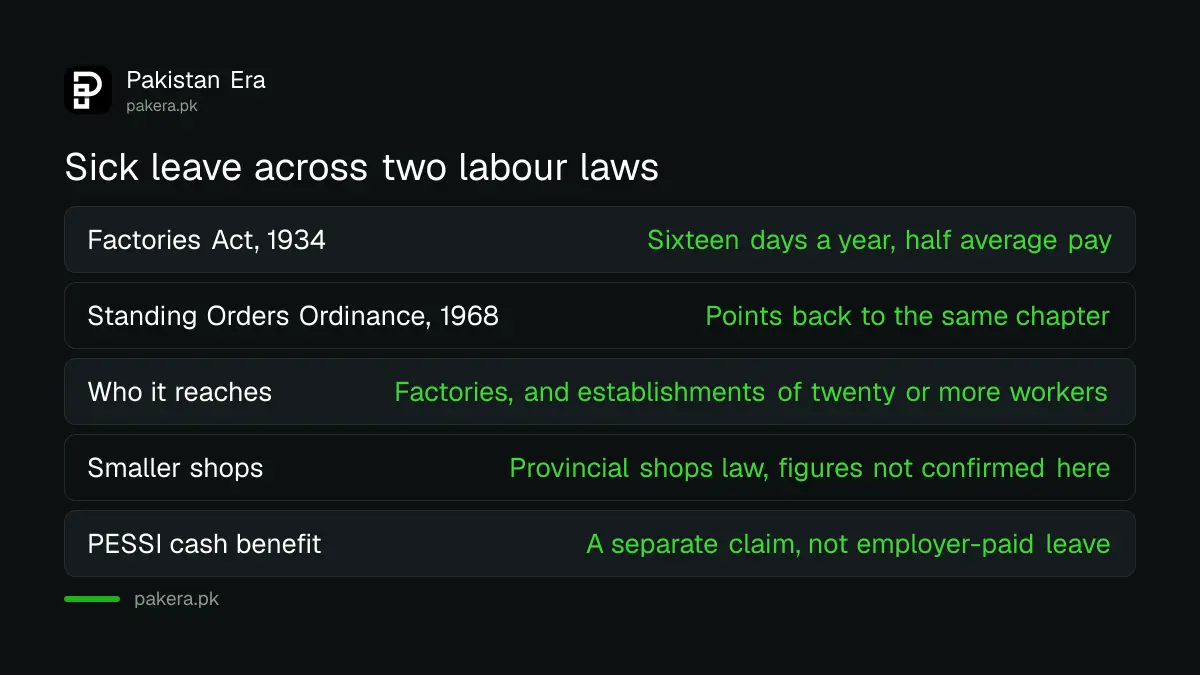
Section 1(4)(a) of the Standing Orders Ordinance, 1968 applies it to every industrial or commercial establishment where twenty or more workmen were employed on any day in the preceding twelve months. Fall under that threshold and you are outside this particular law.
A small shop with six staff is not automatically covered by this Ordinance. It likely falls under a provincial Shops and Establishments law instead, and we have not read that legislation province by province, so no sick leave figure for that case is stated here as fact. If that is your situation, ask your provincial labour department directly rather than trust a number you saw online.
Half pay is lower than most employees expect
Sixteen days sounds generous until the payslip arrives at half your average wage rather than the full amount. That is not a company decision. Section 49H sets it at half average pay, and the Standing Orders Ordinance adopts the same figure by reference.
Half average pay is not simply half your basic salary either. The rate is tied to average wages as defined in wage legislation, which can include regular allowances, so the exact number on your payslip depends on what counts as wages in your contract. Ask payroll to show the calculation rather than accept a flat half of basic pay without checking.
The law does not actually spell out a certificate requirement
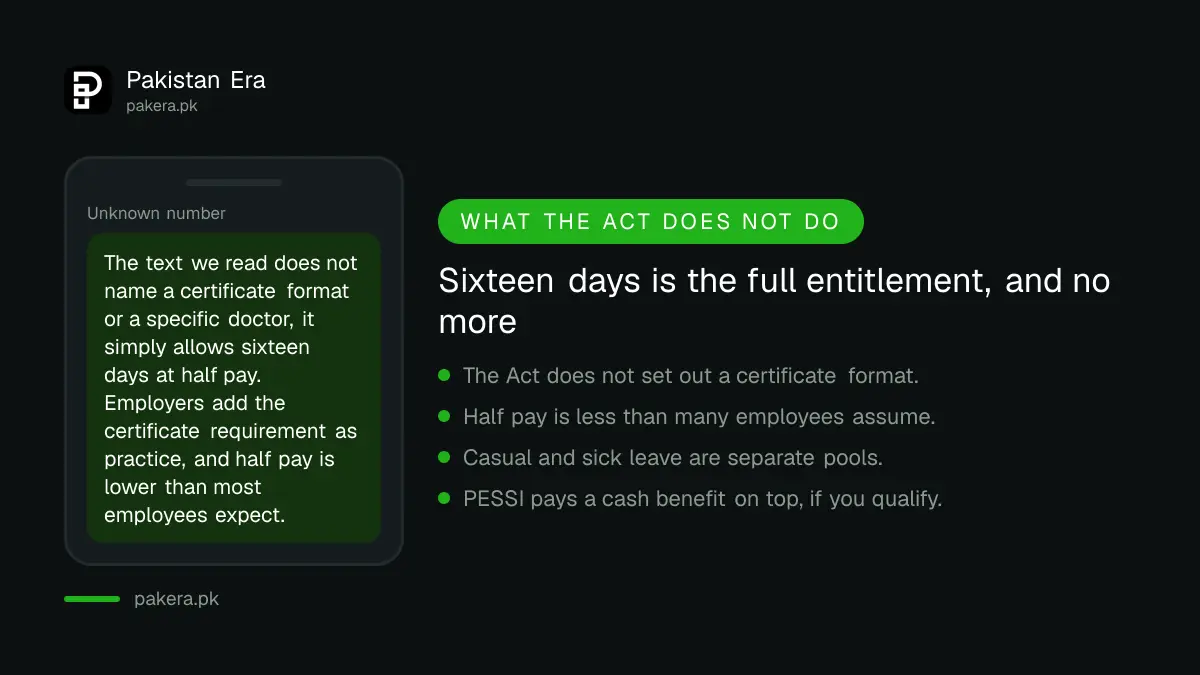
Here is the part that surprises people. The text of Section 49H gives the number of days and the rate of pay. It does not lay out a certificate format, a named category of doctor, or a notice period for sick leave the way some employers describe it.
In practice almost every employer asks for a certificate from a registered medical practitioner before treating absence as paid sick leave rather than unpaid absence or a casual day. That is standard, sensible HR practice, but it is the employer's policy filling a gap the statute leaves open, not a line from the Act itself. Keep that distinction in mind if a certificate is refused for a reason that is not actually in the law.
A long illness does not erase your years of service
This is the detail that protects people with a serious diagnosis. Under the continuous service rules tied to annual leave in the same Act, an interruption caused by sickness, accident or authorised leave of up to ninety days in total does not break your continuous service.
So a worker recovering from surgery or a long infection for two or three months has not reset the clock on their years of service, whatever a manager might suggest. That matters for annual leave eligibility and for any benefit that depends on continuous years worked, including points covered in our guide to how termination and notice actually work.
Sick leave from your employer is not PESSI's sickness benefit
These two get confused constantly, and they are not the same claim. Sick leave under the Factories Act or the Standing Orders Ordinance is your employer paying you half wages out of its own payroll for up to sixteen days.
A separate cash benefit exists through the provincial social security institution for workers who are registered and contributing. In Punjab that benefit runs to seventy five per cent of wages for up to one hundred and twenty one days, which is a different scheme entirely, with its own registration and its own helpline, covered in our guide to the benefits a registered worker in Punjab can claim. Being owed one does not mean you are owed, or have claimed, the other.
Keep a paper trail if sick leave is refused
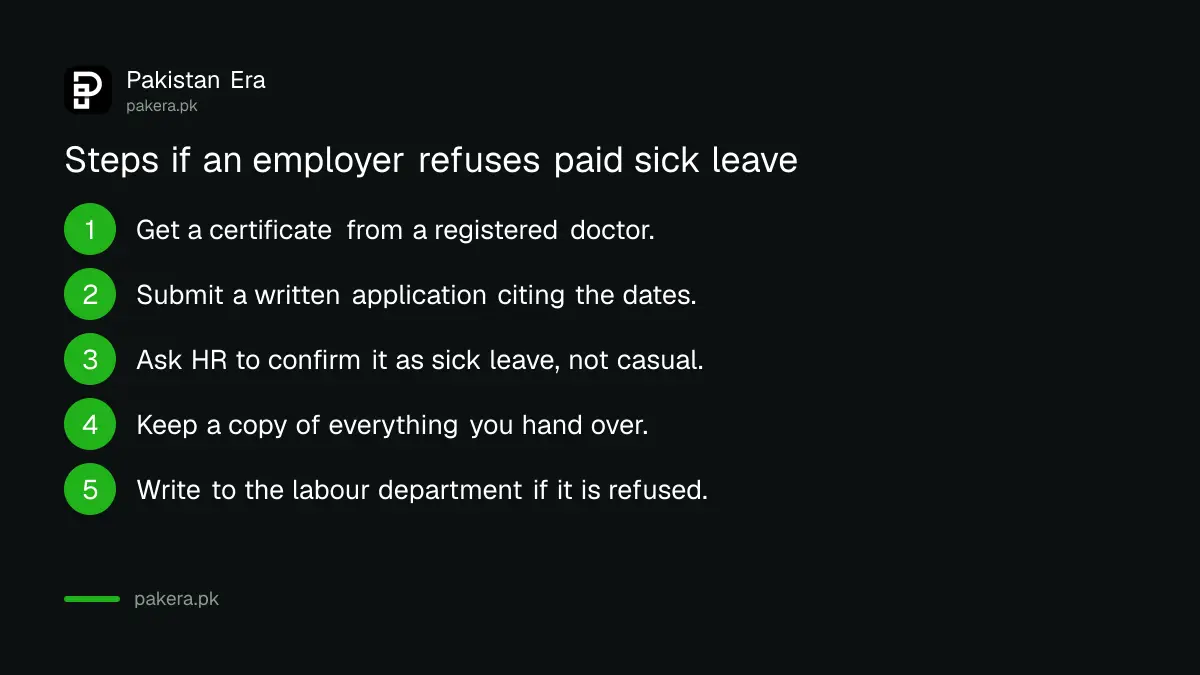
- Get a certificate from a registered doctor for the days you were unwell.
- Submit a written application to HR naming the exact dates.
- Ask HR in writing to confirm it is being treated as sick leave, not casual leave.
- Keep a copy of everything you hand over, including the date you handed it over.
- If it is still refused, take the file to your provincial labour department.
Verbal promises get forgotten at appraisal time. A written application with a date on it is the only version of events a labour officer can act on later.
Common questions
How many days of sick leave am I entitled to in Pakistan?
Sixteen days a year, on half average pay, under Section 49H of the Factories Act, 1934, applied directly to factory workers and by reference through the Standing Orders Ordinance to many other employees.
Does the law require a medical certificate for sick leave?
The text of Section 49H does not spell one out. Employers requiring a certificate from a registered doctor are applying common practice, not a clause written into the Act.
Is sick leave paid at full salary?
No. It is paid at half average pay, which can be lower than half your basic salary once allowances and the legal definition of wages are applied.
Does a long illness count against my years of service?
No, up to ninety days of interruption for sickness, accident or authorised leave does not break continuous service under the Act.
Is PESSI's sickness benefit the same as sick leave?
No. Sick leave is paid by your employer. PESSI's sickness cash benefit is a separate claim against the social security institution, open only to registered, contributing workers.
What if my workplace has fewer than twenty employees?
The Standing Orders Ordinance may not apply. Smaller shops typically fall under a provincial Shops and Establishments law, and we have not confirmed a sick leave figure under that legislation here.
How we verified this
What we checked, where we read it, and what we could not confirm.
Last checked 5 October 2026. We read the West Pakistan Industrial and Commercial Employment (Standing Orders) Ordinance, 1968 in the text hosted by the International Labour Organisation, confirming Section 1(4)(a) on the twenty-worker threshold and Standing Order 8 pointing to Chapter IV-A of the Factories Act, 1934 for leave. The sixteen days at half average pay figure under Section 49H of the Factories Act, and the ninety day continuous service allowance for sickness, were verified at source for an earlier guide on this site from the Law and Parliamentary Affairs Department, Government of the Punjab, and are not re-derived independently here. We did not read any provincial Shops and Establishments law, so no sick leave figure is stated for employees outside the Factories Act or the Standing Orders Ordinance. The certificate practice described is common employer policy, not a quoted clause of the Act. Nothing on this page is legal advice.
About the author

Tax, Bills and Technology Writer
Ali Akhtar is a young and curious voice here at Pakistan Era. He is currently pursuing his A-Levels and has a growing interest in Pakistan’s changing industrial landscape and educational trends. Ali likes to write in a way that helps him explain and explore the world around him. His writing reflects the perspective of the new generation navigating the evolving trends of Pakistan where technology, youth innovation, and shifting opportunities are reshaping the country’s future.