How Legal Guardianship Works in Pakistan, Since Adoption Does Not
Pakistan's courts grant guardianship under an 1890 law, not Western-style adoption. See who can apply, what a guardian cannot do, and why a will still matters.
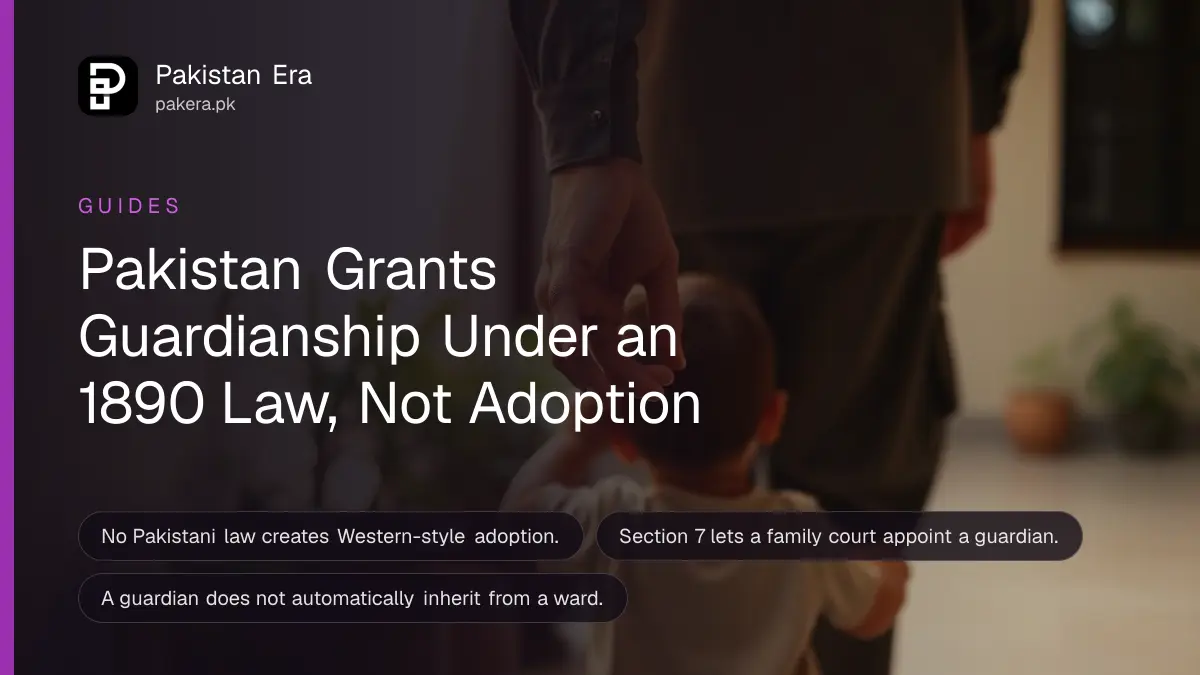
There is no such thing as legal adoption in Pakistan the way it works in the West. What the law actually gives you is guardianship, granted by a family court under an 1890 Act, and it does not change who a child's parents are in law.
That single fact trips up a lot of well-meaning families. Someone raises a relative's child for ten years, calls it adoption at home, then discovers at a bank counter or a passport office that nothing on paper says they can act for that child at all.
We read the Guardians and Wards Act, 1890 on 5 October 2026, in the text published by the Ministry of Religious Affairs, and cross checked the section numbers against a second reproduction of the Act.
Guardianship is not adoption, and the difference is not just wording
Adoption, as it exists in Western law, ends one set of parental rights and creates another. The adopted child becomes a legal child of the new parents for every purpose, including inheritance.
| What it actually does | |
|---|---|
| Changes the child's legal parentage | No, under Muslim personal law |
| Gives an automatic inheritance share | No, not from guardianship alone |
| Lets someone act for the child in law | Yes, that is the point of the order |
| Decided by | A family court, applying the 1890 Act |
| Can be ended by the court | Yes, on several named grounds |
Pakistan, under Muslim personal law, does not recognise that kind of severing and remaking of parentage. What a family court grants instead is guardianship: the right and duty to act for a child, manage their affairs and protect their welfare, without pretending the child was born to you. Our guide to how guardianship differs from custody covers the related question of who a child lives with, which is a separate decision from who may act for them.
Section 7 is the actual power the court is using
Section 7 of the Guardians and Wards Act, 1890 is short. Where the court is satisfied that it is for the welfare of a minor, it may appoint a guardian of the minor's person, their property, or both.
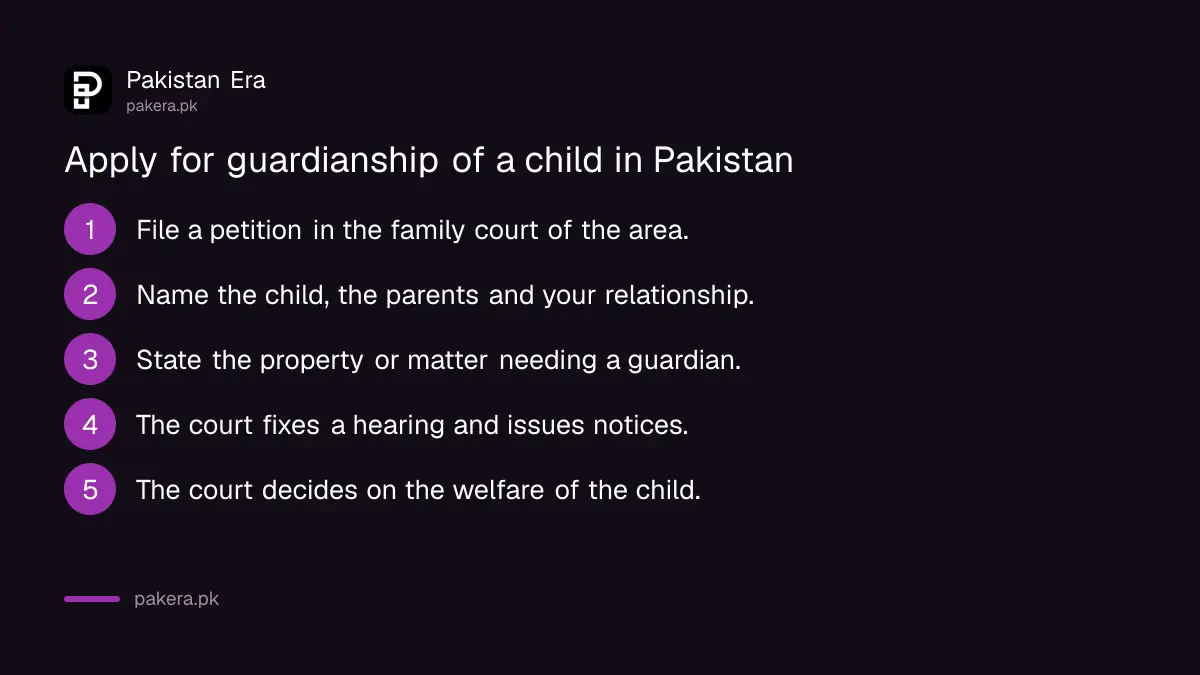
Section 8 names who can even ask. That includes the person wanting to be guardian, any relative or friend of the minor, or the Collector of the district where the minor lives or holds property. A stranger with no connection to the child cannot simply walk in and apply.
- File a petition in the family court for the area where the child ordinarily lives.
- Name the child, the parents or existing custodian, and your relationship to the child.
- State clearly what needs a guardian, such as property, a bank account or travel documents.
- The court fixes a date for hearing and sends notice to the parents and anyone currently caring for the child.
- The court decides based on the welfare of the minor, not on who applied first.
Section 9 to 11 set out that jurisdiction sits with the district court for the area, which under separate family courts legislation is exercised by the family court, and that the application has to be a signed, verified petition giving real detail about the child and the proposed guardian rather than a vague request.
Welfare of the child decides it, not who asked first
Section 17 is the test the court actually applies, and it is worth knowing before you file. The court looks at the age, sex and religion of the minor, the character and capacity of the proposed guardian, and, where the child is old enough to form one, their own intelligent preference.
Section 19 then rules certain appointments out entirely. The court cannot appoint a guardian for a married minor girl whose husband is fit to act, and it cannot appoint one for a minor whose father is alive and fit. Those exclusions exist because the law assumes an existing fit parent or husband already has that role.
A guardian cannot profit from the position
Sections 20 and 21 set real boundaries on what a guardian may do. The law treats a guardian as standing in a fiduciary relationship to the ward, which means acting for the child's benefit, not their own.
A guardian cannot buy the ward's property for themselves and cannot otherwise profit from managing it. A minor generally cannot be appointed guardian of another minor either, with a narrow exception for a minor guardian of their own spouse or child.
Guardianship ends, and it does not create inheritance on its own
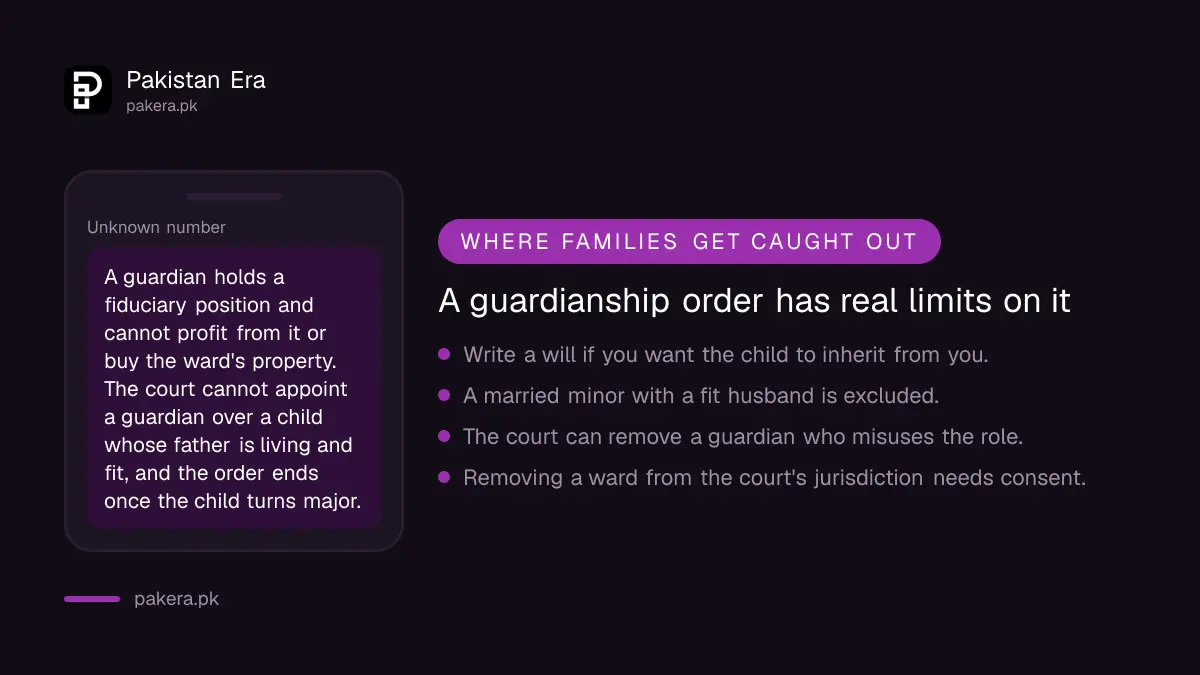
Section 41 sets out when a guardian's powers stop: on their death, removal or discharge by the court, when the ward stops being a minor, or when a female ward marries a husband who is fit to take over.
This is where the inheritance confusion usually lands. Raising a child as your own for twenty years under a guardianship order does not, by itself, make that child your heir the way a biological child is. If you want the child you have raised to inherit from you, that generally needs a will, written within what Muslim inheritance law allows, and our guide to how inheritance shares are worked out covers that separately. Section 44 also carries a real penalty, a fine of up to one thousand rupees or up to six months' imprisonment, for removing a ward from the court's jurisdiction without its leave.
What to bring, and what we are not stating as fact
The Act itself does not set out a document checklist or a fee, so we are not inventing one. Expect to need the child's birth registration, your own identity documents, proof of your relationship or role in the child's life, and details of whatever property or matter needs a guardian, and our guide to the NADRA B Form covers one of those documents.
Confirm the exact filing requirements and any court fee with the family court in your area rather than a figure repeated online, since the statute we read does not prescribe either.
Common questions
Can I legally adopt a child in Pakistan?
Not in the Western sense. No Pakistani statute creates adoption that changes a child's parentage. Courts instead grant guardianship under the Guardians and Wards Act, 1890.
Who can apply to be a child's guardian?
The person wanting to be guardian, any relative or friend of the minor, or the Collector of the district, under Section 8 of the Act.
Does guardianship give a child inheritance rights over me?
No, not automatically. Guardianship does not create parentage, so write a will within Muslim inheritance law if you want the child to inherit from you.
Can a court refuse to appoint a guardian?
Yes. Section 19 bars appointing a guardian where the minor's father is alive and fit, or where a married minor girl's husband is fit to act.
What test does the court use to decide?
The welfare of the minor, under Section 17, including age, sex, religion, the proposed guardian's character and the minor's own preference if old enough.
When does a guardianship order end?
Under Section 41, on the guardian's death, removal or discharge, when the ward stops being a minor, or on marriage for a female ward with a fit husband.
How we verified this
What we checked, where we read it, and what we could not confirm.
Last checked 5 October 2026. We read the Guardians and Wards Act, 1890 in the text published by the Ministry of Religious Affairs at mora.gov.pk, and cross-checked the section numbers against a second published reproduction of the Act. Sections 7 to 11 on the power to appoint a guardian, who may apply, jurisdiction and the form of the petition; Section 17 on the welfare test; Section 19 on appointments the court cannot make; Sections 20 and 21 on a guardian's fiduciary duty; Section 25 on a ward leaving a guardian's custody; Section 41 on when guardianship ends; and Sections 44 and 45 on penalties, are all taken from that text. We did not read a specific court rules circular, so no fee or document checklist is stated as fact, and readers are told to confirm those with their local family court. This is a summary of what the statute says and not legal advice.
About the author

Public Services and Education Journalist
Fajr Riaz is a journalist and content writer at Pakistan Era, based in Lahore. She covers the questions people meet in everyday life in Pakistan: how a public service works, what a change in the rules means, and where to find a reliable answer.