How to Verify a Charity Is Registered Before Donating in Pakistan
A charity can be SECP registered, provincially licensed, FBR tax approved or PCP certified, and these are not the same. Check before you donate in Pakistan.
Before donating in Pakistan, check the collector's name against the Sindh or Punjab Charity Commission register if they work in those provinces, search its name on SECP's free company search if it says it is a registered company, and ask for a receipt with a registration number. If a collector cannot show one, or only wants cash with no receipt, treat that as a red flag.
"Registered" gets used loosely by street and door-to-door collectors, and it can mean four genuinely different things, only one of which tells you anything about where your money actually goes. We checked the live public tools each regulator offers on 4 October 2026, and two of the four turned out not to have one.
Four different registrations, and none of them are interchangeable
A donor hearing "we are registered" should ask registered as what, because the answer changes what that actually guarantees.
| Registration | Who grants it | What it actually confirms |
|---|---|---|
| Section 42 company | SECP | Incorporated as a non-profit company, not whether donations reach beneficiaries |
| Charity Commission registration | Punjab or Sindh Charity Commission | Licensed to collect in that province under its Charities Act |
| FBR-approved NPO, section 2(36) | Commissioner Inland Revenue | Your donation qualifies for a tax credit |
| PCP certification | Pakistan Centre for Philanthropy | Passed an independent review of governance and finances |
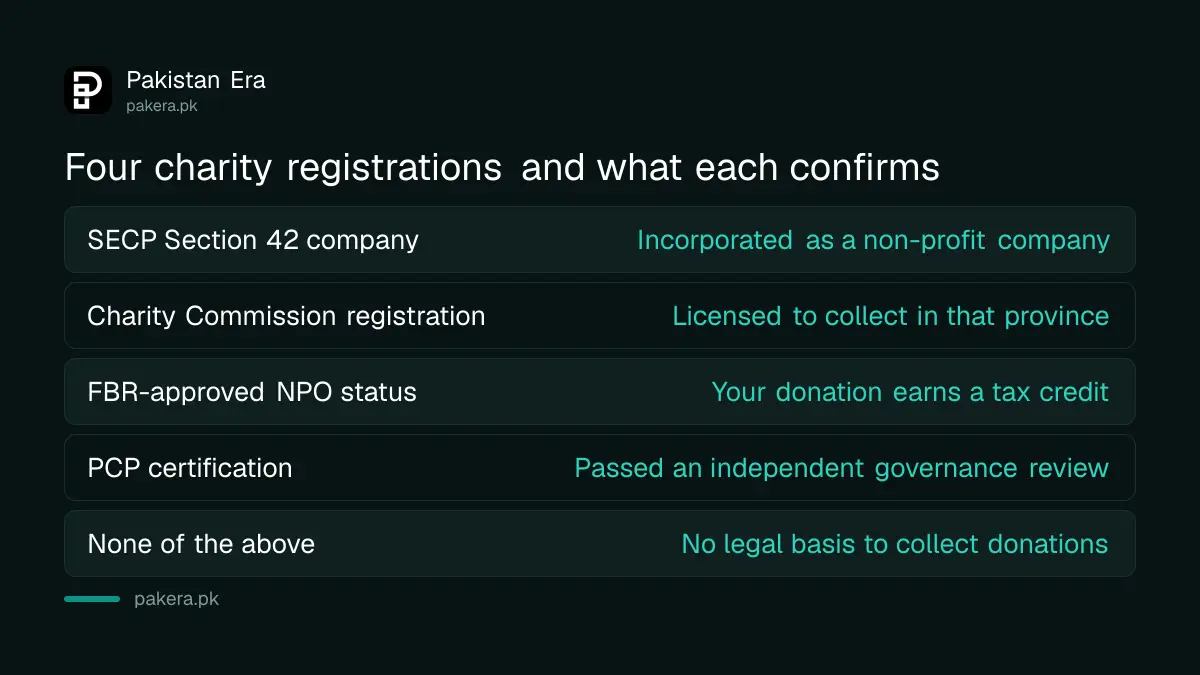
An organisation can hold one of these and not the others. A Section 42 company is not automatically tax credit eligible, and a charity registered with a provincial commission is not automatically PCP certified. Ask which one you are being shown.
Checking a Section 42 company with SECP
Many larger NGOs are structured as non-profit companies under section 42 of the Companies Act 2017, which SECP licenses. SECP's free eServices portal lets you search a company by name or its CUIN, the seven digit company number, without creating an account, and a result shows the company type, its incorporation date, registered address and whether it is active, wound up or dissolved.
A company type showing something like "association not for profit" tells you it is structured for that purpose. It does not tell you how the money is spent once donated, so treat it as one data point, not the whole answer.
Checking a provincial Charity Commission registration
If the collector operates in Sindh, the Sindh Charity Commission runs a public search at its portal, where you can look up a charity by name and filter by district, category and the objective it registered for, such as education, health or poverty relief. Under the Sindh Charities Act 2019, an organisation cannot lawfully collect donations in the province without this registration, whatever other registration it already holds. Our guide on registering a charity with the Sindh Charity Commission covers that side of the process for an organisation itself.
Punjab has its own equivalent, the Punjab Charity Commission under the Punjab Charities Act 2018, and its website has been live since September 2021. We could not find a public name-search database on the Commission's own site when we checked it on 4 October 2026, only a general site search and a login-only portal for registered organisations. A WhatsApp verification number, 0313-4995564, is widely reported in the press as a way to check a registration, but we did not find that number stated on the Commission's own pages, so treat it as reported rather than confirmed at source.
Checking whether your donation qualifies for a tax credit
A donation only earns you a tax credit if the recipient holds approved non-profit organisation status under section 2(36) of the Income Tax Ordinance 2001, granted by a Commissioner Inland Revenue. This is issued to one organisation at a time as a dated certificate, not published as a single searchable list on FBR's site as far as we could find. A legitimate organisation claiming this status should be able to show you its own certificate with a validity period, since these are typically time-limited and renewed.
Our guide on how zakat and donations reduce your income tax covers the credit itself and what to keep for your own return.
What PCP certification actually tells you
The Pakistan Centre for Philanthropy is a non-profit itself, and FBR designated it the agency that evaluates NPOs against standards of governance, financial management and programme delivery. PCP publishes a public directory of certified local NPOs and INGOs on its own site, searchable alphabetically, which is the most donor-friendly of the four checks here because it is built for exactly this question.
PCP certification is a performance review, not a government licence by itself, though PCP's role in recommending organisations for tax-exempt status connects it to the FBR process. A PCP-certified organisation has been independently assessed. An organisation that only says it is "SECP registered" has simply filed paperwork to exist as a company.
Signs you are dealing with an unregistered or fraudulent collector
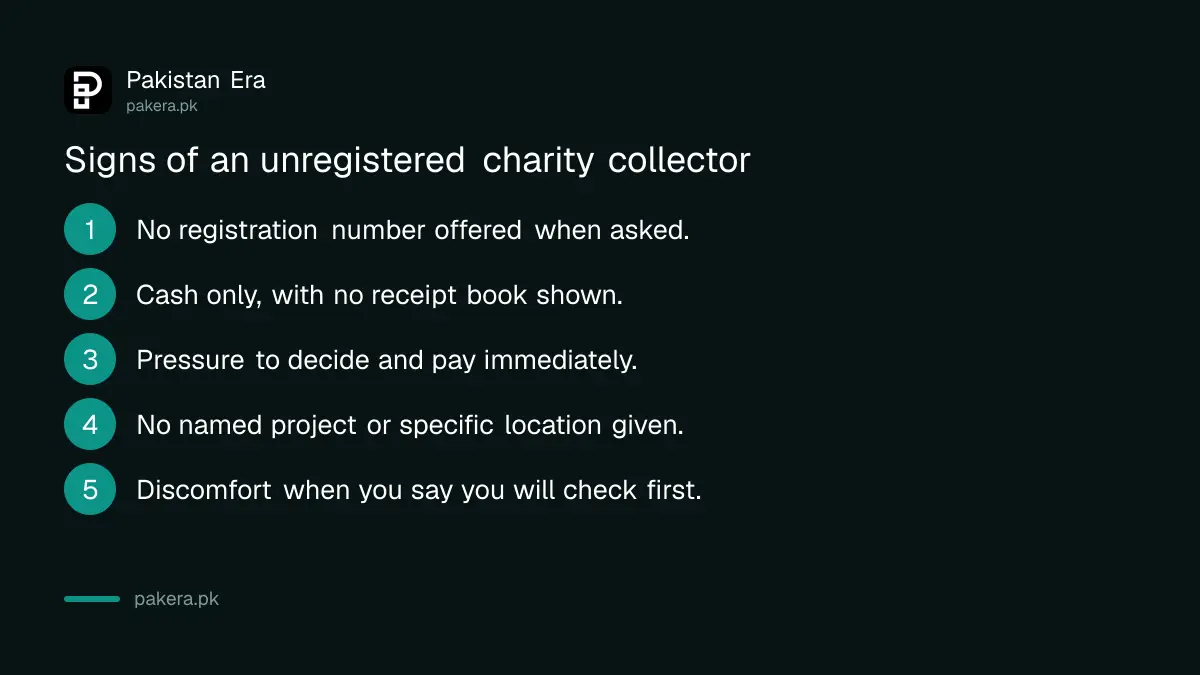
Most people do not have time to run four separate checks on a street collector, so these are the practical signs worth acting on.
- No registration number is offered when you ask, or the person is vague about which body it is registered with.
- Insistence on cash only, with no receipt book or digital payment option tied to an organisation's name.
- Pressure to decide immediately, or discomfort when you ask to note the organisation's name and check it later.
- A collection for a disaster or cause that is not matched by any news of an active appeal from a known organisation.
- A door-to-door collector who cannot name the specific project or location the money is going to.
Reporting a suspected fake or unregistered collector
If a collector is operating without registration in Sindh or Punjab, the relevant provincial Charity Commission is the body with legal authority over that collection, and both commissions maintain lists of proscribed organisations alongside their registration systems. If the approach is a scam asking for money online or through a messaging app, that is a cybercrime matter, and our guide on reporting a cybercrime to the NCCIA covers that channel. For an in-person collector you believe is simply pocketing the money, a police complaint for cheating is the direct route, the same as for any other fraud.
Common questions
Is a charity that is SECP registered automatically trustworthy?
No. SECP registration confirms it is legally incorporated as a company, not that donations reach beneficiaries or that it meets any performance standard.
Can I check a charity's registration on the spot, from my phone?
Yes, for Sindh's registered charities and for PCP-certified organisations, both of which have a public search you can use immediately. Punjab and FBR approval are harder to verify on the spot with what we could confirm today.
Does PCP certification mean my donation is tax deductible?
Not automatically. Tax credit eligibility depends on the organisation's own section 2(36) approval from FBR, which is a separate status PCP's evaluation can support but does not itself grant.
What if a collector says they are registered but cannot show anything?
Ask for the organisation's full legal name and note it down, then check it yourself later rather than donating on the spot. A genuine organisation will not mind the delay.
Is it illegal to collect charity without registering in Punjab or Sindh?
Yes, under both provinces' Charities Acts, collecting without registration is an offence once the law applies to that organisation, with fines that can run into hundreds of thousands of rupees.
How we verified this
What we checked, where we read it, and what we could not confirm.
Last checked 4 October 2026. The Sindh Charity Commission's public search tool at mis.charitycommission.sindh.gov.pk, its filters by charity name, district, category and objective, and the Sindh Charities Act 2019's registration requirement, are read directly from the commission's own site on 4 October 2026, consistent with the Act details our sister article on registering a Sindh charity read directly from the Act text. The Punjab Charity Commission's website, live since 2 September 2021 per PITB's own announcement, was checked directly on 4 October 2026, and we could not find a public charity name-search database on it, only a general site search and a login-only portal; the widely reported WhatsApp verification number 0313-4995564 is marked reported, not confirmed on the commission's own pages. SECP's free company name and CUIN search, and that results show company type, incorporation date and status, are reported from multiple independent registry-search guides describing the same public eServices portal, since our own direct attempt to load the portal returned a server error at the time of checking. FBR's approval of non-profit organisations under section 2(36) of the Income Tax Ordinance 2001 being issued as individual, dated certificates by a Commissioner Inland Revenue, rather than published as one searchable list, is based on finding individual sample certificates online and not finding a consolidated public list on fbr.gov.pk; we note this as an absence rather than certainty that no such list exists anywhere on the site. PCP's role as the FBR-designated NPO certification agency and its public NPO directory are read from PCP's own site, pcp.org.pk, on 4 October 2026. NOT VERIFIED: the exact current fine amounts under the Punjab Charities Act 2018 for unregistered collection, which this article does not state as a figure; whether Punjab's Charity Commission has since added a public search tool after our check. No outlet or competitor named in the article; the body links only to SECP, PCP and the two provincial Charity Commissions as primary sources.
About the author
Public Services and Education Journalist
Fajr Riaz is a journalist and content writer at Pakistan Era, based in Lahore. She covers the questions people meet in everyday life in Pakistan: how a public service works, what a change in the rules means, and where to find a reliable answer.