Cut Your Income Tax in Pakistan With Zakat, Donations, a Pension Fund and School Fees
Four claims still cut your 2026 income tax in Pakistan: Zakat, donations, VPS pension fund and school fees. Limits under sections 60 to 63 and how to claim.

You can lower your tax year 2026 income tax in Pakistan with four claims in the return: Zakat paid under the Zakat Ordinance, donations to approved bodies, contributions to a Voluntary Pension System fund, and children's school fees if your income is under Rs 1.5 million. Claim them on IRIS before filing by 15 October 2026.
Most salaried people never claim any of these. Their employer deducts tax each month, the return is filed from the salary certificate, and the receipts stay in a drawer. That is money left with FBR.
We read each rule in FBR's copy of the Income Tax Ordinance 2001, amended up to 30 June 2026, on 2 October 2026. We also found two claims people still talk about that no longer exist, so check before you count on them.
Four claims still cut your income tax in 2026
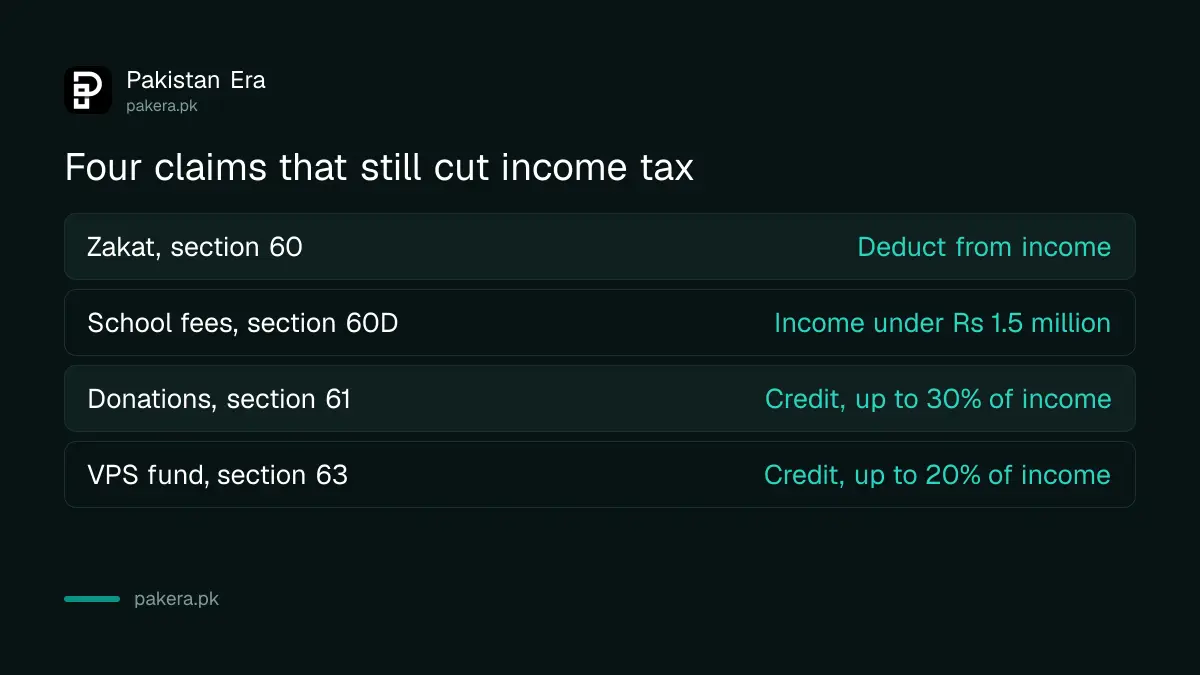
The Ordinance has two kinds of relief. A deductible allowance cuts your taxable income. A tax credit cuts the tax itself. Zakat and school fees are allowances. Donations and pension fund contributions are credits, worked out at your average tax rate.
| Claim | Section | Type | Limit |
|---|---|---|---|
| Zakat | 60 | Deductible allowance | Zakat paid under the Zakat and Ushr Ordinance 1980 |
| Children's tuition fees | 60D | Deductible allowance | Lesser of 5% of fees, 25% of income or Rs 60,000 a child; income under Rs 1.5 million |
| Donations | 61 | Tax credit | Donation up to 30% of taxable income |
| Voluntary Pension System | 63 | Tax credit | Contribution up to 20% of taxable income |
None of these claims makes a refund on its own if your tax is already zero. They only reduce tax you would otherwise pay. If more tax was deducted than you owe after the claims, the extra can come back through an income tax refund.
Zakat deducted by your bank is a deductible allowance
Section 60 lets you deduct the Zakat you paid in the tax year under the Zakat and Ushr Ordinance 1980 from your income. The common case is the Zakat your bank cut from your savings account on the first of Ramazan.
Private Zakat you give by hand to a relative or a neighbour is not paid under the Ordinance. The wording of section 60 does not cover it, so do not claim it. Keep the bank's Zakat deduction certificate. The amount is on your account statement.
Any part of the allowance you cannot use this year is lost. Section 60(3) says it is not refunded, carried forward or carried back. If you prefer your bank not to deduct Zakat at all, the CZ-50 Zakat exemption is a separate process.
Donations give a tax credit up to 30% of your income
Section 61 gives a tax credit for donations to a university or education board set up by law, a government-run school, hospital or relief fund, an approved non-profit, or a body named in the Thirteenth Schedule. Cash donations count only if paid by crossed cheque through a bank.
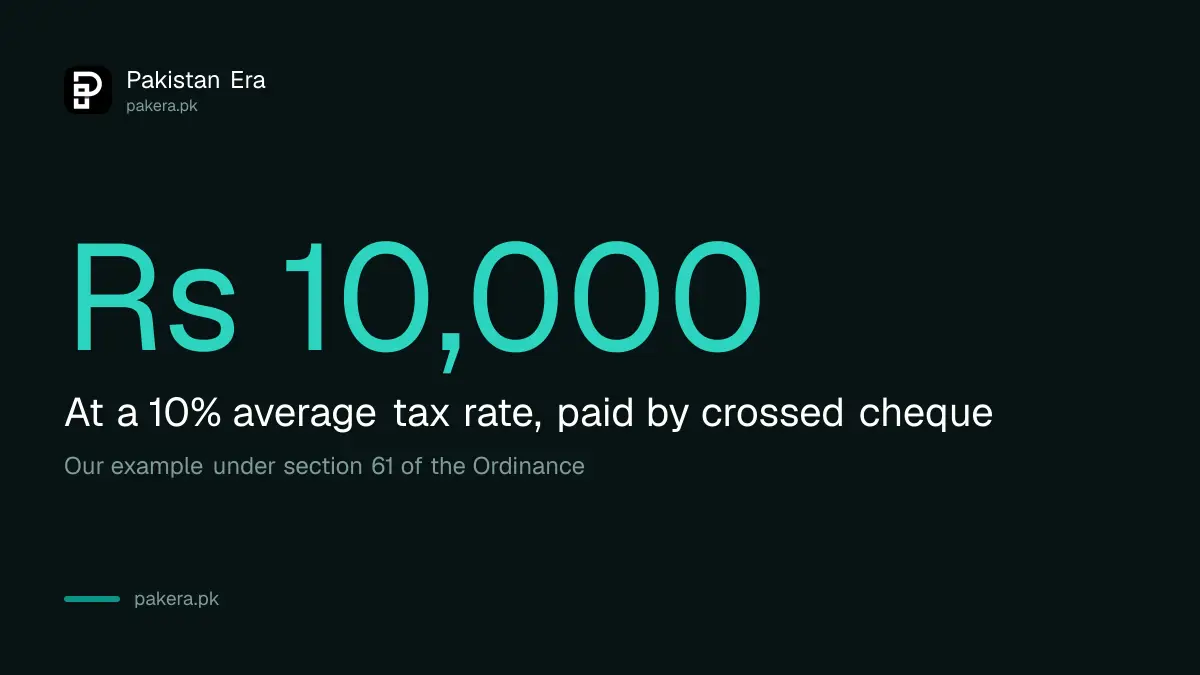
The credit uses a formula. Divide your tax by your taxable income to get your average rate. Multiply that by your donation, or by 30% of your taxable income if that is lower. If the donation is to an associate, the cap falls to 15%.
Say your taxable income is Rs 3 million and your tax before credits is Rs 300,000. Your average rate is 10%. A Rs 100,000 donation to an approved hospital gives a Rs 10,000 credit. Cash in a donation box gives nothing, because it was not paid by cheque.
Ask the charity for a receipt in your name and check that it is approved. A receipt from an unapproved trust will not hold up if FBR asks.
A Voluntary Pension System fund gives a credit up to 20%
Section 63 gives a tax credit to anyone with salary or business income who pays into an approved pension fund under the Voluntary Pension System Rules 2005. The contribution counts up to 20% of taxable income.
The credit uses the same average-rate formula as donations. People who join a fund at 41 or older get an extra 2% a year for each year above 40, during their first ten years. The total cannot pass 50% of the previous year's taxable income.
Pension fund managers offer these funds under the Voluntary Pension System Rules 2005. Ask your fund for its contribution certificate for July 2025 to June 2026. This claim suits people who already save. Opening a fund in October does nothing for tax year 2026, which ended on 30 June 2026.
School fees cut tax only for incomes under Rs 1.5 million
Section 60D gives a deductible allowance for tuition fees paid by a parent whose taxable income is under Rs 1.5 million. It is the lowest of 5% of the fees, 25% of taxable income, or Rs 60,000 for each child.
Only one parent can claim for the same fee, the one who paid it. You must give the school's NTN or name. With a taxable income of Rs 1.5 million or more, the allowance does not apply at all.
Under the 2026 salary slabs, a person earning Rs 600,000 or less a year pays no tax, so the allowance helps only a narrow band of earners. Check where you sit on the salary tax slabs for 2026-27 before you collect fee receipts.
Two old credits no longer exist
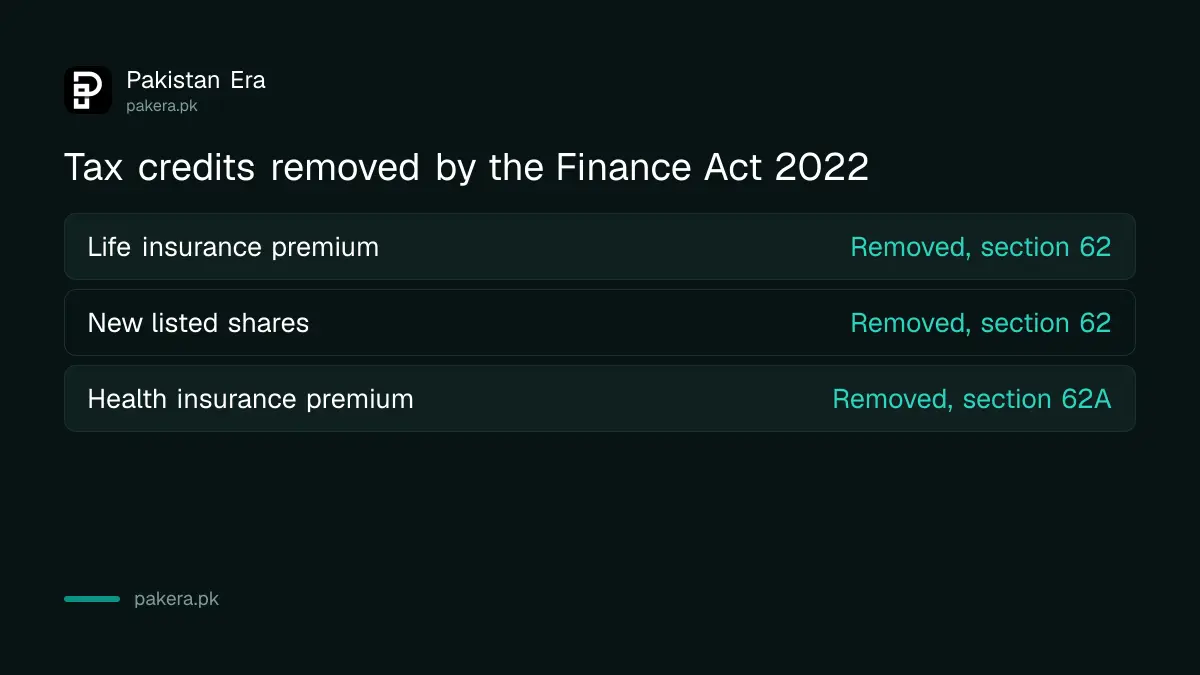
The Finance Act 2022 removed section 62, the credit for buying new listed shares and paying life insurance premiums. It also removed section 62A, the credit for health insurance premiums. Neither can be claimed for tax year 2026.
Old tax guides and some agents still mention them. If someone offers to file your return with an insurance credit, ask which section they are using. Claiming a credit that does not exist can mean a revised return later, or a notice.
To claim the four that remain:
- Collect the Zakat certificate, donation receipts, VPS certificate and fee vouchers for July 2025 to June 2026.
- Log in to IRIS and open the tax year 2026 return.
- Enter Zakat and tuition fees in the deductible allowances part.
- Enter donations and the VPS contribution in the tax credits part.
- Check that the tax payable drops, then submit by 15 October 2026.
The rest of the form follows the usual steps to file your income tax return.
Common questions
Can I claim Zakat I paid to a poor relative?
No. Section 60 covers Zakat paid under the Zakat and Ushr Ordinance 1980, which in practice means Zakat your bank deducted or paid into the official Zakat system.
Is life insurance still a tax credit in Pakistan?
No. The Finance Act 2022 omitted section 62, which gave the credit for life insurance premiums and new shares.
How much tax credit do I get on a donation?
Your average tax rate times the donation, with the donation capped at 30% of your taxable income. Cash counts only if paid by crossed cheque.
Can both parents claim the school fee allowance?
No. Section 60D allows it against the tax of the parent who paid the fee, and only if that parent's taxable income is under Rs 1.5 million.
Can I join a pension fund now and claim for 2026?
No. Tax year 2026 ended on 30 June 2026. A contribution made in October counts for tax year 2027.
How we verified this
What we checked, where we read it, and what we could not confirm.
Last checked on 2 October 2026. Sections 60 (Zakat), 60D (education expenses), 61 (charitable donations) and 63 (approved pension fund), and the omission of sections 62 and 62A by the Finance Act 2022, are read in FBR's Income Tax Ordinance 2001, amended up to 30 June 2026. The 15 October 2026 due date is from FBR's Circular No. 3 of 2026-27. The Rs 100,000 donation example is our own arithmetic. We did not log in to IRIS to check the exact field labels for each claim. Nothing here is tax advice for your own case.
About the author

Tax, Bills and Technology Writer
Ali Akhtar is a young and curious voice here at Pakistan Era. He is currently pursuing his A-Levels and has a growing interest in Pakistan’s changing industrial landscape and educational trends. Ali likes to write in a way that helps him explain and explore the world around him. His writing reflects the perspective of the new generation navigating the evolving trends of Pakistan where technology, youth innovation, and shifting opportunities are reshaping the country’s future.