Declare Your Wife's and Children's Assets in Your FBR Wealth Statement
Your dependent wife's gold and your children's accounts go in your FBR wealth statement. Who to include under section 116, how to add them and how to revise.

If your wife depends on you, her assets go in your FBR wealth statement, and so do the assets of your minor children and other dependants. A wife who files her own return declares her own assets instead. File the tax year 2026 statement on IRIS by 15 October 2026.
This is the part of the return most families get wrong. A husband files his own house and car, leaves out his wife's gold and his son's bank account, and the statement no longer matches how the family lives. That gap is what a tax officer notices.
We read section 116 of the Income Tax Ordinance 2001 in FBR's copy, amended up to 30 June 2026, on 2 October 2026. The rules below come from that text.
Section 116 puts your dependants' assets in your statement
Section 116(1)(b) asks for the assets and liabilities, including foreign ones, of your spouse, minor children and other dependants. Section 116(1)(d) asks for their spending too. Every resident individual who files a return must attach a wealth statement and a reconciliation.
The wealth statement is a list of what you own and owe on 30 June 2026. The reconciliation explains how your wealth changed since last year: income in, spending and gifts out. Both are filed with the return, under section 116(2).
The family part is not optional. The law asks about the whole family's assets and spending. If you leave out a dependant's asset, your reconciliation will not explain how it was paid for.
A wife's assets go in only if she is a dependant
The Finance Act 2024 added an Explanation to section 116(1)(b). It says a spouse's assets are included in your wealth statement only if the spouse is dependent. A wife who earns, files her own return and keeps her own statement is not included in yours.
Our text copy of FBR's file lost the last word of that Explanation, but the wording is otherwise clear and matches the law as amended in 2024. The practical rule is simple. Either she is in your statement, or she files her own. She cannot be in neither.
| Family member | Whose statement | What to include |
|---|---|---|
| Wife with no income of her own | Yours | Her gold, bank accounts, any plot or car in her name |
| Wife who files her own return | Hers | Her own assets, in her own wealth statement |
| Minor child | Yours | Bank accounts, savings certificates, prize bonds, property in the child's name |
| Adult child who depends on you | Yours | Their assets, as another dependant |
| Adult child who files | Theirs | Their own assets |

Wedding gold and a child's account are the common misses
The two assets most often left out are a wife's jewellery and accounts opened in a child's name. Both belong in a dependant's section of your statement. Record each item once and carry it forward every year.
Gold given at a wedding is still an asset. FBR does not tax holding it, but a statement without it makes later sales and purchases hard to explain. The rules on buying gold and the wealth statement cover how new purchases are recorded.
A savings account opened in a minor's name, or prize bonds bought for children, also count. So do prize bonds kept at home. If a relative gave the money, show it as a gift received in the reconciliation.
Add dependants' assets on IRIS in five steps
Each dependant's asset goes into the asset sections of your own wealth statement, with a clear note of whose name it is in. Then make sure the reconciliation balances.
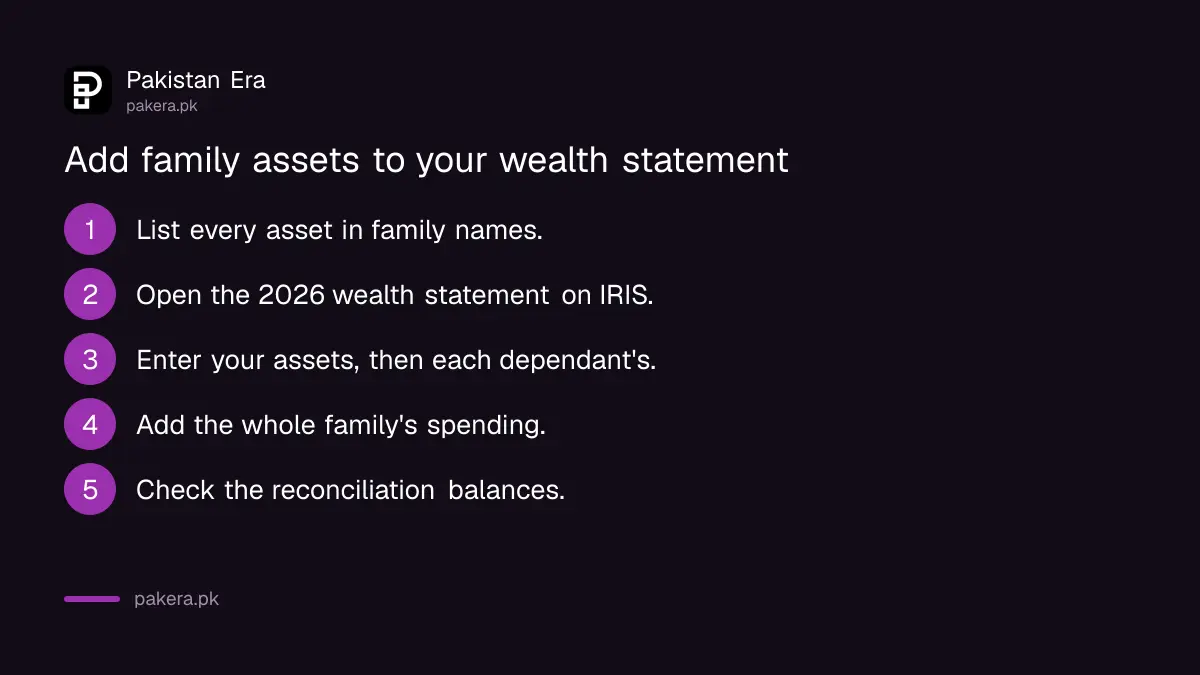
- List every asset in your wife's and children's names on 30 June 2026: gold, bank balances, certificates, plots and vehicles.
- Log in to IRIS and open the wealth statement for tax year 2026.
- Enter your own assets first, then each dependant's asset, noting whose name it is in.
- Add household spending for the whole family, not just yourself, as section 116(1)(d) requires.
- Check that the reconciliation shows zero unexplained difference, then submit with the return.
We did not log in to a family's IRIS account for this, so the exact labels on your screen may differ. The general screens are explained in the walk-through to fill your tax return and wealth statement.
You can correct a missed asset before a notice arrives
If you filed and forgot a dependant's asset, section 116(3) lets you file a revised wealth statement with a revised reconciliation and your reasons. You must do it before you receive a notice under section 122(9), and within five years of the due date.
The Commissioner can declare the revision void if it is not correcting an honest mistake, after hearing you. So revise early and give a plain reason, such as "wife's jewellery omitted". The return itself is revised separately, as the steps to revise an income tax return explain.

A revision filed after a notice arrives is too late under this subsection. That is the main reason to get the family part right before 15 October.
Common questions
Do I have to show my wife's gold in my wealth statement?
Yes, if she is your dependant. Section 116(1)(b) covers the spouse's assets, and the 2024 Explanation limits it to a spouse who is dependent.
My wife is a filer. Do I still include her assets?
No. A wife who files her own return declares her own assets in her own wealth statement, not in yours.
Should my child's bank account be in my wealth statement?
Yes. A minor child's assets go in your statement under section 116(1)(b).
Can I add a missed asset after filing?
Yes. File a revised wealth statement under section 116(3) before any notice under section 122(9), and within five years of the due date.
Do I list family spending or only my own?
Family spending. Section 116(1)(d) asks for the expenditure of you, your spouse, minor children and other dependants.
How we verified this
What we checked, where we read it, and what we could not confirm.
Last checked on 2 October 2026. Section 116(1)(b) and (d), the 2024 Explanation on a spouse's assets, section 116(2) on the wealth statement and reconciliation with every resident individual's return, and section 116(3) on revision before a section 122(9) notice and within five years are read in FBR's Income Tax Ordinance 2001, amended up to 30 June 2026. The last word of the 2024 Explanation was lost in our text extraction of that file. The 15 October 2026 due date is from FBR's Circular No. 3 of 2026-27. We did not check the IRIS screen labels from a logged-in account. Nothing here is tax advice for your own case.
About the author

Tax, Bills and Technology Writer
Ali Akhtar is a young and curious voice here at Pakistan Era. He is currently pursuing his A-Levels and has a growing interest in Pakistan’s changing industrial landscape and educational trends. Ali likes to write in a way that helps him explain and explore the world around him. His writing reflects the perspective of the new generation navigating the evolving trends of Pakistan where technology, youth innovation, and shifting opportunities are reshaping the country’s future.