Olive Plantation Subsidy Punjab: Rs 57,960 an Acre, Who Qualifies and How to Apply in Potohar and Soon Valley
Punjab's olive subsidy pays Rs 57,960 an acre for 161 trees in Potohar and the Soon Valley. See who qualifies, the form, the cost table and the 10-year rule.
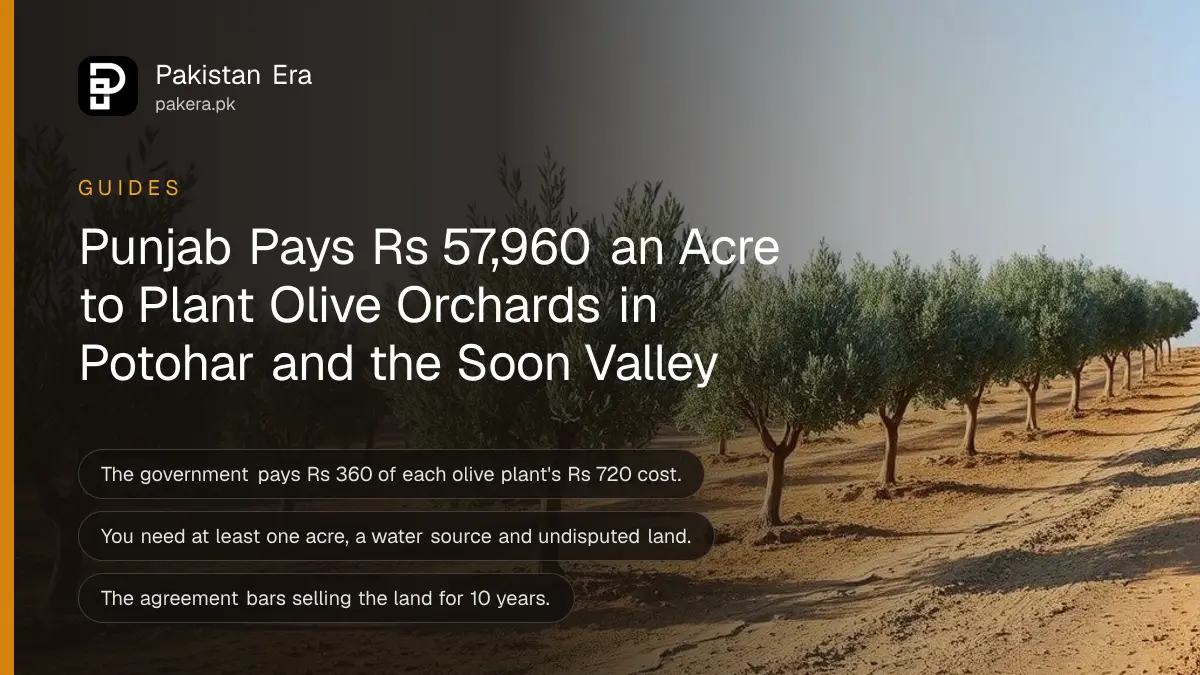
Punjab's olive plantation subsidy pays Rs 57,960 an acre, in two instalments, to farmers in the Potohar region and the Soon Valley of Khushab who plant a new olive orchard of 161 trees an acre. Applications for 2026-27 are taken first come, first served, on a free form from the Agriculture Department or the olive research centre in Chakwal. Below are the rules from the form itself, what you pay from your own pocket, and the mistakes that can cost you the subsidy.
The scheme is part of the Punjab government's Potohar Agriculture Transformation Plan. We read its advertisement and the four-page application form on the Agriculture Department's download page on 31 October 2026.
The subsidy is Rs 57,960 an acre, which is half the cost of each plant
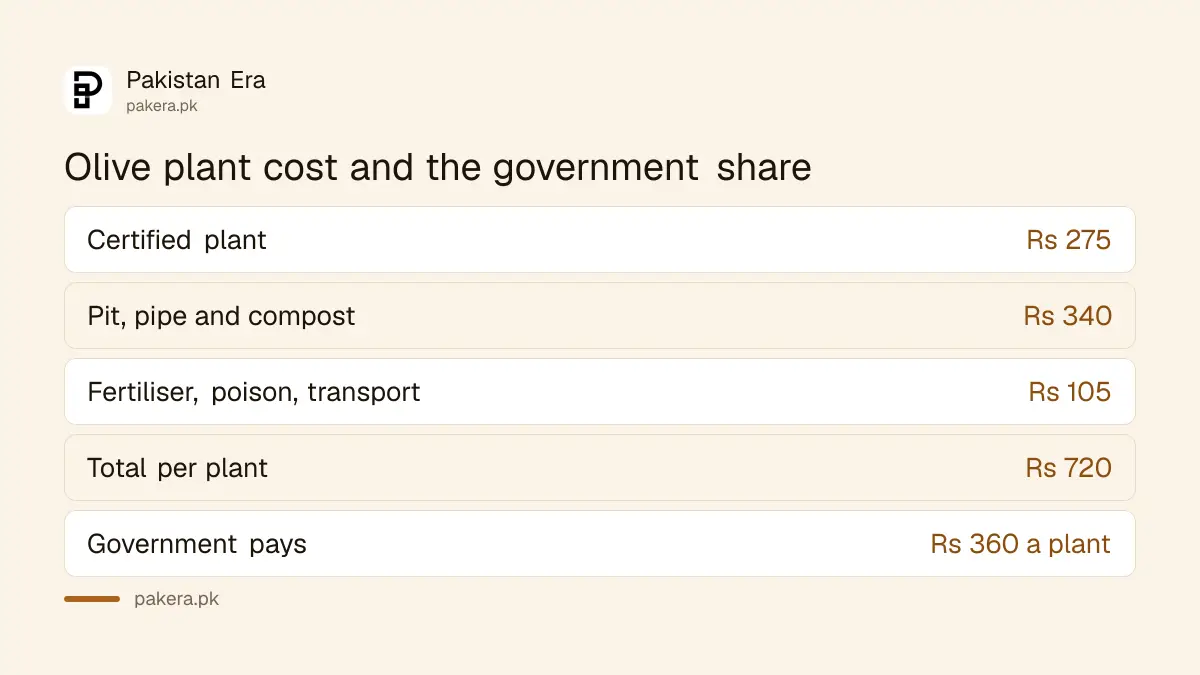
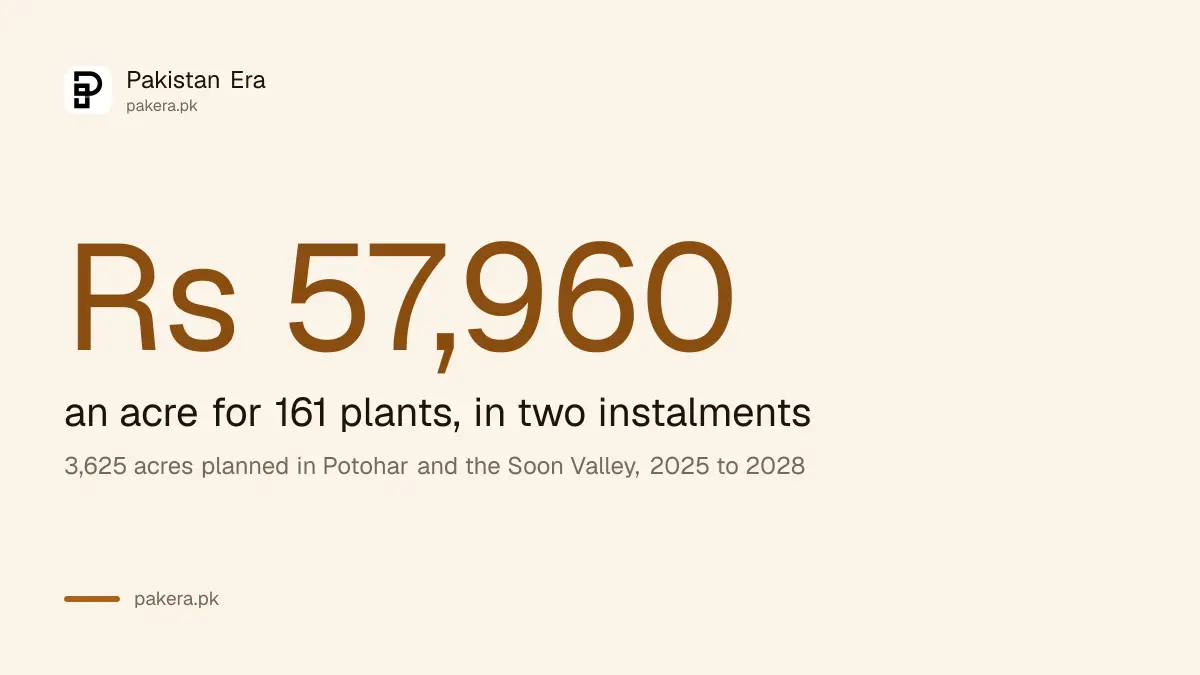
The department puts the full cost of planting one olive tree at Rs 720. The government pays Rs 360 of it. At 161 plants an acre, that comes to Rs 57,960, paid in two instalments. Plant fewer trees and the subsidy falls in the same proportion.
The form breaks the Rs 720 down item by item. This is useful, because it tells you what the department expects you to buy and do for each tree.
| Cost item per plant | Rs |
|---|---|
| Certified olive plant | 275 |
| One metre strong plastic pipe to support the plant | 100 |
| Digging and filling the pit | 120 |
| Compost, 5 kg | 120 |
| Termite poison, 100 g | 25 |
| DAP fertiliser, 250 g | 60 |
| Carrying the plant from the nursery, and other costs | 20 |
| Total per plant | 720 |
| Government share per plant | 360 |
A worked example, on our own arithmetic: a farmer planting 2 acres puts in 322 trees. The full cost is Rs 231,840. The subsidy is Rs 115,920, and the farmer pays the other Rs 115,920, plus water and any drip system.
You need at least one acre in Rawalpindi Division or the Soon Valley, and water
The form sets five conditions. You must own at least one acre, or hold a long-term lease with the owner, in Rawalpindi Division or the Soon Valley of Khushab. You need a water source, land free of disputes, and a working irrigation system if you plant five acres or more.
- At least one acre owned, or farmed under a long-term written agreement with the owner.
- Land in Rawalpindi Division or the Soon Valley in Khushab district.
- A source of water for the plants, such as a tube well or bore.
- No dispute or court case of any kind on the land.
- Copies of your CNIC and the ownership record (fard) or lease, attached to the form.
- For five acres or more, an irrigation system for the whole orchard.
The form also asks whether you have a water storage tank and whether you want drip irrigation. Those answers do not disqualify you, but they help the department judge whether the trees will survive.
Apply on the free form, and sign a Rs 100 stamp paper agreement if selected
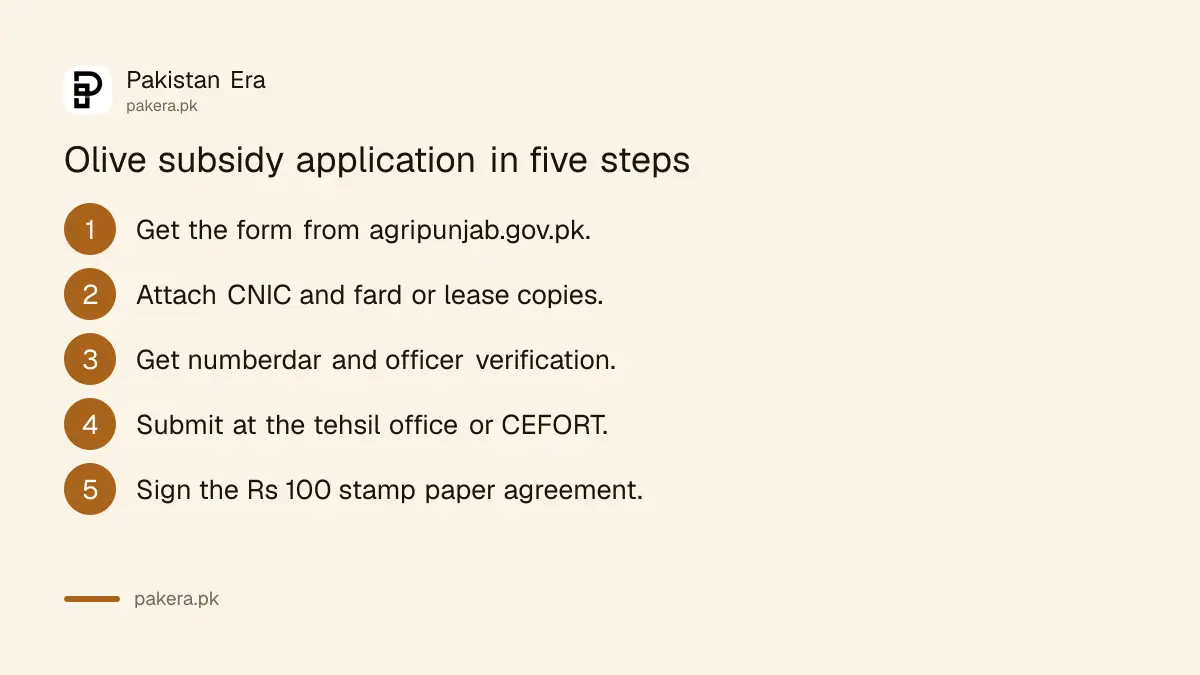
Download the form from agripunjab.gov.pk or collect it free from the tehsil office of the Agriculture Department (Extension and Water Management) or from the olive centre, CEFORT, in Chakwal. Fill it in, attach the papers and get it verified.
- Get the "application for olive cultivation" form from agripunjab.gov.pk or a tehsil agriculture office.
- Write the number of acres, your CNIC, mouza, union council, tehsil and district.
- Attach attested copies of your CNIC and the fard, or the long-term lease.
- Get the form signed by your numberdar and by the Agriculture Officer (Extension or Water Management) of your tehsil.
- Submit it at the tehsil office or at CEFORT, and keep a receipt.
- If selected, sign the agreement with CEFORT on stamp paper worth at least Rs 100. Without it, the department is not bound to pay.
- Attend the practical training before planting, then plant 161 certified trees an acre.
The planting pattern is fixed: rows 18 feet apart and trees 15 feet apart in each row. The plants must be certified, of approved varieties and at least two feet tall.
The agreement binds you for 10 years and makes you replace dead plants
The subsidy comes with conditions that last long after planting. You may not sell the land for 10 years. Dead plants must be replaced at your own cost, or the department can recover the subsidy under its rules.
- You prepare the orchard, the water source and the care of the trees at your own cost and as the department directs.
- You take practical training before planting.
- You will not sell the land for 10 years.
- If any plant dies for any reason, you buy and plant a new one yourself, or the subsidy can be recovered.
- The department gives technical guidance, and you can complain in writing if it does not.
- In a dispute, the decision of the department's committee or officer is final.
Read these terms before signing, especially if the land is jointly owned. A sale or a family partition within 10 years could put the subsidy at risk.
Last year's approved farmers do not need to apply again
The advertisement says applications approved last year can stay valid this year, so those farmers need not reapply. Places are limited: the programme covers 3,625 acres from 2025 to 2028, and the 2026-27 advertisement lists 50 acres in Potohar and 50 acres in the Soon Valley.
Because it is first come, first served, apply early in the financial year. Questions go to the agriculture helpline 0800-17000, open 8 am to 8 pm daily, or to CEFORT on 0543-662012. If your land is in the Thal desert instead, the department runs separate Thal farm subsidies for drip irrigation and orchards. A wider list of what Punjab pays for machinery is in our guide to Punjab farm machinery subsidies for 2026-27.
Common questions
How much is the olive subsidy in Punjab?
Rs 57,960 an acre, paid in two instalments, for 161 plants. That is Rs 360 of each plant's Rs 720 cost.
Who can apply for the olive plantation subsidy?
Farmers with at least one acre, owned or on long-term lease, in Rawalpindi Division or the Soon Valley of Khushab, with a water source and undisputed land.
Is there a last date to apply?
The 2026-27 advertisement gives no closing date. Applications are taken first come, first served until the acreage is filled.
Where do I get the olive subsidy form?
Download it from agripunjab.gov.pk or collect it free from a tehsil agriculture office (Extension and Water Management) or CEFORT in Chakwal.
Can I sell my land after planting?
Not for 10 years. The agreement you sign with CEFORT bars a sale for that period.
What happens if some olive plants die?
You must replace them at your own cost. Otherwise the department can recover the subsidy.
How we verified this
What we checked, where we read it, and what we could not confirm.
Last checked 31 October 2026. The subsidy, plant count, programme acreage, first come rule, carry-over of last year's approvals and helpline are from the department's olive plantation subsidy advertisement. The eligibility rules, cost table, instalments, spacing, stamp paper agreement and 10-year condition are from the olive plantation application form issued by the Centre of Excellence for Olive Research and Training, Chakwal. Both are in Urdu and we read them on 31 October 2026. The 2-acre example is our own arithmetic. We could not confirm when each instalment is paid or how the 50-acre yearly targets will be shared, because the form does not say.
About the author

Public Services and Education Journalist
Fajr Riaz is a journalist and content writer at Pakistan Era, based in Lahore. She covers the questions people meet in everyday life in Pakistan: how a public service works, what a change in the rules means, and where to find a reliable answer.